Why Use a Notary Public: Ontario’s 2026 Guide

TL;DR:
- A notary public verifies identities and witnesses signatures to confirm signing is voluntary and authentic in Ontario. They help prevent fraud, strengthen legal standing, and are often required for high-stakes documents like real estate deeds and powers of attorney. Online notarization services make the process accessible, fast, and legally valid without sacrificing security.
A notary public is an impartial, state-commissioned official who verifies identity, witnesses signatures, and confirms that signers act voluntarily on important documents. Understanding why use a notary public matters for anyone in Ontario dealing with real estate, estate planning, business agreements, or cross-border paperwork. Notarization adds evidentiary weight that courts, lenders, and government agencies rely on to accept documents as authentic. The National Notary Association recognizes notaries as a frontline defense against document fraud, and Ontario’s legal system reflects that same standard. Theonlinenotary provides these services online, making the process accessible without sacrificing legal rigor.
Why use a notary public: key benefits and legal protections
Notarization is the single most reliable way to prove a document was signed willingly, knowingly, and by the right person. That proof matters in every high-stakes transaction, from buying property to granting someone power of attorney over your finances.
The core benefits of notarization include:
- Fraud prevention. The National Notary Association estimates that notarization prevents significant fraud annually by requiring government-issued ID and in-person or video-verified identity checks. That verification step alone removes the easiest avenue for forgery.
- Evidentiary weight. A notarized document carries stronger legal standing than an unnotarized one. Courts and financial institutions treat it as reliable proof of the signing event.
- Voluntary signing confirmation. Notaries confirm that signers understand what they are signing and are not under duress. A notary may refuse notarization if coercion or mental incompetence is suspected.
- Cross-jurisdictional acceptance. Notarized documents are recognized across provinces and international borders, which matters for immigration applications, foreign real estate, and international business contracts.
- Institutional compliance. Banks, courts, and government agencies routinely require notarized documents before processing applications or releasing assets.
“Notary services provide impartial third-party assurance that signers appear voluntarily and understand the document, which is exactly what courts and institutions need to trust a transaction.”
Pro Tip: Notarization is almost always required for high-value or legally sensitive transactions. If you are unsure whether your document needs it, assume it does and confirm with a notary before signing.
Which documents require notarization in Ontario?
Ontario law and institutional practice require notarization for a defined set of documents. The rationale is consistent: the higher the stakes, the greater the need for verified authenticity.
| Document Type | Notarization Required? | Reason |
|---|---|---|
| Real estate deeds and transfers | Yes | Lenders and land registry offices require verified signatures |
| Powers of attorney | Yes | Protects the grantor from unauthorized use |
| Affidavits and statutory declarations | Yes | Courts require sworn statements to carry evidentiary weight |
| Estate planning documents (wills, trusts) | Often required | Prevents challenges to authenticity after death |
| Partnership agreements | Recommended | Reduces dispute risk in business relationships |
| Articles of incorporation | Situational | Required when filing with certain government bodies |
| Standard contracts between private parties | No | Unless a specific clause or institution requires it |
| Personal letters | No | No legal obligation unless used as evidence |
Documents like real estate deeds, powers of attorney, and estate planning instruments must be notarized to be legally recognized by courts, lenders, and agencies. That requirement exists because the consequences of a forged or coerced signature on these documents are severe and often irreversible.
Two types of notarial acts apply to most Ontario documents:
- Acknowledgments. The signer appears before the notary and confirms they signed the document freely. The notary does not administer an oath. This applies to real estate deeds and powers of attorney.
- Jurats. The signer swears or affirms the truth of the document’s contents under oath. This applies to affidavits and statutory declarations in court. The legal implications differ significantly: a false jurat exposes the signer to perjury charges.
Business owners should note that notarizing business documents such as partnership agreements and corporate resolutions creates a clear record that reduces the risk of internal disputes later. A signed but unnotarized agreement is harder to defend in court when a partner later claims they never agreed to the terms.
What notarization does not do
Notarization is a procedural act. It authenticates the signing event, not the document’s substance. This distinction is one of the most misunderstood aspects of notarial services.
A notarized document does not become legally enforceable simply because a notary stamped it. If the underlying agreement is fraudulent, illegal, or unconscionable, notarization changes nothing. A forged contract with a notary seal is still a forged contract.
Common misconceptions about notarization:
- Notaries do not provide legal advice. A notary’s role is strictly limited to witnessing signatures and verifying identity. They do not evaluate whether a contract is fair, legal, or in your best interest.
- Notarization does not guarantee enforceability. Courts assess the content and legality of a document separately from its notarization status.
- A notary seal does not mean the document was reviewed. The notary confirms who signed and that they did so willingly. They do not read the document for errors or legal problems.
- Defective notarizations create real risk. Improper notarization, such as failing to verify identity or completing the certificate incorrectly, can cause courts or institutions to reject the document entirely.
Pro Tip: If you need someone to review the fairness or legality of a document’s content, consult a lawyer. A notary handles the signing process. A lawyer handles the substance.
The distinction between these two roles protects you. Notaries remain impartial precisely because they do not interpret law. That impartiality is what gives their certification credibility with courts and agencies.
How notaries assist individuals and businesses in Ontario
Notaries serve a practical function that goes beyond stamping paper. They reduce the risk of legal disputes, speed up institutional processes, and give all parties confidence that a transaction is legitimate.
Here is how notary public services assist Ontario residents and businesses in concrete terms:
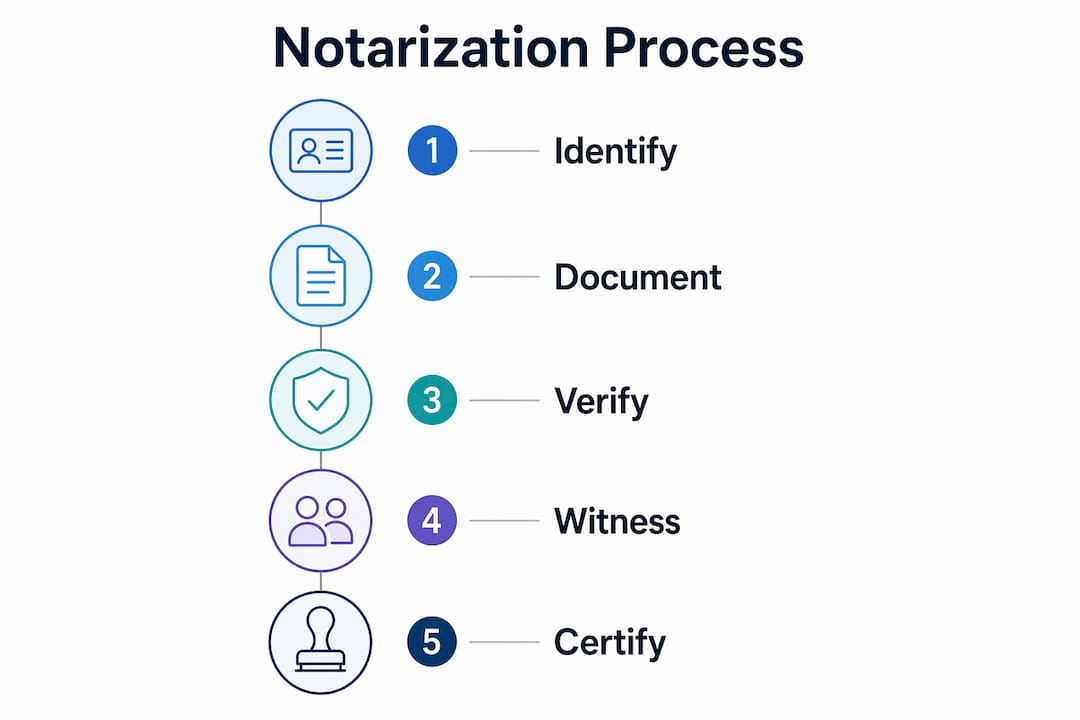
- Identity verification for complex transactions. When you sell property or grant power of attorney, the other party and any institution involved need proof that you are who you say you are. A notary provides that proof through a structured, documented process.
- Evidentiary protection against disputes. A notarized document’s evidentiary weight significantly reduces the likelihood of authenticity disputes in legal and financial settings. That protection is worth far more than the cost of notarization.
- Cross-border document recognition. Canadian documents used abroad, such as immigration affidavits or foreign property agreements, often require notarization and sometimes apostille certification. A notary familiar with these requirements saves you from costly rejections.
- Remote online notarization. Remote online notarization allows signers to complete the process over a secure video call with full identity verification, digital seals, and electronic signature witnessing. This is especially useful for Ontario residents who cannot travel or need documents processed quickly.
- Streamlined institutional submissions. Banks, immigration authorities, and courts process notarized documents faster because they arrive pre-verified. You avoid the back-and-forth of rejected submissions.
The advantages of e-notary services in Canada have expanded access significantly. Individuals in remote communities, people with mobility limitations, and businesses with tight timelines all benefit from the ability to complete notarization without leaving their location.
Pro Tip: Gather all required identification before your notary appointment. Ontario notaries typically require government-issued photo ID. Missing documents delay the process and may require rescheduling.

Key Takeaways
Notarization is the most reliable way to protect document authenticity, prevent fraud, and meet legal requirements for high-stakes transactions in Ontario.
| Point | Details |
|---|---|
| Notarization deters fraud | Notaries verify identity using government-issued ID, removing the easiest path for forgery. |
| Evidentiary weight matters | Notarized documents carry stronger legal standing in courts and financial institutions than unnotarized ones. |
| Know your document type | Acknowledgments confirm voluntary signing; jurats require an oath and carry perjury risk if false. |
| Notarization has clear limits | A notary confirms the signing process only. They do not review content, provide legal advice, or guarantee enforceability. |
| Online notarization is fully valid | Remote notarization via secure video call is legally recognized in Ontario and offers the same protections as in-person services. |
What I’ve learned after years of watching notarization go wrong
Most people treat notarization as a formality. They show up, sign, and leave without understanding what just happened or what it protects them from. That attitude is the source of most notarization problems I’ve seen.
The biggest mistake is assuming a notary seal means a document is legally airtight. It does not. A notary confirms the signing event. If the document itself has problems, those problems survive the notarization. I’ve seen people hand over powers of attorney with vague language, get them notarized, and then face serious disputes years later because the document did not say what they thought it said. The notarization was perfect. The document was not.
The second mistake is waiting too long. People often contact a notary the day before a deadline, only to discover they are missing ID, the document needs a specific certificate type, or the institution requires an apostille. These are not quick fixes. Build in at least a week for any notarization that involves cross-border recognition or government submission.
Online notarization has genuinely changed the picture for Ontario residents. The ability to complete a notarization over a secure video call, with a digital seal that institutions accept, removes the friction that used to make people delay. Theonlinenotary has made this process straightforward for affidavits, statutory declarations, powers of attorney, and more. The technology is solid. The legal standing is the same as in-person.
My honest advice: treat notarization as the first step in protecting a transaction, not the last. Get your document reviewed by a lawyer if the content is complex. Then get it notarized. Both steps serve different purposes, and skipping either one creates risk.
— Ken
Notarization in Ontario made simple with Theonlinenotary
Ontario residents and businesses no longer need to schedule in-person appointments or take time off work to get documents notarized.

Theonlinenotary provides trusted online notary services 24/7, covering affidavits, powers of attorney, statutory declarations, solemn declarations, invitation letters, and real estate documents. Every session uses secure video verification and produces a digitally sealed document that courts, lenders, and government agencies accept. Whether you need a single affidavit or ongoing notarization support for your business, Theonlinenotary connects you with qualified Ontario notaries who know exactly what each document requires. The process is fast, legally sound, and built for people who need results without unnecessary delays.
FAQ
What does a notary public actually do?
A notary public verifies your identity, witnesses your signature, and confirms you are signing voluntarily and with understanding. They do not review document content or provide legal advice.
When is notarization required in Ontario?
Notarization is required for real estate deeds, powers of attorney, affidavits, statutory declarations, and many estate planning documents. Banks, courts, and government agencies specify when they require it.
Does a notarized document mean it is legally valid?
Notarization confirms the signing process was authentic, not that the document’s content is legal or enforceable. A fraudulent agreement remains fraudulent even with a notary seal.
Can I use an online notary in Ontario?
Yes. Remote online notarization is legally recognized in Ontario. Theonlinenotary offers secure video-based notarization with digital seals accepted by institutions across Canada.
What is the difference between an acknowledgment and a jurat?
An acknowledgment confirms you signed a document freely, without an oath. A jurat requires you to swear or affirm the truth of the document’s contents, and a false jurat exposes you to perjury charges.