Where to Notarize Documents Near You in Ontario

For Ontario residents, the fastest lawful path to notarized documents is Theonlinenotary: remote commissioning by video for affidavits, statutory declarations, solemn declarations, invitation letters, and wills or powers of attorney, plus in-person certified true copies at the Brampton office. Two steps get you started: 1) book an online appointment, and 2) prepare government-issued photo ID, your original document pages, and any required witnesses before the session begins.
One critical warning up front. The Law Society of Ontario confirms that the Notaries Act does not permit notaries to exercise their powers without the person’s physical presence unless specific regulations allow it. Providers advertising “online notary” services outside those regulations risk regulatory action, and documents they produce may be invalid. Lawful remote commissioning under the Commissioners for Taking Affidavits Act and O. Reg. 21/26 is a different, permitted process — and that is exactly what Theonlinenotary provides.
Key Takeaways
Remote commissioning under O. Reg. 21/26 is the lawful, practical way to notarize most Ontario documents without leaving home — provided the service uses real-time video, verified identity, and a modified jurat.
| Point | Details |
|---|---|
| Two lawful paths | Remote commissioning for sworn documents; in-person at Brampton for certified true copies. |
| What to bring | Government-issued photo ID, original document pages, and any required witnesses on-screen. |
| Red flags to avoid | Providers skipping real-time video or modified jurat requirements may produce invalid documents. |
| Mandatory vs. optional | Courts and IRCC require notarization by law; invitation letters and many declarations are recipient-driven. |
| Theonlinenotary | Books remote commissioning sessions online and offers in-person certified true copies in Brampton. |
Table of Contents
- What types of notaries can help you in Ontario?
- Which documents actually require notarization by law?
- Why lawful remote commissioning matters more than convenience
- Theonlinenotary: what the service covers and how to book
- Sources
What types of notaries can help you in Ontario?
Ontario has two distinct roles, and the difference matters when you are searching for notarization services nearby.
A notary public holds broader powers: certifying true copies, authenticating documents for international use, and more. Under the Notaries Act, those powers require physical presence unless a regulation specifically permits remote exercise. A commissioner for taking affidavits has narrower authority — administering oaths and taking sworn statements — but remote commissioning is fully permitted when the commissioner and deponent can see, hear, and communicate in real time, identity is confirmed, and a modified jurat recording both parties’ locations is used.
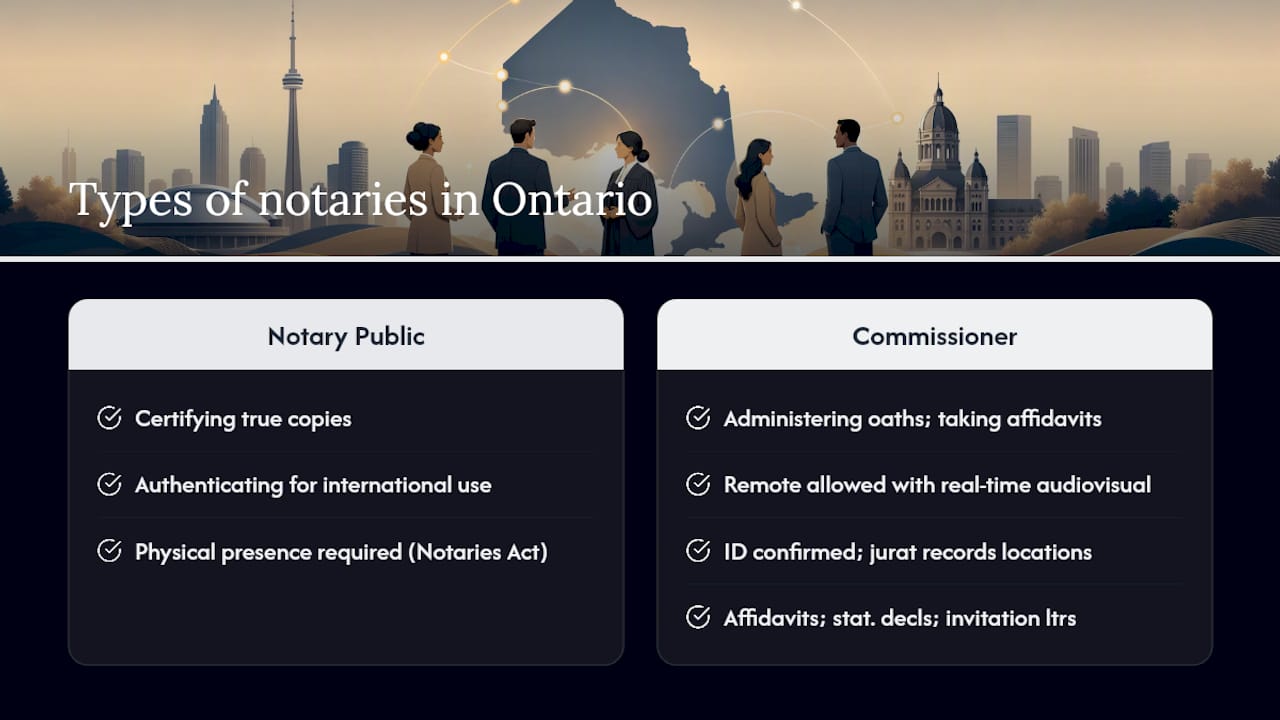
Most everyday documents — affidavits, statutory declarations, invitation letters — need a commissioner, not a notary. Certified true copies are the main exception: those require in-person notarization, which is why Theonlinenotary offers that service at its Brampton location.

Which documents actually require notarization by law?
Mandatory notarization is narrower than most people expect. Courts, immigration authorities (IRCC), and financial institutions typically require sworn affidavits or statutory declarations. Certified true copies for foreign governments or regulated bodies must be notarized in person. Remote execution of wills and powers of attorney is now permanently permitted in Ontario under Bill 245 (Accelerating Access to Justice Act, 2021), subject to procedural safeguards and lawyer oversight where required.
Optional notarization — where no law demands it but a recipient requests it — covers a wide range of letters and declarations. Invitation letters for visa applications fall here. The recipient’s requirements, not Ontario law, drive the need. Check the document types guide before booking to confirm what your specific use case actually requires.
Why lawful remote commissioning matters more than convenience
The appeal of “online notary” services is obvious: no travel, no waiting rooms. But the regulatory gap is real. O. Reg. 431/20 and its 2026 successor, O. Reg. 21/26, set precise technical requirements: real-time audiovisual communication, active identity verification, and a modified jurat. A provider skipping any of those steps is not offering a shortcut — they are producing a document that may be rejected or trigger regulatory consequences for the licensee. For clients, that means redoing the process entirely, often under deadline pressure. The Brampton in-person option exists precisely for document types that cannot be commissioned remotely under any current regulation.
Theonlinenotary: what the service covers and how to book
Skip the drive across town. Theonlinenotary handles remote commissioning for Ontario — affidavits, statutory and solemn declarations, invitation letters, and remote witnessing of wills and POAs — fully compliant with O. Reg. 21/26’s real-time video and modified jurat requirements. Certified true copies are available in person at the Brampton office for documents that must be notarized physically.

Booking takes minutes: select your document type on the services page, choose a time slot, and upload your document before the session. Bring valid government-issued photo ID and have any required witnesses present on-screen. Pricing is listed per document with additional-page fees shown clearly — no surprises at checkout. The how-to-notarize guide walks through every preparation step if you want to review the process before your appointment.
Sources
The legal framework for remote commissioning in Ontario rests on a small set of primary sources. Verify any compliance question directly against these:
- Notice to the Professions: Online notary services are not permitted under the Notaries Act | Law Society of Ontario
- Ontario
- Administering Oath or Declaration Remotely, O Reg 431/20
This article provides general information about notarization processes in Ontario and is not legal advice. Confirm your document’s specific requirements with a qualified legal professional or the requesting authority before booking.
This article is general information, not a substitute for advice from a qualified lawyer. Consult a qualified legal professional about your own circumstances before acting on anything here.