Where to Get Paperwork Notarized Near You in Ontario

If you need paperwork notarized in Ontario, Theonlinenotary is the most direct option: remote commissioning province-wide, plus in-person service in Brampton. Book an appointment online and you can have your documents commissioned the same day.
Commonly accepted documents include:
- Affidavits (general, financial, proof of relationship)
- Statutory and solemn declarations
- Invitation letters for visa applications
- Wills and powers of attorney (remote witnessing available)
Most receiving organizations, including government agencies and financial institutions, accept remotely commissioned documents when the jurat shows the required location and method details. Confirm acceptance with the receiving body before your appointment.
Pro Tip: Have your government-issued photo ID and your document ready to share on screen before the call starts. It cuts the appointment time significantly.
Key Takeaways
Remote commissioning across Ontario is the fastest, most accessible way to get affidavits, statutory declarations, and invitation letters notarized, provided the receiving organization accepts remotely commissioned documents.
| Point | Details |
|---|---|
| Where to book | Theonlinenotary handles remote commissioning province-wide and in-person Brampton notarizations. |
| ID required | Bring government-issued photo ID (passport, driver’s license, or PR card) to every appointment. |
| Check acceptance first | Confirm the receiving organization accepts remotely commissioned documents before booking. |
| Certified true copies | These typically require the Brampton in-person option, not remote commissioning. |
| Legal limits | Notarization attests to your oath or declaration; it is not legal advice. Consult a lawyer for disputes or complex estate matters. |
Table of Contents
- How does online notarization work, step by step?
- Who can use the service, and what ID do you need?
- What does it cost, and how long does it take?
- How does in-person Brampton service differ?
- What does notarization actually accomplish legally?
- What to expect after your appointment
- Why remote commissioning in Ontario is more reliable than most people expect
- Theonlinenotary: book your Ontario notarization today
- Sources
How does online notarization work, step by step?
The process follows five clear steps:
- Book your appointment online, selecting your document type and a time slot.
- Upload or prepare your document and have acceptable ID ready.
- Join the video call. The commissioner verifies your identity in real time.
- Sign the document on screen while the commissioner watches.
- The commissioner signs the jurat and delivers your commissioned document digitally, with a certified copy available by mail if needed.
O. Reg. 431/20 sets the legal framework: remote oaths and declarations require real-time audiovisual communication, confirmed identity, a modified jurat recording both locations, and a transaction record kept by the commissioner. O. Reg. 21/26, in force from March 1, 2026, reinforces those audiovisual requirements.
Who can use the service, and what ID do you need?
Any Ontario resident or business can use remote commissioning for eligible documents. You need:
- Government-issued photo ID (passport, driver’s license, or permanent resident card)
- A device with a working camera and microphone (laptop, tablet, or smartphone)
- A stable internet connection and a supported browser (Chrome or Firefox work reliably)
If your document is in draft form, review the preparation checklist before booking. For business contracts specifically, a step-by-step contract guide covers what to upload and how to format the signature block.
What does it cost, and how long does it take?
Pricing follows a per-document model with a surcharge for additional pages. Remote will signing and powers of attorney carry a higher one-time fee given the added witnessing requirements. Appointments typically run 15–30 minutes. Digital copies are delivered the same day; certified paper copies sent by mail arrive within a few business days.
How does in-person Brampton service differ?
Notarial acts, such as certifying true copies of original documents, generally require in-person attendance because they involve a notary’s seal. Theonlinenotary’s Brampton office handles certified true copies and any notarization where the receiving organization specifically requires an in-person notarial act. You bring the original document; the notary compares, certifies, and seals the copy on the spot.

What does notarization actually accomplish legally?
A commissioned document carries the commissioner’s attestation that the deponent swore or declared the contents before them. That attestation satisfies the evidentiary requirements of courts, government agencies, and many foreign institutions. It is not legal advice, and it does not guarantee the document’s content is accurate. The Ontario government’s guide for commissioners explicitly cautions that receiving organizations may refuse remotely commissioned documents, so always confirm acceptance first. If your situation involves a legal dispute, estate planning complexity, or immigration refusal, consider whether online will writing services might be a suitable option, but for complex cases, consult a licensed lawyer.
What to expect after your appointment
You receive a confirmation email with your commissioned document attached as a PDF. If you need a wet-ink certified copy for a foreign authority, Theonlinenotary can mail one. Keep the digital copy as a backup; some organizations accept it directly, especially for Canadian government submissions.
Why remote commissioning in Ontario is more reliable than most people expect
The conventional wisdom is that notarization means a physical stamp in a physical office. Ontario moved past that in 2020, and the 2026 amendment to the remote-administering regulation makes the framework more durable, not less. Remote commissioning under the Law Society of Ontario’s guidance requires the same identity verification and oath administration as in-person work. The modified jurat records both the deponent’s and commissioner’s locations, which is actually more transparent than a traditional jurat.
The real limitation is not legal validity. It is institutional conservatism: some foreign embassies and older financial institutions still expect a physical seal. That is why the Brampton in-person option matters. For the vast majority of Ontario affidavits, statutory declarations, and invitation letters, remote commissioning is fully accepted and faster.
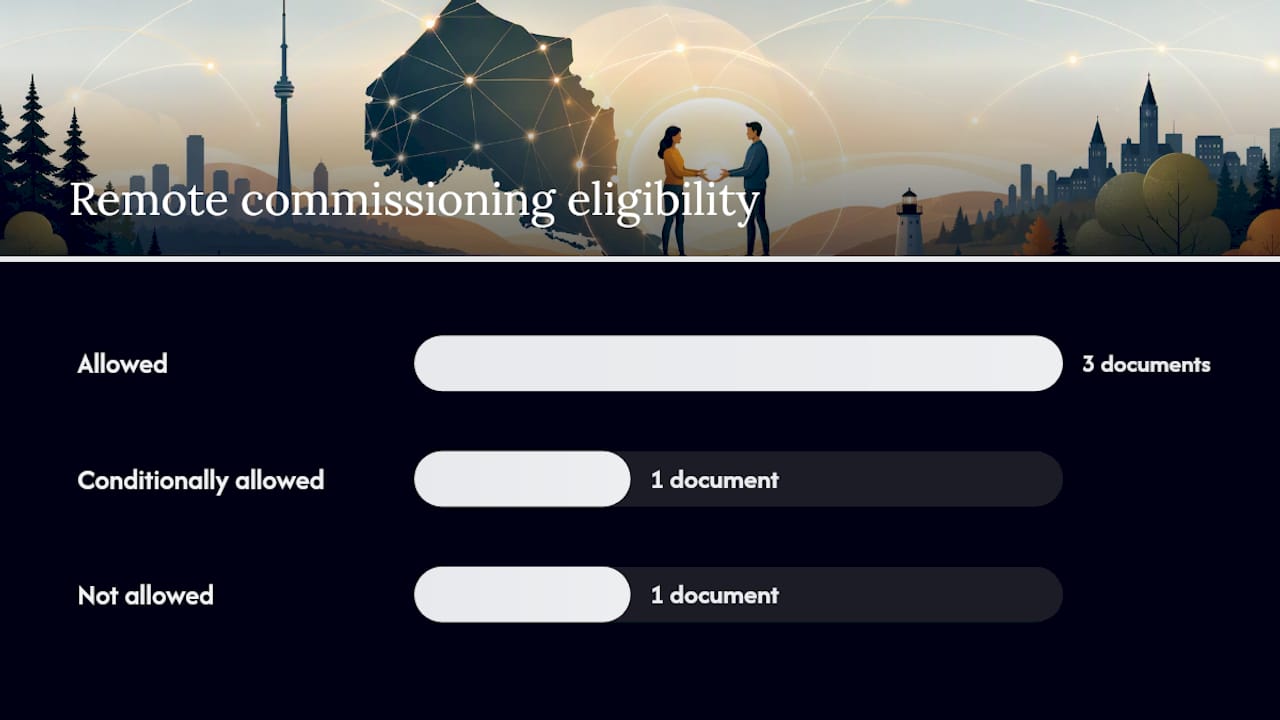
| Document type | Remote commissioning allowed? | Notes |
|---|---|---|
| Affidavit | Yes | Standard remote process |
| Statutory/solemn declaration | Yes | Standard remote process |
| Invitation letter | Yes | Standard remote process |
| Will / POA (remote witnessing) | Yes, with conditions | Higher fee; remote witnessing rules apply |
| Certified true copy | Generally no | Notarial act; Brampton in-person recommended |
Theonlinenotary: book your Ontario notarization today
Theonlinenotary offers remote commissioning across Ontario for affidavits, statutory declarations, solemn declarations, invitation letters, and wills or powers of attorney, with same-day appointments available most days. No commute, no waiting room.

For documents requiring a notarial seal or certified true copy, the Brampton office handles in-person appointments. Pricing is per document with no hidden retainers. Visit the services page to choose your document type, pick a time, and confirm your booking in under two minutes.
Sources
These are the governing regulations and service pages to verify requirements and book your appointment.
This article is general information, not a substitute for advice from a qualified lawyer. Consult a qualified legal professional about your own circumstances before acting on anything here.