When to Use an Affidavit: A Practical U.S. Guide

TL;DR:
- An affidavit is a sworn, written statement of facts used when live testimony is unavailable or impractical. It must contain first-hand facts, a proper jurat, and be signed in front of a notary or under a statutory declaration, depending on jurisdiction. Most affidavits require notarization, but federal courts permit unsworn declarations with specific language, and professional review is advised for high-stakes cases.
Use an affidavit when you need a sworn, written statement of facts and live testimony is unavailable, unnecessary, or impractical. That’s the short answer. Before you draft one, do three things: verify the rules of the court or agency receiving it, write only what you personally know to be true, and sign it in front of a notary or use an approved unsworn declaration where permitted.
A few immediate steps:
- Check whether your court or agency accepts unsworn declarations under 28 U.S.C. §1746 as an alternative to a notarized affidavit.
- Draft your statement in numbered paragraphs, sticking to first-hand facts only.
- Never sign before the notary. The notary must witness the act of signing, or the jurat is invalid.
Table of Contents
- What is an affidavit and why do courts accept it?
- When should you use an affidavit?
- What makes an affidavit legally valid in the United States?
- How do you write an affidavit that holds up?
- Does an affidavit need to be notarized, and how do state rules vary?
- Affidavit vs. declaration vs. deposition: which one do you need?
- What mistakes can get your affidavit rejected or cause legal trouble?
- How long does it take and what does notarization cost?
- When should you consult a lawyer or professional notary?
- Key Takeaways
- The part most guides skip
- Authoritative sources and where to check the rules
What is an affidavit and why do courts accept it?
An affidavit is a voluntary, written statement of facts sworn under penalty of perjury, typically before a notary public or other authorized official. Think of it as a paper witness: it lets a judge review sworn facts without requiring everyone to appear in person. Legal commentators describe affidavits as essential for fast-tracking uncontested matters and urgent applications, precisely because they deliver sworn testimony on paper.
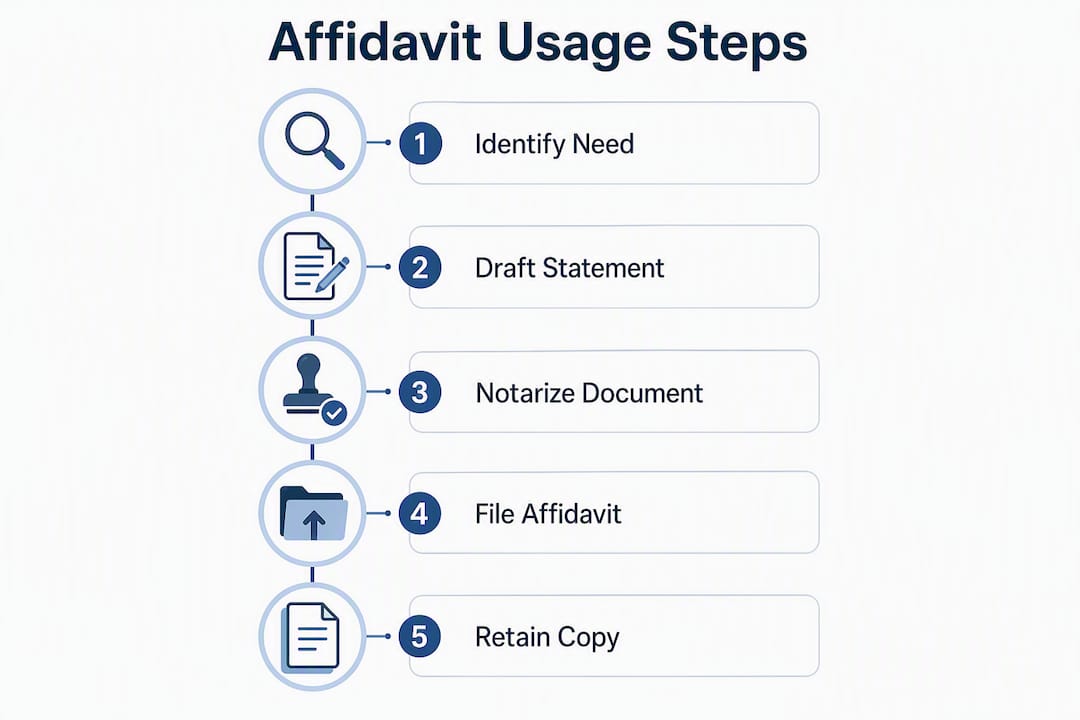
The evidentiary weight comes from the oath. When you sign an affidavit, you’re swearing that the contents are true, and that oath carries the same legal consequences as oral testimony. Making a knowingly false statement can constitute perjury, a criminal offense that carries fines and potential imprisonment.
Affidavits generally can’t replace live testimony at trial because they can’t be cross-examined. They’re most powerful for motions, administrative filings, and situations where the facts aren’t genuinely disputed and the court just needs sworn confirmation.
Pro Tip: If a court or agency has its own affidavit form, use it. Courts and institutions often require specific forms — a financial affidavit in family court, for example — and submitting a custom document when an official form exists is one of the fastest ways to get rejected.
When should you use an affidavit?
The short rule: reach for an affidavit whenever formal, sworn evidence of facts is required but live testimony would be impractical or unnecessary. Here are the situations where affidavits are most commonly needed.
Court proceedings
- Summary judgment motions: Parties submit affidavits to establish undisputed facts without a full trial.
- Temporary restraining orders and injunctions: Courts often require sworn facts to justify urgent relief.
- Proof of service: An affidavit of service confirms that legal documents were properly delivered.
Family law
- Financial affidavits disclosing income, assets, and expenses are standard in divorce and support proceedings.
- Custody-related statements from parents or witnesses about a child’s living situation.
- Proof of marital status or identity when records are unavailable.
Probate and estate matters
- An affidavit of heirship establishes family relationships when no will exists.
- Self-proving will affidavits, signed by witnesses at the time of execution, can speed probate by eliminating the need to locate witnesses later.
Real estate and property transactions
- Ownership verification when title records are unclear.
- Lost-deed or indemnity affidavits when original documents can’t be located.
- When replacing a lost instrument such as a promissory note, pair the affidavit with an indemnity clause where possible and follow any statutory requirements the financial institution or court imposes.
Government and immigration
- Affidavits of residence to establish eligibility for in-state tuition or local benefits.
- Immigration support letters or relationship affidavits confirming facts about a petitioner or beneficiary. An affidavit for proof of relationship is a common example in family-based immigration cases.
- Sworn statements supporting applications where documentary proof is limited.
Business and financial matters
- Affidavits of financial condition in bankruptcy or lending contexts.
- Lost-promissory-note affidavits when original instruments are missing.
The U.S. federal courts publish their own financial affidavit form for Criminal Justice Act purposes, which illustrates how specific and standardized these documents can be depending on the context.

What makes an affidavit legally valid in the United States?
A valid affidavit has several required elements, and missing any one of them can get it rejected.
The core requirements:
- Caption or case information (when filing with a court): case name, court, and docket number.
- Identity of the affiant: full legal name and enough identifying information to establish who is making the statement.
- Factual statements from personal knowledge: numbered paragraphs, each covering one discrete fact the affiant personally observed or knows.
- Jurat or sworn language: the clause confirming the affiant swore or affirmed the statement before an authorized official.
- Signature, dated and witnessed: signed in the presence of the notary or authorized official.
- Notary block: the notary’s signature, seal, commission expiration date, and registration number where required.
Competency matters. The affiant must be legally competent to make the statement and must present acceptable identification for notarization. A person who lacks legal capacity to testify generally cannot execute a valid affidavit.
Federal vs. state rules. Most affidavits require notarization, but 28 U.S.C. §1746 allows unsworn declarations “under penalty of perjury” to substitute for notarized affidavits in many federal filings, provided the required statutory language is included. Some states have adopted similar rules. North Dakota, for example, allows unsworn declarations in certain civil cases when specific requirements are met; otherwise, notarization is standard. Always confirm what your specific court or agency accepts before relying on an unsworn declaration.

How do you write an affidavit that holds up?
A well-drafted affidavit follows a predictable structure. Here’s what every affidavit should include, in order:
- Caption: Court name, case name, and docket number (for court filings).
- Title: “Affidavit of [Full Name]” or “Affidavit in Support of [Motion Name].”
- Identity paragraph: “I, [Full Name], residing at [Address], being duly sworn, state as follows:”
- Numbered factual paragraphs: One fact per paragraph. Use dates, locations, and specifics. “On March 4, 2025, I personally observed…”
- Penalty of perjury / statement of truth: “I declare under penalty of perjury that the foregoing is true and correct to the best of my knowledge.”
- Signature block: Affiant’s printed name and signature, with date.
- Jurat / notary block: Completed by the notary after witnessing the signing.
Sample jurat language (standard U.S. form):
Subscribed and sworn to before me this ___ day of ________, 20*.*
[Notary Signature] [Notary Seal]
My commission expires: ___________
Dos:
- Stick to facts you personally witnessed or know.
- Use specific dates, names, and locations.
- Number every paragraph and keep each one short.
- Attach exhibits and label them (Exhibit A, Exhibit B) with a reference in the relevant paragraph.
- Run a quick fact-check before you appear before the notary.
Don’ts:
- Don’t include legal argument or opinion. Legal analysis belongs in motions or memoranda, not in sworn testimony. A court can disregard an affidavit that reads like a legal brief.
- Don’t include hearsay unless it’s clearly labeled and you explain why you have that information and who told you.
- Don’t sign before the notary. The notary must witness the signing, or the jurat is void.
- Don’t speculate or use language like “I believe” or “I think” for facts you should know directly.
Pre-notarization checklist:
- [ ] All paragraphs numbered and factual
- [ ] No legal argument or opinion included
- [ ] Exhibits attached and labeled
- [ ] Correct court caption (if filing)
- [ ] Penalty of perjury language present
- [ ] ID ready for the notary
- [ ] Have NOT yet signed the document
Pro Tip: If the court or agency provides an official form, fill that in rather than drafting from scratch. Official forms are pre-formatted to meet local requirements, which eliminates most rejection risks before they start.
Does an affidavit need to be notarized, and how do state rules vary?
Most affidavits in the United States require notarization. The notary’s role is specific: they must witness you sign, confirm your identity, administer the oath or affirmation, and complete the jurat. Signing the document before you arrive and asking the notary to stamp it afterward doesn’t count. That sequence invalidates the jurat because the notary didn’t witness the signing.
When notarization can be skipped:
- Federal filings: 28 U.S.C. §1746 permits unsworn declarations as a substitute when the statement includes the required “under penalty of perjury” language.
- Some state courts accept similar unsworn declarations for specific filing types. North Dakota is one example where civil cases may qualify under defined conditions.
- Always confirm with the specific court or agency before relying on this option.
Remote online notarization (RON):
- Many states now authorize RON, which lets you complete notarization via video call with a commissioned notary.
- State authorization alone isn’t enough. The receiving court or agency must also accept RON-notarized documents. Some courts still require physical presence or a specific notarization format even when state law authorizes remote notarization.
- Confirm RON acceptance with the receiving party before booking an appointment.
Pro Tip: Always check local court rules or agency guidance before assuming an unsworn declaration or remote notarization will be accepted. A quick call to the clerk’s office can save you from a rejected filing.
| Scenario | Notarization required? |
|---|---|
| State court filing | Usually yes — check local rules |
| Federal court filing | Often no — 28 U.S.C. §1746 unsworn declaration may suffice |
| Immigration application | Yes, typically notarized |
| Real estate transaction | Yes, notarized standard |
| Administrative agency filing | Varies — confirm with the agency |
Affidavit vs. declaration vs. deposition: which one do you need?
These terms get used interchangeably, but they’re not the same thing.
| Document type | What it is | Best for |
|---|---|---|
| Sworn written affidavit | Written statement sworn before a notary or authorized official | Court motions, administrative filings, notarized proof of facts |
| Unsworn statutory declaration | Written statement under penalty of perjury per statute (e.g., 28 U.S.C. §1746) | Federal filings and some state proceedings where notarization isn’t required |
| Oral deposition | Oral testimony under oath, recorded by a court reporter | Trial preparation, discovery, cross-examination |
| Sworn statement (general) | Broad term covering any statement made under oath | Varies widely by context |
When to pick an affidavit: You need written, sworn evidence for a motion, an administrative filing, or a notarized proof of fact. The matter doesn’t require live cross-examination, and the receiving party accepts written sworn testimony.
When you need a deposition instead: The opposing party needs the opportunity to cross-examine the witness, or you’re building a record for trial. Affidavits can’t be cross-examined, which is precisely why they don’t substitute for depositions in contested litigation.
Quick decision rules:
- Filing a motion and need sworn facts? Use an affidavit.
- Federal filing and notarization is inconvenient? Check whether an unsworn declaration under 28 U.S.C. §1746 works.
- Preparing for trial and need to lock in testimony? Schedule a deposition.
- Unsure what the receiving party accepts? Ask before you draft anything.
For a deeper look at how affidavits compare to sworn statements specifically, Theonlinenotary has a useful breakdown of affidavit vs. sworn statement differences worth reviewing.
What mistakes can get your affidavit rejected or cause legal trouble?
Perjury exposure is the most serious risk. Knowingly false statements in an affidavit can lead to criminal charges. The key elements are materiality (the false statement had to matter to the proceeding) and intent (you knew it was false). Even if criminal charges don’t follow, contradictory sworn statements across filings can be used to impeach your credibility at trial, which is damaging in any contested matter.
Execution errors:
- Signing before the notary witnesses it (invalidates the jurat).
- Missing jurat or incomplete notary block.
- Failing to present valid ID to the notary.
- Undated signature.
- Exhibits not attached or not labeled to match references in the text.
Content errors:
- Hearsay presented as personal knowledge. Even well-meaning hearsay (“I was told by my neighbor that…”) weakens admissibility. If hearsay is genuinely necessary, label it and explain the source.
- Legal argument in the affidavit body. Courts can disregard sworn statements that read like briefs.
- Speculative language (“I believe,” “I assume,” “probably”) for facts you should know directly.
- Contradictions with other sworn filings in the same case.
How to minimize risk:
- Draft conservatively. If you’re not certain of a fact, don’t include it.
- Cross-check every factual claim against other documents you’ve filed in the same matter.
- For high-stakes or complex matters, have an attorney review the draft before you sign.
Pro Tip: Before you walk into the notary appointment, read the affidavit aloud. Anything that sounds like an argument, a guess, or something you heard secondhand needs to come out.
How long does it take and what does notarization cost?
Typical timeline:
- Drafting: Anywhere from 30 minutes for a simple residency affidavit to several hours for a complex financial disclosure.
- Arranging notarization: Same day if you use a remote online notary or walk into a bank or UPS Store; up to several days if you need to schedule an appointment with a specific official.
- Filing and processing: Depends entirely on the court or agency. Some accept same-day electronic filing; others have processing queues of days or weeks.
Typical costs:
| Service | Typical cost range |
|---|---|
| In-person notary (bank, UPS Store, etc.) | Free–$15 per signature (state-regulated) |
| Remote online notarization (RON) | $25 per session, depending on platform |
| Attorney drafting and review | $150 depending on complexity |
| Court filing fee | Varies by court and document type |
State law caps what notaries can charge per signature, and those caps vary. California, for example, sets a maximum of $15 per notarial act. Check your state’s notary fee schedule for the exact figure that applies to you.
For readers evaluating remote notarization options, Theonlinenotary offers a comparison of online notary solutions that covers platform features and workflow differences, though note those services are based in Ontario and U.S. rules differ.
When should you consult a lawyer or professional notary?
Most straightforward affidavits — a proof of residence, a simple financial disclosure, a self-proving will affidavit — don’t require an attorney. But there are clear situations where DIY drafting is the wrong call.
Situations that call for legal counsel:
- Any matter with potential criminal exposure (perjury risk, fraud allegations, criminal proceedings).
- Complex estate or real-property title disputes where the affidavit could affect ownership.
- Immigration filings where an error could affect a visa, green card, or removal proceeding.
- High-dollar civil litigation where the affidavit will be scrutinized and potentially used for impeachment.
When a notary or remote notary is enough:
- The form is clear, the facts are straightforward, and you just need the jurat completed properly.
- The receiving agency accepts remote online notarization and you want to avoid an in-person appointment.
- You need a certified true copy or a simple sworn statement for an administrative purpose.
Practical threshold: If you’re uncertain about the format, the jurisdictional rules, or whether your statement could contradict something else you’ve filed, a short paid review from an attorney or an experienced notary service is worth the cost. Getting it right the first time is always cheaper than refiling after a rejection or, worse, defending a perjury allegation.
This article is general information, not legal advice. Confirm the current rules with the relevant court, agency, or a qualified attorney for your specific situation.
Key Takeaways
An affidavit is valid only when it contains first-hand facts, proper sworn language, and a correctly executed jurat witnessed by an authorized official.
| Point | Details |
|---|---|
| Use an affidavit for sworn written facts | Reach for one when live testimony is impractical and the court or agency requires sworn evidence. |
| Notarization is usually required | Most U.S. affidavits need a notary; federal filings may accept an unsworn declaration under 28 U.S.C. §1746. |
| Never sign before the notary | The notary must witness the signing — doing it beforehand invalidates the jurat. |
| Keep it factual, not argumentative | Legal argument belongs in motions; including it in an affidavit can get the document disregarded. |
| Get professional help for high-stakes matters | Criminal exposure, contested real estate, and immigration filings warrant attorney review before signing. |
The part most guides skip
Most articles about affidavits focus on the format checklist. That’s useful, but the real problem I see repeatedly is people treating an affidavit like a persuasion document. They load it with legal argument, they include things they were told rather than things they witnessed, and they write in a way that’s designed to win rather than to inform. That approach backfires. A judge reading a motion doesn’t need the affidavit to argue the case — they need it to establish facts. The motion does the arguing.
The other recurring issue is the signing sequence. Clients show up to a notary appointment with an already-signed document, assuming the notary just needs to stamp it. That’s not how it works. The notary’s entire function is to witness the signing and administer the oath. Skipping that step doesn’t just create a technical defect — it can invalidate the entire document.
Remote notarization has made the process genuinely faster for most people. A straightforward affidavit can go from draft to notarized document in under an hour when you use a reliable online service. But the same rules apply: confirm the receiving court or agency accepts remote notarization before you book the appointment. Some courts still require physical presence regardless of what state law permits. That one confirmation call saves a lot of rework.
If you’re in Ontario and need a commissioner or notary for an affidavit, statutory declaration, or solemn declaration, Theonlinenotary handles remote appointments online. For U.S.-based readers, the affidavit preparation guide on the site walks through the signing and jurat process in detail, and the general framework applies even if the specific rules differ by jurisdiction.

Need a notary for your affidavit? Theonlinenotary provides remote online notary and commissioner services for affidavits and declarations in Ontario, with appointments available online. U.S. readers should confirm local notarization requirements with their court or agency.
Authoritative sources and where to check the rules
The sources below are the most reliable starting points for verifying affidavit requirements, federal statute language, and state-specific rules.
- Legal Information Institute — Affidavit (Wex): Plain-language definition, perjury notes, and a summary of 28 U.S.C. §1746 for unsworn declarations. Start here for the federal framework.
- 28 U.S.C. §1746 (Cornell LII): The federal statute authorizing unsworn declarations as a substitute for notarized affidavits in federal proceedings.
- Your state court’s self-help or forms page: Every state court system publishes its own affidavit forms and instructions. Search “[your state] courts self-help affidavit” to find the official page. The Colorado Judicial Branch general affidavit form is a good example of what these look like.
- Virginia General District Court affidavit form (vacourts.gov): A practical example of standard U.S. jurat language and the penalty-of-perjury clause used in state court filings.
- Your state’s notary fee schedule: Published by the secretary of state’s office in most states. Search “[your state] notary public fee schedule” for the current cap on per-signature fees.
- U.S. Courts financial affidavit (uscourts.gov): The federal CJA financial affidavit form illustrates how standardized federal affidavit formats work in practice.
- LegalZoom — What Is an Affidavit and How Is It Used?: A practical overview of common use cases and when official forms are required.