Notary Attestation Explained: A Clear Guide for Individuals

TL;DR:
- Witness attestation involves a person simply witnessing a signature without official credentials, suitable for low-risk domestic uses. Notarization requires a licensed notary public to verify identity, confirm willingness, and apply an official seal, offering stronger legal validity for formal documents.
Notary attestation is a term that covers two different things depending on who’s asking: a witness signing to confirm they saw you sign a document, or a notary public formally certifying that signing with an official seal. The core distinction is authority. A witness attestation requires no official credentials. A notarization requires a state-commissioned notary public who verifies your identity, confirms you’re signing willingly, and applies a notarial certificate and seal.
- Witness attestation works for many low-risk domestic uses: internal agreements, personal permission letters, some informal affidavits where the receiving party accepts a witness signature.
- Notarization is required for real estate deeds, wills, powers of attorney, immigration forms, court filings, and almost any document headed abroad for apostille or consular legalization.
When in doubt, get notarized. It’s accepted everywhere a witness signature is, but the reverse is rarely true.
Table of Contents
- What notary attestation actually means: witnessing a signature
- What notarization is and what a notary public actually does
- Attestation vs. notarization: a side-by-side comparison
- When is attestation enough, and when do you need notarization?
- How to get a document notarized in the United States
- Why notarization carries more legal weight — and why it matters internationally
- Key Takeaways
- Why the “notary attestation” confusion costs people more than they expect
- Theonlinenotary: online notarization for Ontario residents
- Authoritative sources for further reading
What notary attestation actually means: witnessing a signature
Attestation, at its core, is a witness statement that a signature was made in the witness’s presence. The witness doesn’t verify your identity with a government database or apply any official seal. They simply observe and sign.
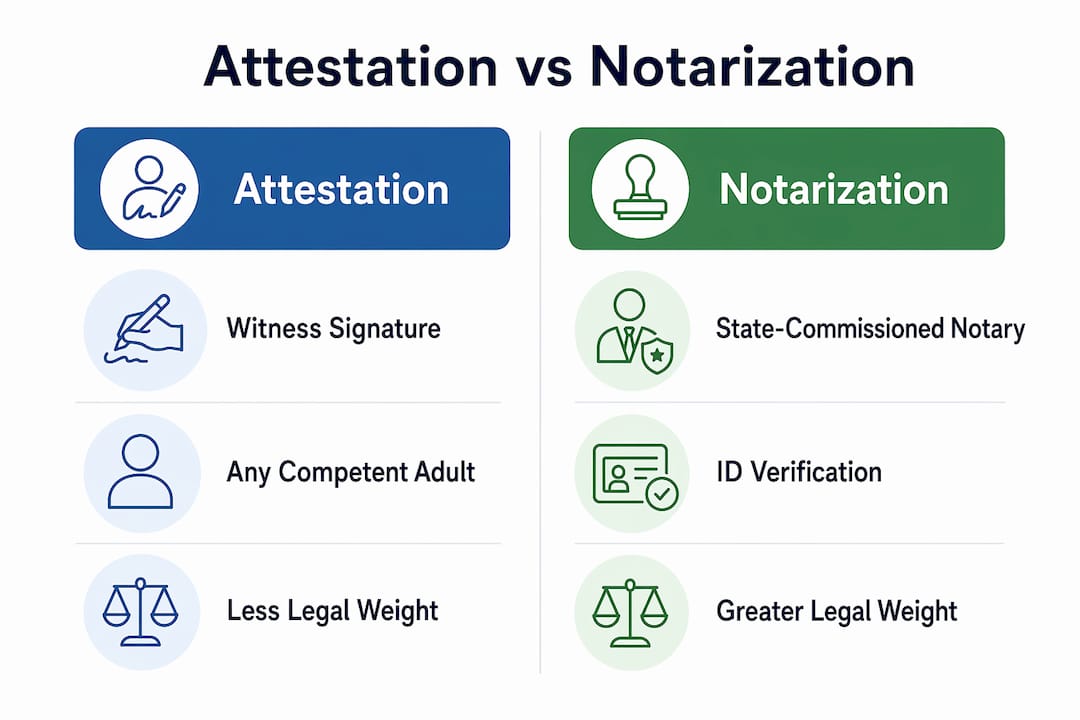
Who can do it? Usually any competent adult who isn’t a party to the document. State and local rules vary, so always check the receiving party’s requirements before relying on a witness.

A typical witness line looks like this:
“Signed before me on [date] by [signer’s name]. Witness: [printed name], [signature], [date].”
That’s it. No seal, no commission number, no identity check beyond what the witness personally knows.
Common uses where attestation often suffices:
- Internal company agreements with no legal filing requirement
- Personal letters of permission or consent
- Some informal affidavits where the receiving organization explicitly allows witness signatures
- Simple acknowledgment forms for low-stakes transactions
Pro Tip: Always read the form instructions before deciding a witness signature is enough. Many government agencies and courts specify “notarized” explicitly, and a witness signature will get the document rejected.
What notarization is and what a notary public actually does
A notary public is a state-appointed official whose job is to verify signer identity, confirm willingness and competence, administer oaths when needed, and deter fraud. That’s a meaningfully higher bar than a witness watching you sign.
The core steps a notary performs:
- Personal appearance: You must appear before the notary (in person or via Remote Online Notarization where permitted).
- ID verification: The notary checks government-issued photo ID, typically a driver’s license or passport.
- Willingness check: The notary confirms you understand what you’re signing and aren’t under duress.
- Notarial certificate: The notary completes a certificate stating what act was performed (acknowledgment, jurat, oath, etc.).
- Seal and signature: The notary applies an official stamp or embossed seal and signs the certificate.
- Record keeping: Many states require the notary to log the act in a notarial journal.
Common notarial acts include acknowledgments (confirming you signed voluntarily), jurats (you swear the contents are true), oaths and affirmations, and certified true copies of original documents.
One thing a notary does NOT do: verify that the facts inside the document are true. As Chase’s banking guidance puts it clearly, notaries are neutral officials limited to authenticating the signing process, not the document’s content.
“A notary public is a person authorized by law to administer oaths, certify documents and signatures, and perform other official commercial duties.” — Cornell Law LII / Legal Information Institute
Seal and stamp requirements differ by state. Some states require an embossed seal; others accept an inked stamp. A document notarized in one state may face scrutiny if the receiving party in another state expects a different format.
Attestation vs. notarization: a side-by-side comparison
| Dimension | Witness attestation | Notarization |
|---|---|---|
| Who can perform it | Any competent adult witness | State-commissioned notary public only |
| Identity verification | None required | Government-issued photo ID required |
| Official seal/stamp | No | Yes — required in most states |
| Evidentiary weight | Low — witness credibility only | Higher — public official verification |
| Typical use cases | Personal letters, informal agreements | Real estate, wills, POAs, immigration, court filings |
| International use (apostille) | Generally not accepted | Required as the first step |
Reading the table: Courts and government agencies favor notarization because a public official verified the signer, giving the document what the National Notary Association calls “probative force” — a stronger evidentiary standing. A witness signature carries only the credibility of the individual witness.
- For domestic, low-stakes uses: check whether the receiving party explicitly accepts witness signatures.
- For anything filed with a court, government agency, or foreign authority: assume notarization is required unless the instructions say otherwise.
- The term “notarially attested” can mean different things in different jurisdictions — wording and certificate formats vary, so always confirm what the receiving authority actually needs.
When is attestation enough, and when do you need notarization?
The fastest way to answer this: check the form instructions from the receiving authority. If they say “notarized,” a witness signature won’t work. Full stop.
Red flags that push you toward notarization:
- Real estate deeds, mortgages, or title transfers
- Wills, trusts, or powers of attorney
- Immigration forms (USCIS and most embassies require notarized documents)
- Court filings and affidavits submitted as evidence
- Vehicle title transfers
- Documents headed abroad for apostille or consular legalization
- High-value financial transactions or bank requirements
Where a witness attestation often suffices:
- Internal business agreements not filed with any authority
- Personal consent or permission letters
- Some informal declarations where the recipient explicitly accepts witness signatures
Pro Tip: When you’re unsure, notarize. A notarized document is accepted wherever a witness signature is, but a witness signature is almost never accepted where notarization is required. The extra step costs little and prevents rejection.
How to get a document notarized in the United States
- Prepare your document. Have it complete and ready, but do NOT sign it yet. Signing before the notary defeats the purpose of the notarial act in most cases.
- Bring acceptable ID. A state-issued driver’s license or U.S. passport are the most widely accepted. The notary will compare your signature to the ID.
- Bring any required witnesses. Some documents (wills, for example) require additional witnesses beyond the notary. Check the document’s requirements in advance.
- Appear before the notary. In person at a bank, UPS Store, law office, or notary’s office — or online via Remote Online Notarization (RON) if your state permits it.
- Sign in the notary’s presence. The notary witnesses the signing, completes the certificate, and applies the seal.
- Pay the fee. State laws cap notary fees; many states set maximums of a few dollars per signature, though mobile and RON services may charge more for convenience.
- Verify the notary’s commission. Most states maintain an online notary directory where you can confirm a notary’s active commission before or after the appointment.
Remote Online Notarization (RON) lets you complete the entire process via video call with identity-proofing technology. Many U.S. states now permit RON, which is especially useful for affidavits and statutory declarations when visiting an office isn’t practical. Check your state’s rules — not all states have enacted RON legislation, and some document types still require in-person notarization.
Why notarization carries more legal weight — and why it matters internationally
The National Notary Association explains that notarization provides “probative force” — a higher evidentiary weight — because a credentialed public official verified the signer. That’s why courts and agencies treat a notarized document differently from one with only a witness signature.
For international use, the workflow is almost always: notarization first, then apostille or consular legalization. A notarization is typically required before a Hague apostille or embassy legalization will be issued. A witness signature alone generally won’t survive that process.
State variability adds another layer. Requirements for seal format, journal keeping, and acceptable ID differ across states, and RON adoption continues to expand. If your document crosses state or national borders, confirm the destination authority’s specific requirements before you start.
Key Takeaways
Notarization carries more legal weight than witness attestation because a state-commissioned notary public verifies identity and applies an official seal, giving the document stronger evidentiary standing in courts, agencies, and international processes.
| Point | Details |
|---|---|
| Core difference | Attestation is a witness signature; notarization requires a state-commissioned notary with an official seal. |
| When to notarize | Real estate, wills, POAs, immigration forms, court filings, and any document requiring apostille or legalization. |
| What to bring | Government-issued photo ID, unsigned document, and any required witnesses. |
| Verify the authority | Always check the receiving party’s instructions — “notarized” means notarization, not a witness signature. |
| Theonlinenotary | Offers remote online notarization for affidavits, statutory declarations, and more — book an appointment to complete your document without visiting an office. |
Why the “notary attestation” confusion costs people more than they expect
The phrase “notary attestation” sits in an awkward middle ground. It sounds official enough that people assume a witness signature will do, but formal enough that receiving authorities assume a notary seal is attached. That gap is where documents get rejected.
The practical lesson isn’t complicated: the receiving authority’s instructions are the only thing that matters. A court clerk, immigration officer, or foreign embassy doesn’t care what you thought the term meant. They care whether the document meets their specific requirements.
What I find consistently underestimated is the downstream cost of getting this wrong. A rejected document in an immigration process or a real estate closing doesn’t just mean redoing the paperwork. It means delays, missed deadlines, and sometimes fees paid twice. The five minutes spent reading the form instructions, or calling the receiving office to confirm, is almost always worth it.
For international use especially: start with notarization. A witness signature is not a shortcut — it’s a dead end in most cross-border processes.
Theonlinenotary: online notarization for Ontario residents
If you’ve read this far and realized your document needs a proper notarization, not just a witness signature, Theonlinenotary handles exactly that — remotely, without the office visit. For Ontario residents needing affidavits, statutory declarations, solemn declarations, invitation letters, or remote will and power of attorney signing, the process runs entirely online via a secure video appointment.

The practical advantage over hunting for a local notary: fixed pricing per document, no travel, and appointments available when you need them. If you need certified true copies or in-person notarization in Brampton, that’s covered too. Book your appointment at Theonlinenotary’s services page and have your government-issued ID and unsigned document ready.
Authoritative sources for further reading
- National Notary Association — What Is a Notary Public? — The industry authority on notary roles, duties, and probative force.
- Cornell Law LII — Notary Public (Wex) — Plain-language legal definition and state-by-state context.
- Investopedia — What Does a Notary Do? — Practical overview of notary duties and common document types.
- Bankrate — What Is a Notary? — Covers fees, where to find a notary, and Remote Online Notarization basics.
- Chase — What Are Notary Services? — Accessible explanation of notary limitations and what notarization does not certify.
- NNA — What Is Notarization? — Step-by-step breakdown of the notarization process from the leading industry body.
- ksign.co — Online Notary Services — Useful for understanding apostille and consular legalization steps following notarization.
This article is general information, not legal advice. For your specific document and jurisdiction, confirm requirements with the receiving authority or a qualified legal professional.