What is an oath? Understanding its legal role in Ontario

TL;DR:
- Making a false oath in Ontario can lead to perjury charges with up to 14 years in prison.
- Only authorized professionals like lawyers, judges, and commissioners can legally administer oaths.
- Remote oath-taking is permitted since 2020, following official procedures via video conferencing.
Most people treat an oath as a routine formality, something you do quickly before signing a document or testifying in court. But making a false statement under oath in Ontario can lead to a perjury charge carrying up to 14 years in prison under the Criminal Code. That is not a formality. Whether you are swearing an affidavit for an immigration application, signing a statutory declaration for a business transaction, or giving testimony, understanding what an oath actually means legally can protect you from serious consequences. This guide breaks down what oaths are, who can administer them, the legal risks involved, and what modern rules say about taking oaths online.
Table of Contents
- What is an oath and why does it matter?
- Who can administer oaths in Ontario?
- Legal implications of taking an oath
- Exceptions, remote oaths, and common misunderstandings
- What most people get wrong about oaths in Ontario
- Get your oath administered securely—online or in person
- Frequently asked questions
Key Takeaways
| Point | Details |
|---|---|
| Oaths are legally binding | An oath in Ontario binds you to truth or duty, backed by significant legal consequences. |
| Authorized professionals matter | Only specific officials can administer oaths—choose the right person to avoid invalidation. |
| Remote options are valid | Oaths can be taken remotely in Ontario if proper legal procedures are followed. |
| Severe penalties deter falsehood | Perjury carries up to 14 years’ imprisonment in Ontario, making honesty essential. |
| Nuances accommodate diversity | Ontario’s oath laws include exemptions and remote flexibility for special cases. |
What is an oath and why does it matter?
An oath, in the legal sense, is a formal promise made by a person to tell the truth or carry out a duty, typically invoking a personal belief or a sense of moral responsibility. In Ontario’s legal system, an oath is not just a verbal gesture. It is a binding legal act with enforceable consequences.
When you create an affidavit, for example, you are making a sworn written statement. The oath you take transforms that written statement from a simple letter into a legally recognized document. Courts, government agencies, financial institutions, and regulatory bodies all rely on oaths to ensure the accuracy and trustworthiness of the documents they receive.
Oath, affirmation, and sworn statement: what’s the difference?
These three terms are often used interchangeably, but they mean slightly different things:
- Oath: A promise made while invoking a religious or spiritual belief. Traditionally, this involved placing a hand on a Bible, though today, any sacred text relevant to the individual’s faith can be used.
- Affirmation: A secular alternative to an oath. It carries the same legal weight but does not invoke a religious belief. Anyone can choose an affirmation without needing to state a reason.
- Sworn statement: A broader term that refers to any statement made under oath or affirmation, which includes affidavits and statutory declarations.
The key distinction is that both oaths and affirmations create identical legal obligations. Choosing an affirmation does not reduce your legal responsibility to tell the truth. Courts and commissioners treat them as legally equivalent.
Why oaths matter in Ontario documents
Oaths serve as a foundation of trust in Ontario’s legal and administrative systems. Without the legal weight of an oath, there would be no reliable mechanism to hold individuals accountable for the accuracy of their statements. This matters in a wide range of contexts, from family law affidavits to business contracts to immigration paperwork.
“An oath transforms a personal statement into a legal obligation. The moment you swear or affirm, you accept accountability under Ontario law.”
Authorized persons in Ontario such as lawyers, paralegals, judges, justices of the peace, and appointed commissioners are the professionals legally empowered to witness and administer these acts. Common scenarios where you will encounter an oath include:
- Swearing an affidavit for a court proceeding
- Signing a statutory declaration for government applications
- Providing testimony as a witness in a legal hearing
- Completing immigration-related documentation
- Certifying documents for real estate or business transactions
Understanding the oath in law means recognizing that this act carries both moral and criminal implications. Ontario’s legal infrastructure depends on individuals taking oaths seriously, and the penalties for misuse exist precisely to protect that integrity.
Who can administer oaths in Ontario?
Knowing who can legally administer an oath is just as important as understanding what an oath is. Not every professional or official has the authority to do this, and using an unauthorized person can invalidate your document entirely.
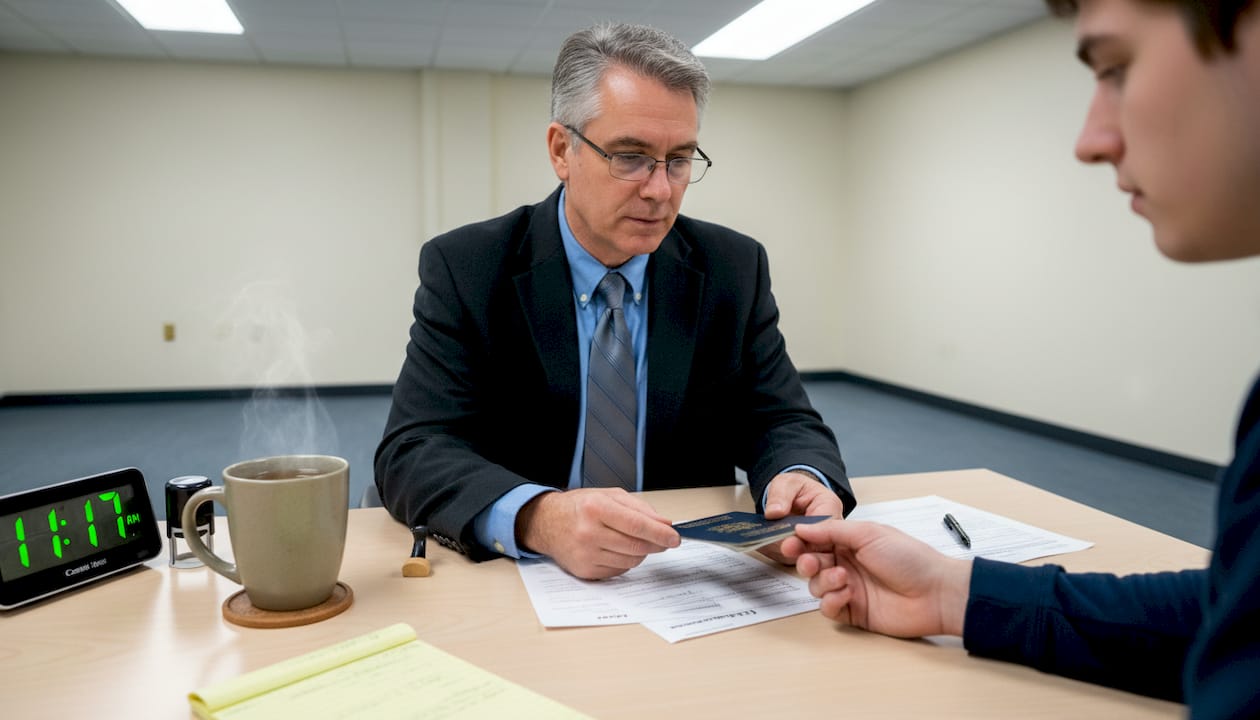
Authorized persons in Ontario who can administer oaths include lawyers, paralegals, judges, justices of the peace, and appointed commissioners for taking affidavits. Each plays a distinct role depending on the context of the document.
Comparison of oath administrators in Ontario
| Role | Authority | Typical use case | Limitations |
|---|---|---|---|
| Lawyer | Full authority under the Law Society Act | Affidavits, statutory declarations, court documents | Active membership required |
| Paralegal | Licensed by Law Society of Ontario | Affidavits in certain tribunal matters | Scope limited by license |
| Judge or Justice of the Peace | Judicial authority | Court testimony, arrest warrants | Formal court contexts |
| Commissioner for Taking Affidavits | Appointed under Evidence Act | Everyday affidavits and declarations | Must display authority on stamp |
Step-by-step: how to get an oath properly administered
- Identify the document type. Determine whether you need an affidavit, statutory declaration, or another sworn document.
- Select an authorized administrator. Choose someone from the list above who is appropriate for your document’s purpose.
- Prepare your document in advance. Do not sign it yet. The oath must be administered before or at the time of signing.
- Appear before the commissioner or authorized official. For remote oaths, follow the official procedures introduced since 2020.
- Swear or affirm. Verbally commit to the truth of the document’s contents.
- Sign in the presence of the administrator. The administrator then signs and stamps the document to certify the oath.
Commissioners for taking affidavits must operate within the rules set by Ontario’s Evidence Act and the Commissioners for Taking Affidavits Act. They are typically appointed by the government and may include court clerks, certain public servants, and individuals appointed for specific purposes. Their stamp must accurately indicate the scope of their authority. If there are limitations, those must appear on the stamp itself.
For details about who can sign an affidavit and what qualifications matter, it’s worth checking a current Ontario-specific resource before proceeding. Consulting an Ontario affidavit guide can also save you time and prevent errors that could result in your document being rejected.
Pro Tip: Always ask the person administering your oath to confirm their current status and authority before proceeding. An expired appointment or license can make your sworn document invalid, which may force you to restart the process from scratch.
Legal implications of taking an oath
The legal stakes of taking an oath in Ontario are serious and often underestimated. Once you swear or affirm a statement, you accept personal responsibility for its accuracy. If you knowingly provide false information, you are committing perjury.
What is perjury?
Perjury is the act of intentionally making a false statement while under oath in a judicial proceeding or in any sworn document. Under Criminal Code s.131, perjury is an indictable offense punishable by up to 14 years in prison. This applies not only to courtroom testimony but to sworn affidavits and statutory declarations submitted to government agencies, courts, and other bodies.
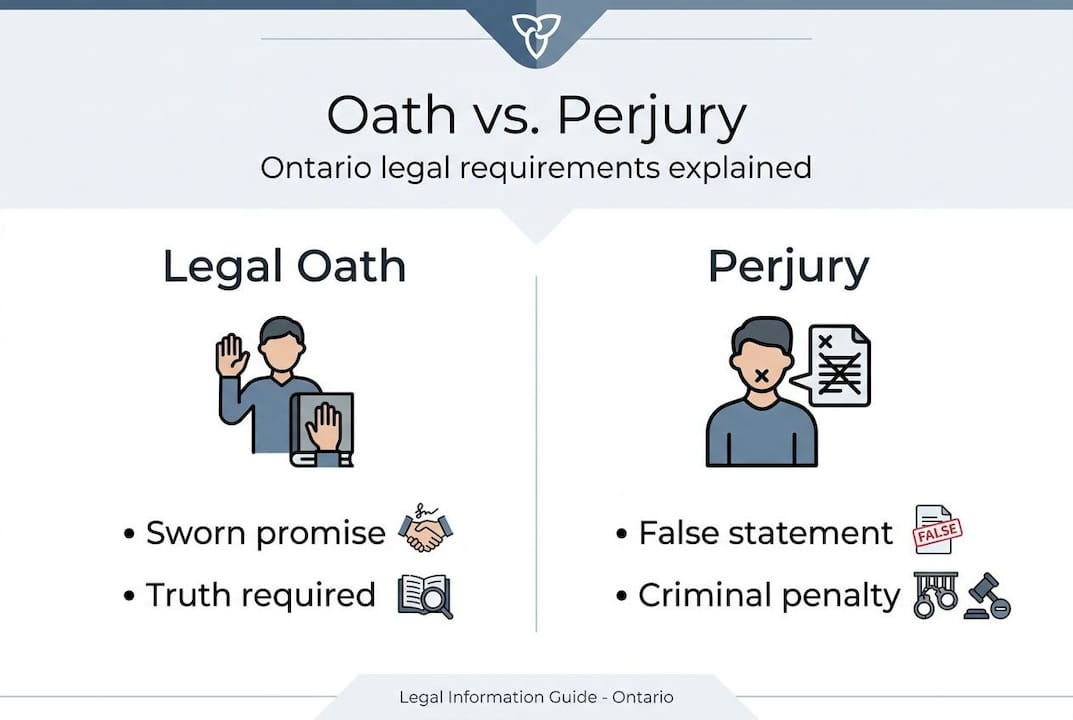
Here is a practical example. Suppose you swear an affidavit for a rental tribunal claiming you have lived at an address for two years when in fact you lived there for six months. That false statement, made under oath, could result in a perjury charge. The fact that the document was administrative rather than judicial does not protect you.
Penalties overview
| Offense | Who is affected | Maximum penalty |
|---|---|---|
| Perjury (s.131 Criminal Code) | Person taking the oath | 14 years imprisonment |
| Subornation of perjury | Person who convinced another to lie | 14 years imprisonment |
| Commissioner misconduct | Administering official | Fine up to $2,000 |
| Obstructing justice | Anyone involved | 10 years imprisonment |
Commissioners who improperly administer oaths face their own consequences. If a commissioner fails to follow proper procedures, administers an oath outside their authority, or fails to verify identity, they can be fined under Ontario’s Commissioners for Taking Affidavits Act. The integrity of the oath process rests on both parties following the rules.
The severe perjury penalties are not arbitrary. They exist because the legal system depends entirely on the reliability of sworn statements. Courts and tribunals make decisions that affect people’s lives, property, custody, and finances based on these documents. False oaths corrode that trust at every level.
To understand exactly when a notary is needed versus when a commissioner will suffice, the distinction matters practically. Getting the wrong type of witness could delay your application or invalidate your document entirely.
Pro Tip: Before you sign any sworn document, read every word carefully. If something in the document is inaccurate, even by accident, raise it with the commissioner or lawyer before signing. Correcting an error before taking the oath costs nothing. Correcting it after could cost you everything.
Exceptions, remote oaths, and common misunderstandings
Ontario’s oath rules are not one-size-fits-all. Several exceptions and modern updates affect how and when oaths must be taken, and many people are not aware of them.
Who is exempt from certain oath requirements?
Specific exemptions exist for certain groups, including public servants who may be in the process of losing citizenship status and Indigenous persons regarding oaths of Crown allegiance. These accommodations recognize the complex legal and historical relationships between certain individuals and the Crown, ensuring that oath requirements do not create unjust barriers.
This is an area most people are completely unaware of. If you fall into one of these categories and are being required to take an oath that conflicts with your legal status or cultural obligations, you may have grounds to request an alternative process.
Remote oaths: what changed in 2020?
One of the most significant developments in Ontario’s oath administration is the legalization of remote commissioning. Since 2020, commissioners have been permitted to administer oaths via video conferencing, provided they follow official procedures. This means:
- The deponent (the person taking the oath) must appear live on video
- The commissioner must be able to see and hear the deponent clearly
- Identity must be verified through the video session
- The document must still be signed and stamped through an approved process
This change dramatically increased access to oath services, particularly for individuals in rural areas, those with mobility limitations, or anyone who cannot easily travel to a commissioner’s office. Understanding online notary legalities in Ontario ensures you know when remote options are valid and when in-person attendance is still required.
Common myths about oaths in Ontario
- “I can witness my own oath.” You cannot. Taking your own oath is legally invalid. A neutral, authorized third party must administer it.
- “All legal documents must be signed in person.” Not true since 2020. Many documents can now be sworn remotely through approved video commissioning.
- “If the document is minor, the oath doesn’t really matter.” Every sworn document carries full legal weight regardless of the size of the matter.
- “Any professional can administer an oath.” Only specifically authorized individuals can do this. A friend who happens to be a doctor or accountant has no authority to administer a legal oath.
Understanding online notarization in Ontario helps clarify exactly what is permitted and what is not, so you do not accidentally invalidate an important document.
Pro Tip: If you are using remote commissioning, confirm in advance that the service you are using follows Ontario’s official video conferencing requirements. Not all online signing platforms meet the legal standard. Choose a service with commissioners who are explicitly authorized under Ontario law.
What most people get wrong about oaths in Ontario
Here is an uncomfortable truth: most people who take oaths in Ontario do not actually understand what they are agreeing to. They repeat a few words, sign a paper, and assume the hard part is over. But the act of swearing an oath is not just administrative. It is one of the few moments in civilian life where you personally accept a criminal liability for the truth of your words.
What makes this even more interesting is that the system works largely on deterrence. There is no empirical data on how often oaths are falsified, but the severity of perjury penalties appears to keep misuse rare. In other words, the system is self-regulating to a significant degree. Few people lie under oath because the consequences are too severe.
What often gets overlooked is how thoughtfully Ontario’s oath framework accommodates diversity. The exemptions for Indigenous persons and certain public servants are not loopholes. They reflect a legal system that recognizes historical and cultural complexity rather than demanding blanket compliance regardless of context.
Remote commissioning is another area where public awareness lags far behind legal reality. The option has existed since 2020, but many people still assume they must appear in person. Professionals who work with types of affidavits in Ontario regularly encounter clients who did not know they had remote options, sometimes after making an unnecessary trip.
The bottom line is that oaths are serious, flexible, and more modern than most people assume. Taking the time to understand them properly is not just good legal hygiene. It is self-protection.
Get your oath administered securely—online or in person
Now that you understand what oaths involve and what is at stake, the next step is making sure yours is handled correctly by a qualified professional.

Our Ontario notary services make it easy to get your oaths, affidavits, statutory declarations, and solemn declarations administered accurately and securely, whether you prefer to meet remotely or in person. We work with individuals and businesses across Ontario, offering flexible scheduling and clear guidance at every step. Before you proceed, it’s worth reviewing public notary requirements and understanding what a notary does so you arrive prepared and confident. Avoid costly mistakes by working with a trusted professional from the start.
Frequently asked questions
Is an oath legally binding in Ontario?
Yes, oaths are legally binding in Ontario, and making a false statement under oath can result in a perjury conviction carrying up to 14 years in prison. The legal obligation applies equally whether you swear an oath or choose an affirmation.
Can I take an oath remotely or does it have to be in person in Ontario?
You can take an oath remotely in Ontario as long as official procedures are followed, since remote commissioning has been permitted since 2020. The commissioner must still verify your identity and witness the act via live video.
Who is allowed to administer an oath in Ontario?
Authorized individuals include lawyers, paralegals, judges, justices of the peace, and commissioners for taking affidavits. Each has specific authority that may vary depending on the type of document and context.
What happens if I lie under oath in Ontario?
Providing false information under oath can result in a perjury conviction under the Criminal Code s.131 with imprisonment of up to 14 years. Even errors in administrative documents, such as affidavits submitted to tribunals, can trigger this charge.
Are there exceptions or exemptions to taking an oath?
Certain public servants and Indigenous persons may qualify for specific exemptions related to oaths of Crown allegiance. These accommodations are built into Ontario’s legal framework to reflect historical and cultural realities rather than impose blanket requirements.
Recommended
- Understanding the Importance of Notarization in Ontario - The Online Notary
- Solemn Declaration Meaning: Complete Guide for Ontario - The Online Notary
- Understanding Solemn Declaration Sample for Ontario Residents - The Online Notary
- How to Create an Affidavit in Ontario (2025 Guide) - The Online Notary