What Is a Notarial Seal? Ontario Guide 2026

TL;DR:
- A notarial seal authenticates notarized documents and must include specific elements like the notary’s name, “Notary Public,” jurisdiction, and expiration date. Proper use of the seal, with the correct ink and placement, is essential to prevent document rejection and ensure legal validity. Both physical and electronic seals convey official authority and pair with signatures to verify document authenticity in Ontario.
A notarial seal is the official impression a notary public applies to a document to certify its authenticity and confirm the notary’s legal authority. Every valid notarization in Ontario requires this mark. The seal proves the notary verified the signer’s identity, witnessed the signature, and completed all required steps under Ontario’s notary commission rules. Without it, banks, courts, and government offices will reject the document. Understanding what a notarial seal is, what it must contain, and how to use it correctly protects you from costly delays and document rejections.
What is a notarial seal and what must it contain in Ontario?
A notarial seal is legally required to authenticate documents notarized by a notary public. The seal confirms the notary completed identity verification, witnessed the signature, and exercised their commission authority. No seal means no valid notarization, regardless of how carefully the rest of the process was followed.
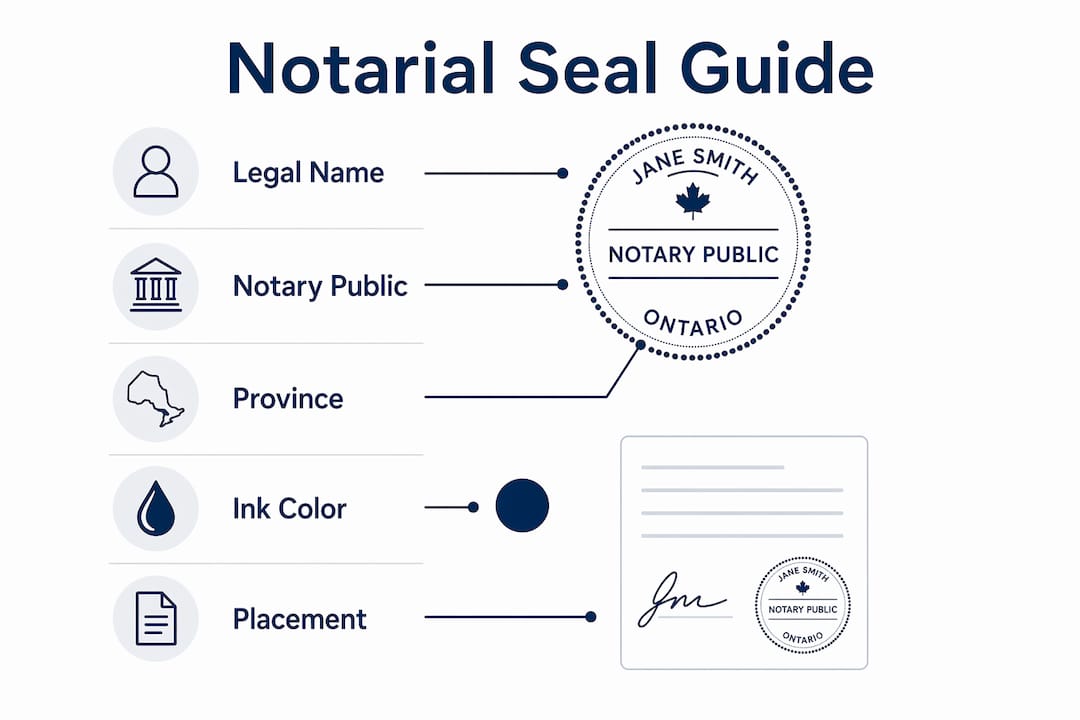
Ontario notaries must include specific elements on every compliant seal. Missing even one of these details causes document rejection by government offices. The required elements are:
- Notary’s full legal name as it appears on the commission
- The words “Notary Public” printed clearly on the seal
- Jurisdiction of commission (Province of Ontario)
- Commission number where required by the issuing authority
- Commission expiration date so recipients can confirm the seal is current
Placement matters as much as content. Seals must use black or dark blue ink, produce a clear impression in a blank area near the notary’s signature, and remain legible after scanning or photocopying. Some documents mark seal placement with the letters “L.S.” (from the Latin locus sigilli, meaning “place of the seal”). A seal that overlaps printed text is grounds for rejection.
Pro Tip: Always test your stamp on scrap paper before applying it to a legal document. Ink distribution is uneven on new stamps and after long periods of non-use.
| Seal Element | Requirement |
|---|---|
| Notary’s full legal name | Must match commission exactly |
| “Notary Public” designation | Must appear on every seal impression |
| Ontario jurisdiction | Province of Ontario stated clearly |
| Commission expiration date | Must be current at time of notarization |
| Ink color | Black or dark blue only |
What types of notarial seals are used and how do they differ?
Three types of seals are used in Ontario notarization: ink stamps, embossers, and electronic seals. Each serves the same core purpose but works differently, and each carries different legal weight depending on the context.
Ink stamps
Ink stamps dominate as the primary notarial seal in most jurisdictions, including Ontario. They produce a flat, inked impression that photocopies and scans clearly. This matters because most official processing today involves digital records. Rubber stamps and self-inking stamps are both widely used. Self-inking models are more consistent and less prone to smudging on high-volume days.
Embossers
An embosser presses a raised or recessed impression into paper without ink. The tactile result is difficult to forge and was the standard seal format for centuries. The problem is that embossed impressions do not photocopy well. They appear blank or faint on copies, which creates problems for document processing. Embossers remain secondary security devices today, still requested by lenders and title companies for real estate transactions and wills because of their tamper-evident quality.
Electronic seals
Electronic notary seals are becoming standard with remote online notarization. A digital seal contains the same identifying elements as a physical one and links to an electronic signature and a tamper-evident certificate. If the document is altered after signing, the certificate flags the change. Theonlinenotary uses this technology to provide legally valid notarizations for Ontario residents without requiring an in-person appointment. For more on how digital security works in this context, see Ontario digital notarization compliance.
Pro Tip: If you regularly submit documents to foreign embassies or civil law countries, carry both an ink stamp and an embosser. Physical ink seals carry more international weight in those jurisdictions.
| Seal Type | Photocopies Well | Tamper Evident | Used in Online Notarization |
|---|---|---|---|
| Ink stamp | Yes | No | No |
| Embosser | No | Yes | No |
| Electronic seal | Yes (digital) | Yes | Yes |
Why is a notarial seal important for individuals and businesses in Ontario?
A notarial seal is a trust signal. It tells every receiving party, whether a bank, a court, or a foreign embassy, that a licensed professional verified the document’s authenticity and the signer’s identity. Without that signal, the document carries no official weight.
For Ontario individuals and businesses, the practical stakes are high. The seal and signature together constitute formal authentication recognized by banks, courts, and government authorities. The seal alone is not enough. A notary stamp does not legalize a document on its own. It certifies that the notary completed identification, voluntary acknowledgment, and witnessing steps beforehand. The signature and seal work as a pair.
The consequences of a missing or defective seal are concrete:
- Government offices reject documents with illegible or incomplete seals
- Banks refuse to process affidavits and statutory declarations without a valid seal
- Foreign authorities, especially in civil law countries, require physical ink seals for cross-border recognition
- Courts can invalidate notarized evidence if the seal does not meet commission requirements
“A notary seal acts as a gatekeeper to commerce and law. It is not decoration. It is the official, registered mark that verifies identity and authority, and without it, the entire notarization process collapses.”
For businesses handling contracts, documents requiring notarization in Ontario include affidavits, statutory declarations, solemn declarations, and certified copies. Each of these requires a compliant seal to be accepted. A single rejected document can delay a real estate closing, a visa application, or a court filing by weeks.
How to obtain and properly use a notarial seal in Ontario
Obtaining a notarial seal follows a clear sequence after a notary public receives their commission appointment. Proper use from day one prevents the most common causes of document rejection.
- Receive your commission. Ontario notaries are commissioned through the Ministry of the Attorney General. Your commission certificate confirms your name, jurisdiction, and expiration date. All three must appear on your seal.
- Order from an authorized supplier. Purchase your seal from a reputable stamp manufacturer. Provide your exact commission details. The manufacturer produces a die or stamp that matches your legal name and commission information precisely.
- Verify the impression before use. Test the stamp on plain paper. Check that every required element is legible and that the ink distributes evenly across the full impression area.
- Apply the seal correctly. Press straight down and lift without rocking the stamp. Rocking causes smudging and blurring. A smudged seal is grounds for rejection. Place the seal in a blank area near your signature, never over printed text.
- Handle smudged impressions properly. Do not wipe or erase a smudged seal. Apply a second clean impression nearby and note in writing which impression is the official one. This is the accepted professional practice.
- Destroy the seal when your commission ends. When a commission expires or is revoked, destroy the physical stamp to prevent unauthorized use. Cut or break the die and dispose of it securely.
Pro Tip: Store your stamp in a cool, dry location away from direct sunlight. Heat warps the rubber die and produces uneven impressions that look unprofessional and may not pass document review.
Combining your signature and seal correctly is the final step. Sign first, then apply the seal adjacent to or below the signature. The combination of seal and signature is what constitutes a complete, legally recognized notarization. One without the other is incomplete. For a full breakdown of when Ontario law requires this combination, see when a notary is required in Ontario.
Key Takeaways
A notarial seal is only legally valid when it contains all required commission elements, uses compliant ink, and appears alongside the notary’s signature on the document.
| Point | Details |
|---|---|
| Seal is legally mandatory | Every Ontario notarization requires a compliant seal or the document will be rejected. |
| Five required elements | Full legal name, “Notary Public,” Ontario jurisdiction, commission number, and expiration date must all appear. |
| Ink stamps are the standard | Ink stamps photocopy clearly and are the preferred seal type for most Ontario notarizations. |
| Seal and signature work together | Neither the seal alone nor the signature alone constitutes valid notarization. Both are required. |
| Electronic seals are legally valid | Digital seals used in online notarization carry the same identifying elements and tamper-evident protection as physical seals. |
The seal is more than a formality
I have worked with notarized documents long enough to know that most people treat the seal as the last step, almost an afterthought. That is the wrong way to think about it. The seal is the whole point. Everything the notary does before that moment, checking ID, confirming the signer understands the document, witnessing the signature, only counts because the seal records that it happened.
What surprises people is how often documents get rejected not because of fraud, but because of a smudged impression or a missing expiration date. These are not obscure technicalities. They are the basic requirements that every receiving institution checks first. I have seen real estate closings delayed and visa applications sent back because a notary applied the seal over printed text or used the wrong ink color.
The shift toward electronic seals in Ontario is real and accelerating. Online notarization through platforms like Theonlinenotary makes the process faster and more accessible, especially for non-residents and people with tight schedules. But the underlying logic of the seal has not changed. It still needs to contain the right information, link to a verified identity, and pair with a valid signature. Digital or physical, the standard is the same.
My practical advice: treat your seal like a professional credential, not a rubber stamp. Know what it must contain, apply it with care, and replace it the moment the impression quality degrades.
— Ken
Notarial seal services from Theonlinenotary
Theonlinenotary provides professional notary services for Ontario residents and businesses, including affidavits, statutory declarations, solemn declarations, and invitation letters. Every notarization includes a compliant seal applied by a commissioned Ontario notary public.

Access to a notary is available 24/7, with no in-person appointment required. Whether you need a single document authenticated or ongoing support for business filings, Theonlinenotary handles the full process with a seal and signature that meets Ontario’s legal requirements. Explore Ontario notary services to get started, or review the types of documents that require notarization to confirm what your situation needs.
FAQ
What is a notarial seal used for?
A notarial seal certifies that a notary public verified the signer’s identity, witnessed the signature, and completed all required notarization steps. Banks, courts, and government offices use the seal to confirm a document’s authenticity.
What information must appear on a notarial seal in Ontario?
A compliant Ontario notarial seal must show the notary’s full legal name, the words “Notary Public,” the Province of Ontario as the jurisdiction, the commission number, and the commission expiration date.
Can a notarized document be rejected because of the seal?
Yes. Documents with smudged, illegible, or incomplete seals are rejected by government offices and financial institutions. A seal that overlaps printed text or uses the wrong ink color is also grounds for rejection.
Is an electronic notarial seal legally valid in Ontario?
An electronic notarial seal is legally valid for remote online notarizations in Ontario. It contains the same required identifying elements as a physical seal and links to a tamper-evident certificate that flags any post-signing alterations.
Do I need both a seal and a signature for valid notarization?
Yes. The seal and the notary’s signature are both required. Neither is sufficient on its own. The combination of the two constitutes formal authentication recognized by courts, banks, and government authorities.