What Is a Notarial Certificate? Parts, Types, and Uses

What is a notarial certificate and why does it matter?
A notarial certificate is the official written statement a notary public completes to prove that a specific notarial act took place. It records who appeared, what the notary verified, and when and where the act occurred. Per the Washington State Department of Licensing, documents lacking a proper certificate are routinely rejected by courts or recording offices.
Think of it as the paper trail that makes a notarization real. Without it, the notary’s signature and seal sitting on a document mean nothing legally.
What a notarial certificate does:
- Confirms the notary verified the signer’s identity
- Records the type of notarial act performed (acknowledgment, oath, copy certification, etc.)
- Establishes the date and location of the act
- Provides legal evidence that proper notarization procedures were followed
- Protects against document fraud by creating an official, traceable record
The certificate may appear as a section already printed on the document itself, or it may be a separate page attached to it. Either form is valid, provided it is properly completed and connected to the document being notarized.
Table of Contents
- The four main parts every valid certificate must include
- Common types of notarial certificates
- What a notary can and cannot do when issuing certificates
- How certificate requirements vary across US states
- Standard wording examples for common certificates
- When you actually need a notarial certificate
- What qualifies a notary to issue a valid certificate
- Key Takeaways
The four main parts every valid certificate must include
Most US states require four core components in a notarial certificate. Miss any one of them and the notarization is incomplete.
-
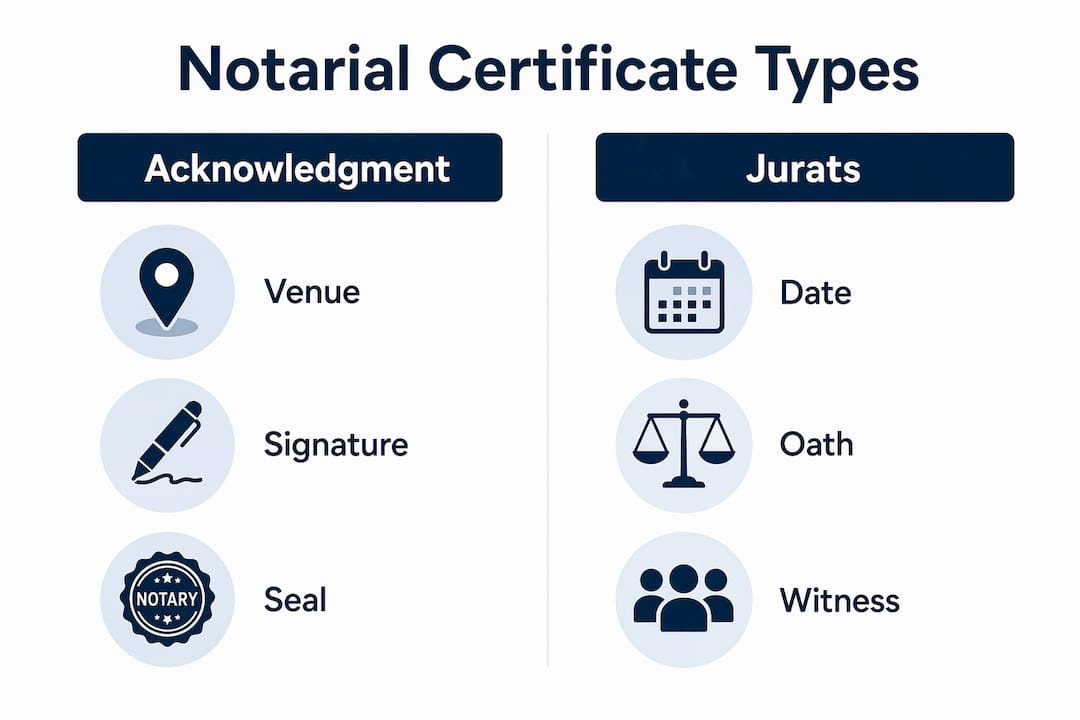
Venue: The state and county where the notarial act was performed. This is not a formality. It establishes that the notary was acting within their authorized geographic jurisdiction. If a notary commissioned in one state performs an act in another without proper authority, the venue line is where that problem surfaces.
-
Body (statement of particulars): The narrative text describing what actually happened. It names the signer, states the date, explains how identity was confirmed, and identifies the type of act performed. An acknowledgment certificate typically reads, “This record was acknowledged before me on [date] by [name].” A jurat reads differently, stating the signer “subscribed and sworn to before me.”
-
Notary’s signature: The notary must sign using the name exactly as it appears on their commission. Signature stamps and facsimile copies do not satisfy this requirement anywhere in the US.
-
Official seal or stamp: Applied near the signature, the seal must be capable of photographic reproduction. Under the Revised Uniform Law on Notarial Acts (RULONA), which a majority of states have adopted, the seal must include the notary’s name, jurisdiction, and commission expiration date. A missing or illegible seal gets the document rejected.
Pro Tip: The certificate should ideally appear on the same page as the document being notarized. If it is on a separate page, both the document and the certificate must reference each other to prevent fraud.

Common types of notarial certificates
Four main certificate types cover the vast majority of notarizations performed in the US. Each serves a distinct legal purpose, and the wording differs enough that substituting one for another creates real problems.
-
Acknowledgment (individual capacity): The most common type. The signer appears before the notary and declares that they signed the document willingly and understand its contents. The notary does not need to watch the signing. Real estate deeds, powers of attorney, and trust documents routinely use acknowledgments.
-
Acknowledgment (representative capacity): Used when someone signs on behalf of a company, trust, or organization. The certificate language identifies both the individual and the capacity in which they are acting, such as “officer of [company name].”
-
Verification on oath or affirmation (jurat): The signer must sign the document in front of the notary, then swear or affirm under oath that the contents are true. The notary administers a spoken oath and the signer must respond verbally. Affidavits and sworn financial statements typically require jurats. The National Notary Association notes that the choice between an oath and an affirmation belongs to the signer.
-
Signature witnessing: The signer executes the document in the notary’s presence. Unlike an acknowledgment, signing in advance is not allowed. Unlike a jurat, no oath is administered. This act is used when proving a document was signed on a specific date matters most.
-
Copy certification: The notary compares a reproduction against the original and certifies the copy is accurate and complete. Common for academic transcripts, diplomas, and business records. Most states prohibit notaries from certifying copies of vital records like birth certificates, since those must come from the issuing government agency.
What a notary can and cannot do when issuing certificates
A notary’s role is strictly to perform the notarization requested, never to advise on which certificate type to use. The Virginia Notary Handbook states plainly that selecting or recommending a certificate type for a client may constitute unauthorized practice of law.
-
Notaries must complete the certificate as presented. If a document already contains a certificate, the notary fills it in. They do not rewrite it or substitute a different form.
-
Notaries cannot advise on certificate selection. If a signer arrives without a certificate attached to their document, the notary must ask what specific act is needed, not suggest one. The Iowa Secretary of State’s guidance puts it directly: the requestor must tell the notary what they need done.
-
Notaries should refer unclear cases to attorneys or document creators. When a signer does not know which certificate applies, the right answer is to contact the agency or attorney who prepared the document, not to guess. This protects both the signer and the notary from legal liability.
-
Accuracy in completion is non-negotiable. Names, dates, and jurisdiction must be correct. A certificate completed with the wrong county or a misspelled signer name can cause a document to be rejected at recording.
-
Journal entries are required in most states. The notary records each act in a journal, including the date, type of act, signer’s name, and identification method used.
Understanding notary responsibilities in detail helps signers know what to expect and what to bring to a notarization appointment.
How certificate requirements vary across US states
The core four components (venue, body, signature, seal) are consistent nationwide, but states layer additional requirements on top. Knowing your state’s rules prevents a completed notarization from being rejected later.

Virginia law requires seven items on every notarial certificate, going beyond the national baseline:
| Required element | Standard (most states) | Virginia |
|---|---|---|
| Venue (state and county) | Yes | Yes |
| Date of notarial act | Yes | Yes |
| Notary’s signature | Yes | Yes |
| Official seal/stamp | Yes | Yes |
| Commission expiration date | Varies | Yes (mandatory) |
| Notary’s registration number | No | Yes (mandatory) |
| Notarial statement identifying the act | Yes | Yes |
For electronic notarizations, Virginia adds two more requirements: the county where the notary was physically located at the time, and whether the notarization was performed in person or by remote online notarization. Pennsylvania’s RULONA-based rules similarly require that the certificate be executed while the signer is present, not after the fact.
The Pennsylvania Department of State is direct on one point: placing only a signature and seal on a document, with no notarial language, is never acceptable. The certificate must identify the type of act, the parties, the date, and the location.
A missing or incorrect certificate renders the notarization legally incomplete, causing problems in court acceptance or recordation.
Standard wording examples for common certificates
Seeing the actual language makes the differences between certificate types concrete. The following examples follow the short-form formats published by the New Jersey Treasury and are representative of RULONA-based wording used across most states.
Acknowledgment (individual capacity):
State of _______________ County of ______________ This record was acknowledged before me on [date] by [name of individual].
Signature of notarial officer [Stamp] My commission expires: [date]
Verification on oath or affirmation (jurat):
State of _______________ County of ______________ Signed and sworn to (or affirmed) before me on [date] by [name of individual].
Signature of notarial officer [Stamp] My commission expires: [date]
Witnessing or attesting a signature:
Certifying a copy:
The language in the body can vary from document to document, as long as all four required components are identifiable within the certificate.
When you actually need a notarial certificate
Notarial certificates show up across a wide range of legal and personal transactions. Some of the most common scenarios:
- Real estate transactions: Deeds, mortgages, and deeds of trust almost always require acknowledgments to be recorded with a county recorder’s office.
- Powers of attorney: A power of attorney grants someone authority to act on your behalf. Most states require notarization to make it legally effective.
- Affidavits and sworn statements: Any document where you are swearing to the truth of its contents needs a jurat. This includes affidavits of residency, financial affidavits, and immigration-related declarations.
- Business documents: Corporate resolutions, loan agreements, and contracts involving significant assets often require notarized signatures to be enforceable.
- Academic and professional credentials: Universities and licensing boards frequently require certified copies of transcripts or diplomas when originals cannot be submitted.
- Court filings: Depositions, sworn statements, and certain pleadings require notarized signatures to be accepted by courts.
- International document use: Documents sent abroad often need notarization as a first step before apostille certification under the Hague Convention.
For affidavit-specific needs, understanding the types of affidavits that require notarization helps you prepare the right certificate from the start.
What qualifies a notary to issue a valid certificate
Not every person can complete a notarial certificate. Notaries must meet specific requirements set by their state before they can perform any notarial act.
-
Commission from the state: Every notary must be officially commissioned by their state government. The commission authorizes them to perform notarial acts within a defined geographic jurisdiction and for a set term.
-
Identity verification competency: Notaries must be able to verify a signer’s identity through personal knowledge or satisfactory evidence, typically a government-issued photo ID. Without confirmed identity, the certificate cannot be completed.
-
Geographic authority: A notary commissioned in one state generally cannot perform notarial acts in another state. The venue on the certificate must match the state where the notary holds their commission.
-
No conflict of interest: Under RULONA, a notary certifies by executing the certificate that they are not prohibited from performing the act due to a conflict of interest, such as being a party to or having a financial interest in the document.
-
Proper training and knowledge: Most states require notaries to pass an exam, complete a training course, or both before receiving their commission. This covers certificate completion, journal requirements, and the boundaries of the notary’s role.
-
Active commission at time of notarization: A certificate signed after a notary’s commission has expired is invalid. The commission expiration date on the seal is there precisely so anyone reviewing the document can verify the notary was authorized at the time.
Key Takeaways
A notarial certificate is the legally required written record that makes a notarization valid, and without all four core components, courts and recording offices will reject the document.
| Point | Details |
|---|---|
| Four required components | Every valid certificate needs a venue, body statement, notary signature, and official seal. |
| Certificate types differ by purpose | Acknowledgments, jurats, copy certifications, and signature witnessings each use distinct wording. |
| Notaries cannot advise on type | Selecting a certificate type for a signer may constitute unauthorized practice of law. |
| State rules vary significantly | Virginia mandates a registration number and commission expiration date beyond the national baseline. |
| Missing certificates cause rejection | Documents lacking a proper certificate are rejected by courts and recording offices. |