What Does Getting a Paper Notarized Mean?

Getting a paper notarized means a commissioned notary public has verified your identity, confirmed you signed willingly, and officially recorded the act — giving the document prima facie evidentiary weight in courts, banks, and government offices. The notary’s seal signals that rigorous anti-fraud protocols were followed, but it does not validate whether anything written in the document is true.
- What notarization certifies: your identity, your willingness to sign, and the type of notarial act performed
- What it does NOT certify: the accuracy, fairness, or legality of the document’s contents
- Immediate practical effect: the signature is presumed genuine, making the document far easier to accept by courts, recording offices, and financial institutions
- Who oversees notaries: state notary commissions, with professional guidance from the National Notary Association (NNA)
RON is now authorized in most U.S. states and the District of Columbia, meaning most Americans can complete a notarization over a live video call without leaving home.
Table of Contents
- What does a notary public actually do during a notarization?
- Acknowledgment, jurat, certified copy: which notarial act do you need?
- When is notarization legally required versus optional?
- How to get a document notarized, step by step
- Using notarized documents abroad: apostille and consular authentication
- What notarization does not do — and mistakes that cause rejections
- Your quick checklist before the notarization appointment
- Key Takeaways
- Why the “notarized = legal” assumption keeps causing problems
- Theonlinenotary: remote notarization for Ontario residents
- Authoritative sources to check for state-specific rules
What does a notary public actually do during a notarization?
A notary’s job is procedural, not substantive. They confirm who you are, watch you sign (or acknowledge a prior signature), and complete an official certificate. That’s the whole scope.
Identity verification comes first. You present a government-issued photo ID — a driver’s license, passport, or state ID. For remote online notarization (RON), the notary uses credential analysis software and knowledge-based authentication questions to meet the same standard electronically.
Next, the notary checks for volition and awareness. They watch for signs of duress, confusion, or incapacity. If something seems off, notaries may refuse to proceed — and they are right to do so. A notarization completed under coercion is voidable.
After witnessing or acknowledging the signature, the notary completes the notarial certificate, signs it, and applies an official seal. Roughly 18 states explicitly require notaries to keep a sequential journal of notarizations; those entries strengthen the chain of evidence if the notarization is ever challenged.
One hard boundary: notaries are prohibited from giving legal advice or selecting the notarial certificate wording for you, because doing so crosses into unauthorized practice of law.
Pro Tip: Bring a fully completed document and a valid photo ID. If your document requires a jurat (see below), do not sign it beforehand — the notary must watch you sign.
Acknowledgment, jurat, certified copy: which notarial act do you need?
The type of notarial act determines what you must do at the appointment. Getting this wrong is the most common reason documents get rejected.
| Notarial Act | Must Sign in Front of Notary | Oath Required | Typical Uses |
|---|---|---|---|
| Acknowledgment | No (may pre-sign) | No | Deeds, powers of attorney, mortgages |
| Jurat | Yes | Yes (swear/affirm) | Affidavits, sworn statements |
| Certified Copy | N/A | No | Diplomas, passports, licenses |
| Witnessing | Yes | No | Wills, some contracts |
Acknowledgment: You declare that the signature on the document is yours and was made voluntarily. In many states, you may have already signed before appearing — you’re simply acknowledging it.
Jurat: You must sign in the notary’s presence and swear or affirm that the document’s contents are true. Affidavits almost always require a jurat. Pre-signing a jurat document typically forces you to start over with a fresh copy.
Certified copy: The notary compares your copy to an original and certifies they match. Useful for diplomas or licenses when an institution won’t accept photocopies.
A few edge cases worth knowing:
- Multiple signers on one document each need their own identity check and may need separate certificates
- Powers of attorney have state-specific rules about who can notarize them and whether witnesses are also required
- If a document arrives without notarial certificate wording, you must supply the correct language — the notary cannot choose it for you
When is notarization legally required versus optional?
Courts, recording offices, and some financial institutions require notarization for specific document types. Many private contracts, however, don’t legally need it — notarization just adds credibility.
Commonly required:
- Real estate deeds and mortgage documents
- Powers of attorney
- Affidavits and sworn statements
- Wills and certain estate planning documents
- Immigration forms and notarized documents for immigration purposes
- School enrollment documents for foreign students
Often optional but strongly recommended:
- Business contracts between private parties
- Loan agreements between individuals
- Parental consent letters for travel
The key distinction is statutory versus practical. Some statutes name notarization as a condition of validity — a deed that isn’t notarized may not be recordable. Other times, the receiving organization simply won’t process the document without a seal, even if no law requires it.
Note: Always confirm the receiving agency’s exact requirements before your appointment — including whether they need a specific certificate wording, an apostille, or an original ink seal rather than an electronic one.
How to get a document notarized, step by step
Most notarizations take a short amount of time when you arrive prepared. Here’s the sequence:
- Complete the document — before the appointment. Blank spaces can cause the notary to refuse.
- Pay the fee — State law caps per-act fees in most states; check your state’s schedule.
Where to find a notary: banks, UPS or FedEx stores, law offices, mobile notaries, and RON platforms. RON is authorized in most U.S. states plus DC, using live audio-video, credential analysis, and a recorded session to satisfy the personal-appearance requirement. For Ontario residents, Theonlinenotary’s step-by-step guide covers the remote process in detail.
Pro Tip: Before booking a RON session, ask the receiving agency whether they accept electronically notarized documents — some courts and recording offices still require an original ink seal.
Using notarized documents abroad: apostille and consular authentication
A domestic notarization alone is rarely enough for international use. You typically need an additional layer of authentication.
Apostille applies when the destination country is a member of the Hague Convention. The process:
- Get the document notarized locally.
- Submit it to your state’s Secretary of State (or designated authority) for an apostille certificate.
- Present the apostilled document in the destination country.
Consular legalization applies for non-Hague countries. After notarization and state authentication, the document goes to the destination country’s consulate for a final stamp.
- Timelines and fees vary by state; some Secretary of State offices offer expedited processing.
- Some countries also require a certified translation alongside the apostille.
- Confirm the foreign recipient’s exact requirements before notarizing — a wrong certificate type can mean redoing the entire process.
What notarization does not do — and mistakes that cause rejections
Notarization certifies the signing process. It says nothing about whether the document’s contents are accurate, fair, or legally sound.
- A notarized false affidavit can still expose the signer to perjury charges — the notary’s seal doesn’t protect against that.
- A notarized contract with illegal terms is still unenforceable.
- Notarization does not substitute for legal advice or document drafting.
Common errors that get documents rejected:
- Blank spaces left in the document before notarization
- Wrong or missing notarial certificate wording
- Signer pre-signed a jurat document
- Name on ID doesn’t match the name on the document
- Notarial certificate is missing entirely
Warning: If your document arrives without certificate wording, you must supply the correct language. The notary cannot select it for you — that crosses into unauthorized practice of law.
Your quick checklist before the notarization appointment
Print this or screenshot it before you go:
- [ ] Document is fully completed — no blank spaces
- [ ] Did NOT pre-sign (if the act is a jurat)
- [ ] Valid government-issued photo ID in hand
- [ ] All required signers present (in person or confirmed for RON)
- [ ] Fee ready (cash or card, depending on the notary)
- [ ] Certified translation included if the document is in a foreign language
- [ ] Confirmed RON acceptance with the receiving agency if using a remote session
- [ ] Verified the receiving agency’s exact certificate wording, apostille, or seal requirements
Key Takeaways
Notarization certifies identity, willingness, and the signing process — it never validates the truth of a document’s contents or substitutes for legal advice.
| Point | Details |
|---|---|
| What notarization certifies | Identity, voluntary signing, and the notarial act — not the accuracy of the document’s contents. |
| Acknowledgment vs. jurat | Acknowledgments allow pre-signing; jurats require signing in front of the notary under oath. |
| RON availability | Remote online notarization is authorized in most U.S. states plus DC via live video and credential analysis. |
| Rejection prevention | Confirm the receiving agency’s exact certificate wording and seal requirements before your appointment. |
| Theonlinenotary | Ontario residents can book remote notarizations for affidavits, statutory declarations, and more at Theonlinenotary. |
Why the “notarized = legal” assumption keeps causing problems
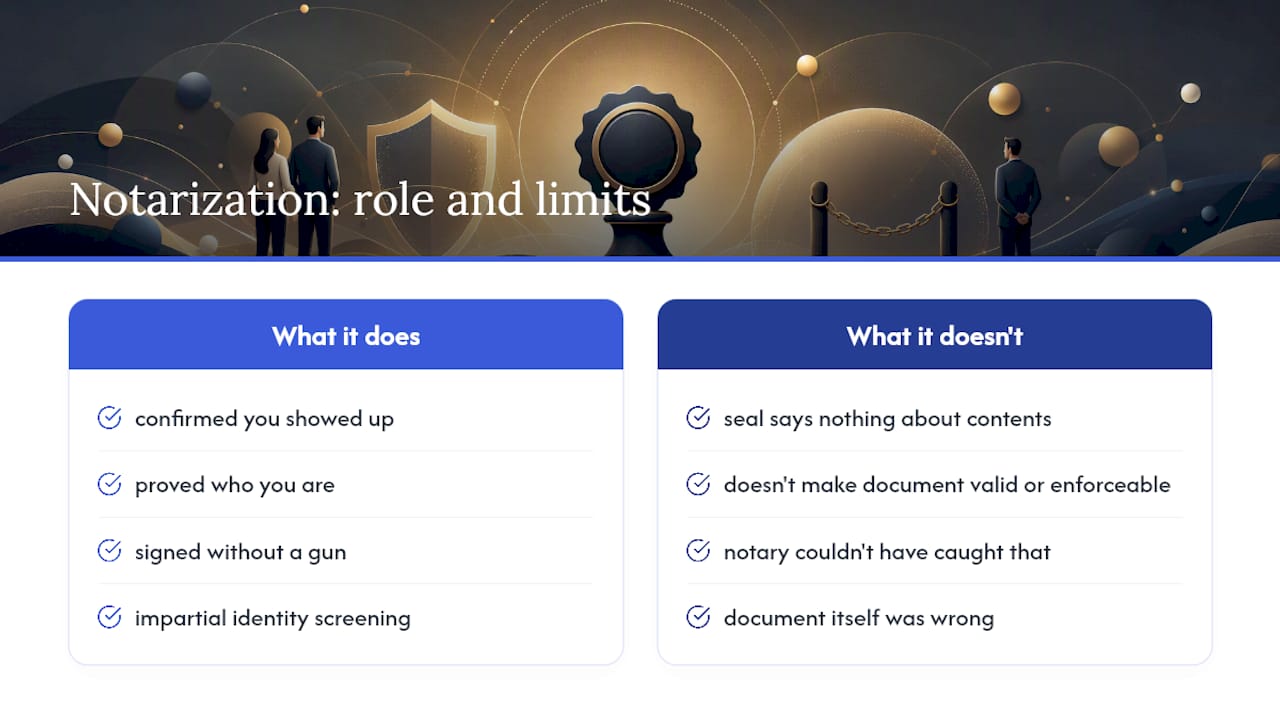
Most people walk into a notarization expecting it to do more than it does. They assume the seal means the document is valid, enforceable, or somehow blessed by the legal system. It isn’t. The notary confirmed you showed up, proved who you are, and signed without a gun to your head. That’s genuinely useful — the NNA describes notarization as a pillar of civil society precisely because impartial identity screening prevents coerced and forged signings at scale. But the seal says nothing about the document’s contents.
The practical consequence: people notarize a badly drafted power of attorney, hand it to a bank, and get rejected — not because the notarization failed, but because the document itself was wrong. The notary couldn’t have caught that, and wasn’t supposed to. If you’re unsure whether your document is correctly drafted, consult a lawyer before you book the notary appointment, not after.
Theonlinenotary: remote notarization for Ontario residents
If you need an affidavit, statutory declaration, solemn declaration, or invitation letter notarized and you’re in Ontario, Theonlinenotary removes the trip to a physical office entirely. The process runs over a secure live video session — you present your ID on camera, sign electronically, and receive a sealed document the same day. No waiting rooms, no scheduling around a bank’s hours.

In-person appointments are also available in Brampton for certified true copies and documents that require an original ink seal. Ontario clients dealing with immigration documents, wills, or powers of attorney can review available services and book directly — appointments are available online around the clock.
Authoritative sources to check for state-specific rules
- LII / Legal Information Institute — “notarize”: Plain-language legal definition and overview of notarial acts; good starting point for understanding the legal framework.
- North Dakota Secretary of State — How to Get Something Notarized: Practical state-level guidance on ID requirements, refusal grounds, and jurat rules (representative of most state SOS pages).
- Theonlinenotary — document types for Ontario: Ontario-specific guidance on which documents require notarization and what to bring.
Recommended
- Understanding Notarized Statement Meaning in Ontario - The Online Notary
- Document types for notarization in Ontario: what you need - The Online Notary
- Guide to Documents Requiring Notarization in Ontario - The Online Notary
- What makes a document notarized in Ontario? Complete guide - The Online Notary