Yes, You Can Get a Weekend Notary in Canada

You can get a document notarized on a weekend. The fastest valid route is remote online notarization (RON) if the organization receiving your document accepts it, or a same-day mobile notary if it doesn’t. Both operate outside the standard nine-to-five, Monday-to-Friday window that trips up most people who wait until Saturday morning to start looking.
Which route fits depends on what you’re signing and who’s asking for it:
- Urgent travel consent letter for a child flying with one parent this weekend: online notarization usually works fine since airlines and border agents typically just need a signed, notarized document in hand.
- Last-minute real estate paperwork with a closing deadline: mobile notary, especially if a lawyer or lender wants a physical wet-ink signature and stamp.
- Wills or powers of attorney: these often require witnesses physically present, so in-person or mobile is usually the safer call, and in some cases the only valid one.
Pro Tip: Call or email whoever is asking for the notarized document, whether that’s IRCC, a bank, a court clerk, or a landlord, and confirm they accept your planned notary method before you pay for anything. A $50 notarization is worthless if the recipient rejects the format.
Key Takeaways
Weekend notarization is available through online 24/7 platforms and same-day mobile notaries, but acceptance by the receiving organization always determines which method actually works.
| Point | Details |
|---|---|
| Confirm acceptance first | Call the recipient (IRCC, a bank, a court) before booking to confirm they accept online or mobile notarization. |
| Match the method to the document | Use online notarization for straightforward affidavits and consent letters; use mobile for wills, POAs, or witnessed documents. |
| Expect surcharges on weekends | Per-document and per-page fees are standard, and weekend or travel surcharges commonly apply on top. |
| Bring the right ID and format | Government photo ID and unsigned originals are required; digital copies work for online, printed originals for mobile. |
| Book with a verified provider | Theonlinenotary offers 24/7 online booking in Ontario with transparent pricing and in-person options in Brampton when needed. |
Table of Contents
- Weekend Notary Routes: Online, Mobile, and In-Person Options
- How Does Online Notarization Actually Work?
- What ID and Documents Do You Need for Weekend Notarization?
- How Much Does Weekend Notarization Cost?
- How to Choose a Trustworthy Weekend Notary
- Booking a Weekend Notary Appointment: A Step-by-Step Playbook
- Why Online Notarization Is Usually the Better Weekend Bet
- Get Notarized This Weekend With The Online Notary
- Official Resources to Verify Before You Book
- Sources
Weekend Notary Routes: Online, Mobile, and In-Person Options
Three practical paths exist for getting something notarized outside business hours, and each trades off speed, cost, and paperwork weight differently.
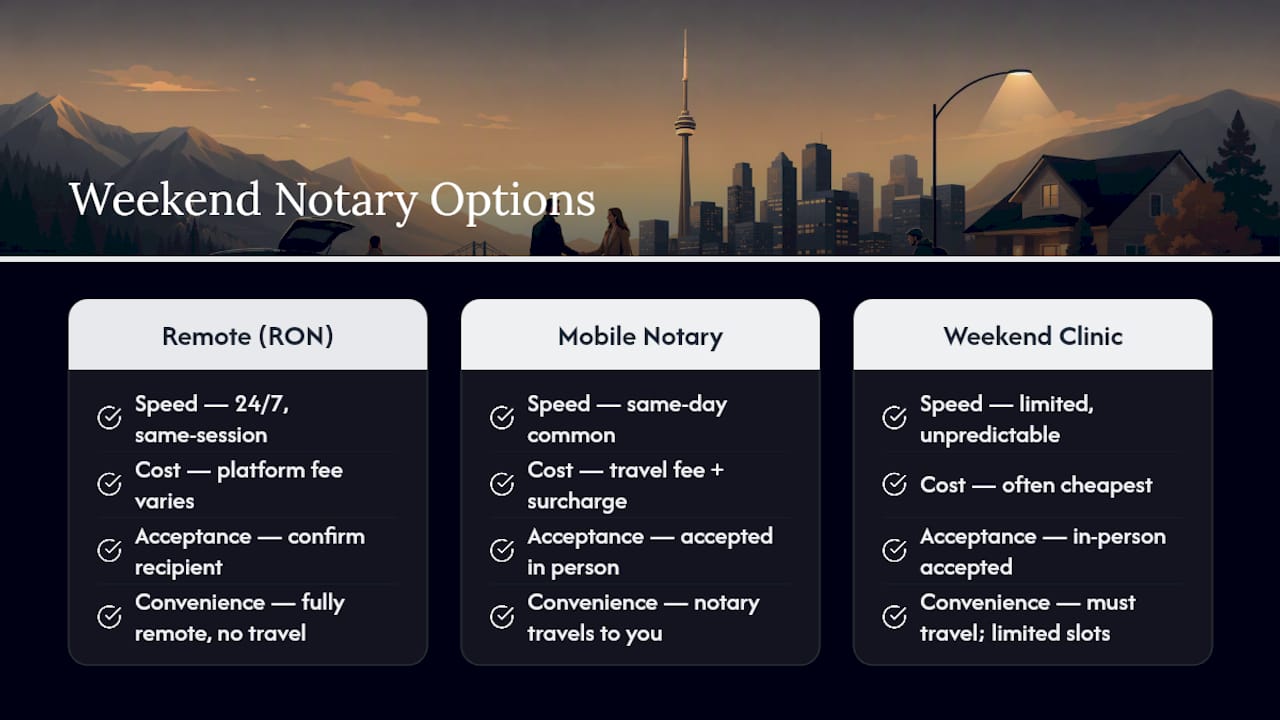
1. Remote online notarization (RON). You connect with a commissioned notary through a video call, show your ID, sign digitally, and receive a notarized document, often within the same session. Speed is the obvious advantage: many platforms run 24/7, including weekends and holidays. The tradeoff is acceptance. Not every institution recognizes a remote e-signature and digital certificate the same way it recognizes a wet-ink stamp, so this only works if the recipient has confirmed they’ll take it.
2. Mobile notary. The notary travels to your home, hospital room, or office. This is the standard fallback when a document needs in-person witnessing, like a will or a POA, or when the signer can’t travel. You’ll typically pay a travel fee on top of the notarization charge, and weekend bookings often carry an after-hours surcharge. Same-day service is common if you call early enough in the day.

3. In-person weekend clinic or walk-in hours. A small number of law offices, community legal clinics, or independent notaries keep limited Saturday hours. This tends to be the cheapest option when it exists, but availability is thin and unpredictable. Most storefront notary services, banks, and libraries close entirely on weekends.
For speed and certificate verification, RON usually wins. For documents needing a witness in the room, or for people who don’t do well with video calls, mobile is the more dependable choice. A weekend clinic is worth checking only if you have flexibility and don’t need same-day certainty.
How Does Online Notarization Actually Work?
The mechanics behind remote notarization are simpler than most people expect, but the legal caveats matter more than the tech does.
- Book an appointment. Most RON providers let you schedule instantly or within a couple of hours, even on Sundays.
- Upload or prepare your document. You’ll typically send an unsigned draft ahead of the call so the notary can review it.
- Verify your identity on video. Expect to show a government photo ID to the camera; some providers cross-check it against a database.
- Sign in front of the notary. You sign electronically (or on paper, holding it up to the camera, depending on the platform) while the notary watches live.
- Receive your notarized document and certificate. This usually arrives digitally within minutes to a few hours, complete with the notary’s commission number and a tamper-evident seal.
That process is legally valid across most of Canada for domestic use, but two catches deserve attention. First, IRCC’s document guidance notes that certain immigration submissions require original or specifically notarized paperwork, and their instructions don’t automatically assume a remote signature will qualify. Second, if your document is headed outside Canada, notarization alone often isn’t the finish line.
Global Affairs Canada is explicit that a notarized document intended for use abroad frequently needs an additional authentication and legalization step before a foreign government or institution will honor it. Skipping that step is one of the most common reasons a rushed weekend notarization gets rejected later.
Before you rely on RON for a hard weekend deadline, check where the document is going. If it’s crossing a border for use in another country, look at where authentication services are available and build that extra time into your plan.
What ID and Documents Do You Need for Weekend Notarization?
Show up prepared and you’ll get through a weekend appointment in minutes. Show up without the right ID and you’ll be rebooking for Monday.
- Government-issued photo ID. A driver’s license or passport covers most cases; some notaries ask for a second piece of ID if your document is high-stakes (real estate, POA, sworn affidavits).
- Unsigned original document. Never sign it before the appointment. The notary has to witness the signature happen, so a pre-signed page usually means starting over.
- All pages, in order, with nothing missing. Multi-page documents often carry a per-page fee, and a missing page can delay the whole notarization.
- Special forms filled out correctly. A child travel consent letter, for example, has specific wording expected by carriers and border officials; the official government template and its accompanying PDF version are the safest starting points.
- Proof of authority, if you’re signing as a power of attorney or legal representative rather than for yourself.
Pro Tip: If you’re going the online route, have clear digital scans or photos of your ID and document ready before the call starts. For mobile or in-person appointments, bring printed originals. Mixing up the two formats is the single most common reason weekend appointments run long.
How Much Does Weekend Notarization Cost?
Pricing structures follow a fairly predictable shape, even though exact numbers vary by provider and province.
Most notaries charge per document, then add a per-page fee once you go past a certain page count. On top of that base cost, weekend and after-hours appointments frequently carry a surcharge, and mobile notaries add a travel fee that depends on distance. A same-day emergency request, especially outside standard hours, tends to sit at the higher end of whatever range a provider quotes.
Free or low-cost notarization does exist in limited pockets: some public legal clinics, community centres, and volunteer notary programs offer no-cost or reduced-fee service, usually tied to income eligibility or specific document types like affidavits for legal aid applications. The catch is availability. These programs rarely run on weekends, and when they do, hours are limited and the range of documents they’ll touch is narrower than a paid provider’s.
Banks, libraries, and neighborhood storefront notaries often look like the cheap, convenient option on paper. In practice, most simply don’t operate on weekends, and calling ahead to confirm hours will save you a wasted trip more often than not.
How to Choose a Trustworthy Weekend Notary
A notary’s commission is a legal credential, not a marketing claim, and it’s worth verifying before you hand over a sensitive document and a payment.
Ask these questions before booking:
- Are you currently commissioned in my province?
- Do you offer same-day weekend appointments, and what’s your actual availability today or tomorrow?
- Are there travel fees, after-hours surcharges, or per-page charges I should know about upfront?
- For online notarization, what does the certificate look like, and will it hold up with the specific organization I’m sending it to?
Watch for red flags: a notary who can’t produce a verifiable commission number, no written receipt for what you paid, pressure to sign before your ID gets checked, or vague reassurance that “government agencies always accept this” without specifics. That last one is common and almost always wrong, since acceptance depends entirely on which agency and which document.
Trust signals run the other direction. A provincial law society listing, like those maintained through the Ontario Bar Association or the Canadian Bar Association, clear published service hours, upfront pricing, and a real commission number you can look up all suggest a legitimate operation. If you want a deeper look at who’s actually authorized to notarize documents in Ontario, this breakdown of notarization authority covers the distinctions between notaries, commissioners, and lawyers.
Booking a Weekend Notary Appointment: A Step-by-Step Playbook
- Confirm the recipient’s requirements first. Five minutes on the phone with IRCC, your bank, or the court clerk beats an hour spent second-guessing after the fact.
- Pick RON or mobile based on your document type. If witnesses aren’t required and the recipient accepts digital certificates, RON is almost always faster.
- Book the appointment. Online platforms often confirm a slot within minutes; mobile notaries typically need a same-day call placed earlier rather than later for weekend availability.
- Gather ID and unsigned documents. Budget 10 to 15 minutes for this if you haven’t done it already.
- Complete the notarization. A straightforward RON session usually runs 10 to 20 minutes; mobile appointments depend on travel time plus a similar signing window.
- Verify everything before you leave the call or the room. Check the notary’s stamp and commission number, confirm your receipt, and for RON, make sure you have the certificate URL or file saved somewhere you can find it Monday.
Pro Tip: If your deadline is genuinely today, say so immediately when you book. Providers who advertise weekend service usually have a process for urgent same-day requests, but they can’t prioritize you if you bury the deadline in the appointment notes.
Why Online Notarization Is Usually the Better Weekend Bet
Remote notarization solves the actual problem people face on a Saturday: everything else is closed. When a recipient accepts a digital certificate, RON gets a document signed, witnessed, and sealed faster than driving anywhere, and it does it with a verifiable commission number attached, not a handshake and a hope.
That said, I wouldn’t push someone toward RON for a will signing or a POA where a witness needs to physically watch the pen hit the paper. Some legal instruments carry formalities that a screen doesn’t satisfy cleanly, and provincial rules on remote witnessing for these documents still vary. In those cases, a mobile notary who shows up at your kitchen table is the right call, even if it costs more and takes longer to arrange.
The credibility question matters too. A provider that lists its 24/7 service hours plainly, shows its commission credentials, and explains its step-by-step online process up front is a different animal than a website that just promises “fast, easy notarization” with no specifics. Availability claims are cheap. Verifiable process and credentials aren’t.
Get Notarized This Weekend With The Online Notary
If Saturday morning has you scrambling for a notary and every storefront in town is dark, Theonlinenotary is built for exactly that gap. It runs a 24/7 online notarization service out of Ontario, so weekend and after-hours appointments aren’t a special exception. They’re the normal way it operates.

Theonlinenotary handles affidavits, statutory declarations, invitation letters, and remote witnessing for wills and powers of attorney where remote signing applies, with pricing set per document and per additional page so you know the cost before you commit. Appointments run through a video call with ID verification, and you walk away with a signed, sealed certificate the same day. For document types that genuinely need a physical presence, Theonlinenotary also offers in-person notarization and certified true copies in Brampton.
If you’re not sure whether your document qualifies for the remote process, the services page breaks down what’s covered and what pricing looks like. Book a weekend slot there and get your document handled today instead of waiting for Monday.
Official Resources to Verify Before You Book
- Authentication and legalization of documents — Global Affairs Canada for documents headed outside Canada.
- IRCC document guidance for immigration submissions requiring original or notarized paperwork.
- Where to get documents authenticated if your notarized document needs an added certification step.
- Travel consent for children for the official template many border officials expect notarized.
- Ontario Bar Association and Canadian Bar Association for checking a legal professional’s standing.
- If your document supports an immigration application, visitor visa guidance and family sponsorship resources from immigration specialists can clarify what supporting documents need notarization.
Always confirm acceptance rules directly with the receiving organization before relying on any weekend notarization method for a hard deadline.
This article is general information, not a substitute for advice from a qualified lawyer. Consult a qualified legal professional about your own circumstances before acting on anything here.
Sources
- Authentication and legalization of documents — Global Affairs Canada
- IRCC: Document guidance and requirements
- Where to get documents authenticated — Global Affairs Canada
- Travel consent for children — Government of Canada
- Ontario Bar Association (OBA)