Validity of Notarized Documents: Ontario 2026 Guide

TL;DR:
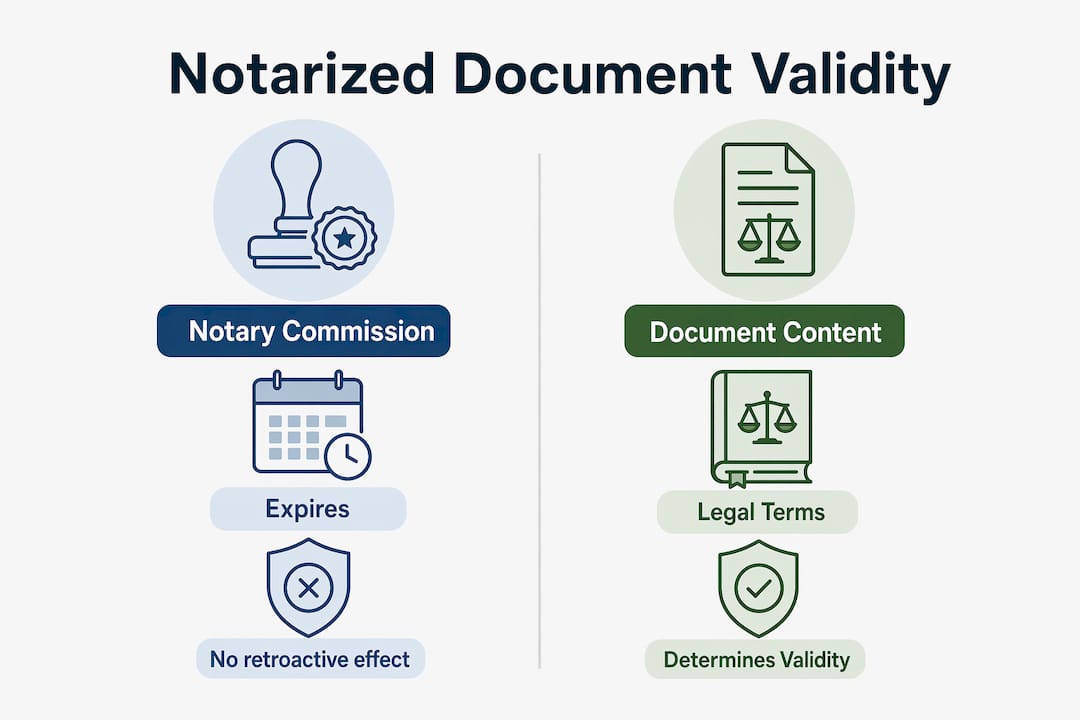
- The validity of notarized documents depends on the legality of the content and proper notarization, not expiration dates. Notarization confirms identity and voluntary signing but does not certify the document’s truthfulness or enforceability, which is determined by law. A notarized document remains valid as long as the content is lawful, regardless of when it was notarized or the notary’s commission status.
The validity of notarized documents is defined by the legal substance of the document and the correctness of the notarization process, not by any expiration date stamped on a seal. Notarized document legality in Ontario depends on whether the notary was properly commissioned at the time of signing, whether the signer’s identity was verified, and whether the document’s content meets the relevant legal standard. The notary public’s role is to confirm identity and voluntary intent, not to certify that every word in the document is true. Understanding this distinction protects you from costly legal surprises.
What does notarization actually certify?
Notarization confirms two things: the signer’s identity and that the signature was given willingly. It does not certify that the document’s contents are accurate, legal, or enforceable. This is the most misunderstood aspect of notarized document legality.
A notarized contract between two parties is still void if its terms violate the law. Illegal or unconscionable contracts remain unenforceable despite notarization. The notary seal adds evidentiary weight to the signature, not legal authority to the content.
Real estate deeds, wills, and powers of attorney are common documents where notarization directly affects enforceability. A notarized will with a self-proving affidavit, for example, carries greater evidentiary weight in probate court and avoids costly challenges. For these document types, proper notarization is not optional. It is the difference between a document courts accept and one they reject.
- Notarization confirms the signer appeared before the notary in person or via an approved remote platform.
- Notarization confirms the signer presented valid government-issued identification.
- Notarization confirms the signing was voluntary, not under duress.
- Notarization does NOT confirm the document’s facts are true.
- Notarization does NOT make an otherwise illegal agreement enforceable.
Pro Tip: Before you notarize any document, verify that the underlying content is legally sound. A notary seal on a flawed contract does not fix the flaw.
How long are notarized documents valid in Ontario?
Notarized documents do not have a standard expiration date. Validity rests on the document’s content, the applicable statute of limitations, and the parties’ legal capacity at the time of signing. This means a deed notarized 20 years ago can still be fully valid today if the underlying transaction was lawful.

The confusion often comes from conflating the notary’s commission with the document’s validity. A notary commission does expire, typically every few years depending on the jurisdiction. But a commission expiring does not retroactively invalidate documents notarized while that commission was active. The notarization remains legally sound.
What can make an older document appear “outdated” is not the notarization itself but the document’s terms. A power of attorney may contain language that limits its own duration. A lease agreement becomes irrelevant once the term ends. These are content issues, not notarization issues.
| Scenario | Does the notarization expire? | What actually determines validity? |
|---|---|---|
| Notary’s commission expires | No | Commission was valid at time of signing |
| Document signed 10+ years ago | No | Statute of limitations and document terms |
| Signer’s circumstances change | No | Document content and applicable law |
| Notary seal is missing or incorrect | Possibly | Depends on jurisdiction and severity of defect |
Pro Tip: If a receiving institution questions an older notarized document, ask them to specify the legal basis for their concern. Most objections are policy preferences, not legal requirements.
When can the validity of a notarized document be challenged?
Notarized documents carry a rebuttable presumption of authenticity. Courts treat them as self-authenticating, meaning they are admitted into evidence without further proof unless a challenger provides clear and convincing evidence of a defect. That is a high legal bar.
The most common grounds for challenge fall into four categories:
- Fraud or forgery. The signer’s identity was misrepresented, or the document was altered after notarization.
- Signer absence. The notary did not actually witness the signing or verify identity in person or through an approved remote process.
- Conflict of interest. The notary had a direct financial or personal stake in the document’s outcome. Notarizing for family members or parties where the notary benefits financially creates grounds for challenge.
- Improper notarization. The notarial certificate was incomplete, the wrong notarial act was used, or the notary acted outside their commissioned authority.
A notarization’s legal strength comes from the integrity of the process, not the presence of a seal. Courts have consistently found that a seal without a proper process is weaker than a process without a perfect seal. The burden to overturn a properly executed notarization is substantial, but a flawed process can collapse that presumption quickly.
Minor technical defects, such as a missing seal or an incorrect date, do not always invalidate a notarization. However, relying on curable defects poses real risk. Correcting them often requires additional legal steps, and the window to do so may close depending on the context.
How are notarized documents recognized across jurisdictions?
Notarizations executed according to the commissioning jurisdiction’s law are generally recognized in other jurisdictions. In the United States, the Full Faith and Credit Clause provides the constitutional foundation for this recognition. In Canada, similar principles of interprovincial comity apply, though Ontario businesses dealing with cross-border documents should verify specific requirements.
The practical reality is more nuanced. Some receiving institutions, particularly foreign governments or financial institutions, require a Certificate of Authority to confirm the notary’s commission was valid. These certificates typically cost between $10 and $25 and are issued by the relevant government office. That small cost can prevent significant delays.
For Ontario individuals and businesses, cross-jurisdictional recognition matters in several common situations:
- Real estate transactions involving parties in different provinces or countries.
- Immigration documents, including invitation letters for visa applications, which often require notarization recognized by foreign consulates.
- Corporate agreements where counterparties are in different legal jurisdictions.
- Affidavits filed in courts outside Ontario.
Out-of-jurisdiction notarizations carry a specific risk. If the notary did not follow the rules of their commissioning jurisdiction, the receiving jurisdiction may reject the document entirely. This is why working with a notary who understands both Ontario law and cross-border requirements matters.
Pro Tip: When sending a notarized document internationally, contact the receiving institution before notarization to confirm exactly what certification they require. Assumptions here are expensive.
Best practices for keeping your notarized documents valid
The single most effective way to protect notarized document validity is to use an impartial, properly commissioned notary. Choosing the wrong notary or one with a conflict of interest creates grounds for legal challenge that can surface years after the document was signed.
Beyond notary selection, the following practices reduce legal risk significantly:
- Verify the notarial certificate is complete. Every notarial certificate must include the notary’s name, commission details, the date, and the correct notarial act. An incomplete certificate is a defect waiting to be exploited.
- Match the notarial act to the document type. An acknowledgment is not the same as a jurat. Using the wrong act for the document type is a substantive error, not a technicality.
- Correct errors immediately. If you spot an error after notarization, address it before the document is filed or submitted. Correcting errors after submission requires additional legal steps and may not always be possible.
- Keep certified copies. Original notarized documents can be lost or damaged. Certified copies provide a backup that courts and institutions generally accept.
- Select documents appropriate for notarization. Not every document benefits from notarization. Understanding which document types require notarization in Ontario prevents unnecessary costs and ensures you are using the right legal tool.
Notarization is a fraud prevention mechanism. Notaries create impartial paper trails through journals and certificates that courts rely on for credibility years later. Treating the process seriously from the start protects that paper trail.
Key Takeaways
The validity of notarized documents in Ontario depends on the document’s legal content, proper notarization execution, and the notary’s commission status at signing, not on any expiration date.
| Point | Details |
|---|---|
| No standard expiration | Notarized documents do not expire; validity is governed by document content and applicable law. |
| Notarization certifies identity only | A notary confirms who signed and that signing was voluntary, not that the content is true or legal. |
| Rebuttable presumption of authenticity | Courts treat notarized documents as self-authenticating; challengers must provide clear and convincing evidence. |
| Commission expiry does not void past acts | A notary’s expired commission does not retroactively invalidate documents notarized while it was active. |
| Conflict of interest creates risk | Notarizing through a partial notary weakens the document’s legal standing and invites challenge. |
Why I think most people misunderstand what a notary seal actually does
Why I think most people misunderstand what a notary seal actually does
Most people treat a notary seal as a stamp of legal approval. It is not. After years of working with notarized documents in Ontario, the pattern I see most often is this: someone spends significant time and money notarizing a document, then discovers the underlying agreement was flawed from the start. The seal did nothing to fix that.
The other misconception I encounter regularly is the belief that an older notarized document is automatically suspect. Receiving institutions sometimes reject documents that are more than six months old, citing “policy.” That is a policy preference, not a legal standard. Knowing the difference gives you real leverage when you push back.
The most underappreciated function of notarization is fraud deterrence. The notary’s journal and certificate create a record that courts trust years after the fact. That record is what makes a notarized document worth the effort. Protect it by choosing a notary who takes the process seriously, not one who treats it as a rubber stamp.
— Ken
Theonlinenotary: notarization that holds up when it matters
Ontario residents and businesses need notarization that is legally sound from the first step. Theonlinenotary provides expert online notary services for affidavits, statutory declarations, invitation letters, solemn declarations, and more, available 24/7 without the delays of in-person appointments.

Every notarization through Theonlinenotary is handled by properly commissioned notary professionals who follow Ontario law and maintain the impartiality that protects your document’s legal standing. Whether you are an individual managing a personal legal matter or a business handling cross-border agreements, Theonlinenotary delivers certified, court-ready notarization you can rely on.
FAQ
Do notarized documents expire in Ontario?
Notarized documents do not have a standard expiration date. Validity is determined by the document’s content, the applicable statute of limitations, and the parties’ legal capacity at the time of signing.
Does a notary’s expired commission invalidate past notarizations?
No. A notary’s commission expiring does not retroactively invalidate documents notarized while the commission was active. The notarization remains legally sound.
Can a notarized document be rejected by a court?
Yes, but only if a challenger provides clear and convincing evidence of a defect such as fraud, signer absence, or improper notarization. Courts treat properly notarized documents as self-authenticating.
Are Ontario notarizations recognized in other provinces or countries?
Ontario notarizations are generally recognized in other Canadian provinces and many foreign jurisdictions if performed correctly. Some receiving institutions require a Certificate of Authority to confirm the notary’s commission was valid at the time of signing.
What makes a notarized document invalid?
A notarized document can be invalidated by fraud, the signer’s absence during notarization, a conflict of interest involving the notary, or a substantive defect in the notarial certificate. Minor technical errors may be curable but require additional legal steps.