Validity of Electronic Signatures: U.S. Law Explained

TL;DR:
- Electronic signatures are legally valid in the United States under federal and state laws, but enforceability depends on proper consent, intent, and record integrity. Courts examine audit trails and verification records more than the signature itself, especially for high-stakes documents like wills or notarized agreements. Using platforms that provide comprehensive evidence and verifying jurisdictional requirements are essential for ensuring legal enforceability.
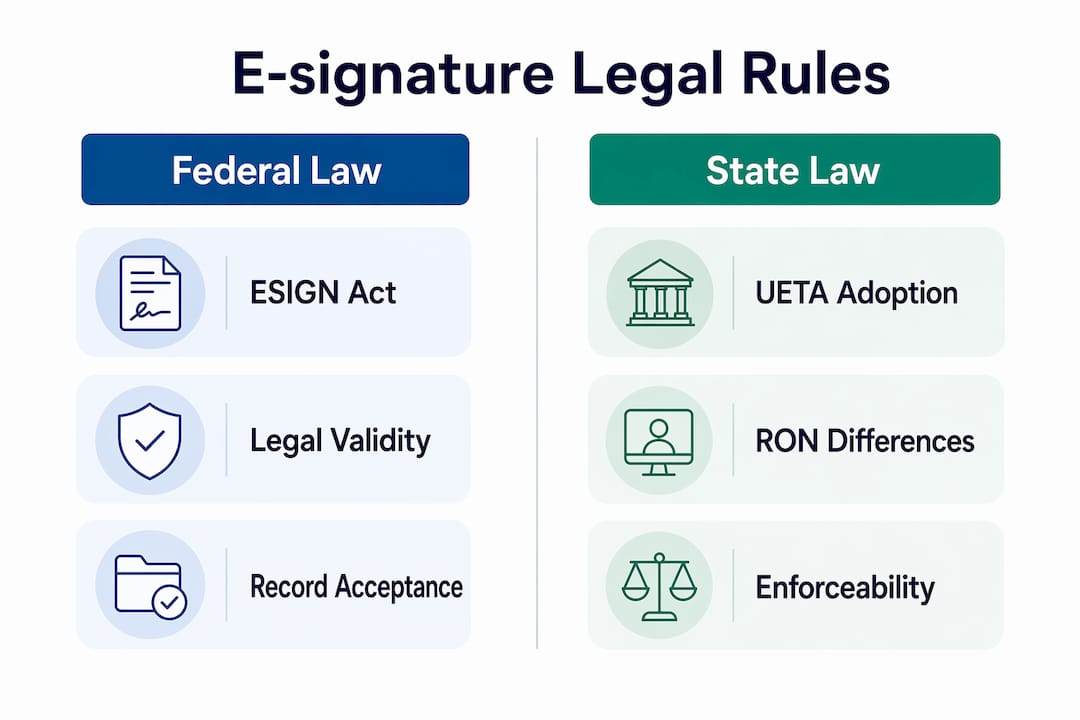
Electronic signatures are legally valid in the United States. Under the federal ESIGN Act (15 U.S.C. §7001) and the Uniform Electronic Transactions Act (UETA), a signature cannot be denied legal effect simply because it exists in electronic form. That single rule covers the vast majority of commercial and personal transactions across all 50 states and Washington, D.C.
Three things determine whether an e-signature will hold up:
- Consent: the signer agreed to transact electronically
- Intent: the act was performed with the intent to sign
- Record integrity: the signed document can be reproduced accurately and has not been altered
For Ontario individuals and businesses dealing with U.S.-governed contracts, affidavits, or notarized documents, the practical takeaway is this: use a platform that captures consent, generates a tamper-evident audit trail, and verifies signer identity for anything high-stakes. Theonlinenotary’s remote online notary and commissioner services are built around exactly those requirements.
Note: This article is general information, not legal advice. Confirm the current rules with a qualified professional or the relevant jurisdiction’s primary source for your specific situation.
Table of Contents
- Are electronic signatures legally enforceable under U.S. law?
- What actually qualifies as an electronic signature?
- Which documents are often excluded from e-signature rules?
- How do courts weigh electronic signature evidence?
- Best practices to maximize enforceability of e-signatures
- Where state laws and RON rules differ
- Your pre-signing checklist and sample consent language
- Key Takeaways
- Why the “just use any e-signature” approach is riskier than it looks
- Useful sources
Are electronic signatures legally enforceable under U.S. law?
The ESIGN Act is the federal anchor. Passed in 2000, it states plainly that a contract or record “may not be denied legal effect, validity, or enforceability solely because it is in electronic form.” That language comes directly from 15 U.S.C. §7001 and applies to any transaction in or affecting interstate or foreign commerce.
UETA operates alongside ESIGN at the state level. Drafted by the Uniform Law Commission, it has been widely adopted across the United States. New York is the notable holdout, relying instead on its own Electronic Signatures and Records Act (ESRA). Illinois and Washington have also enacted their own statutes with some variations. The practical effect: all 50 states recognize e-signatures, but the precise rules differ depending on where the transaction occurs or where the receiving party is located.
A few points worth knowing about how the two laws interact:
- ESIGN is federal and preempts state law only when a state has not enacted UETA or an equivalent
- States that adopted UETA can modify or supplement ESIGN’s consumer-consent provisions
- Federal agencies may still require paper for specific regulatory filings
Pro Tip: Before sending a document for e-signing, confirm whether the receiving party or jurisdiction operates under UETA, ESRA, or a state-specific variant. A quick check of the recipient’s state rules takes five minutes and can prevent a rejected filing.
What actually qualifies as an electronic signature?
ESIGN defines an electronic signature as “an electronic sound, symbol, or process, attached to or logically associated with a contract or other record and executed or adopted by a person with the intent to sign the record.” That definition is deliberately broad.
Common forms include:
- A typed name at the bottom of an email or PDF
- A click-to-accept button (“I agree”)
- A scanned image of a handwritten signature
- A structured digital signature using a cryptographic certificate
The last category, often called a digital signature, is a subset of the broader electronic signature category. It uses public-key infrastructure (PKI) to bind a signer’s identity to the document mathematically. A typed name in an email is technically an e-signature under ESIGN, but it carries far less evidentiary weight than a timestamped, certificate-backed signature generated through a platform with multi-factor authentication (MFA).
For business use cases and higher-risk documents, the gap between a simple typed name and a cryptographic signature matters enormously in court.

Pro Tip: For any document that could be disputed, choose a platform that produces a downloadable audit trail with timestamps, IP addresses, and authentication records. That package is what courts actually examine.
Which documents are often excluded from e-signature rules?
General e-signature legality does not mean universal acceptance. Several document categories are commonly carved out of UETA and ESIGN coverage, and state law controls most of these exceptions.
Documents that frequently require wet signatures, notarization, or specific formalities:
- Wills, codicils, and testamentary trusts — UETA explicitly excludes unilateral testamentary documents; most states follow suit
- Certain family-law documents — adoption papers, divorce decrees, and custody orders often require court-specific procedures
- Real estate deeds and mortgage instruments — some states require notarized wet signatures for recording
- Court filings — many courts have their own e-filing rules that may or may not accept standard e-signatures
- Notices of cancellation or termination of utility services — specifically excluded under federal ESIGN
For wills in particular, the stakes are high. A will executed without proper formalities can be invalidated entirely, leaving an estate without clear direction. State-specific witness and notarization requirements still govern even when an e-signature platform is used for the surrounding paperwork.
Ontario clients sending documents to U.S. recipients should verify the receiving party’s jurisdictional acceptance before relying on an electronic signature for estate or family law matters.
How do courts weigh electronic signature evidence?
Admissibility is rarely the problem. Courts generally admit e-signatures as evidence. The real question is weight: how persuasive is the evidence that a specific person signed a specific document at a specific time?
Judges and arbitrators look at four core factors:
- Intent to sign — did the signer’s conduct clearly indicate agreement?
- Consent to transact electronically — was there documented agreement to use electronic records?
- Association — is the signature logically linked to the document it purports to sign?
- Record integrity — has the document been altered since signing?
The evidence that supports those factors includes audit trails, timestamps, IP address logs, MFA records, and email exchanges. An email trail can support authenticity but is not a substitute for formal identity verification when the transaction risk is high. A platform-generated audit log that captures every signing event, with timestamps and device data, is far more persuasive than a forwarded email chain.
Pro Tip: Export and store the signed document and its signing log together in tamper-evident storage immediately after execution. Waiting until a dispute arises to locate the audit trail is a losing strategy.
Best practices to maximize enforceability of e-signatures
Enforceability is not automatic. The legal framework creates the possibility; your workflow determines whether you can actually prove it.
- Capture explicit consent before the signing event. A checkbox with clear language (“I agree to conduct this transaction electronically”) is stronger than implied consent from conduct alone.
- Require signer authentication scaled to document risk. Low-risk agreements: email link plus click-to-sign. Medium-risk: email plus password plus audit trail. High-risk: government ID verification, knowledge-based authentication, or remote online notarization.
- Preserve a complete audit trail that includes timestamps, IP addresses, device fingerprints, and authentication records.
- Provide a downloadable executed copy to all parties immediately after signing. ESIGN requires that records be reproducible and available to all parties entitled to retain them.
- Use tamper-evident storage. A PDF with a digital certificate that breaks if the file is altered is the standard minimum for anything consequential.
- Inform signers of their rights. Under ESIGN’s consumer-consent provisions, signers must be told they have the right to a paper copy and the right to withdraw consent.
For document authentication in Ontario that crosses into U.S. jurisdiction, mapping authentication level to document risk is the single most effective way to reduce enforceability exposure.
Where state laws and RON rules differ
UETA is a model law, not a uniform one. States adopted it with modifications, and a handful did not adopt it at all. That variation creates real risk for Ontario businesses sending documents to U.S. counterparties without checking the destination state’s rules first.
Key state-level considerations:
- New York uses ESRA, which has its own consent and record-retention requirements
- Remote Online Notarization (RON) frameworks exist in most states but vary significantly in identity-proofing standards, audiovisual recording requirements, and which document types they cover
- Some states require the notary and signer to be in the same state for RON; others permit cross-state sessions under specific conditions
- RON frameworks commonly require identity verification and audiovisual recording as baseline standards
For Ontario clients, the relevant question is whether the U.S. recipient’s state accepts RON-notarized documents and whether the notary performing the RON is commissioned in the appropriate jurisdiction. Theonlinenotary’s electronic notarization services address Ontario-governed documents, but U.S.-governed transactions require confirming the destination state’s acceptance rules before proceeding.
Your pre-signing checklist and sample consent language
Pre-signing checklist
- Confirm the recipient’s jurisdiction accepts electronic signatures for this document type
- Verify whether notarization, witnessing, or a wet signature is required
- Select an authentication method appropriate to the document’s risk level
- Confirm your platform generates a tamper-evident audit trail
- Prepare a downloadable executed copy for all parties
- Retain the signed file and signing log together in secure storage
Sample signer consent language
Place this immediately above the signature field or as a required checkbox:
Sample signature block
Signed electronically by: [Full Name] Date: [MM/DD/YYYY] IP Address: [captured automatically by platform] Authentication method: [e.g., email verification + MFA]
Capture the consent checkbox with a timestamp. Store the completed signing log alongside the executed document. For notarized documents, the notary’s electronic seal and the audiovisual session record serve as the primary evidence of authenticity.
Key Takeaways
Electronic signatures are legally valid in the U.S. under ESIGN and state UETA adoptions, but enforceability depends on consent capture, audit trails, and identity verification scaled to document risk.
| Point | Details |
|---|---|
| Federal legal basis | The ESIGN Act (15 U.S.C. §7001) prevents denial of legal effect to e-signatures in interstate commerce. |
| State law variation | All 50 states recognize e-signatures; New York uses ESRA instead of UETA, so check destination-state rules. |
| Key exceptions | Wills, codicils, and testamentary trusts are commonly excluded and typically require wet signatures or state formalities. |
| Court evidence factors | Audit trails, timestamps, IP logs, and MFA records are what courts actually examine to assess enforceability. |
| RON for notarized docs | Remote online notarization requires identity-proofing and audiovisual recording; rules vary by state. |
Why the “just use any e-signature” approach is riskier than it looks
The legal framework for electronic signatures is genuinely permissive. ESIGN and UETA together cover an enormous range of transactions, and courts have consistently upheld e-signed agreements when the basics are in place. But the gap between “technically valid” and “enforceable when challenged” is where most problems live.
A typed name in an email satisfies the ESIGN definition. It will not satisfy a judge who wants to know exactly who typed it, when, and whether the document was altered afterward. The authentication level has to match the stakes. A low-value service agreement is fine with click-to-sign. A statutory declaration, a power of attorney, or any document destined for a U.S. court or government agency needs a stronger chain of evidence.
For Ontario clients working with U.S.-governed documents, the smarter move is to build the audit trail and consent capture into the workflow from the start, rather than reconstructing it after a dispute. Theonlinenotary’s online notary services are structured around exactly that approach: identity verification, documented consent, and a complete signing record for every transaction.
Useful sources
The following authoritative references support the legal claims in this article.
| Source | What it covers |
|---|---|
| 15 U.S.C. §7001 (GovInfo) | Full statutory text of the ESIGN Act general rule of validity |
| 15 U.S.C. §7001 (Cornell LII) | Annotated version of ESIGN with cross-references |
| Adobe: U.S. E-Signature Laws | State-by-state regulatory overview including RON frameworks |
| Purdue Global Law School | Practical summary of ESIGN/UETA requirements, exceptions, and best practices |
| Oldham Law: Will validity pitfalls | Practical guidance on testamentary formalities and common execution errors |
Before relying on an electronic signature for a notarization-heavy or estate document, verify the receiving party’s jurisdictional rules. The sources above are the right starting point; a qualified attorney in the relevant state is the right finishing point.