Understanding Drafting Legal Documents in Ontario

Legal documents shape everything from your inheritance to your next business partnership and they are the bedrock of trust in Ontario. You might expect these papers to be nothing more than dry formalities. In reality, an error or missed detail can mean the difference between peace of mind and a costly legal dispute. The most powerful legal documents do more than fill a file cabinet—they actively protect your rights and set clear boundaries that can outlast any handshake.
Table of Contents
- What Are Legal Documents And Their Purpose?
- Importance Of Drafting Legal Documents In Ontario
- Key Elements And Structure Of Legal Documents
- Common Types Of Legal Documents And Their Uses
- Best Practices For Effective Legal Document Drafting
Quick Summary
| Takeaway | Explanation |
|---|---|
| Understand legal document types | Familiarize yourself with categories like contracts and wills for better handling of legal matters. |
| Clarity is crucial in drafting | Use precise language and clear definitions to avoid misunderstandings and misinterpretations. |
| Legal documents protect rights | Proper documentation establishes enforceable rights, responsibilities, and expectations among parties involved. |
| Anticipate potential disputes | Draft legal documents that include contingency plans and dispute resolution mechanisms to mitigate risks. |
| Authentication is often essential | Ensure documents are properly certified for legal validity, especially when used in different jurisdictions. |
What are Legal Documents and Their Purpose?
Legal documents represent formal written instruments that establish, record, or communicate legal rights, obligations, agreements, or statements with significant legal implications. These critical instruments serve as foundational evidence in various legal contexts, providing clarity, protection, and a comprehensive record of interactions between individuals, businesses, and organizations.
Types of Legal Documents
Legal documents come in numerous forms, each serving a specific purpose within legal frameworks.
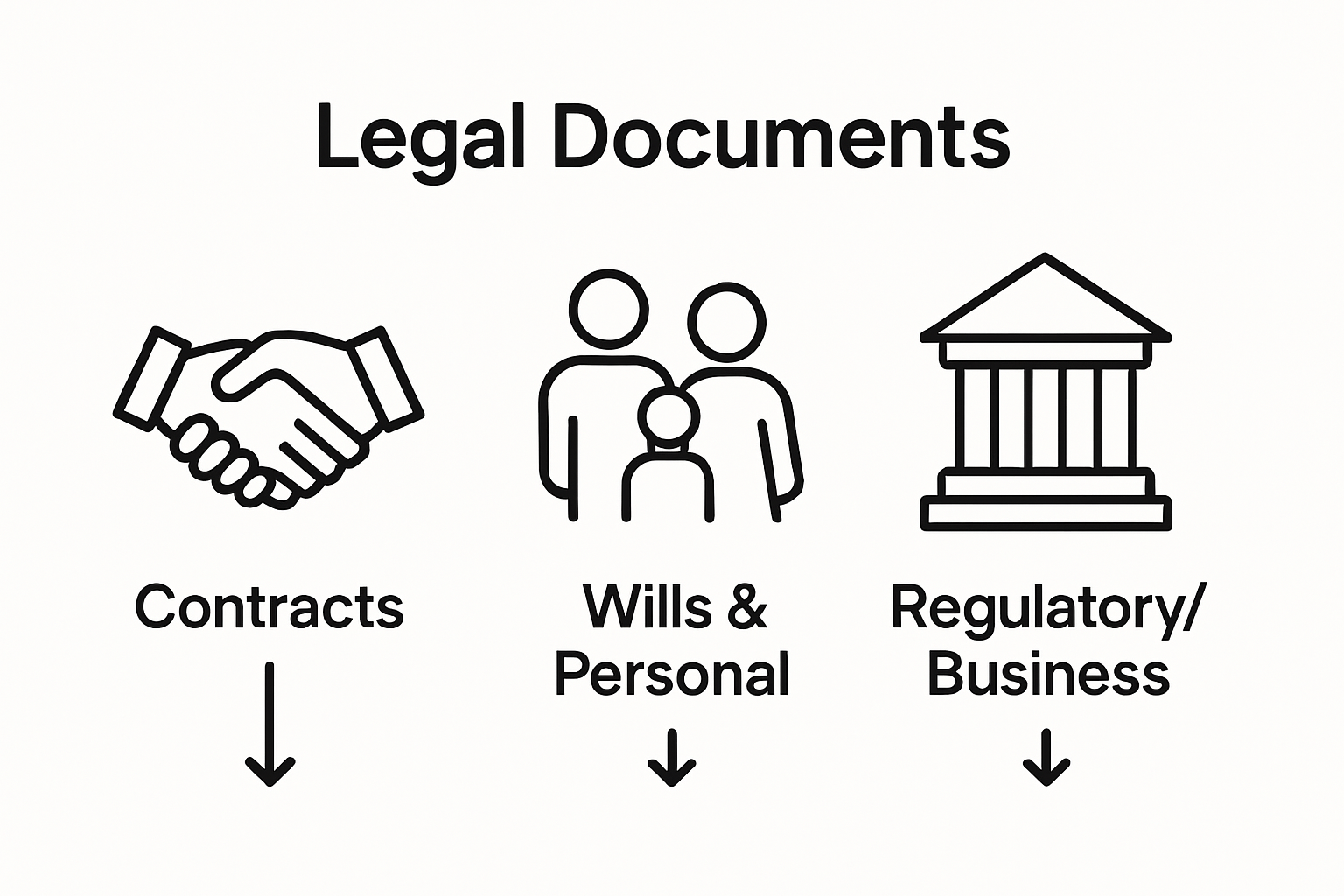 Some primary categories include:
- Contractual Documents: Agreements establishing mutual obligations between parties
- Regulatory Documents: Formal papers demonstrating compliance with legal requirements
- Personal Legal Instruments: Documents establishing individual rights or status
Contracts represent one of the most common legal documents, outlining precise terms of engagement between parties. According to Government of Canada, these documents provide organizations with their legal existence, identifying their name, purpose, and operational structure.
Purpose and Significance
Legal documents serve multiple critical functions within personal and professional domains. They provide legal recognition, establish clear expectations, and create enforceable frameworks for various interactions. Whether initiating court proceedings, defining business relationships, or protecting individual rights, these documents ensure transparent and accountable communication.
Authentication plays a crucial role in legal document validity. In Ontario, documents often require specific certification to be considered legally binding, especially when used across different jurisdictions. Ontario’s official authentication guidelines emphasize the importance of proper verification to ensure international legal recognition.
Understanding legal documents requires recognizing their role as more than mere paperwork. They are powerful instruments that define relationships, protect rights, and provide structured mechanisms for resolving potential disputes. Drafting legal documents demands precision, clarity, and a comprehensive understanding of legal principles and specific contextual requirements.
Importance of Drafting Legal Documents in Ontario
Drafting legal documents is a critical process that requires meticulous attention to detail, ensuring legal precision and protecting the rights and interests of all parties involved. In Ontario, the quality and accuracy of legal documentation can significantly impact personal, professional, and business interactions.
Legal Protection and Risk Mitigation
Properly drafted legal documents serve as fundamental shields against potential legal disputes and misunderstandings. They establish clear boundaries, expectations, and obligations that can prevent costly litigation and provide a solid framework for resolving conflicts.
 Ontario Public Service emphasizes the necessity of precise documentation in various sectors, highlighting the critical role of comprehensive legal drafting.
Key considerations in drafting legal documents include:
- Clarity of Language: Ensuring terms are unambiguous and easily understood
- Comprehensive Coverage: Addressing potential scenarios and contingencies
- Legal Compliance: Adhering to provincial and federal regulations
Professional and Business Implications
In the Ontario legal landscape, drafting legal documents goes beyond mere paperwork. These documents are instrumental in establishing professional credibility, protecting business interests, and creating enforceable agreements. From corporate contracts to personal legal instruments, the precision of documentation can determine the success and security of various legal interactions.
Businesses and professionals must recognize that legal documents are not just formalities but strategic tools that define relationships, allocate risks, and provide clear mechanisms for dispute resolution. Learn more about our online notary services for precise legal documentation.
Ultimately, the importance of drafting legal documents in Ontario cannot be overstated. It requires a comprehensive understanding of legal principles, attention to specific contextual requirements, and a commitment to creating documents that are both legally robust and practically functional. Professionals involved in legal drafting must possess not just technical knowledge, but also the ability to anticipate potential challenges and craft documents that provide comprehensive protection and clarity.
Key Elements and Structure of Legal Documents
Legal documents require a precise and systematic approach to ensure their validity, comprehensiveness, and legal enforceability. Understanding the fundamental elements and structural components is crucial for creating robust and effective legal instruments that can withstand legal scrutiny.
Essential Structural Components
Every legal document follows a standardized structure designed to provide clarity, establish context, and define precise legal obligations. Ontario Ministry of the Attorney General emphasizes the importance of maintaining a consistent and comprehensive document framework.
Key structural elements typically include:
- Title and Identification: Clearly stating the document’s purpose and identifying parties
- Introductory Recitals: Providing background context and intent
- Operative Clauses: Defining specific rights, obligations, and terms
- Signature Section: Authenticating the document with legal endorsements
Critical Content Requirements
Beyond structural elements, legal documents must incorporate precise language, comprehensive definitions, and unambiguous terms. Each section must be crafted to minimize potential misinterpretation and provide clear guidance for potential dispute resolution.
The content should address:
- Specific roles and responsibilities of involved parties
- Detailed description of rights and obligations
- Mechanisms for addressing potential conflicts
- Conditions for modification or termination
Legal Validity and Precision
The effectiveness of a legal document hinges on its ability to anticipate potential scenarios, protect involved parties, and create enforceable frameworks. Explore our comprehensive online notary services for document authentication, which can help ensure your legal documents meet rigorous standards.
Professional legal drafting requires more than technical knowledge.
This table outlines the essential structural components of a legal document in Ontario, briefly describing the function of each section to clarify their roles in the drafting process.
| Structural Component | Description |
|---|---|
| Title and Identification | States the document’s purpose and identifies all relevant parties |
| Introductory Recitals | Provides background information and context for the document |
| Operative Clauses | Defines the rights, obligations, and terms agreed upon |
| Signature Section | Authenticates the document through legal endorsements |
Common Types of Legal Documents and Their Uses
Legal documents serve diverse purposes across personal, professional, and institutional domains. Understanding the different types of legal documents helps individuals and organizations navigate complex legal landscapes and protect their interests effectively.
Personal Legal Documents
Ontario’s official documents portal highlights several critical personal legal documents that play pivotal roles in individual legal interactions:
- Wills and Testaments: Defining asset distribution and inheritance preferences
- Power of Attorney: Authorizing legal representation and decision making
- Affidavits: Providing sworn statements for legal proceedings
- Marriage and Divorce Certificates: Documenting significant personal legal status changes
These documents serve as essential instruments for personal legal protection, ensuring individual rights are recognized and preserved in various life circumstances.
Business and Commercial Legal Documents
In the professional realm, legal documents form the backbone of organizational interactions and regulatory compliance. Critical business legal documents include:
- Contracts: Establishing formal agreements between parties
- Articles of Incorporation: Defining business entity legal structures
- Intellectual Property Agreements: Protecting creative and innovative assets
- Employment Agreements: Outlining workplace rights and responsibilities
Specialized Legal Instruments
Some legal documents require specialized expertise and serve unique purposes in specific contexts. Learn more about our comprehensive online notarization services for various document types.
Beyond standard documentation, specialized legal instruments might include:
- Real estate transfer documents
- Government permits and authorizations
- Memoranda of understanding
- Regulatory compliance documentation
The effectiveness of legal documents depends not just on their content, but on their precise drafting, comprehensive coverage, and alignment with specific legal requirements.
The table below summarizes common types of legal documents in Ontario, highlighting their purpose and typical users to help readers quickly compare their core functions.
| Type of Legal Document | Main Purpose | Typical User |
|---|---|---|
| Will and Testament | Outlines asset distribution and inheritance wishes | Individual |
| Power of Attorney | Grants authority for legal decisions on someone else’s behalf | Individual |
| Affidavit | Provides a sworn statement for legal proceedings | Individual, Business |
| Contract | Establishes formal agreements between parties | Business, Individual |
| Articles of Incorporation | Defines the legal structure of a business entity | Business |
| Employment Agreement | Details workplace rights and responsibilities | Employer, Employee |
| Intellectual Property Agreement | Protects creative or innovative assets | Business, Creator |
| Regulatory Compliance Document | Demonstrates adherence to legal requirements | Business, Organization |
Best Practices for Effective Legal Document Drafting
Legal document drafting demands precision, clarity, and a strategic approach to ensure comprehensive protection and minimize potential misunderstandings. Mastering these practices is crucial for creating legally robust and enforceable documents that effectively communicate complex legal intentions.
Language and Clarity Principles
The Department of Justice Canada emphasizes the critical importance of readability and clarity in legal documentation. Effective drafting requires a meticulous approach to language that balances legal technicality with comprehensibility.
Key language considerations include:
- Precise Terminology: Using unambiguous and specific legal language
- Consistent Definitions: Establishing clear meanings for key terms
- Avoiding Ambiguity: Eliminating potential interpretative conflicts
- Structured Sentences: Creating logical and direct communication
Comprehensive Document Architecture
The structural integrity of a legal document is as important as its linguistic precision. Effective drafting involves creating a comprehensive framework that anticipates potential scenarios and addresses potential legal complexities.
Critical structural elements to consider:
- Logical section progression
- Explicit rights and obligations
- Contingency and dispute resolution mechanisms
- Clear allocation of responsibilities
Advanced Drafting Strategies
Professional legal drafting transcends basic documentation. Explore our comprehensive online notary services for expert document authentication, which can help ensure your legal documents meet the highest standards.
Advanced drafting strategies include:
- Anticipating potential legal challenges
- Incorporating flexible modification clauses
- Ensuring jurisdictional compliance
- Balancing specificity with adaptability
Ultimately, successful legal document drafting requires a holistic approach that combines technical legal knowledge, strategic thinking, and a deep understanding of potential interpersonal and institutional dynamics. Professionals must craft documents that are not just legally sound, but also practical, forward thinking, and aligned with the evolving legal landscape.
Take Control of Your Legal Documents with Reliable Online Notary Services in Ontario
Drafting legal documents in Ontario is demanding. You know a single vague word or missing element could expose you to serious risks. The article highlighted just how crucial clarity and accuracy are for documents like affidavits, statutory declarations, and invitation letters. But turning legal requirements into clear, enforceable paperwork can be overwhelming, and finding in-person notary services adds another layer of stress.
Let us give you confidence that your documents are correct and properly authenticated. With our online notary services, you can notarize affidavits, invitation letters, and statutory declarations quickly and securely. No need to leave your home or worry about scheduling challenges. Your important documents deserve professional attention—visit The Online Notary today and get started. Act now to avoid costly mistakes and enjoy peace of mind knowing your paperwork meets Ontario’s legal standards.
Frequently Asked Questions
What is the purpose of legal documents in Ontario?
Legal documents serve as formal instruments that establish, record, or communicate legal rights, obligations, and agreements, providing clarity and protection in various legal contexts.
What are the key elements of a well-drafted legal document?
Essential elements include a clear title, introductory recitals, operative clauses defining rights and obligations, and a signature section for authentication.
Why is clarity important in legal document drafting?
Clarity minimizes misinterpretation, ensuring that terms are understandable and that rights and obligations are explicitly defined, which helps prevent legal disputes.
What types of legal documents are commonly used in Ontario?
Common types include wills, power of attorney, contracts, articles of incorporation, and employment agreements, each serving unique purposes in personal and business contexts.
Recommended
- The Complete Guide to Using an Online Notary Public for Affidavits and Declarations in Ontario (2025) - The Online Notary CA
- Why Opt for an Online Notary in Ontario - The Online Notary CA
- Everything You Need to Know About Online Notarization in Ontario: Fast, Legal, and Convenient for Affidavits and Declarations (2025) - The Online Notary CA
- Online Notary Services | Fast & Secure Notary Online Today