Types of Notarized Documents in Ontario: 2026 Guide

TL;DR:
- Notarized documents in Ontario include acknowledgments, jurats, oaths, and copy certifications, each serving distinct legal purposes. Properly choosing and executing the correct notarization type is essential to ensure acceptance and validity in legal and governmental processes. Both traditional in-person and remote online notarizations are legally valid methods, but precision and understanding are crucial to avoid costly errors.
Types of notarized documents are specific legal or official papers authenticated by a notary public to verify identity, confirm willingness to sign, and deter fraud, giving them recognized legal weight in courts, government agencies, and financial institutions. Ontario residents and businesses encounter these documents constantly, from real estate closings to immigration applications. This guide breaks down the four core notarization types, the most common documents in Ontario that require them, and the practical steps to get any document notarized correctly in 2026.
What are the main types of notarized documents?
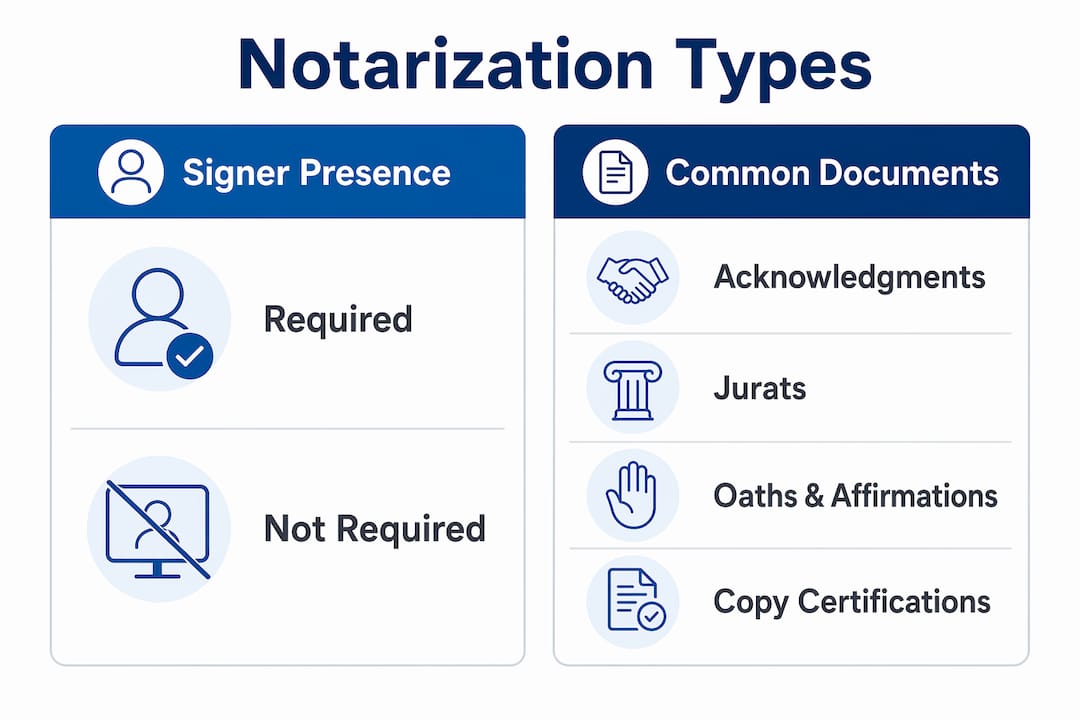
The four primary types of notarized documents are acknowledgments, jurats, oaths and affirmations, and copy certifications. Each serves a distinct legal purpose and carries different requirements for the signer.

Acknowledgments
An acknowledgment is the most common notarization type. The signer confirms to the notary that they signed a document voluntarily and that the signature is their own. For an acknowledgment, the signer does not need to sign in the notary’s presence. They may arrive with a pre-signed document and simply declare it as their own. Real estate deeds, powers of attorney, and mortgage documents typically use acknowledgments.
Jurats
A jurat requires the signer to swear or affirm the truth of a document’s contents before the notary. For a jurat, the signer must sign in the notary’s presence, not before. False statements made under a jurat carry legal consequences for perjury. Affidavits and sworn statements are the most common jurat documents.
Oaths and affirmations
An oath or affirmation without an attached document is a standalone notarial act. The notary administers a verbal pledge, and the signer commits to telling the truth or fulfilling a duty. Government officials, witnesses in legal proceedings, and new citizens often use this type.
Copy certifications
A copy certification confirms that a photocopy is an accurate reproduction of the original document. Notaries cannot certify copies of vital records such as birth certificates or marriage certificates. Those certified copies can only be issued by the originating government agency. Diplomas, licenses, and passports are common candidates for copy certification.
| Notarization Type | Signer Must Sign in Presence | Common Documents | Key Requirement |
|---|---|---|---|
| Acknowledgment | No | Deeds, powers of attorney | Voluntary signature confirmation |
| Jurat | Yes | Affidavits, sworn statements | Oath or affirmation of truth |
| Oath/Affirmation | Yes | Official ceremonies, court proceedings | Verbal pledge only |
| Copy Certification | N/A | Diplomas, passports, licenses | Original document must be present |
Pro Tip: Always confirm which notarization type your recipient institution requires before your appointment. A jurat and an acknowledgment are not interchangeable, and submitting the wrong type can result in outright rejection.
Which documents commonly require notarization in ontario?
Deeds, mortgages, powers of attorney, affidavits, and loans typically require notarization to file or enforce legally. Ontario adds several document categories to that list based on provincial requirements and institutional practices.
The most frequently notarized legal papers in Ontario include:
- Real estate transfer deeds confirm ownership changes and are required by the Ontario Land Registry Office.
- Powers of attorney authorize another person to act on your behalf for financial or personal care decisions.
- Affidavits are sworn written statements used in court proceedings, immigration applications, and insurance claims.
- Wills with self-proving affidavits allow executors to probate an estate without tracking down witnesses.
- Travel consent letters authorize a minor to travel internationally with one parent or a non-parent guardian.
- Loan and mortgage documents require notarization before lenders will fund or register the transaction.
- Business formation documents such as articles of incorporation or partnership agreements often need notarized signatures for filing.
- Statutory declarations are formal written statements declared before a notary, used widely for name changes, residency confirmation, and government benefit applications.
Notarization adds a layer of legal presumption to each of these. A properly notarized document forces a challenger to prove fraud rather than requiring the signer to prove every detail. That shift in burden of proof is the core value of notarization for Ontario residents.
Pro Tip: Before your notarization appointment, call the receiving institution, whether a court, bank, or government office, and confirm the exact notarization type and certificate wording they require. Requirements vary more than most people expect.
What notarization methods are available in ontario?
Ontario recognizes two primary methods for notarizing documents: traditional in-person notarization and remote online notarization (RON). Both are legally valid, and the right choice depends on your document type, timeline, and location.
Traditional in-person notarization
Traditional notarization requires the signer to appear physically before a notary public, present government-issued photo identification, and sign or acknowledge the document in person. The notary applies a physical seal and ink signature to the certificate. This method works well for complex real estate transactions or situations where original paper documents must be filed.
Remote online notarization
Remote online notarization allows signers to complete the entire process via a secure video call. Documents are signed electronically, and the notary applies a digital seal. Technology aids convenience, but the notary’s human role in assessing coercion or incapacity remains critical and cannot be replaced by software alone. Ontario has expanded acceptance of RON for a wide range of document types, making it a practical option for individuals outside major urban centers or those with tight schedules.
Here are the steps to notarize documents online in Ontario:
- Choose a platform. Select a licensed Ontario notary service that offers remote online notarization.
- Upload your document. Submit the document electronically through the platform’s secure portal.
- Verify your identity. Present government-issued photo ID via the video call. Some platforms use knowledge-based authentication as an additional step.
- Attend the video session. Meet the notary live on camera, sign electronically, and take any required oath or affirmation.
- Receive your notarized document. Download the digitally sealed document, which carries the same legal weight as a paper-notarized version.
Pro Tip: Scan your ID and have your document open on screen before the video session starts. Technical delays during identity verification are the most common reason online notarization appointments run over time.
What common errors should you avoid when notarizing documents?
Defective notarizations are more common than most people realize, and the consequences range from document rejection to costly legal delays. Misspelled names, missing notary seals, and wrong dates can cause a notarization to be deemed invalid. Catching these errors at the appointment is far easier than correcting them after the fact.
The most frequent pitfalls Ontario residents encounter include:
- Wrong notarization type. Submitting an acknowledgment when a jurat is required, or vice versa, leads to automatic rejection by courts and government offices.
- Blank fields in the certificate. Any unfilled line in the notarial certificate creates grounds for challenge.
- Expired or missing notary seal. A notary’s commission can expire. Always confirm the notary’s credentials before signing.
- Expecting legal advice from the notary. Notaries cannot provide legal advice or explain document contents. That requires a licensed attorney. Confusing the two roles leads to misplaced reliance and potential legal exposure.
- Misunderstanding what notarization certifies. A notarized document confirms identity and willingness to sign. It does not certify that the contents are true or accurate. Many clients discover this distinction too late.
Notarization is a low-cost precaution that prevents costly legal complications, such as needing a lawyer to prove a will’s legitimacy during probate. Getting it right the first time is always worth the extra preparation.
Pro Tip: Review the completed notarial certificate before you leave the appointment. Check your name spelling, the date, the document description, and the notary’s seal. A two-minute review prevents weeks of delays.
Key takeaways
Notarized documents in Ontario fall into four distinct types, and choosing the correct one for your specific legal purpose determines whether the document will be accepted or rejected.
| Point | Details |
|---|---|
| Four core notarization types | Acknowledgments, jurats, oaths/affirmations, and copy certifications each serve different legal purposes. |
| Ontario-specific document list | Real estate deeds, powers of attorney, affidavits, and statutory declarations are the most frequently notarized papers in Ontario. |
| Two valid methods | Traditional in-person and remote online notarization are both legally accepted in Ontario for most document types. |
| Notarization confirms identity only | A notarized document verifies the signer’s identity and willingness, not the truth of its contents. |
| Errors invalidate notarizations | Missing seals, wrong dates, and misspelled names can render a notarization invalid and cause document rejection. |
Why getting the right notarization type matters more than most people think
I have reviewed hundreds of notarization situations over the years, and the single most consistent mistake I see is treating notarization as a formality rather than a legal act with specific requirements. People show up with a document, get a stamp, and assume the job is done. Then the bank, court, or immigration office sends it back because the wrong certificate was used.
The distinction between an acknowledgment and a jurat is not bureaucratic hair-splitting. It reflects a real legal difference in what the signer is swearing to. Getting that wrong does not just delay your transaction. It can invalidate a power of attorney at the exact moment a family needs it most, or stall a real estate closing with thousands of dollars on the line.
Online notarization has genuinely improved access for Ontario residents, particularly those in smaller communities or with demanding schedules. I think the adoption curve will accelerate through 2026 and beyond. But convenience does not reduce the need for precision. If anything, the ease of online notarization makes it tempting to rush through the process without verifying the certificate details.
My honest recommendation: treat every notarization appointment as a legal transaction, not an errand. Know which type you need before you book. Confirm the receiving institution’s requirements. And read the certificate before you leave, whether you are sitting across from a notary in an office or finishing a video call from your kitchen.
— Ken
Get your documents notarized online with Theonlinenotary
Theonlinenotary provides 24/7 expert notary services for Ontario residents and businesses, covering affidavits, statutory declarations, invitation letters, solemn declarations, and more. You do not need to take time off work or travel across the city to get a legally valid notarization.

The process is straightforward: upload your document, verify your identity on a secure video call, and receive your notarized document electronically. Every notarization is handled by a licensed Ontario notary public and meets provincial legal standards. Whether you need a jurat for a court affidavit or a copy certification for an immigration application, Theonlinenotary has you covered. Explore the full range of documents available for online notarization in Ontario.
FAQ
What is the difference between an acknowledgment and a jurat?
An acknowledgment lets a signer confirm a pre-signed document as their own, while a jurat requires the signer to sign in the notary’s presence and swear to the truth of the document’s contents. Submitting the wrong type to a court or institution will result in rejection.
Which documents require notarization in ontario?
Real estate deeds, powers of attorney, affidavits, statutory declarations, travel consent letters, and loan documents are among the most commonly notarized papers in Ontario. The specific requirement depends on the receiving institution or legal process.
Can a notary certify a copy of a birth certificate?
No. Notaries cannot certify copies of vital records such as birth certificates or marriage certificates. Only the originating government agency can issue certified copies of those documents.
Is online notarization legally valid in ontario?
Yes. Remote online notarization is legally accepted in Ontario for most document types. The notary conducts the session via secure video call, and the resulting digital document carries the same legal weight as a traditionally notarized paper document.
Does notarization confirm that a document’s contents are true?
No. Notarization confirms the signer’s identity and their willingness to sign. It does not verify that the information in the document is accurate or truthful. For content verification, you need a licensed attorney.