Travel consent for minors: a step-by-step guide for Ontario parents

TL;DR:
- A consent letter is highly recommended but not legally required for children traveling internationally in Canada.
- Proper preparation includes detailed, notarized consent letters and supporting documents like passports and birth certificates.
- In complex cases, legal advice and additional documentation may be necessary to ensure smooth border crossings.
Picture this: you arrive at the airport with your child, bags checked and boarding passes in hand, only for a border officer to pull you aside and ask why your child is traveling without the other parent present. You have no letter, no supporting documents, and no way to prove consent was given. The flight leaves without you. This exact situation happens more often than most Ontario parents expect, and it is entirely preventable. This guide walks you through every step of the travel consent process so you can travel with your child confidently and without last-minute surprises.
Table of Contents
- Understanding travel consent requirements for minors
- What documents you need: consent letter and supporting papers
- How to prepare and notarize your travel consent letter
- Dealing with edge cases and troubleshooting issues
- Our perspective: why the consent letter is a crucial but imperfect safeguard
- Get your consent letter notarized online in Ontario
- Frequently asked questions
Key Takeaways
| Point | Details |
|---|---|
| Consent letter recommended | Although not legally required, a travel consent letter is strongly urged to help avoid delays or refusal at borders. |
| Essential document checklist | Prepare both the consent letter and supporting documents including passport and birth certificate for each trip. |
| Edge cases need special handling | If one parent is unavailable or refuses consent, be ready with court orders or agency authorization documentation. |
| Notarization boosts credibility | Getting your consent letter notarized increases its official credibility and reduces questioning by authorities. |
| Government template is best | Use the official Government of Canada template and consult a lawyer in any complex custody situation. |
Understanding travel consent requirements for minors
Many parents are surprised to learn that there is no hard law in Canada that forces you to carry a consent letter when traveling with your child. However, the absence of a legal mandate does not mean you can skip it. A consent letter is not legally required under Canadian or Ontario law, but it is strongly recommended by the Government of Canada for children traveling outside Canada without one or both parents or guardians, to demonstrate permission from absent parents with decision-making responsibility.
That distinction matters enormously at the border. Officers at international checkpoints are trained to watch for potential child abduction scenarios. When a child is traveling with only one parent, or with a grandparent, aunt, or family friend, the absence of any documentation immediately raises questions. The officer cannot read your mind. They need proof.
Multiple sources note that without a consent letter, travelers risk delays, denied boarding, or outright entry refusal. The Canada Border Services Agency (CBSA) actively reminds travelers about this through public advisories. While no official refusal rate data is published, the consistency of these warnings from government and border agencies tells you that real incidents do happen regularly.
Understanding when you need a consent letter is equally important. Here is a quick comparison:
| Travel scenario | Consent letter needed? |
|---|---|
| Both parents traveling with the child | Not typically required |
| One parent traveling, other parent in Canada | Strongly recommended |
| Child traveling with a grandparent or relative | Strongly recommended |
| Child traveling alone | Strongly recommended |
| Sole custody, traveling parent has full rights | Recommended plus custody proof |
| Child in government care | Agency authorization required |
The most common misconception is that a consent letter guarantees entry into another country. It does not. Border officials in destination countries make their own decisions based on their own rules. What the letter does is significantly reduce the chance of being stopped, questioned, or turned away. Think of it as insurance: you may never need to file a claim, but you will be very glad you have it if things go sideways.
To understand how notarization fits into this process, the notarized consent letter process at The Online Notary provides a practical overview tailored to Ontario families. And if you are also preparing a passport application for your child at the same time, reviewing minor passport requirements is a logical next step before your trip.
What documents you need: consent letter and supporting papers
Knowing that a consent letter is recommended is one thing. Knowing exactly what goes in it and what else to bring is where preparation really begins. The consent letter should include the child’s name and date of birth, the parents’ or guardians’ names and contact information, the accompanying person’s details and relationship to the child, and a full travel itinerary including dates and destinations.
That level of detail matters. A vague letter that says “I allow my child to travel” is far less convincing to a border officer than a specific, dated letter naming the countries being visited, the return date, and the accompanying adult’s passport number. Specificity signals that the document is legitimate.
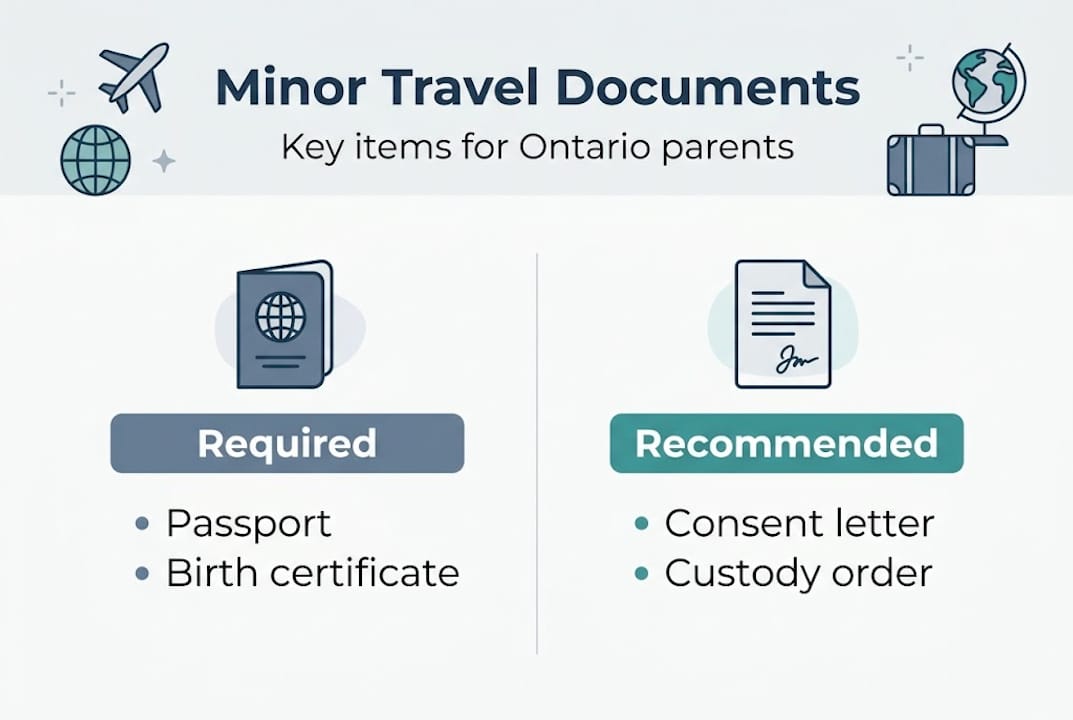
Beyond the consent letter itself, you should also carry a set of supporting documents. According to the Government of Canada, these include:
- The child’s valid passport
- A long-form birth certificate (not the wallet-sized short form)
- Custody orders or separation agreements, if applicable
- A death certificate if one parent is deceased
Here is a practical breakdown of what falls into each category:
| Document | Required or recommended |
|---|---|
| Child’s passport | Required for international travel |
| Consent letter | Strongly recommended |
| Long-form birth certificate | Strongly recommended |
| Custody order or separation agreement | Required if custody is shared or disputed |
| Death certificate (if one parent deceased) | Required if applicable |
| Accompanying adult’s ID or passport | Recommended |
Pro Tip: Always bring originals and at least two photocopies of each document. Keep one set in your carry-on bag and another in checked luggage. If customs officers retain one copy for review, you still have the originals on hand. Organization at this level can shave minutes or even hours off your border crossing experience.

One document that Ontario parents sometimes overlook is the proof of birth affidavit. In situations where a long-form birth certificate is unavailable, a proof of birth affidavit can serve as a supporting document. This is particularly relevant for families with newborns, children born abroad, or situations where official records were delayed.
Keep in mind that different countries have different entry requirements for minors. Some countries in Latin America, for example, have strict rules that go beyond what Canada recommends. Research the specific entry requirements for your destination country before you finalize your document package. What works at the Canadian border may not satisfy every foreign customs authority.
How to prepare and notarize your travel consent letter
Preparing the consent letter is easier than most parents assume, but getting it wrong can cost you the trip. Follow these steps to do it right:
- Download the official template. The Government of Canada provides a sample consent letter that covers all the required fields. Start there rather than writing one from scratch.
- Fill in every required field. Include the child’s full legal name, date of birth, and passport number. Add the full names and contact details of both parents or guardians. Specify the accompanying adult’s name, passport number, and relationship to the child.
- Write a detailed itinerary. List every country being visited, the planned entry and exit dates, and the name of the airline or mode of transportation. The more specific, the better.
- Have both parents sign the letter. If only one parent is signing because the other is unavailable, document the reason clearly and attach supporting evidence.
- Get the letter notarized. A notary public in Ontario can witness the signatures and affix a seal, which significantly boosts the document’s credibility.
- Make certified copies. After notarization, make several copies and keep them organized alongside the supporting documents.
The government’s own position on this is clear. Notarization is not required but is strongly recommended by the Government of Canada and CBSA because it increases credibility and reduces questioning by officials.
“A notarized letter adds a layer of official verification that border agents trust. It signals that the document was created with legal awareness and that both parties understood what they were signing.” This principle applies whether you are traveling to the United States, Mexico, or anywhere in Europe.
For a detailed walkthrough of the notarization process itself, the step-by-step notarization guide covers exactly what Ontario parents need to know. If your situation involves a guardianship arrangement rather than straightforward parental consent, reviewing guardianship notarization tips will help you avoid the most common pitfalls.
Pro Tip: Start the notarization process at least three to four weeks before your travel date. This gives you time to correct errors, get both parents to sign, and handle any delays at the notary’s office without the pressure of a looming departure date.
Common mistakes that derail consent letters include leaving out the return date, failing to include the accompanying adult’s identification details, signing the letter without a witness, and using a short-form birth certificate instead of the long-form version. Each of these can trigger additional questioning or outright rejection at the border.
Dealing with edge cases and troubleshooting issues
Not every family situation is straightforward, and the consent letter process reflects that reality. The Government of Canada outlines several edge cases that Ontario parents need to plan for:
- Deceased parent: Carry a certified copy of the death certificate alongside the consent letter. This documents why only one parent’s signature appears.
- Parent who is unavailable or incarcerated: Carry a court order confirming the traveling parent’s authority to make decisions for the child.
- Sole decision-maker: If you have sole custody or sole decision-making responsibility, carry documentation that proves it, such as a court order or separation agreement.
- Child in government care: You will need written authorization from the child welfare agency that holds legal responsibility for the child.
- Parent refuses to give consent: This is the most legally complex scenario. If a parent refuses to sign, you may need to apply to a court for an order permitting travel, based on the child’s best interests.
“In Canadian family law, decisions about a child’s travel are governed by the principle that the child’s best interests come first. A court will weigh factors like the purpose of the trip, the child’s relationship with each parent, and the risks involved before granting a travel order.”
This legal standard applies in Ontario under the Children’s Law Reform Act and related federal legislation. It is not a rubber stamp. Courts take these applications seriously, which means parents in dispute need professional legal guidance, not just a notarized letter.
If you encounter a situation where your documentation is questioned or challenged at the border, stay calm and ask to speak with a supervisor. Never surrender original documents without a receipt. If you believe the challenge is unjust, contact the nearest Canadian consulate or embassy. For edge case solutions related to documentation rejections, The Online Notary has resources specifically for Ontario families navigating these more complex situations.
Complex guardianship arrangements often require more than just a consent letter. Understanding the full scope of what courts and border officials expect is covered in the court order and guardian issues resource, which walks through documentation requirements for non-standard custody arrangements.
Pro Tip: If you are unsure whether your situation qualifies as an edge case, consult a family law lawyer before your travel date. A 30-minute consultation is far less disruptive than a denied boarding at the airport.
Our perspective: why the consent letter is a crucial but imperfect safeguard
Here is something that most travel guides will not tell you: a consent letter is a tool, not a shield. Parents often treat notarization as the finish line, when it is really just one part of a broader safety strategy.
We have seen many cases where families had a beautifully notarized letter but were still delayed because they forgot the long-form birth certificate, or because the letter was generic and did not list specific travel dates. The letter’s legal weight is only as strong as its specificity and the supporting documents around it.
There is also a broader misconception worth addressing. A consent letter does not prevent child abduction. It is not registered in any database. No international system cross-references it. Its purpose is to give border officers a reason to let you through, not to create a global safety net. For that reason, we encourage parents to take additional steps: register your travel with the Government of Canada’s Travel Smart program, inform your child’s school, and make sure both parents have a shared understanding of travel plans.
The consent letter limitations are real, and acknowledging them is not pessimism. It is smart parenting. Use official templates, get it notarized, bring every supporting document, and in complex cases, get a lawyer involved. Preparation is the only real guarantee.
Get your consent letter notarized online in Ontario
Planning a trip with your child should feel exciting, not stressful. If you are an Ontario parent who needs a travel consent letter notarized quickly and correctly, The Online Notary makes the process straightforward.

Our online notary services are available 24/7, so you can get your consent letter notarized from home without taking time off work or scheduling around a notary’s office hours. We specialize in travel documents, affidavits, statutory declarations, and more, serving Ontario families who need reliable notarization on their schedule. Whether your situation is simple or involves custody arrangements, our team has the experience to guide you through it. Visit our consent letter expertise page to get started today.
Frequently asked questions
Is a travel consent letter legally required for minors leaving Canada?
No, a consent letter is not legally required under Canadian or Ontario law, but it is strongly recommended by the Government of Canada to help avoid travel complications when children travel without both parents or guardians.
What information should the consent letter contain?
The letter should include the child’s name and DOB, both parents’ or guardians’ names and contact details, the accompanying adult’s information and relationship to the child, and a full travel itinerary with dates and destinations.
Is notarization required or just recommended?
Notarization is not mandatory, but the Government of Canada and CBSA strongly recommend it because it increases the document’s credibility and reduces the likelihood of detailed questioning by border officials.
What documents should I bring besides the consent letter?
Beyond the consent letter, bring the child’s passport, long-form birth certificate, any applicable custody orders or separation agreements, and a death certificate if one parent is deceased.
What if one parent refuses to give consent?
If a parent refuses to sign the consent letter, you may need to seek a court order authorizing the child’s travel, based on the legal standard of the child’s best interests under Ontario family law.