Statutory declarations in Ontario: Clear steps and online options

TL;DR:
- Ontario allows online commissioning of statutory declarations via real-time video since August 2020.
- Only specific authorized persons, like lawyers, notaries, and officials, can commission these documents legally.
- Proper preparation and understanding of legal requirements prevent rejection and ensure validity.
Many people assume a statutory declaration needs a notary public specifically, or that it has to happen in person at a law office. Neither is necessarily true. Ontario recognizes a broader list of authorized persons, and since August 2020, you can complete a statutory declaration online using real-time video. Whether you’re handling a court filing, an immigration application, or a business transaction, this guide walks you through who can authorize your declaration, what the process looks like in person and remotely, and how it differs from an affidavit so you can choose the right document the first time.
Table of Contents
- Understanding statutory declarations in Ontario
- Who is authorized to commission statutory declarations
- Step-by-step statutory declaration process: In-person and online
- Statutory declarations vs. affidavits: Key differences
- What most guides miss about Ontario statutory declarations
- Take the next step with trusted online notary solutions
- Frequently asked questions
Key Takeaways
| Point | Details |
|---|---|
| Authorized professionals | Statutory declarations in Ontario must be commissioned by specific legal professionals, notaries, or officials. |
| Remote commissioning | Online statutory declarations are legally valid if strict process steps are followed under current regulations. |
| Affidavit vs declaration | Affidavits are sworn; statutory declarations are solemn affirmations, each suited to different contexts. |
| Step-by-step guidance | Following clear steps greatly reduces document rejection and speeds up the statutory declaration process. |
Understanding statutory declarations in Ontario
A statutory declaration is a formal written statement of facts that a person makes voluntarily and solemnly. It is used in legal, governmental, and business contexts where an official written confirmation of facts is required but a sworn oath is not necessarily mandated. Understanding the purpose of statutory declaration documents helps you recognize when this is the right tool and when another document, like an affidavit, might be more appropriate.
Common scenarios where Ontario residents and businesses use statutory declarations include:
- Court filings where a sworn affidavit is not specifically required
- Immigration applications, such as supporting a sponsor’s statement of financial support
- Proof of identity or relationship status for government programs
- Business transactions, including confirming ownership or authorizing a representative
- Estate administration when verifying facts about a deceased person’s assets
- Insurance claims requiring a confirmed statement of loss
The legal foundation is clear. Statutory declarations are governed by the Statutory Declarations Act and must be made before an authorized person. This is Ontario’s primary statute on the subject, and it sets the rules for how these documents must be prepared and executed.
One important distinction: statutory declarations are not sworn under oath the way affidavits are. However, making a false statement in a statutory declaration still carries serious legal consequences, including criminal penalties under federal law. The declarant solemnly affirms the truth of the contents, and that affirmation is treated seriously by courts and government agencies alike. This is a point many people overlook. They assume that because there is no oath, the stakes are lower. They are not.
“A person who makes a false statutory declaration is liable to prosecution for an indictable offense under the Criminal Code of Canada, regardless of whether it was sworn.”
You can review statutory declaration samples to understand the standard format, required language, and how different situations affect the wording. Having a reliable template reduces errors significantly before you even sit down with a commissioner.
The statutory declaration differs from an affidavit primarily in form and context, not in seriousness. We will cover that comparison in detail later. For now, the key takeaway is that a statutory declaration is a legally significant document, and treating it carefully from the start saves time and avoids rejection.
Who is authorized to commission statutory declarations
This is where a lot of confusion creeps in. People often assume they need a notary public, or worse, that their neighbor who happens to be a lawyer can just sign off informally. Ontario law is specific about who qualifies, and the rules matter.
Authorized persons include commissioners for taking affidavits, lawyers, paralegals licensed by the Law Society of Ontario, notaries public, judges, justices of the peace, and certain municipal officials. The full list of commissioners is set out in Ontario Regulation 386/12.
Here is a breakdown of the main authorized roles:
- Commissioners for taking affidavits: Appointed specifically for this purpose and common across many professional and government offices
- Lawyers and paralegals: Must be in good standing with the Law Society of Ontario
- Notaries public: Authorized under Ontario law and frequently used for international and business documents
- Judges and justices of the peace: Authorized but typically used in court-adjacent contexts
- Municipal officials: Certain local government employees are designated commissioners
Understanding who can sign statutory declarations in practice means checking that the person you choose holds current credentials. A commissioner whose appointment has lapsed, or a paralegal who is not in good standing, cannot legally commission your declaration. The document would be invalid.
| Authorized person | Legal basis | Typical use case |
|---|---|---|
| Commissioner for taking affidavits | O. Reg. 386/12 | General civil, business, and government matters |
| Lawyer (LSO member) | Law Society Act | Legal proceedings, estate matters |
| Paralegal (LSO licensed) | Law Society Act | Tribunal proceedings, civil matters |
| Notary public | Notaries Act | Business, international, immigration documents |
| Justice of the peace | Courts of Justice Act | Court-related declarations |
| Municipal official | O. Reg. 386/12 | Local government applications |
Pro Tip: Before scheduling your appointment, ask the commissioner for their designation and verify it through the Law Society of Ontario’s public directory or the relevant appointing authority. A quick check now prevents rejection later.
It is also worth noting that a commissioner cannot commission a declaration in which they have a personal interest. For example, if a lawyer is a party to the transaction being documented, they should not be the one commissioning the declaration. This conflict-of-interest rule is often overlooked but is critically important for document validity.
Step-by-step statutory declaration process: In-person and online
Knowing who can commission your declaration is only part of the picture. You also need to understand exactly how the process unfolds, whether you are walking into an office or connecting via video. Both paths follow a clear sequence, and skipping any step can cause delays or outright rejection.
Since August 2020, remote online commissioning is permitted via real-time video where parties see and hear each other, identity is confirmed, the jurat is modified to note the remote method, and reasonable precautions are taken. This regulatory change, introduced under Ontario Regulation 431/20, made a real difference for people in rural communities, those with mobility limitations, and busy professionals who cannot take time away from work for an in-person appointment.
Here is the full step-by-step process for both routes:
- Draft the statutory declaration. Use an approved template or work with a professional to prepare the document. The wording of the jurat (the closing statement confirming the declaration was made) must meet legal requirements. If you are doing this remotely, the jurat must specify that the process was conducted by real-time video and note the locations of both parties.
- Gather your identification. Government-issued photo ID is standard. For online commissioning, you will typically need to show your ID on camera clearly enough for the commissioner to read and verify it. Some commissioners also require a second piece of ID.
- Schedule with an authorized commissioner. For in-person, book an appointment at a law office, government office, or commissioning service. For online, connect with a service that offers remote commissioning. Not all notaries or commissioners have set up for remote work, so confirm this in advance.
- Attend the commissioning session. Whether in person or online, you will read through the declaration, confirm you understand and agree with its contents, and then sign it in the commissioner’s presence. Online sessions require both parties to be visible and audible throughout.
- Commissioner signs and seals the document. The commissioner adds their signature, commission number, and in online cases, the notation of remote commissioning. This finalizes the document.
- Receive the finalized declaration. In person, you walk out with the signed original. Online, the document is typically sent to you electronically as a certified copy or original, depending on the intended use.
Pro Tip: Double-check every field in the draft before your session. Missing dates, incorrect names, or wrong addresses in the body of the declaration are among the most common reasons documents get rejected. These errors cannot be corrected after commissioning without starting the process over.
Statutory declarations vs. affidavits: Key differences
These two documents are frequently confused, and the confusion can be costly. Submitting the wrong type of document to a court or government agency can mean delays, additional fees, and sometimes having to redo the entire filing. Knowing the difference between an affidavit vs statutory declaration saves you exactly that kind of trouble.
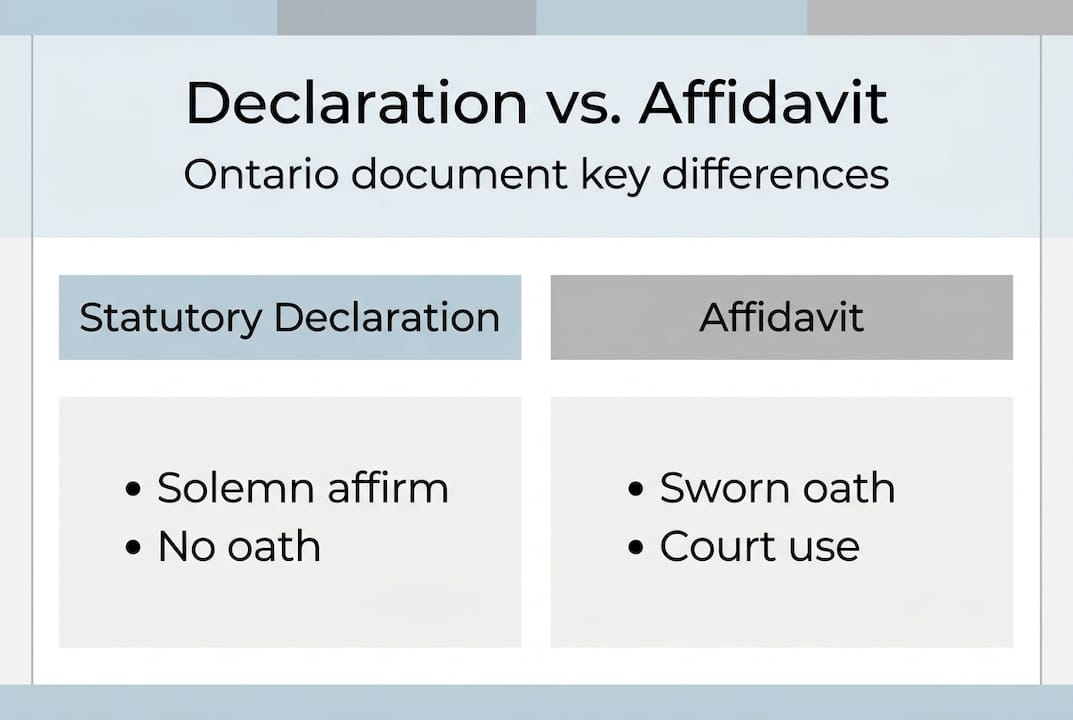
The core difference comes down to the oath. An affidavit is sworn under oath before an authorized person. The declarant swears to the truth of the contents by invoking a religious or solemn affirmation with oath language. A statutory declaration uses a solemn affirmation rather than a formal oath, but the legal consequences for false statements are effectively the same under criminal law.

Here is a side-by-side comparison:
| Feature | Statutory declaration | Affidavit |
|---|---|---|
| Legal form | Solemn affirmation | Sworn under oath |
| Governing law | Statutory Declarations Act (Ontario) | Evidence Act, Rules of Civil Procedure |
| Who can commission | Commissioners, notaries, lawyers, officials | Same authorized persons |
| Legal penalty for falsity | Criminal Code (indictable offense) | Criminal Code (perjury) |
| Typical application | Government, business, immigration | Court proceedings, litigation |
Use a statutory declaration when:
- A government agency or institution specifically requests this form
- You are confirming facts for immigration, business registration, or insurance purposes
- No court proceeding is currently active
Use an affidavit when:
- A court, tribunal, or legal proceeding requires sworn evidence
- The rules of the specific proceeding mandate an oath
- You are responding to or initiating litigation
Understanding the differences between an affidavit and a sworn statement can also help clarify when other document types come into play. Legal terminology in Ontario can overlap in confusing ways, and getting clear on these distinctions upfront prevents costly mistakes.
“The Statutory Declarations Act and related regulations are consistent across all official sources: the process, required parties, and legal penalties are firmly established and uniformly applied.”
It is also worth noting that some bodies accept either document interchangeably, while others are strict about format. When in doubt, ask the receiving agency which they require. Assuming you can substitute one for the other without checking has derailed more than a few applications.
What most guides miss about Ontario statutory declarations
Most articles on this topic cover the basics competently. They list the authorized persons, mention the Statutory Declarations Act, and explain what the document is for. What they rarely discuss is where things actually go wrong in practice, and why.
One of the most common real-world problems involves the jurat for remote declarations. When commissioning a statutory declaration for court or a government agency online, the jurat must explicitly note that the commissioning occurred by real-time video and record the location of both the declarant and the commissioner. Many people complete the video session correctly but use a standard in-person jurat template. The result is a document that looks valid but technically is not compliant with Ontario Regulation 431/20. Agencies increasingly catch this, and the document gets sent back.
Another overlooked issue is technology readiness. Online commissioning requires stable video, clear audio, and the ability to show ID legibly on camera. Clients who rush into sessions with poor lighting or a weak internet connection create problems for themselves. The commissioner has a legal obligation to confirm identity adequately. If they cannot, the session cannot proceed.
There is also the credential assumption problem. Not every notary or commissioner has been authorized or set up to operate remotely. Clients sometimes book sessions with a commissioner, assume remote is available, and show up unprepared to travel in person. Always confirm remote capability explicitly when booking.
Following online statutory declaration tips from experienced practitioners helps you avoid these pitfalls. Preparation is not bureaucratic box-checking. It is the difference between a declaration that gets accepted and one that bounces back at the worst possible moment.
Take the next step with trusted online notary solutions
If you are navigating a statutory declaration in Ontario, whether for immigration, business, estate matters, or a court filing, working with a reliable online notary makes the process faster and less stressful.

Our online notary services are specifically designed for Ontario residents and businesses who need compliant, professionally commissioned documents without the hassle of in-person appointments. We handle statutory declarations, affidavits, solemn declarations, invitation letters, and more. Before your session, we walk you through document preparation and ID requirements so nothing gets missed. If you want to compare your options, review the best online notary solutions available in Ontario. When you are ready to move forward, learn exactly how to complete your declaration online and book your session with confidence.
Frequently asked questions
Who can commission a statutory declaration in Ontario?
Authorized persons include commissioners, notaries public, lawyers and paralegals licensed by the Law Society of Ontario, judges, justices of the peace, and certain municipal officials as listed in O. Reg. 386/12. Always verify that the person you choose holds current, valid credentials.
Is online commissioning of statutory declarations legal in Ontario?
Yes. Remote online commissioning is permitted via real-time video under Ontario Regulation 431/20, introduced in August 2020, provided identity is confirmed, the jurat notes the remote method and location, and reasonable precautions are taken.
What is the main difference between a statutory declaration and an affidavit?
Affidavits are sworn under oath and typically used in court proceedings, while statutory declarations use a solemn affirmation and are more common in government, immigration, and business contexts, though both carry serious legal penalties for false statements.
How can I ensure my statutory declaration is accepted?
Confirm your commissioner holds valid credentials, use an official or professionally reviewed template, and if commissioning online, verify that your jurat explicitly notes the remote method and both parties’ locations as required by O. Reg. 431/20.
Recommended
- How to Complete a Statutory Declaration Online in Ontario - The Online Notary
- Statutory Declaration in Court: Complete Ontario Guide - The Online Notary
- Complete Guide to Statutory Declaration Samples Canada - The Online Notary
- Understanding Who Signs Statutory Declarations in Ontario - The Online Notary