Statutory Declaration vs Affidavit: Your Ontario Legal Guide

TL;DR:
- Statutory declarations are informal, non-sworn statements used mainly for administrative purposes, while affidavits are formal, sworn court evidence.
- Both documents require proper commissioning, with affidavits having stricter formatting and oath requirements.
- Choosing the correct document type is essential to avoid rejections, delays, and legal complications in Ontario processes.
Submitting the wrong legal document to a government agency or court in Ontario can cost you weeks of delay, and sometimes far more than that. Many people use “statutory declaration” and “affidavit” as if they mean the same thing, but these are two distinct legal instruments with different purposes, different weights, and different rules. Getting them mixed up is not just a paperwork inconvenience. It can result in rejected applications, dismissed filings, or broken deadlines. This guide walks you through exactly what each document is, how they compare, and how to use them correctly in Ontario.
Table of Contents
- What is a statutory declaration?
- What is an affidavit?
- Statutory declaration vs affidavit: Key differences
- Commissioning and usage in Ontario: Practical steps
- Our perspective: Why the distinction matters more in 2026
- Easily commission your statutory declaration or affidavit online
- Frequently asked questions
Key Takeaways
| Point | Details |
|---|---|
| Legal distinction matters | Misunderstanding statutory declarations and affidavits can lead to rejection or legal delays in Ontario. |
| Remote commissioning is possible | Both documents can be commissioned online, but acceptance varies across institutions. |
| Choose based on purpose | Statutory declarations suit non-court affirmations; affidavits are needed for court cases. |
| Preparation ensures compliance | Following formal requirements is essential for legal validity and smooth processing. |
What is a statutory declaration?
A statutory declaration is a written statement of fact that a person signs and solemnly declares to be true in the presence of an authorized commissioner. Unlike a sworn oath, a statutory declaration does not require the person to swear on a religious text or take a verbal oath. Instead, the declarant simply affirms the truth of the content they are declaring.
In Ontario, statutory declarations are governed primarily by the Canada Evidence Act and the Ontario Evidence Act, along with the Commissioners for Taking Affidavits Act, R.S.O. 1990, c. C.17. These laws define who can take a statutory declaration and what formalities must be observed.
Common situations where statutory declarations are used in Ontario include:
- Immigration applications, such as proving identity or relationship status
- Name change applications with government agencies
- Vehicle ownership transfers and lost title declarations
- Declarations for insurance purposes
- Confirming marital status for foreign country requirements
- Statutory declarations for probate or estate administration
- Business-related declarations for licensing or regulatory bodies
The declaration itself typically contains a heading, the full name and address of the declarant, the facts being declared, and a commissioning block where the authorized person signs and dates the document. You can review statutory declaration samples to get a clear sense of the expected format before preparing your own.
One important development that affects how you can get this done is remote commissioning. Under O. Reg. 431/20, remote commissioning has been permitted in Ontario since 2020, though acceptance of remotely commissioned documents varies by institution and agency. That means you might be able to sign your statutory declaration via video call with a commissioner, but you should always verify with the receiving agency first.
“A statutory declaration is not sworn testimony. It is a solemn affirmation of truth, and false statements carry serious legal penalties under both federal and provincial law.”
Pro Tip: Always check whether the agency receiving your statutory declaration accepts remotely commissioned versions before booking your appointment. Some federal agencies still require in-person commissioning.
What is an affidavit?
Now that you understand statutory declarations, let’s break down affidavits and how they’re distinct.
An affidavit is a written statement of fact that a person swears or affirms to be true under oath, in the presence of an authorized commissioner, notary public, or lawyer. The key word here is sworn. Affidavits carry a higher degree of formality than statutory declarations because they are typically used as evidence in legal proceedings, court cases, and formal judicial processes.

Under Ontario law, specifically the Commissioners for Taking Affidavits Act, affidavits must follow strict formatting and signing requirements to be accepted by courts and tribunals. The person making the affidavit is called the deponent, and they must appear before the commissioner to be sworn in before signing.
Typical use cases for affidavits in Ontario include:
- Evidence in civil court proceedings
- Support documents in family law matters (custody, divorce)
- Business registration and corporate filings
- Real estate transactions requiring sworn confirmation
- Immigration applications that specifically require a sworn statement
- Estate litigation and probate proceedings
- Supporting documentation for injunctions or motions
The affidavit’s structure is more rigidly defined than a statutory declaration. It typically includes a title, an opening clause identifying the deponent, numbered paragraphs of facts, an oath or affirmation clause, the deponent’s signature, and the commissioner’s certification block.
Understanding writing affidavits in Ontario is particularly important because courts will reject affidavits that do not follow required formatting standards. Consult a reliable Ontario affidavit preparation resource before drafting to avoid common formatting errors that cause rejections.
“An affidavit is a formal sworn document. Courts treat its contents as direct evidence, meaning a false affidavit can be grounds for perjury charges under the Criminal Code of Canada.”
Pro Tip: If you are preparing an affidavit for family court, use numbered paragraphs and stick strictly to facts. Opinion statements or emotional language weaken your affidavit’s credibility with the judge.
The legal weight of an affidavit is significantly higher than a statutory declaration in judicial contexts. However, that does not make affidavits universally better. They are the right tool for specific jobs, and using one when a statutory declaration is required can create confusion and delay.
Statutory declaration vs affidavit: Key differences
With both definitions covered, let’s lay out their differences to help you choose the right document.
The most practical way to understand these two documents is to compare them directly. The table below summarizes the most important differences you need to know before deciding which document to prepare.
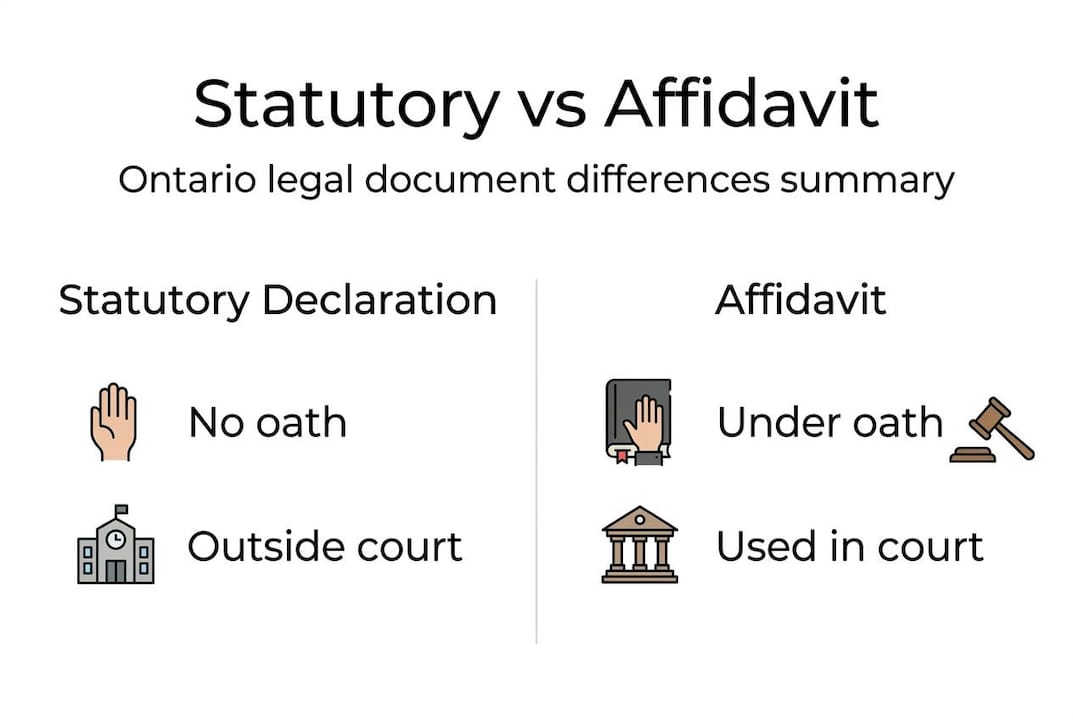
| Feature | Statutory declaration | Affidavit |
|---|---|---|
| Purpose | Affirm facts outside court | Sworn evidence for legal/court use |
| Oath required? | No (solemn declaration) | Yes (sworn oath or affirmation) |
| Primary setting | Government, administrative use | Court proceedings, litigation |
| Who commissions | Commissioner, notary, lawyer | Commissioner, notary, lawyer |
| Legal weight in court | Lower | Higher |
| Remote commissioning | Permitted under O. Reg. 431/20 | Permitted under O. Reg. 431/20 |
| Common example | Immigration identity declaration | Custody hearing evidence |
The differences are more nuanced than they appear. Here is a numbered breakdown of the most critical distinctions:
-
Purpose and context. Statutory declarations are designed for administrative and governmental processes where you need to confirm facts without initiating legal proceedings. Affidavits are designed for situations where your statement will function as direct legal evidence, particularly in court.
-
The oath. An affidavit requires you to swear or affirm the truth of your statement. A statutory declaration uses a solemn declaration. Both carry legal penalties for false statements, but the affidavit’s sworn nature gives it more weight in judicial settings.
-
Legal force in proceedings. Courts will generally accept affidavits as evidence without further formality. Statutory declarations may need to be converted or supplemented if the matter moves to litigation.
-
Document format. Affidavits must follow precise formatting rules, often prescribed by court rules such as the Rules of Civil Procedure in Ontario. Statutory declarations have somewhat more flexibility, though standard templates are widely used.
-
Acceptance by institutions. Some government agencies specifically require one form over the other. Always check the instructions provided by the receiving body.
The affidavit vs statutory declaration guide covers additional nuances for edge cases where the choice is less obvious, such as for immigration applications that might accept either form.
Pro Tip: When in doubt about which document an institution requires, call them directly and ask. Asking takes five minutes. Redoing a rejected document can take weeks.
Remote commissioning is available for both document types under Ontario’s remote commissioning regulation, but the variation in institutional acceptance makes it critical to verify before you proceed with an online session.
Commissioning and usage in Ontario: Practical steps
You now know which document to use. Here’s how to make them legally valid and accepted in Ontario.
Commissioning is the formal process that makes either document legally valid. Without proper commissioning, neither a statutory declaration nor an affidavit holds legal force. Here are the step-by-step processes for each.
To commission a statutory declaration:
- Prepare your declaration using the correct format, including your full legal name, address, and the facts you are declaring.
- Do not sign the document before meeting your commissioner.
- Appear before a commissioner for affidavits, notary public, or lawyer, either in person or via authorized video call under O. Reg. 431/20.
- The commissioner will read or review the declaration with you and confirm you understand its contents.
- You will make your solemn declaration aloud.
- Sign the document in the presence of the commissioner.
- The commissioner signs, stamps, and dates the document to complete commissioning.
To commission an affidavit:
- Draft your affidavit in numbered paragraphs with a proper title and opening identification clause.
- Do not sign it in advance.
- Meet your commissioner, notary, or lawyer in person or via video as permitted under remote commissioning rules.
- Take your oath or affirmation as directed by the commissioner.
- Sign each page of the affidavit in the commissioner’s presence.
- The commissioner completes their certification block, signs, and applies their stamp.
| Common mistake | How to avoid it |
|---|---|
| Signing before commissioning | Always bring an unsigned document to your appointment |
| Missing pages or exhibits | Attach all exhibits before the session and have them initialed |
| Wrong document type | Confirm the required form with the receiving institution in advance |
| Expired commissioner stamp | Verify your commissioner’s credentials are current |
| Remote session not accepted | Call the institution before booking an online session |
For guidance on authorizations and qualifications, review the Ontario notary requirements to understand exactly who is legally authorized to commission your documents. If you prefer to handle the process online, the resource on statutory declaration online provides a full walkthrough specific to Ontario’s remote commissioning procedures.
Pro Tip: Always bring government-issued photo identification to your commissioning appointment, whether in person or online. Commissioners are required to verify your identity before completing the commissioning.
Businesses should note that if you are preparing documents for corporate filings or regulatory submissions, some bodies require additional authentication, such as a notarial certificate or apostille. Always review the submission requirements thoroughly before your appointment so nothing gets missed.
Our perspective: Why the distinction matters more in 2026
Here is something most guides do not tell you: the confusion between statutory declarations and affidavits has actually gotten worse since online commissioning became available, not better. When both documents could be commissioned remotely under O. Reg. 431/20, the procedural similarities made people assume the documents themselves were interchangeable. They are not.
We see this regularly in our work with Ontario residents and businesses. Someone spends time and money commissioning an affidavit for an immigration form that specifically asks for a statutory declaration, or vice versa. The document gets rejected. Deadlines get missed. Applications get delayed by months.
The legal document distinctions that govern these forms have not softened just because commissioning has become more convenient. If anything, the speed of online processes has made people less likely to pause and verify. That pause is worth it. Choosing the right document from the start is the single most important step in the entire process, and it takes less effort than fixing a rejected filing.
Easily commission your statutory declaration or affidavit online
Ready to take the next step? Securing the right legal document does not have to be a confusing or time-consuming process.

At The Online Notary, we help Ontario residents and businesses commission statutory declarations, affidavits, invitation letters, solemn declarations, and more, entirely online. Our service connects you with qualified Ontario commissioners who verify your identity, guide you through the signing process, and deliver properly commissioned documents that meet institutional requirements. Whether you are navigating immigration paperwork, a court filing, or a government application, our Ontario notary services are built for your situation. Learn more about the statutory declaration purpose or explore the different types of affidavits to make sure you start with the right document.
Frequently asked questions
Can I commission both statutory declarations and affidavits online in Ontario?
Yes, both can be commissioned online under Ontario’s O. Reg. 431/20, but you should always confirm with the receiving institution that they accept remotely commissioned versions before proceeding.
What is the main difference between a statutory declaration and an affidavit?
Statutory declarations are used to affirm facts for administrative or government purposes outside of court, while affidavits are sworn statements used as evidence in court proceedings and formal legal matters.
Who can commission these documents in Ontario?
A commissioner for affidavits, notary public, or lawyer authorized under the Commissioners for Taking Affidavits Act can commission both statutory declarations and affidavits in Ontario.
What happens if I use the wrong document?
Using the incorrect document type will likely result in rejection by the court, government agency, or institution receiving it, and you will need to restart the process from scratch, potentially missing critical deadlines.