Role of Witnesses in Online Notary: Ontario Guide

TL;DR:
- In online notarizations, witnesses are impartial third parties who observe, verify, and sign during the session to ensure legality. They confirm the signer’s identity, attest to voluntary signing, and create a reliable legal record, often signing themselves. Ontario permits fully remote witnessing, but witnesses must be disinterested, of legal age, and not serve as the notary to maintain document validity.
A witness in online notarization is defined as an impartial, disinterested third party who observes a signer execute a document in real time during a remote notary session. The role of witnesses in online notary services goes beyond passive observation. Witnesses confirm the signer’s identity, attest to the voluntary nature of the signing, and often sign the document themselves to create a complete legal record. In Ontario, remote witnessing is fully permitted when the document type and technology platform meet provincial requirements. Theonlinenotary facilitates this process for affidavits, statutory declarations, solemn declarations, and more, ensuring every session meets Ontario’s legal standards.
What is the role of witnesses in online notary sessions?
Witnesses in remote notarizations perform four core functions that directly protect a document’s legal standing. Each function must happen live, during the same video session as the notary and signer.
-
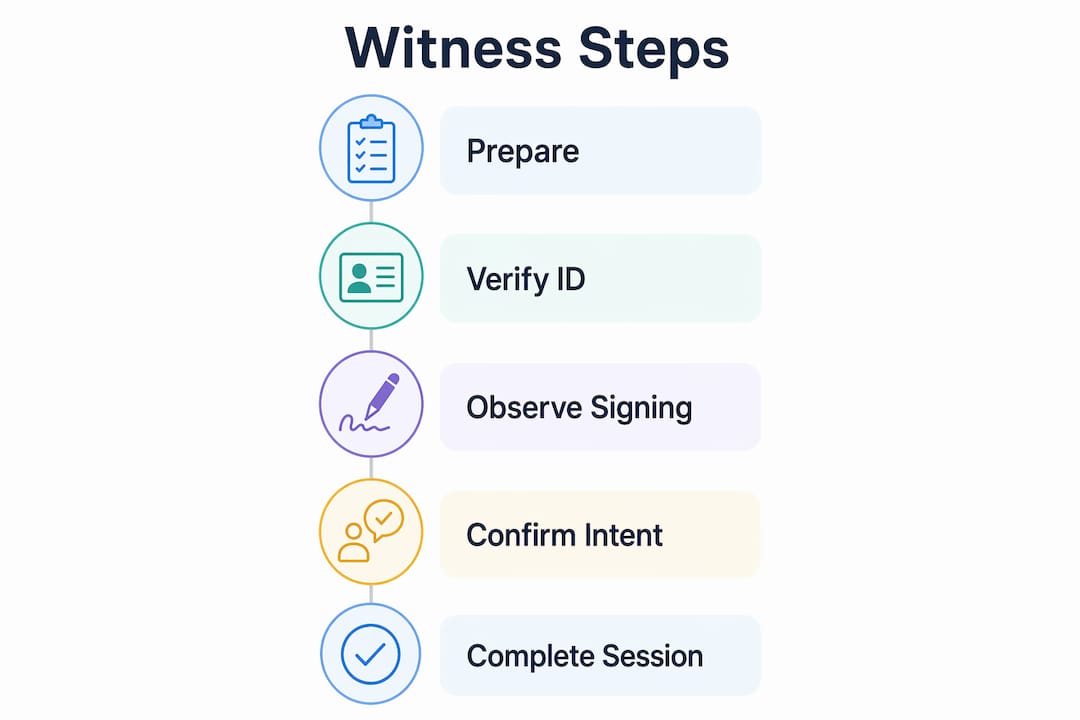
Observe the entire signing process. The witness must watch the signer execute the document from start to finish. Witnesses must observe signing live; post-signing witness participation is invalid and risks rejection of the notarized document.
-
Confirm the signer’s identity. Witnesses verify that the person signing is who they claim to be. In cases where the signer lacks acceptable government-issued ID, a credible identifying witness can step in. A credible identifying witness personally knows the signer and affirms their identity under oath, substituting for traditional ID entirely.
-
Attest to free will and mental competence. The witness confirms the signer is acting voluntarily and appears mentally capable. This protects against future legal challenges claiming the signer was coerced or incapacitated.
-
Sign the document and notary journal. Most documents requiring witnesses also require the witness’s signature. This creates a paper trail that courts can rely on if the document’s validity is ever questioned.
All four functions occur simultaneously. All participants must be present throughout the signing ceremony on video for the notarization to hold legal weight. RON platforms typically support up to two witnesses in a single video session alongside the notary and signer.
Pro Tip: Confirm with your notary service how many witnesses your specific document requires before scheduling. Some documents, like wills, may require two witnesses, while others require none.

Who can serve as a witness in online notarization?
Eligibility for witnessing is stricter than most people expect. The rules exist to prevent conflicts of interest that could invalidate a document years after it was signed.
- Disinterested party requirement. A witness must have no financial or beneficial interest in the document. Using interested parties as witnesses can lead courts to invalidate documents later. This is the single most common mistake people make when arranging witnesses.
- Age and mental competence. Witnesses must generally be at least 18 years old and of sound mind. A witness who cannot fully understand what they are observing cannot provide legally meaningful attestation.
- Family members as witnesses. A family member can serve as a witness only if they have no stake in the document. A sibling witnessing a will that names them as a beneficiary is disqualified. A sibling witnessing a statutory declaration that does not affect them financially is generally acceptable.
- Notaries cannot witness their own notarizations. Notaries must not act as witnesses for documents they notarize. The roles are legally separate, and combining them creates a conflict of interest that undermines the document’s integrity.
- Credible identifying witnesses. This is a specialized category. When a signer has no government-issued ID, a person who knows the signer personally can serve as a credible identifying witness. They swear under penalty of perjury that the signer is who they claim to be. This is a legally binding oath, not a casual confirmation.
- Document-specific exceptions. Some document types carry their own witness rules under Ontario law. Always verify the requirements for your specific document before the session.
Pro Tip: When in doubt about whether your chosen witness qualifies, ask Theonlinenotary before the session. Replacing a disqualified witness after the fact requires a full re-notarization.
How do Ontario’s witness rules compare to other jurisdictions?
Ontario’s approach to remote witnessing is among the more permissive frameworks in North America. Ontario permits fully remote witnessing in online notarizations when the document type and technology platform comply with provincial rules. That flexibility is not universal.
As of early 2026, approximately 45 states and the District of Columbia have enacted permanent laws authorizing Remote Online Notarization. That number shows broad acceptance of the technology, but the witnessing rules within those laws vary widely.
| Jurisdiction | Remote notarization allowed | Remote witnessing allowed | Notes |
|---|---|---|---|
| Ontario, Canada | Yes | Yes | Document type and platform must comply with provincial rules |
| Most U.S. RON states | Yes | Varies by state | Some require physical witness presence even when notary is remote |
| States without RON laws | No | No | Traditional in-person notarization required |
| Florida | Yes | Yes | Witnesses must appear live on video during the session |
| States with hybrid rules | Yes | Partial | Remote notary permitted; witness must be physically present with signer |
The most important distinction is between remote notarization and remote witnessing. A state can allow a notary to work remotely while still requiring the witness to be physically present in the same room as the signer. Ontario does not impose that restriction, which makes online notarization in Ontario more accessible for people who cannot gather in person.
Not all documents eligible for remote notarization allow remote witnessing. Verify the specific document and jurisdiction rules before scheduling any session.
What practical steps should you take to arrange witnesses in Ontario?
Preparation before the session determines whether the notarization succeeds or needs to be redone. Follow these steps to get it right the first time.
- Identify your witness early. Choose someone who meets the disinterested party requirement and is available at the scheduled session time. Confirm their availability at least 48 hours in advance.
- Notify Theonlinenotary about witness participation. Tell the notary service how many witnesses will join and whether any witness is serving as a credible identifying witness. This lets the notary prepare the correct oaths and session structure.
- Prepare your witness for identity verification. Remote witnesses undergo identity checks similar to those applied to signers. Your witness should have a valid government-issued ID ready and expect to complete a brief verification process at the start of the session.
- Test technology in advance. Each participant needs a device with a working camera and microphone. RON platforms support up to 10 devices per session, but audio and video clarity matter more than device count. A witness joining on a phone with poor lighting can cause delays.
- Do not pre-sign the document. The signer must not sign before the witness and notary are present on the call. Pre-signing before the witness appears invalidates the notarization entirely.
- Have your witness join on time. A witness who joins after the signer has already begun the process may disqualify the session. All parties must be present from the start.
For step-by-step guidance specific to Ontario, Theonlinenotary provides detailed notarization instructions that walk you through every stage of the process, including witness preparation.
Pro Tip: Send your witness a short written summary of what to expect: identity check, oath or affirmation, watching the signing, and then signing the document themselves. Witnesses who know the process move through it faster and with fewer errors.
Key Takeaways
Witnesses in Ontario online notarizations must be impartial, present throughout the entire video session, and prepared to verify identity, attest to free will, and sign the document to ensure legal validity.
| Point | Details |
|---|---|
| Witnesses must be disinterested | Any financial or beneficial interest in the document disqualifies a witness. |
| Live presence is mandatory | Witnesses must observe the signing in real time; joining late or post-signing invalidates the session. |
| Credible identifying witnesses fill ID gaps | When a signer lacks government ID, a credible witness can substitute by swearing an oath. |
| Ontario allows fully remote witnessing | Provincial rules permit witnesses to join by video, unlike some U.S. states that require physical presence. |
| Notaries cannot witness their own work | The notary and witness roles must be filled by separate, independent individuals. |
Why the witness role matters more than most people realize
The witness requirement in online notarization is often treated as a formality. It is not. I have seen documents challenged in court years after signing, and the first thing opposing counsel examines is whether the witness was truly disinterested. A family member who stood to inherit under the document they witnessed is a gift to anyone trying to invalidate that document.
The shift to remote notarization has actually made witness integrity easier to verify, not harder. Video sessions create a timestamped record of who was present, when they joined, and what they observed. That record is harder to dispute than a signature on a paper document where the witness may have signed hours later in a different room.
The area where I see the most errors is the credible identifying witness category. People treat it as a workaround for forgetting their ID. It is not. A credible identifying witness takes a legally binding oath and accepts personal liability if the identity claim turns out to be false. Anyone willing to serve in that role should understand the weight of what they are agreeing to.
Ontario’s framework for online notary legalities is well-constructed, but it only protects you if you follow it correctly. The technology is reliable. The legal framework is clear. The weak point is almost always human error in witness selection and preparation.
— Ken
Theonlinenotary: expert witness guidance for Ontario notarizations
Arranging witnesses for an online notarization does not need to be complicated. Theonlinenotary provides 24/7 online notary services in Ontario for affidavits, statutory declarations, solemn declarations, invitation letters, and more. Every session is structured to meet Ontario’s witness requirements from the start, so you are not left guessing about eligibility or procedure.

The platform guides you through witness preparation, identity verification, and document signing in a single video session. Whether you need one witness or two, or you are working with a credible identifying witness because your signer lacks ID, Theonlinenotary’s notaries know exactly how to structure the session for legal compliance. Book your session today and get your documents notarized correctly the first time.
FAQ
What does a witness do in an online notary session?
A witness observes the signer execute the document in real time, confirms the signer’s identity and voluntary intent, and signs the document themselves. All of this happens live during the same video session as the notary.
Do I need witnesses for online notary in Ontario?
Whether you need witnesses depends on the document type. Affidavits and statutory declarations often require witnesses, while other documents may not. Confirm the requirement with Theonlinenotary before your session.
Can a family member be a witness for online notarization?
A family member can serve as a witness only if they have no financial or beneficial interest in the document. A beneficiary named in the document being notarized is disqualified as a witness.
What is a credible identifying witness in online notarization?
A credible identifying witness is someone who personally knows the signer and swears under oath to the signer’s identity when the signer lacks acceptable government-issued ID. This is a legally binding oath with personal liability attached.
Can the notary also serve as the witness in Ontario?
No. Notaries must not act as witnesses for documents they notarize. The two roles must be filled by separate, independent individuals to preserve impartiality and legal validity.
Recommended
- Online Notary Guide Ontario 2026: Notarize Documents Remotely - The Online Notary
- Online Notary Verification in Ontario: Step-by-Step - The Online Notary
- Step-by-step online notarization instructions for Ontario - The Online Notary
- The Complete Guide to Using an Online Notary Public for Affidavits and Declarations in Ontario (2025) - The Online Notary