Proof of residency affidavit in Ontario: your complete guide

TL;DR:
- A proof of residency affidavit is a sworn legal document confirming where you live, used when standard docs aren’t available.
- It is commonly used by students, newcomers, informal renters, and people in temporary accommodations in Ontario.
- To be valid, affidavits must be properly drafted, sworn before a commissioner or notary, and sometimes accepted online.
Most Ontario residents assume that proving where you live means handing over a utility bill or a signed lease. That assumption leaves a lot of people stuck. Students living in university residences, newcomers who just arrived in the province, renters whose landlord handles all the utilities, and anyone staying with family temporarily often can’t produce those “standard” documents. A proof of residency affidavit fills that gap. This guide walks you through exactly what a proof of residency affidavit is, who needs one, what makes it legally valid in Ontario, how to draft and notarize it, and how to give it the best chance of being accepted.
Table of Contents
- What is a proof of residency affidavit?
- Who needs a proof of residency affidavit and when?
- Requirements for a valid proof of residency affidavit in Ontario
- Drafting and getting your affidavit commissioned or notarized
- Our perspective: what most guides miss about residency affidavits
- Secure your proof of residency affidavit with Ontario notary experts
- Frequently asked questions
Key Takeaways
| Point | Details |
|---|---|
| Alternative proof option | A proof of residency affidavit helps when standard documents like bills or leases are unavailable. |
| Institution acceptance varies | Always check with the requesting organization before depending only on an affidavit for residency. |
| Follow legal steps | To be valid, affidavits need the correct legal elements and can face penalties if falsified. |
| Online notarization | Remote commissioning and notarization in Ontario make the affidavit process quicker and more accessible. |
What is a proof of residency affidavit?
Now that we’ve established why proving residency can be a challenge, let’s clarify what a proof of residency affidavit actually is.
An affidavit is a written statement that a person swears or affirms to be true in front of a qualified witness, such as a notary public or a commissioner of oaths. The person making the statement is called the deponent. Once signed and witnessed, the document carries legal weight because the deponent is declaring under oath that every word is accurate. A proof of residency affidavit, specifically, is a sworn statement confirming where a person currently lives.
“An affidavit is a written statement that a person swears or affirms is true. It is used in legal proceedings and can be accepted by banks, government agencies, schools, healthcare providers, and landlords, though it may not replace standard documents in all cases; some prefer third-party records first.”
This distinction matters. The affidavit is not just a letter or a declaration you type up yourself. It becomes a legal document the moment it is commissioned or notarized. That’s precisely why institutions take it seriously, and why providing false information on one carries real legal consequences.
Who typically uses a proof of residency affidavit?
- University and college students living in campus residences, where no lease or separate utility bill exists in their name
- New immigrants and permanent residents who have not yet built up a paper trail of bills or bank statements at their Ontario address
- Renters in informal arrangements, such as people renting a room from a friend or family member without a formal lease
- People in temporary housing, including those staying in a hotel, hostel, or extended-stay property during a move
- Young adults recently out of their parents’ home who have no bills, credit cards, or leases in their own name yet
You can read a proof of address affidavit explained in detail to see exactly how each of these situations maps to the document’s structure and purpose.
Where is it accepted?
Banks, schools, healthcare clinics, landlords, and several government agencies will consider a proof of residency affidavit. However, it is not a universal pass. Some organizations, especially those handling financial compliance or immigration paperwork, will ask for a utility bill or official bank statement first. A notarized residency affidavit may be the deciding document when you can’t meet the primary requirement, for example when you’re registering for documents for OBSP screening in Ontario and lack a standard qualifying document.

The honest reality is that acceptance is always institution-specific, and checking in advance is non-negotiable.
Who needs a proof of residency affidavit and when?
Understanding the core definition, let’s look at real-world examples where you might actually need a proof of residency affidavit.
Common situations where an affidavit solves the problem
- Applying for OSAP (Ontario Student Assistance Program) and lacking a lease or utility bill
- Opening a bank account or applying for a credit product when all household bills are in a spouse’s or parent’s name
- Enrolling a child in a school district when you’ve recently moved and your address hasn’t been updated on official records yet
- Applying for Ontario health coverage as a newcomer before receiving formal mail at your address
- Registering for provincial services as a new resident who doesn’t yet have their driver’s license or provincial ID updated
The OSAP proof of residency process confirms that for renters and new residents without utility bills or leases, a third-party witness affidavit adds verification that many institutions find acceptable. That same principle applies across many provincial service applications.
Third-party witness affidavits
Sometimes, the affidavit isn’t just about you making a statement. A third-party witness affidavit means a parent, landlord, or trusted adult makes the sworn statement on your behalf, confirming that you reside at a particular address. This format is especially powerful for young adults or newcomers who genuinely have no independent documentation. The third party signs the affidavit under oath, lending their credibility to your claim.
For more real-world guidance on understanding address affidavits in Ontario, it’s worth reviewing how different document types are weighted by institutions before you decide which route to take.
When an affidavit is accepted vs. when a formal document is required
| Situation | Affidavit accepted? | Formal document required? |
|---|---|---|
| Student applying for OSAP without a lease | Often yes, with third-party witness | Not always, but preferred |
| Opening a bank account as a newcomer | Sometimes, with notarization | Preferred for higher-tier accounts |
| Enrolling a child in a local school | Usually yes | May require supplementary ID |
| Applying for Ontario OHIP as a newcomer | Case by case | Official address confirmation preferred |
| Renting a new apartment | Rarely; landlords prefer a lease/bill | Yes, in most cases |
| Registering for OBSP as a newcomer | Possible, confirm first | Depends on clinic |
Pro Tip: Always call ahead. No table or general guide can replace a two-minute phone call to the institution you’re dealing with. Ask specifically whether they accept a notarized proof of residency affidavit and whether a third-party witness format satisfies their requirements.
Requirements for a valid proof of residency affidavit in Ontario
Knowing who needs a proof of residency affidavit, let’s break down what makes one legally valid and credible in Ontario.
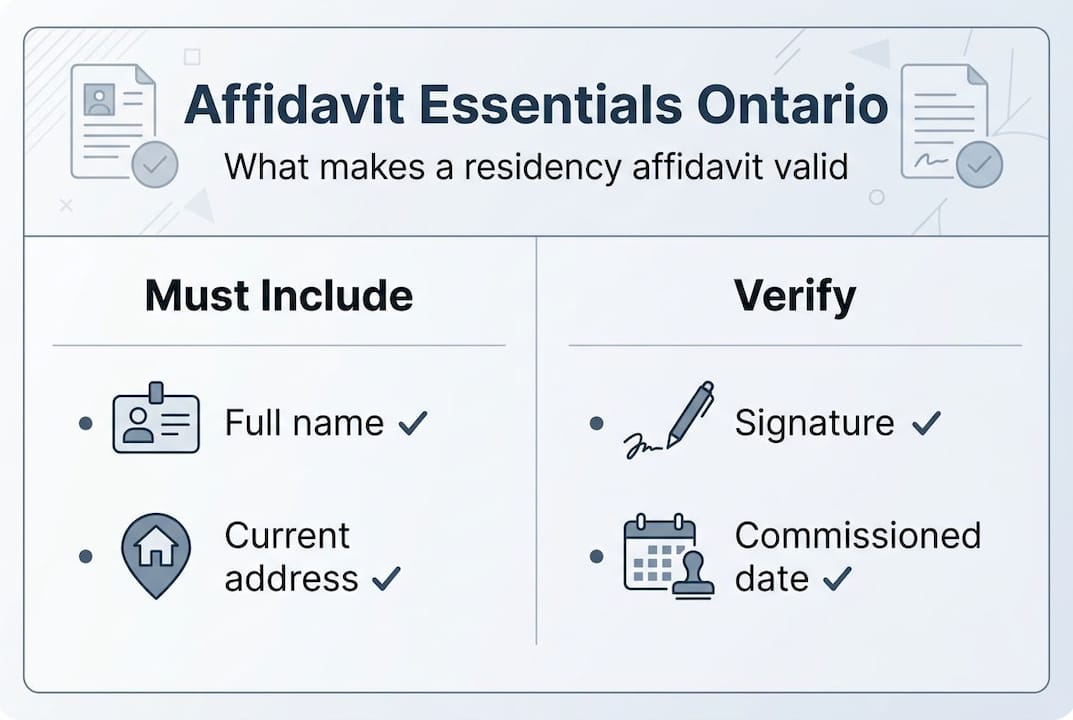
There is no single official government template for a proof of residency affidavit in Ontario. The province does not hand you a form to fill in. Instead, you draft a document that includes all required legal elements, and then have it sworn before a qualified commissioner of oaths or notary public. The Ontario affidavit guidance is clear: custom-drafted affidavits must conform to standard legal elements, and false statements carry legal penalties that can include prosecution for perjury.
Steps to create a valid affidavit
- Write the heading — Include your full legal name, your current address, and the date of the statement.
- Draft the body — State clearly that you reside at the specified address and include how long you have lived there. Add any relevant context, such as your living arrangement or why you lack standard address documents.
- Attach supporting documents — Where possible, attach corroborating evidence such as a recent letter, a photo ID showing a nearby area, or a statement from your landlord.
- Sign in front of a commissioner or notary — Do not sign before your appointment. The signature must be witnessed in real time, whether in person or via an online video session.
- Obtain the commissioner’s seal and signature — This finalizes the document’s legal status.
- Make certified copies if needed — Some institutions want the original; others will accept a notarized copy.
This process is explained in more detail in the guide on writing an affidavit in Ontario, including language examples and formatting best practices.
Legal warning: Signing a false affidavit is not just a bureaucratic problem. It can lead to criminal charges. The statement you swear is treated the same as testimony in court. Only include facts you know to be completely true.
Pro Tip: If you include supporting documentation alongside your affidavit, such as a screenshot of your rental agreement text message thread or a photo of your name on the mailbox, it dramatically increases your chances of acceptance. Affidavits with context are far more credible than bare-minimum statements.
Drafting and getting your affidavit commissioned or notarized
With requirements in mind, here’s exactly how you can draft and commission your affidavit without expensive mistakes.
What to include in the document
Your affidavit should contain:
- Full legal name of the deponent (the person making the statement)
- Current residential address in full, including unit number and postal code
- Statement of truth — a clear, first-person sworn statement confirming residency
- Duration of residency — how long you have lived at the address
- Reason for the affidavit if relevant, for example, “I do not have a utility bill in my name because utilities are included in my rent”
- Date of signing
- Signature of the deponent
- Signature and seal of the commissioner of oaths or notary public
In-person vs. online commissioning: which works for you?
| Feature | In-person | Online |
|---|---|---|
| Where you go | Notary office, bank, ServiceOntario | Your home, via video call |
| Speed | Same day, if appointment available | Often same day or within hours |
| Cost | $50 to $150+ depending on location | Typically $40 to $100 |
| Convenience | Travel required | No travel needed |
| Accepted everywhere? | Almost universally | Most institutions, confirm first |
| Best for | Those with easy access to a notary | Students, newcomers, rural residents |
Ontario allows remote commissioning under provincial rules, which means you can have your affidavit commissioned via a secure video call with a licensed commissioner. This is a genuine game-changer for people in rural areas, students living on campus, or newcomers who haven’t yet navigated local services.
Steps to commission your affidavit online
- Draft your affidavit using the elements listed above.
- Book an appointment with an Ontario-licensed online notary or commissioner.
- Join the secure video call with your photo ID ready.
- Read and confirm your statement aloud before signing.
- Sign the document on screen, witnessed in real time.
- Receive your commissioned, sealed affidavit by email, usually as a certified PDF.
The full process for commissioning affidavits online is accessible to most Ontario residents regardless of where they live. You can also learn more about getting documents notarized online to understand what qualifies as a valid digital seal in Ontario.
Pro Tip: Before you book your appointment, send a quick email or call the institution receiving your affidavit. Ask whether they will accept a digitally commissioned document with an electronic seal. Most modern institutions will, but some government programs still require a wet signature copy. Knowing this beforehand saves you from having to redo the process.
Our perspective: what most guides miss about residency affidavits
You now understand the process, but here’s some expert perspective most Canadians never hear.
Most online guides treat the proof of residency affidavit as a fill-in-the-blank problem. Draft the right words, get a stamp, done. What they consistently miss is that acceptance is institutional, not universal. An affidavit that satisfies a college registrar may be turned away by a bank’s compliance department without a second look. The document itself is only half the equation. The other half is whether the organization you’re presenting it to has internally approved that format.
We’ve seen well-drafted, properly notarized affidavits get rejected because a single detail was missing. No explanation of why the applicant had no utility bill. No third-party witness when the institution expected one. No supporting attachment to back up the claim. The affidavit was technically valid but lacked the context that builds confidence in a reviewer’s mind.
Online commissioning is a genuine breakthrough for students, newcomers, and rural residents who previously had to take time off work or travel significant distances just to get a document witnessed. But not every institution has caught up to this reality. The legalities of online notarization in Ontario are clear and well-established, yet some organizations still look at a digital seal with suspicion. The solution is always to confirm acceptance before you invest time in the process.
Build your affidavit with detail, back it up with whatever evidence you have, and always verify with the institution first. That three-step habit will save you more headaches than any template ever could.
Secure your proof of residency affidavit with Ontario notary experts
If you want trusted support or quick notarization for your residency affidavit, here’s where to start.
Getting your proof of residency affidavit done correctly the first time saves you the frustration of a rejection. Professional online notary services take the guesswork out of drafting, formatting, and commissioning your document.

Our Ontario notary services include affidavit commissioning, statutory declarations, solemn declarations, invitation letters, and more, all completed through secure video sessions available seven days a week. No office visits, no waiting rooms, no uncertainty about whether your document meets legal standards. We also offer guidance on the full range of types of affidavits available in Ontario, so you always know you’re using the right document for your specific situation. Start your session today and have a properly commissioned affidavit ready within hours.
Frequently asked questions
Is a proof of residency affidavit always accepted everywhere in Ontario?
No, acceptance depends on the institution. Some prefer third-party documents like utility bills or bank statements and may only consider an affidavit as a secondary option.
Can I use a proof of residency affidavit if I just moved to Ontario?
Yes, a proof of residency affidavit is especially useful for newcomers. As OSAP’s residency guidance confirms, the third-party witness format adds credibility when you have no bills or leases in your name yet.
Is there a government-issued template for a proof of residency affidavit?
No official template exists. You draft your own document using standard legal elements, and false statements carry penalties under Ontario law.
Can a proof of residency affidavit be notarized online in Ontario?
Yes. Ontario permits remote commissioning under provincial rules, making online notarization a fully legal and convenient option for most residents.
What happens if I make a false statement on my affidavit?
Making a false statement on a sworn affidavit is a serious legal matter. As outlined in Ontario’s affidavit guidance, it can result in criminal penalties including prosecution for perjury.