OSAP Affidavit: Ontario Student Guide for 2026

TL;DR:
- An OSAP affidavit is a sworn statement used by Ontario students to verify information when official documents are missing. It must be prepared carefully, signed by a qualified official, and submitted at least 40 days before the study period ends to ensure timely processing. Proper completion and early submission help prevent delays and rejection of funding.
An OSAP affidavit is a legally sworn statement used by Ontario students to verify personal or financial information that supports their OSAP financial aid application. It is not a standalone form you create freely. The affidavit supplements specific government forms when official documentation is missing or unavailable. Knowing exactly when you need one, how to prepare it correctly, and where to get it signed can be the difference between receiving your funding on time and facing a costly delay.
What is an OSAP affidavit and when do you need one?
An OSAP affidavit is a sworn supplemental statement submitted alongside official OSAP forms to declare facts that cannot be proven through standard documentation. It covers situations where formal records simply do not exist or cannot be retrieved. The Ministry of Colleges and Universities accepts affidavits as a last resort, not a first option.
Students most commonly need a financial aid affidavit in these situations:
- Foreign income not reported to the Canada Revenue Agency (CRA). A parent who earned income abroad may have no Canadian tax record. An affidavit declares the amount, source, and period of that income.
- Sole support parent declarations. A student claiming sole support status must swear that no other parent or guardian contributes financially to the household.
- Marital status verification. Separation or divorce without formal legal documentation may require a sworn statement confirming the current status.
- Missing income proof from a self-employed or informal worker. When no T4 slip or Notice of Assessment exists, an affidavit can fill the gap.
- Deceased parent income. Estates and closed accounts often leave no accessible records for the relevant tax year.
Affidavits are supplemental tools, not substitutes for retrievable information. Before submitting one, you must make a genuine effort to obtain the official record. OSAP reviewers will flag an affidavit submitted in place of a document that clearly could have been retrieved.
Pro Tip: Contact the CRA directly at 1-800-959-8281 to request a copy of a missing Notice of Assessment before assuming an affidavit is your only option.
How to prepare a valid OSAP affidavit
Preparing a valid affidavit requires more than writing down what you know. Incomplete or vague affidavits often result in rejection or requests for additional documentation. Every affidavit submitted to OSAP must meet specific content and format standards.
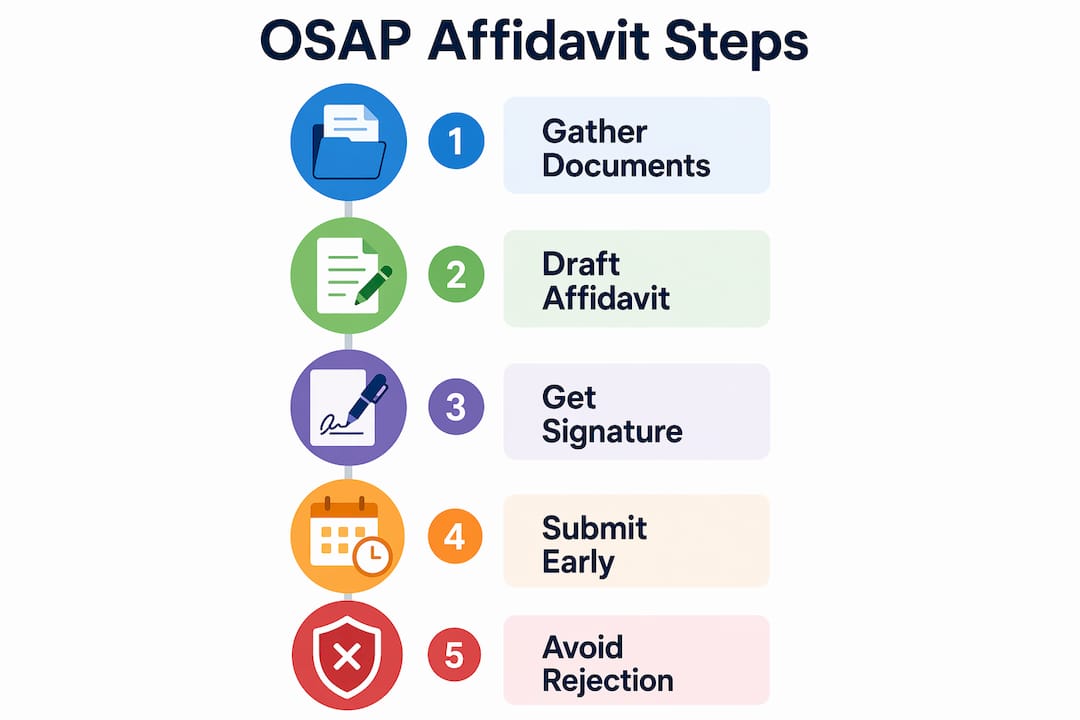
Follow these steps to prepare one correctly:
- State the date and location. The affidavit must open with the exact date and the city or town where it is being sworn. This establishes jurisdiction and timing.
- Identify the deponent clearly. The person swearing the affidavit must state their full legal name, address, and their relationship to the student. A parent swearing on behalf of a student must name the student explicitly.
- Describe the missing information in detail. Vague language fails. State the specific income amount, the source (employer name, type of work, country), the tax year, and the reason no official record exists.
- Explain why official documentation is unavailable. OSAP reviewers need to understand why the standard document cannot be produced. A clear, factual explanation prevents follow-up requests.
- Align the content with the correct affidavit type. Different affidavit types cover marital status, sole support parent status, and foreign income declarations. Each type has specific required details.
- Leave space for the official’s signature, seal, and commission expiry date. The affidavit is not valid until it is sworn before an authorized official.
A common mistake students make is treating the affidavit as a casual letter. Proper affidavit preparation requires detailed sworn statements that align precisely with OSAP documentation requirements. Theonlinenotary provides step-by-step affidavit preparation guidance tailored to Ontario requirements.
Pro Tip: Write the affidavit in plain, factual sentences. Avoid emotional language or opinions. OSAP reviewers assess facts, not circumstances.

Where and how to get your OSAP affidavit signed in Ontario
An OSAP affidavit must be signed before a lawyer, commissioner of oaths, or notary public who verifies your identity and applies an official seal. The seal and signature are what give the document legal force. Without them, OSAP will not accept the affidavit.
Who can sign your affidavit
- Commissioner of oaths. This is the most accessible option. Commissioners of oaths are available at municipal offices, community legal clinics, and law offices across Ontario.
- Notary public. A notary public carries broader authority than a commissioner of oaths and can certify documents for international use as well.
- Lawyer. Any licensed Ontario lawyer can witness and commission an affidavit.
What to bring to your signing appointment
You must bring government-issued photo ID to every signing appointment. The official is legally required to verify your identity before administering the oath. Acceptable ID includes a valid Ontario driver’s license, Canadian passport, or permanent resident card.
The official will sign the affidavit, print their name and title, apply their official seal or stamp, and note their commission expiry date. All four elements must appear on the document for OSAP to accept it.
| Signing official | Where to find them | Cost range |
|---|---|---|
| Commissioner of oaths | Municipal offices, legal clinics | Low to no cost |
| Notary public | Law offices, online services | Moderate fee |
| Lawyer | Law firms, legal aid offices | Varies by firm |
Pro Tip: Theonlinenotary offers online affidavit notarization in Ontario with no travel required. This is particularly useful for students in rural areas or those with tight schedules.
For a full breakdown of who can sign affidavits in Ontario, including 2026 updates, Theonlinenotary has published a detailed reference guide.
How and when to submit your OSAP affidavit
Timing your submission correctly is as critical as preparing the affidavit itself. All required documents, including affidavits, must be submitted no later than 40 days before the end of your study period. That deadline exists because the Ministry requires 4–6 weeks to review uploaded documents after receipt.
Here is the submission process:
- Log in to your OSAP account at ontario.ca/osap. Navigate to the document upload section within your application.
- Upload the signed affidavit as a PDF or clear image. The file must be legible. Blurry scans are a common reason for processing delays.
- Attach all supporting documents. An affidavit submitted without the corresponding OSAP form it supplements will be flagged as incomplete.
- Confirm the upload was received. Your OSAP account will show a status update once the document is received. Check this within 24–48 hours of uploading.
- Track your application status. The Ministry issues a Notice of Assessment 4–8 weeks after submission of required documents. Monitor your account regularly.
| Submission milestone | Timeline |
|---|---|
| Affidavit submission deadline | 40 days before study period ends |
| Ministry document review | 4–6 weeks after receipt |
| Notice of Assessment issued | 4–8 weeks after full submission |
Submitting close to the deadline risks delays or application cancellation. A student who uploads an affidavit 35 days before their study period ends has already missed the window for guaranteed processing. Submit early and confirm receipt.
Common reasons OSAP affidavits get rejected and how to avoid them
Affidavit rejection is more common than most students expect. The good news is that nearly every rejection reason is preventable with preparation.
The most frequent problems include:
- Missing or incomplete identity information. The deponent’s full name, address, and relationship to the student must appear clearly.
- No official seal or stamp. An affidavit signed by a commissioner of oaths without their official seal is legally invalid.
- Vague income descriptions. Stating “my parent earned money overseas” is not sufficient. OSAP requires specific amounts, sources, and tax years.
- Submitting an affidavit instead of a retrievable document. Affidavits do not replace official records that could have been obtained. Reviewers will return the file and ask for the proper document.
- Wrong affidavit type for the situation. A marital status affidavit cannot substitute for a foreign income declaration.
If OSAP requests further clarification after you submit, respond through your online account and upload any additional documents promptly. Do not wait for a second notice. Processing time restarts each time a new document is added.
“Affidavits are meant as exceptional declarations. Students who treat them as a shortcut to avoid gathering proper documentation will face delays, not avoid them.”
Pro Tip: Before submitting, have someone unfamiliar with your situation read the affidavit. If they cannot understand the income source, amount, and reason for missing documents from the text alone, rewrite it.
Key Takeaways
An OSAP affidavit is a last-resort sworn statement that supplements missing documentation, and submitting it correctly and on time is the single most important factor in avoiding funding delays.
| Point | Details |
|---|---|
| Affidavits are supplemental | Submit an affidavit only after exhausting all efforts to obtain official records. |
| Content must be specific | Include the date, deponent identity, income amounts, sources, and reasons for missing documents. |
| Official signing is mandatory | A lawyer, notary public, or commissioner of oaths must sign, seal, and date the affidavit. |
| Submit 40 days early | OSAP requires documents at least 40 days before your study period ends for timely processing. |
| Track your submission | Confirm document receipt in your OSAP account and monitor for a Notice of Assessment. |
What I have learned from watching students get this wrong
The most common mistake I see is students treating the affidavit as a workaround. They assume that because an affidavit is a sworn statement, it carries the same weight as a tax return or a court order. It does not. OSAP reviewers are trained to identify when a retrievable document was simply not pursued. An affidavit submitted in place of a CRA Notice of Assessment that could have been ordered online in 10 minutes will be returned every time.
The second mistake is leaving the signing to the last minute. Students often prepare a solid affidavit and then spend two weeks trying to find a commissioner of oaths with availability. Online notarization services have changed this significantly. Theonlinenotary, for example, handles affidavit notarization entirely online, which removes the scheduling problem entirely.
My honest advice: treat the affidavit like a legal document, because it is one. Write it in plain, factual language. Get it signed by a qualified official with a proper seal. Submit it well before the 40-day deadline. And check your OSAP account after uploading to confirm the document was received. Students who follow these four steps rarely have problems.
— Ken
Theonlinenotary: get your affidavit signed without leaving home
Getting your OSAP affidavit notarized does not have to mean taking time off class or traveling across town to find a commissioner of oaths.

Theonlinenotary provides professional notarization services for affidavits, statutory declarations, and solemn declarations entirely online, available 24/7 across Ontario. The process is straightforward: upload your document, verify your identity by video, and receive your signed and sealed affidavit ready for OSAP submission. For students managing tight deadlines and full course loads, this is a practical way to meet the 40-day submission requirement without added stress. Visit Theonlinenotary to book your affidavit signing today.
FAQ
What is an OSAP affidavit used for?
An OSAP affidavit is a sworn statement submitted to verify personal or financial information when official documents are unavailable. Common uses include foreign income declarations, sole support parent status, and marital status verification.
Who can sign an OSAP affidavit in Ontario?
A lawyer, notary public, or commissioner of oaths can sign an OSAP affidavit. The official must verify your identity and apply an official seal for the document to be valid.
How early should I submit my OSAP affidavit?
Submit your affidavit at least 40 days before your study period ends. The Ministry requires 4–6 weeks to review documents after receipt, so late submissions risk funding delays.
Can I write my own OSAP affidavit?
You can draft the affidavit yourself, but it must follow OSAP’s required format and include specific details such as income amounts, sources, and the reason official documents are unavailable. It becomes legally valid only after being sworn before an authorized official.
What happens if my OSAP affidavit is rejected?
OSAP will request additional documentation or clarification through your online account. Respond promptly and upload any revised or supporting documents, as processing time restarts with each new submission.