Ontario statutory declaration: requirements, process, and solutions

TL;DR:
- Statutory declarations in Ontario have the same legal weight as sworn oaths and are binding.
- Only authorized professionals like notaries, lawyers, or commissioners can witness them, especially remotely.
- Mistakes such as false statements or improper witnessing can lead to criminal penalties and document rejection.
A statutory declaration in Ontario carries far more legal weight than most people realize. Many individuals and businesses treat it like a simple form, yet it functions with the same gravity as a sworn oath in the eyes of the law. Confusing it with a regular letter or even a standard affidavit is a surprisingly common mistake. And with the rise of remote commissioning since 2020, new questions about online validity have created even more uncertainty. This guide walks you through exactly what a statutory declaration is, who can witness it, how to complete one remotely, and what costly mistakes to avoid.
Table of Contents
- What is an Ontario statutory declaration?
- Who can take and witness a statutory declaration in Ontario?
- How does remote (online) statutory declaration work in Ontario?
- Common mistakes and legal consequences
- Why understanding statutory declarations is more crucial than ever
- Simplify your statutory declaration with trusted online notary services
- Frequently asked questions
Key Takeaways
| Point | Details |
|---|---|
| Equal legal force | Statutory declarations in Ontario are as binding as sworn oaths when made correctly. |
| Authorized witness required | Only certain officials, like notaries, can legally commission your statutory declaration. |
| Remote commissioning accepted | Since 2020, Ontario allows remote online statutory declarations with specific steps for validity. |
| Errors have penalties | Mistakes or false statements can result in fines or legal consequences for all involved. |
What is an Ontario statutory declaration?
A statutory declaration is not just a formal piece of paper. It is a legally binding written statement in which you declare certain facts to be true, and that declaration carries real legal consequences if it turns out to be false.
Under Ontario law, a statutory declaration is a written statement of facts declared true in the form prescribed by the Ontario Evidence Act, carrying the same legal weight as an oath. That means the moment you sign it and it gets witnessed, you are legally bound to the truth of every word inside it. This is not something you can walk back easily.
The standard language at the end of any Ontario statutory declaration reflects just how serious this is. The Ontario Evidence Act prescribes the closing words: “I make this solemn declaration conscientiously believing it to be true and knowing that it is of the same force and effect as if made under oath.” This closing phrase is not optional language. It is required, and it is what gives the document its legal force.
“I make this solemn declaration conscientiously believing it to be true and knowing that it is of the same force and effect as if made under oath.” — Required closing language, Ontario Evidence Act
Understanding the purpose of statutory declarations helps clarify when you actually need one versus when another document type might be more appropriate.
Where are statutory declarations commonly required?
- Government benefit applications and identity verification
- Real estate transactions and title matters
- Probate filings and estate administration
- Business licensing and regulatory compliance
- Immigration-related paperwork and sponsorship forms
- Resolving disputes where a witnessed, sworn statement is needed
- Court filings where statutory declarations in court substitute for live testimony
The range of people who need them is equally wide. A small business owner might need one to declare they are the sole operator of their company. An individual might use one to confirm their marital status. An executor of an estate uses one to assert facts about the deceased’s assets. In each of these situations, the document must follow the exact format and be witnessed by an authorized person. Getting either of those things wrong can make the entire document invalid.
Who can take and witness a statutory declaration in Ontario?
Understanding the document’s legal roots leads to another vital point: who is allowed to make your declaration official?
Not just anyone can witness a statutory declaration in Ontario. The person witnessing your declaration must hold a specific legal designation. According to the Commissioners for Taking Affidavits Act, statutory declarations must be commissioned by a commissioner for taking affidavits, notary public, lawyer, or authorized official, who verifies identity, ensures understanding, and witnesses the signature. Each of those roles comes with its own scope of authority and professional obligations.
Authorized witnesses for Ontario statutory declarations include:
- Notaries public (licensed under Ontario law)
- Lawyers who are members of the Law Society of Ontario
- Commissioners for taking affidavits (appointed by the province)
- Judges and certain court officers for specific matters
- Members of Parliament or the Legislative Assembly in some contexts
There is an important distinction to understand here. A notary public in Ontario generally has broader powers than a basic commissioner for taking affidavits. A notary can often certify documents, prepare certain legal instruments, and operate with more recognized authority internationally. A commissioner for taking affidavits is authorized specifically to witness oaths, declarations, and affidavits, but their scope is narrower. For most statutory declarations, either will work. But for anything that needs to be used outside Ontario, a notary public is usually the safer choice.
The witness is not just a passive observer. Their job is to confirm your identity (usually through government-issued photo ID), ensure you understand what you’re signing, confirm you’re signing voluntarily, and then witness your signature in real time. If any of these steps are skipped, the declaration can be challenged as invalid.

Understanding who signs statutory declarations in different scenarios helps you prepare the right documentation and avoid the frustration of having a document rejected.
Pro Tip: If you’re unsure whether your witness qualifies, ask them to provide their official designation and appointment details before the signing. A legitimate commissioner or notary will always have this information ready.
Knowing the difference between these document types can also protect you from using the wrong one. Reviewing the key distinctions in an affidavit vs statutory declaration comparison ensures you submit the correct format every time.
One critical warning: having a friend, coworker, or family member witness your statutory declaration, even if they are a notary in another province or country, does not automatically make it valid in Ontario. Jurisdiction matters. Authorization must apply specifically in Ontario, and the individual must be in good standing with the relevant regulatory body.
How does remote (online) statutory declaration work in Ontario?
With more people working remotely and legal innovation on the rise, understanding online statutory declarations is crucial.
Before 2020, you had to be physically present in the same room as your commissioner to complete a statutory declaration. Then the pandemic forced a rapid rethink of that requirement. Ontario responded with a regulatory change that permanently altered how commissioning works in the province.
Since August 1, 2020, remote online commissioning is permitted under O. Reg. 431/20 for statutory declarations via real-time video where the commissioner verifies ID, uses a modified jurat noting the remote process, and keeps records. This was not a temporary pandemic measure. It is now a permanent fixture of Ontario’s legal framework.
Here is what the remote process looks like step by step:
- Book your appointment with a qualified Ontario notary or commissioner who offers remote services.
- Prepare your declaration in advance. Your document should follow the prescribed format under the Ontario Evidence Act, including the required closing language.
- Connect via real-time video. Both you and the commissioner must be visible and audible throughout the session. Pre-recorded video is not acceptable.
- Present your government-issued photo ID. The commissioner must be able to see it clearly on screen and confirm your identity.
- Read and understand the declaration. The commissioner will ask if you understand the contents and are signing voluntarily.
- Sign the document and transmit it electronically or by another agreed method so the commissioner can witness it and complete the jurat.
- The modified jurat is completed. This is the section at the bottom of the declaration that identifies the commissioner, the date, and now the fact that the process was conducted remotely, along with both parties’ locations.
- Records are retained. The commissioner must keep a record of the remote session for a specified period.
The modified jurat is one of the most misunderstood parts of the remote process. It is not the same as the jurat used in an in-person session. It must explicitly state that the declaration was taken remotely, include the locations of both the declarant and the commissioner, and confirm compliance with O. Reg. 431/20. Missing any of these details can create challenges if the document is later reviewed.
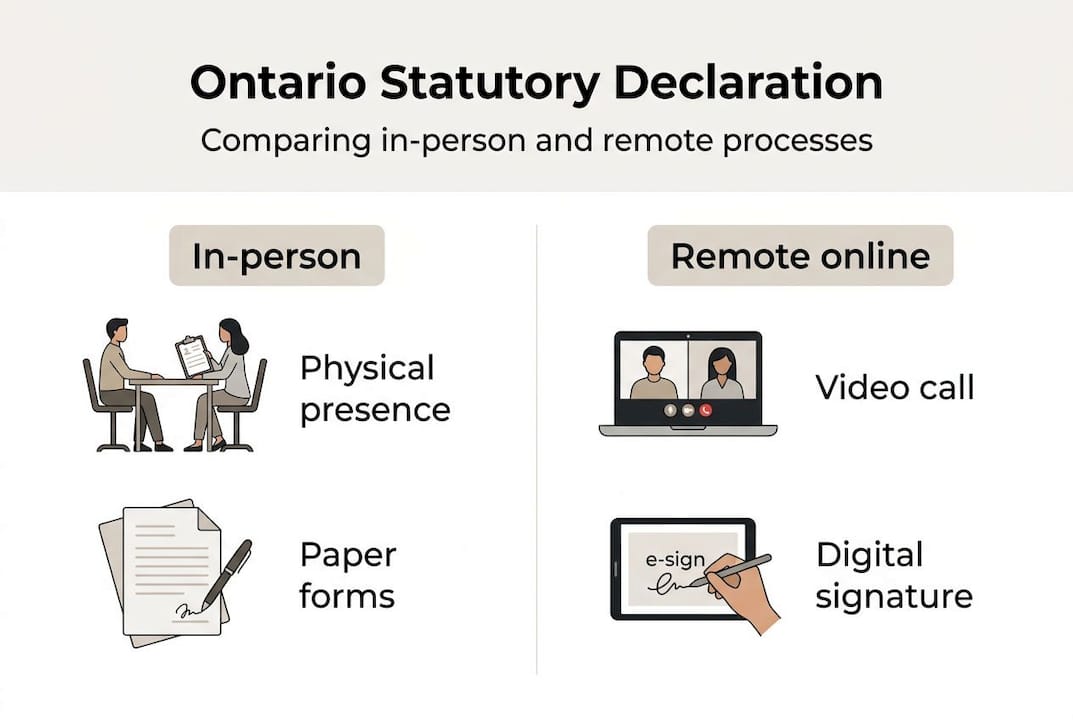
| Requirement | In-person process | Remote (online) process |
|---|---|---|
| Physical presence | Required | Not required |
| Real-time video | Not applicable | Mandatory |
| ID verification | In person | Via video, on screen |
| Jurat type | Standard | Modified (remote noted) |
| Record-keeping | Standard | Enhanced (session record) |
| Certified copies | Included in scope | Not covered remotely |
Pro Tip: Before your remote session, test your video connection and ensure your ID is in excellent condition with no glare or damage. A commissioner cannot proceed if they cannot clearly verify your identity on screen.
Understanding the full scope of Ontario online notary legalities matters especially if your declaration will be used outside of Ontario, as some jurisdictions may have additional requirements for remotely commissioned documents. You should also explore your Ontario online notary options before committing to a provider to ensure they understand both the technical and legal requirements of the remote process.
Common mistakes and legal consequences
As convenient as the current system is, mistakes can be costly. Let’s look at the risks.
The legal penalties for errors in statutory declarations are real and serious. The Commissioners for Taking Affidavits Act is clear: false declarations are criminal offenses with penalties up to $2,000 fine, and commissioners must ensure proper administration or face their own penalties.
Making a false statutory declaration is not a paperwork error. It is a criminal offense under Ontario law, with consequences for both the declarant and the commissioner who witnessed it.
The most common mistakes people make fall into a few categories:
Errors made by declarants:
- Including inaccurate or incomplete facts, even unintentionally
- Signing before the commissioner is ready and watching
- Using a template from another province that does not meet Ontario’s requirements
- Failing to bring proper identification to a remote session
- Assuming verbal statements made during the session are part of the declaration
Errors made by commissioners:
- Failing to properly verify the declarant’s identity
- Signing off on a declaration without confirming the person understands it
- Using a standard jurat instead of a modified one in a remote session
- Not retaining records of remote sessions as required
- Commissioning a document outside their authorized jurisdiction or scope
| Mistake type | Risk to declarant | Risk to commissioner |
|---|---|---|
| False statement | Criminal offense, fines up to $2,000 | Potential liability, professional discipline |
| Wrong witness used | Declaration invalidated | No legal authority, potential misrepresentation |
| Missing modified jurat | Document rejected by recipient | Professional and legal consequences |
| No ID verification | Declaration challengeable | Disciplinary action under the Act |
| Wrong document format | Rejection, delays, restart required | None directly, but poor practice |
Reviewing statutory declaration samples before you draft your document is one of the best ways to avoid format errors that can get your declaration rejected.
Best practices for staying compliant:
- Always draft your declaration carefully, reviewing every factual claim before submission
- Use a commissioner or notary you have verified as currently authorized in Ontario
- For remote sessions, confirm the provider follows O. Reg. 431/20 explicitly
- Keep a copy of your completed declaration and the modified jurat for your own records
- Never rush the process; a rejected declaration means starting over entirely
Why understanding statutory declarations is more crucial than ever
Here is the honest perspective that most articles skip: people are treating statutory declarations like they’re just another form to tick off a checklist. They’re not.
The digital shift has made these documents faster to complete, which sounds like a win. But speed without understanding creates real risk. When someone completes a remote statutory declaration without fully grasping that they are making a legally binding oath, they are exposing themselves to criminal liability without realizing it. We see this pattern repeatedly in online contexts where the process feels too easy.
The technology is not the problem. The problem is that familiarity breeds carelessness. Sitting in your home on a video call does not feel the same as sitting in a notary’s office. That shift in atmosphere can lead people to treat the moment casually, skipping mental steps that matter enormously.
Our strong advice: treat every statutory declaration with the same formality regardless of whether you’re doing it in person or through a screen. Read every word of the document before you sign it. Ask questions if anything is unclear. Use a qualified provider who makes the legal gravity of the process clear, not one who makes it feel like ordering takeout.
The stakes of secure document handling go beyond compliance. Done right, a statutory declaration is one of the most powerful tools available to you. Done carelessly, it becomes a liability.
Simplify your statutory declaration with trusted online notary services
If you’re ready to act with clarity, here’s how you can simplify the process.
Navigating Ontario’s statutory declaration requirements does not have to be stressful. The right notary service removes the guesswork and ensures every step meets the legal standard, whether you’re filing a personal declaration or handling a complex business matter.

Our Ontario online notary services are designed specifically for individuals and businesses who need declarations, affidavits, solemn declarations, and more, all completed remotely, compliantly, and efficiently. You can complete a statutory declaration online from anywhere in Ontario, with a qualified commissioner who understands both the legal requirements and the practical needs of your situation. Book your session with confidence and get your documents done right the first time.
Frequently asked questions
What is the difference between a statutory declaration and an affidavit in Ontario?
Both are sworn statements with legal force, but affidavits are sworn before someone authorized to administer oaths, while statutory declarations are affirmed. The Ontario Evidence Act prescribes the standard closing language that gives statutory declarations the same force and effect as an oath.
Are online statutory declarations legally valid in Ontario?
Yes, they are fully valid when conducted according to O. Reg. 431/20, which permits remote commissioning via real-time video with proper identity verification, a modified jurat, and required record-keeping.
What happens if you make a false statutory declaration?
Making a false declaration is a criminal offense under Ontario law. The Commissioners for Taking Affidavits Act allows for fines of up to $2,000, and the offense can carry additional consequences depending on the circumstances.
Can any notary or lawyer in Ontario witness my statutory declaration online?
Yes, as long as they are currently authorized and follow the remote commissioning requirements under O. Reg. 431/20, including using the modified jurat, verifying your identity, and retaining records of the session.