Ontario Hiking Trails: A US Visitor’s Seasonal Guide
TL;DR:
- Ontario offers scenic hiking across five regions, with the best season from late April to early November.
- Peak times are May–June for wildflowers, September–October for fall foliage, and parking reservations should be made weeks in advance.
Ontario’s best hiking falls across five regions: the cliff-and-cobalt-water walks of Bruce Peninsula near Tobermory, the quartzite scramble at The Crack in Killarney, the forest lookouts of Algonquin’s Track and Tower and Centennial Ridges, and the Niagara Escarpment day hikes along the Bruce Trail near Lion’s Head. The standard hiking season runs late April through early November.
TL;DR for U.S. visitors: Go in May–June for wildflowers or September–October for fall color; book parking reservations weeks ahead; bring your passport; and sort any notarized travel documents before you leave home.
- Best months: May–June (wildflowers, birds), July–August (warmest, busiest), September–October (peak fall color)
- Parking/permits: Reserve ahead for Bruce Peninsula National Park and popular conservation areas, especially May–October
- Safety: Sturdy ankle-support boots, bear canister, tick check after every hike
- Documents: Need a notarized invitation letter, statutory declaration, or certified copy fast? Theonlinenotary handles remote commissioning for Ontario residents
The Bruce Trail stretches roughly 900 km along the Niagara Escarpment — one of the longest marked footpaths in North America, accessible at dozens of points from Toronto’s doorstep.
Table of Contents
- Best Ontario hiking trails by region
- When should you hike in Ontario?
- Safety, gear, and trail etiquette
- Permits, parking, and what a weekend costs
- Travel logistics for U.S. visitors
- Weekend itinerary ideas
- Maps, apps, and official resources
- Legal documents and notarization for hikers and groups
- Ontario weather: what to expect on the trail
Best Ontario hiking trails by region
Ontario’s geological variety — Lake Superior shoreline cliffs, Niagara Escarpment limestone, La Cloche quartzite at Killarney — means trail character shifts dramatically by region. Match terrain to your experience level before you book.
| Region | Representative Trail | Distance | Difficulty | Standout Feature |
|---|---|---|---|---|
| Bruce Peninsula | Halfway Log Dump / Grotto | 8 km loop | Moderate | Turquoise Georgian Bay water, cliff ledges |
| Algonquin Park | Track and Tower / Centennial Ridges | 7–11 km | Moderate | Fire-tower panoramas, mixed forest |
| Killarney | The Crack | 8 km return | Hard | Quartzite scramble, ridge views |
| Niagara Escarpment | Lion’s Head Loop (Bruce Trail) | 11 km | Moderate | Escarpment cliffs, Georgian Bay overlooks |
| Lake Superior | Sleeping Giant (Top of the Giant) | 24 km return | Hard | Remote shoreline, dramatic mesa views |
Bruce Peninsula suits hikers who want water and rock together. Parking at the Grotto requires an advance reservation through Parks Canada — show up without one in July and you will be turned away.
Algonquin rewards day-trippers. Track and Tower is forgiving on the legs; Centennial Ridges is steeper but delivers the best open-sky views in the park. Both work well for families with older kids.
Killarney’s Crack is the province’s most satisfying scramble, but loose rock and exposed roots demand real ankle support and a slow pace. Test every boulder before committing your weight.
Lion’s Head on the Bruce Trail is the easiest introduction to Escarpment hiking from southern Ontario — dramatic cliffs, manageable distance, and a small town with a diner at the end.
Sleeping Giant near Thunder Bay is genuinely remote. Plan an overnight, not a day trip.
When should you hike in Ontario?
May and June bring wildflowers and bird migration with lighter crowds. July and August are warmest but also the busiest months at Bruce Peninsula and Algonquin — parking fills before 9 AM on weekends. September and October are the sweet spot for most visitors: cooler temperatures, brilliant foliage, and noticeably thinner crowds after Labor Day.
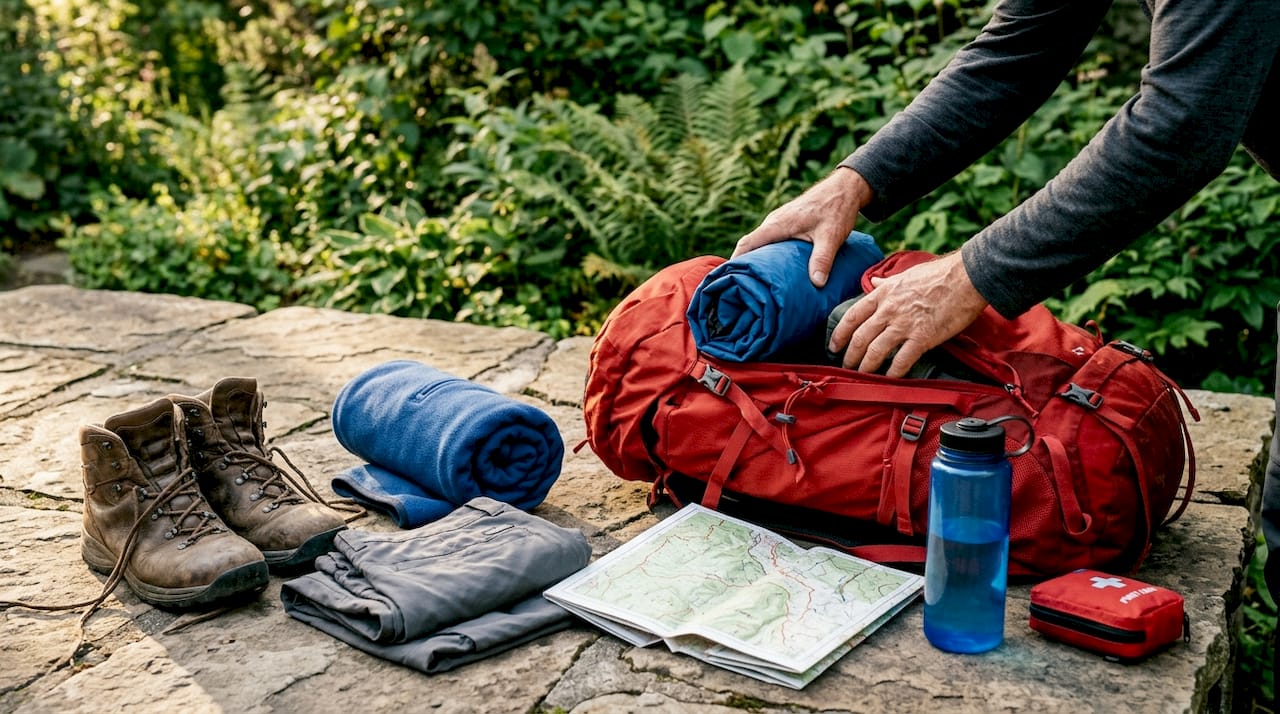
Winter hiking is possible on sections of the Bruce Trail and in Algonquin, but it requires microspikes or snowshoes, extra insulation layers, and a shorter turnaround plan. Conditions change fast.
Winter gear checklist: microspikes or snowshoes, insulated waterproof boots, hand warmers, headlamp, emergency bivvy.
Pro Tip: Book Algonquin and Bruce Peninsula parking reservations through the Ontario Parks or Parks Canada portals at least three weeks out for any summer weekend.
Safety, gear, and trail etiquette
Good footwear is the single biggest safety variable on Ontario trails. Waterproof boots with ankle support handle the wet limestone and root-covered paths far better than trail runners.
- Ticks: Wear long sleeves and tick-proof clothing in spring and early summer; do a full-body check after every hike
- Black bears: Store food in a bear canister or hang it; make noise on blind corners
- Navigation: Download the offline map before you leave cell range; carry a paper backup
- Cliff edges: Test handholds on The Crack and Bruce Peninsula scrambles before weighting them
- Leave No Trace: Stay on marked trails, pack out all waste, and yield to uphill hikers on narrow sections
AllTrails lists thousands of Ontario routes with user reviews and difficulty filters — cross-check any user-reported conditions against the official park page before you go.
Permits, parking, and what a weekend costs
Advance parking reservations are required May–October at Bruce Peninsula National Park and many busy conservation areas. Book through Parks Canada or Ontario Parks online; some sites open reservations 90 days out and fill within hours.
| Cost Item | Typical Range (CAD) |
|---|---|
| Parks Canada day pass | a few dollars per person |
| Ontario provincial park day use | a modest fee per vehicle |
| Campsite (tent, no hookup) | fees vary per night |
| Conservation area parking | fees vary per vehicle |
Remote trailheads often accept cash only. Bring small bills. A realistic two-night weekend for two people — fuel from the border, two nights camping, park passes — runs roughly CAD $200–$350 depending on distance and campsite type.
Travel logistics for U.S. visitors
A valid U.S. passport is required at every land border crossing into Canada. NEXUS card holders use dedicated lanes and speed things up considerably.
- Vehicle insurance: Your U.S. policy covers you in Canada, but carry your insurance card and confirm coverage limits with your insurer before crossing
- Currency: Canadian dollars are widely accepted; most parks and towns take credit cards, but remote trailheads may not
- Driving times: Toronto to Bruce Peninsula is roughly 3.5 hours; Toronto to Algonquin’s south gate is about 2.5 hours; Thunder Bay (Sleeping Giant) is a 16-hour drive or a short flight
- Public transit / shuttles: Bruce Trail Conservancy chapters run organized group hikes with coordinated transport — a practical option if you prefer not to drive or want guided access to remote sections
- Health insurance: Ontario’s provincial health system does not cover U.S. visitors; travel health insurance is strongly recommended
Groups or businesses crossing with vehicles, minors, or formal liability paperwork sometimes need notarized documents. Theonlinenotary provides remote notarization services for Ontario residents and can handle last-minute needs before departure.
Pre-trip checklist:
- Valid passport (and NEXUS card if applicable)
- Vehicle insurance card
- Travel health insurance confirmation
- Park reservation confirmations printed or downloaded offline
- Emergency contact list and trailhead GPS coordinates
Weekend itinerary ideas
1-day near Toronto (Niagara Escarpment)
Leave by 7 AM to beat parking at Mount Nemo or Rattlesnake Point Conservation Area. Hike 2–3 hours on the Bruce Trail, grab lunch in Milton or Dundas, and drive home by late afternoon. Both sites charge a small conservation area parking fee; no advance reservation is currently required, but that can change — check the Conservation Halton website before you go.
2-day Bruce Peninsula trip
Day 1: Drive from Toronto Friday evening; stay in Lion’s Head or Tobermory (book accommodations 6–8 weeks ahead for summer). Day 2: Hit the Grotto / Halfway Log Dump loop early (pre-booked parking essential); afternoon swim at Cyprus Lake; drive home Sunday. For Ontario camping spots near the trailhead, Cyprus Lake Campground inside the national park is the obvious choice — reserve through Parks Canada.
2-day Algonquin trip
Day 1: Drive up Saturday morning; hike Track and Tower (7 km). Day 2: Centennial Ridges for the views, then drive home. Stay at one of the highway-corridor lodges or book a tent site at Mew Lake Campground. Check weekend getaway tips for timing and packing advice.
Maps, apps, and official resources
- Parks Canada — national park passes, campsite reservations, and trail closures for Bruce Peninsula and Pukaskwa
- Bruce Trail Conservancy (brucetrail.org) — official maps, chapter contacts, and organized hike schedules for the full Escarpment route
- Ontario Parks (ontarioparks.com) — provincial park reservations, day-use permits, and trail condition updates for Algonquin and others
- AllTrails — crowdsourced reviews, offline maps, and difficulty filters; always cross-check with the official park page for current closures
- Ontario Trails Council (ontariotrails.on.ca) — searchable database by activity, region, and accessibility
Download offline maps before you lose cell signal. Most Ontario parks lose reliable coverage within 2 km of the trailhead.
Legal documents and notarization for hikers and groups
Most solo hikers need only a passport and a park pass. Groups, clubs, and businesses crossing the border or organizing formal activities sometimes need more.
Common scenarios:
- A hiking club collecting signed liability waivers for a guided group trip
- A business sending employees on a team retreat requiring notarized permission or insurance declarations
- A traveler needing a notarized invitation letter or statutory declaration for a visa or border matter before departure
- Vehicle owners carrying a notarized affidavit for a borrowed or leased vehicle crossing the border
What to prepare:
- Government-issued photo ID (passport preferred for cross-border trips)
- Any group liability or waiver forms signed before the trip, not at the trailhead
- Emergency contact sheet for each participant
- Notarized documents completed and printed ahead of time — remote notarization is not available at a trailhead
Pro Tip: Theonlinenotary handles remote commissioning and notarization for affidavits, statutory declarations, and invitation letters entirely online — no office visit needed. For certified true copies, in-person service is available in Brampton. Check Ontario notary ID requirements before your appointment.
Understanding online notarization rules in Ontario is worth a quick read if your group is organizing anything formal.
Ontario weather: what to expect on the trail
Spring (April–May) is unpredictable. Temperatures swing from near-freezing overnight to 18°C by afternoon, and trails stay muddy well into May. Pack a rain shell and gaiters.
Summer (June–August) brings warm, humid days across southern Ontario, with afternoon thunderstorms common from July onward. Check the Environment Canada forecast the morning of your hike; storms build fast over Georgian Bay and Lake Superior.
Fall (September–October) is the most stable hiking season. Days are crisp and clear, nights drop sharply after mid-October, and the bug pressure disappears. Dress in layers you can shed by midday.
Winter (November–March) is for experienced hikers only. Temperatures regularly fall below -15°C in Algonquin and northern parks, and exposed ridges add significant wind chill. Ice on rock faces is invisible until you step on it.
Sudden-change rule: always carry a waterproof shell, an insulating mid-layer, and enough water for two extra hours beyond your planned turnaround time. Ontario weather does not wait for you to get back to the car.
This article is general travel and planning information, not legal or professional advice. Confirm current park rules, permit requirements, and notarization procedures with the relevant authority or a qualified professional for your specific situation.