Online Notary Services in Ontario: 2026 Guide

TL;DR:
- Remote online notarization in Ontario allows certified notaries to notarize documents via live video, offering increased security through digital audit trails. It is legally valid, suitable for various personal and business documents, and provides a faster, more accessible alternative to in-person notarization. Most institutions accept electronically notarized documents, and the process is safer due to multi-factor authentication and encrypted records.
Online notery is the legally recognized process of notarizing documents remotely through a live video session with a certified notary public, using digital identity verification and encrypted electronic seals. The proper industry term is “remote online notarization,” or RON, and Ontario residents can use it for affidavits, statutory declarations, powers of attorney, and more. Theonlinenotary provides these services fully online, meaning you never need to visit an office. This guide explains exactly how the process works, which documents qualify, and why RON is more secure than most people expect.
How does the online notarization process work in Ontario?
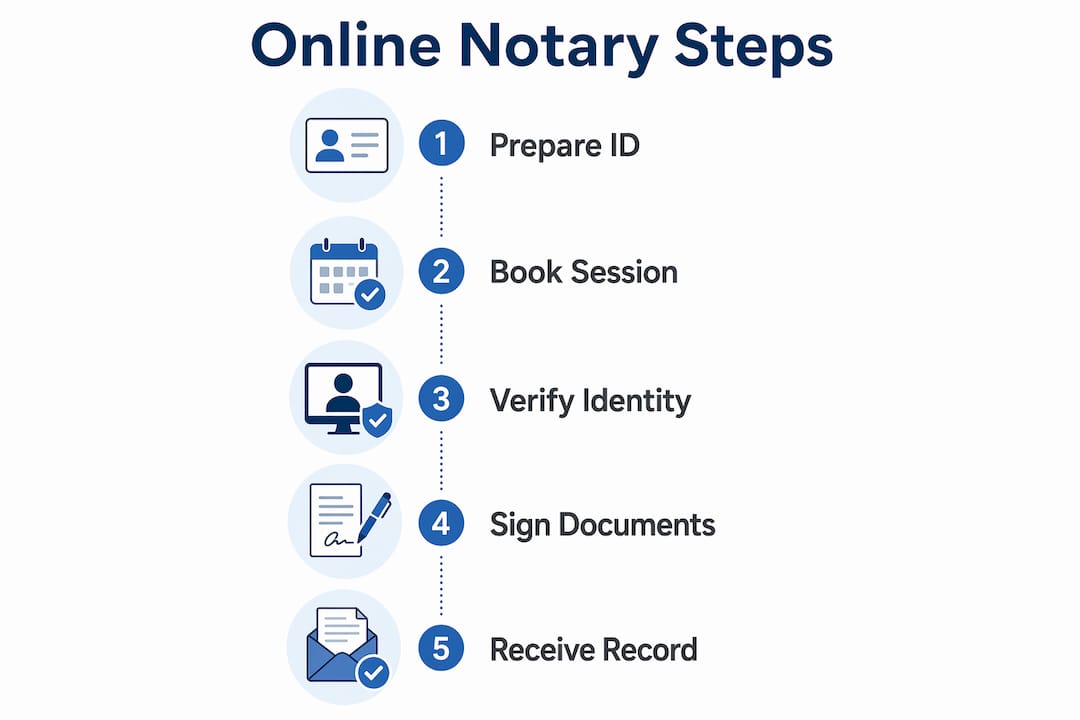
The online notarization process follows a clear sequence of steps. Each step is designed to meet the same legal standards as an in-person appointment, while removing the need for physical travel.
-
Gather your documents and ID. You need a valid government-issued photo ID, a stable internet connection, and a device with a working camera and microphone. Upload your documents to the platform before the session starts.
-
Complete identity verification. The platform runs real-time identity checks, including biometric and knowledge-based authentication. This step captures clear photos of your ID and confirms you are who you say you are.
-
Join the live audio-video session. A commissioned notary public meets you on screen. The notary reviews your documents, confirms your identity verbally, and witnesses your electronic signature in real time.
-
Sign electronically and receive the digital seal. You sign the document through the platform. The notary applies a tamper-evident digital seal, locking the document against any future changes.
-
Receive your notarized copies. The platform delivers your completed documents digitally. You can download, print, or forward them immediately.
The full session typically takes less time than driving to a notary’s office. You can prepare for your session in advance by reviewing the platform’s checklist.
Pro Tip: Test your camera and microphone at least 15 minutes before your scheduled session. A technical failure during identity verification can delay or void the appointment.

What types of documents can you notarize through online notery in Ontario?
Online notarization is valid for a wide range of personal and business documents in Ontario. Knowing which documents qualify saves you time and prevents rejected filings.
Documents commonly accepted for remote notarization in Ontario:
- Affidavits. General affidavits, affidavits of identity, and affidavits for proof of relationship are all eligible.
- Statutory declarations. These cover declarations of common-law status, name changes, and other sworn statements. You can also complete a statutory declaration fully online.
- Powers of attorney. Personal care and property powers of attorney can be notarized remotely in most cases.
- Business contracts and authorization forms. Corporate resolutions, authorization letters, and commercial agreements qualify for online notarization.
- Invitation letters. Letters supporting visa applications or travel documentation are routinely notarized online.
- Solemn declarations. These function similarly to statutory declarations and are accepted for many government and institutional purposes.
Some document categories carry restrictions. Certain real estate transactions and court filings may still require an in-person notarization depending on the receiving institution’s rules. Document eligibility varies by law and purpose, so confirm with the requesting party before booking your session. Businesses that process high volumes of contracts benefit most from online notary services, since they can handle multiple documents in a single session without scheduling delays.
Is online notery secure and legally valid in Ontario?
A common misconception is that online notarization is less secure than traditional notarization. The opposite is true. Remote online notaries use multi-factor digital security that is more rigorous than the visual-only identity check a traditional notary performs in person.
“Online notarization should be understood as an enterprise-grade compliance tool. The digital audit trail it produces, including session recordings, metadata timestamps, IP logs, and encrypted seals, provides stronger evidentiary records than traditional paper-based notarization ever could.”
The audit trail is the clearest proof of this advantage. Professional online notarization sessions generate tamper-evident digital records that include session video, metadata timestamps, and encrypted seals. A paper notary journal, by contrast, contains only a handwritten entry. If a document is later challenged in court, the digital record is far more defensible.
| Feature | Traditional notarization | Remote online notarization |
|---|---|---|
| Identity verification | Visual inspection of ID | Biometric and knowledge-based authentication |
| Document record | Paper journal entry | Encrypted digital audit trail with video |
| Tamper evidence | None after signing | Cryptographic seal detects any alteration |
| Accessibility | In-person required | Available from anywhere with internet access |
| Session record | None | Full video recording with timestamps |
Ontario’s legal framework recognizes remote notarization as legally equivalent to in-person notarization when performed by a commissioned notary following applicable provincial rules. Many institutions across Canada accept documents notarized remotely, provided the notary is properly commissioned and the platform meets security standards. The electronic notarization legal guide for Ontario covers the current regulatory framework in detail.
How can individuals and businesses in Ontario get started with online notery?
Getting started requires less preparation than most people expect. The key is arriving at your session with everything ready so the notary can proceed without interruption.
Preparation checklist:
- Valid government-issued photo ID (passport, driver’s license, or permanent resident card)
- Stable internet connection, ideally wired or strong Wi-Fi
- Device with a functioning camera and microphone
- Documents uploaded to the platform in advance
- Authorization documents if you are signing on behalf of a business or as an agent
Being well-prepared ensures a smooth session and prevents the most common reason sessions fail: incomplete identity verification. Expired ID is the single most frequent cause of a failed notarization attempt.
Businesses that need to notarize multiple documents in one session should consolidate their files before booking. Most platforms allow batch processing, which cuts per-document time significantly. Business users benefit from integrating online notary solutions into workflows to maintain compliance without creating bottlenecks in their operations.
When choosing a platform, prioritize one that is commissioned under Ontario law, uses end-to-end encryption, and provides a full audit trail after each session. Avoid platforms that do not record sessions or cannot produce a digital certificate of completion.
Pro Tip: If you are signing as a corporate officer or agent, prepare a copy of the corporate resolution or authorization letter before your session. Notaries are required to verify your authority to sign on behalf of the organization.
Online notary sessions are faster and eliminate scheduling delays compared to traditional appointments. For individuals with mobility limitations, demanding work schedules, or locations far from a notary’s office, this is a practical and legally sound solution.
Key Takeaways
Remote online notarization in Ontario is legally valid, more secure than traditional methods, and accessible to any individual or business with a camera, valid ID, and a stable internet connection.
| Point | Details |
|---|---|
| Legal validity | Remote online notarization is legally recognized in Ontario when performed by a commissioned notary. |
| Security advantage | Multi-factor authentication and encrypted audit trails exceed the security of traditional paper notarization. |
| Document eligibility | Affidavits, statutory declarations, powers of attorney, and business contracts all qualify for online notarization. |
| Preparation matters | Valid ID, a working camera, and pre-uploaded documents are required for a successful session. |
| Business efficiency | Businesses can batch-process multiple documents in one session, reducing delays and compliance risk. |
Why I think Ontario is underestimating remote notarization
Most of the clients I see come to online notarization out of necessity. They live far from a notary’s office, or they need a document signed on short notice. What surprises them is that the process is not just convenient. It is genuinely more defensible than what they experienced in person.
The audit trail is the part that changes minds. When I explain that the digital record includes a session video, IP logs, timestamps, and an encrypted seal, people stop treating online notarization as a workaround and start treating it as the better option. A paper journal entry from a traditional notary cannot compete with that level of documentation.
The area where I see the most room for growth is business adoption. Individual clients have figured this out. Corporate legal teams are still catching up. Companies that process contracts, authorization letters, or statutory declarations regularly are leaving real efficiency on the table by still sending staff to notary offices. The step-by-step process for Ontario is straightforward enough to integrate into any standard legal workflow.
My prediction is that within a few years, in-person notarization will be the exception rather than the rule for most document types in Ontario. The regulatory framework already supports it. The technology already exceeds the security bar. The only thing lagging is habit.
— Ken
Theonlinenotary: online notary services for Ontario residents and businesses
Theonlinenotary provides online notary services in Ontario for affidavits, statutory declarations, solemn declarations, invitation letters, powers of attorney, and business documents. Sessions are available 24/7, conducted by commissioned notaries, and protected by encrypted audit trails that meet Ontario’s legal standards.

Every session produces a tamper-evident digital record you can use for government filings, institutional submissions, or legal proceedings. Whether you need a single affidavit notarized or a batch of corporate documents processed, Theonlinenotary handles it without requiring you to leave your home or office. Visit the services page to book your session or review which document types are covered.
FAQ
What is remote online notarization?
Remote online notarization (RON) is the process of notarizing documents through a live video session with a commissioned notary, using digital identity verification and electronic seals. It is legally recognized in Ontario when performed by a properly commissioned notary public.
What ID do I need for an online notary session?
You need a valid government-issued photo ID such as a passport, driver’s license, or permanent resident card. The platform will capture clear photos of your ID and run real-time identity checks before the session proceeds.
Are online notarized documents accepted in Ontario courts and government offices?
Most Ontario government offices and institutions accept remotely notarized documents when the notary is properly commissioned and the platform meets security standards. Some court filings may still require in-person notarization, so confirm with the receiving institution before your session.
Can businesses use online notary services for multiple documents at once?
Yes. Most online notary platforms support batch processing, allowing businesses to notarize multiple documents in a single session. This reduces turnaround time and integrates well into standard legal and compliance workflows.
Is online notarization more secure than traditional notarization?
Online notarization uses biometric authentication, knowledge-based identity checks, and encrypted digital audit trails that surpass the visual-only ID inspection used in traditional notarization. The session video and metadata provide a stronger evidentiary record if a document is ever challenged.