The Role of Online Notary in Compliance for Ontario Businesses

TL;DR:
- Remote online notarization uses secure video links and cryptographic seals to produce tamper-proof legal records for Ontario businesses. It ensures compliance through advanced identity verification, validated digital signatures, and comprehensive session recordings that meet jurisdiction-specific standards. Proper RON processes strengthen legal defenses, reduce costs, and integrate seamlessly into existing workflows.
Remote online notarization (RON) is defined as a legally binding notarization process conducted via secure video link, where a commissioned notary verifies identity, applies a cryptographic digital seal, and records the session for long-term retention. The role of online notary in compliance goes well beyond convenience. For Ontario businesses and legal professionals, RON delivers a documented, tamper-evident record that meets provincial and cross-jurisdictional legal standards. Services like those offered by Theonlinenotary cover affidavits, statutory declarations, solemn declarations, invitation letters, and more. Each document type carries specific legal weight, and proper notarization is what makes that weight enforceable.
How online notaries ensure compliance with legal requirements
Online notaries achieve compliance through a layered set of technical and procedural controls that exceed what traditional in-person notarization can offer. The process is not simply a digital copy of a paper workflow. It is a purpose-built system designed to satisfy regulatory requirements at every step.
Identity verification that goes beyond a visual check
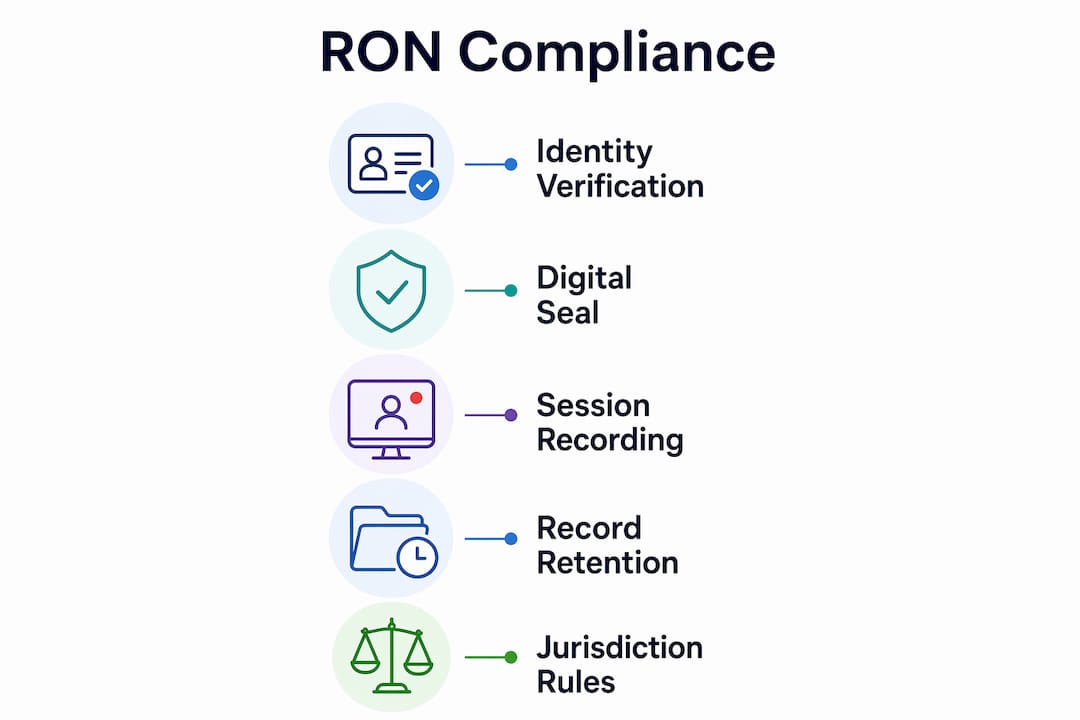
Automated credential analysis detects fake IDs with greater accuracy than human visual inspection. The system also applies knowledge-based authentication, asking the signer questions drawn from public records that only the real person could answer. Liveness detection confirms the signer is physically present and not a recorded image or deepfake. This combination makes RON’s identity proofing materially stronger than the standard in-person check.

Pro Tip: If a signer fails automated identity checks, a qualified notary can apply manual verification protocols. International signers or those with recent name changes may need alternative documentation, so prepare supporting records in advance.
Digital seals and tamper-evident technology
Every RON session produces a cryptographically signed document that reveals any post-signing alteration. The digital seal is tied to the notary’s commission credentials and the specific session metadata. This means a court or regulator can verify the document’s authenticity without contacting the notary directly. Traditional wax or ink seals offer no equivalent technical guarantee.
Session recording and record retention
Session recordings are retained for 5–10 years depending on jurisdiction. The complete audit trail includes the video recording, timestamped logs, and cryptographically signed metadata. This combination creates a legal record that is far stronger evidence in court than a manual notary journal entry. Ontario businesses handling litigation-sensitive documents benefit directly from this standard.
Ontario-specific compliance considerations
Ontario does not yet have a standalone RON statute equivalent to those passed in over 45 U.S. states. However, Ontario notaries operating under provincial law can conduct online notarizations using platforms that meet cybersecurity and identity-proofing standards consistent with the Uniform Electronic Recognition of Notarial Acts framework. Businesses must confirm that the notary they engage is properly commissioned and that the platform used meets applicable data protection standards, including PIPEDA requirements for document handling before and after notarization.
What regulations affect online notarization compliance?
The regulatory picture for Ontario businesses is shaped by both provincial law and cross-border recognition rules. Understanding where your documents will be used determines which compliance standards apply.
| Compliance factor | Ontario context |
|---|---|
| Notary commissioning | Notary must hold a valid Ontario commission or recognized equivalent |
| Cross-border recognition | Follows Uniform Electronic Recognition of Notarial Acts principles |
| Data protection | PIPEDA governs document handling throughout the full lifecycle |
| Session recording retention | Platform must retain recordings for the jurisdiction-required period |
| Identity proofing standard | Credential analysis and knowledge-based authentication required |
Failure to meet jurisdiction-specific RON regulations can result in document rejection, legal disputes, and disciplinary action against the notary. For Ontario businesses with U.S. counterparties, this risk is real. A document notarized on a platform that does not meet the receiving state’s standards may be refused by a court or government agency. The fix is straightforward: verify that the notary is commissioned in an authorized jurisdiction and that the platform meets the cybersecurity requirements of every jurisdiction where the document will be used.
Cross-border transactions add another layer. Ontario businesses exporting documents to the United States, the European Union, or other provinces must confirm that the receiving jurisdiction recognizes the notarization method used. Working with a notary service that understands these cross-jurisdictional rules is not optional. It is the difference between a document that holds up and one that gets rejected at the worst possible moment.
Cost and operational considerations for Ontario businesses
Online notary services follow two main pricing structures. Pay-per-document fees run approximately $25 per seal, with additional witness fees typically in the $10–$15 range. Subscription or volume pricing models exist for businesses that process high document volumes regularly. The right model depends on your transaction frequency and document complexity.
The operational benefits extend well beyond the fee structure:
- Reduced travel costs. Signers and notaries connect via video, eliminating the need for in-person appointments across Ontario’s geography.
- Faster turnaround. RON sessions average 8–14 minutes. High-volume firms report cutting document processing from days to minutes.
- Scalable capacity. Businesses can process multiple notarizations in a single day without scheduling conflicts tied to physical office hours.
- Fewer errors. Guided digital workflows reduce the risk of missing signatures or incomplete fields that would require re-execution.
Pro Tip: For legal teams handling recurring document types like affidavits or statutory declarations, a subscription model with a trusted provider like Theonlinenotary reduces per-document cost and builds a consistent compliance record over time.
Upstream costs also matter. Cybersecurity compliance applies to every phase of the document lifecycle, not just the moment of notarization. Businesses must encrypt documents in transit and at rest before they reach the RON platform. Failing to do so creates PIPEDA exposure that the notarization itself cannot cure.
How online notaries integrate into business compliance workflows
RON is not a standalone tool. It fits directly into existing legal and compliance workflows, adding a verifiable layer of authentication at the point where documents carry the most legal risk.
Common use cases for Ontario businesses include:
- Loan document verification. Lenders use notarized affidavits and declarations to confirm borrower identity and consent, creating a defensible record for regulatory review.
- Power of attorney. Corporate powers of attorney notarized via RON carry the same legal weight as in-person equivalents while creating a stronger audit trail.
- Affidavits and statutory declarations. These documents are frequently required in court proceedings, immigration applications, and corporate governance. Theonlinenotary handles affidavit notarization for Ontario clients with full compliance documentation.
- Corporate approvals. Board resolutions and shareholder declarations requiring notarization can be executed remotely without delaying time-sensitive transactions.
“The immutable audit trail produced by RON, including video recordings, timestamped logs, and cryptographically signed metadata, provides evidentiary strength that paper journal entries cannot match in litigation or regulatory review.”
RON also integrates with Know Your Customer (KYC) and Anti-Money Laundering (AML) compliance programs. The identity verification layer in RON directly satisfies many KYC requirements, reducing duplication of effort for compliance teams. When a document is challenged, the complete digital record is available immediately. There is no need to locate a paper journal or contact a notary who may no longer be practicing.
Compliance pitfalls that RON prevents include unauthorized alterations after signing, identity fraud at the point of execution, and missing or incomplete notarial records. Each of these failures can expose a business to regulatory sanction or litigation loss. The digital notarization process addresses all three by design.
Key Takeaways
Online notarization is the strongest compliance tool available to Ontario businesses for document authentication, combining automated identity verification, cryptographic seals, and mandatory audit trails.
| Point | Details |
|---|---|
| RON exceeds in-person security | Automated credential analysis and liveness detection outperform human visual ID checks. |
| Audit trail is court-ready | Video recordings, timestamped logs, and signed metadata create stronger evidence than paper journals. |
| Jurisdiction compliance is mandatory | Verify the notary’s commission and platform standards for every jurisdiction where documents will be used. |
| Cost scales with volume | Pay-per-document fees average $25 per seal; subscription models reduce costs for high-volume legal teams. |
| Upstream security matters | PIPEDA compliance applies to document handling before notarization, not just during the RON session. |
Why I think most Ontario businesses underestimate RON’s compliance value
Most legal professionals I speak with treat online notarization as a convenience upgrade. They are solving a scheduling problem. What they are actually getting is a compliance infrastructure upgrade, and that distinction matters enormously when a document is challenged.
The audit trail produced by a properly conducted RON session is qualitatively different from anything a traditional notary produces. A paper journal entry is a handwritten note. A RON session record is a timestamped video, a cryptographically signed document, and a metadata log that a court can verify independently. I have seen legal teams spend significant resources reconstructing the circumstances of a traditional notarization during litigation. With RON, that reconstruction is unnecessary. The record is already there.
The area where I see businesses make the most costly mistakes is upstream. They invest in a compliant RON platform and then transmit documents over unsecured channels before the session. PIPEDA does not care that the notarization itself was flawless. The data exposure happened before the notary joined the call. Businesses adopting RON need to treat document security as a full-lifecycle obligation, not a point-in-time event.
The regulatory direction in Ontario is clearly toward broader RON adoption. Businesses that build compliant workflows now will not need to retrofit their processes when formal RON legislation arrives. That is a practical advantage worth acting on.
— Ken
Theonlinenotary: compliance-ready online notary services for Ontario
Ontario businesses need a notary service that understands both the technical and legal dimensions of compliance. Theonlinenotary provides expert online notary services available 24/7, covering affidavits, statutory declarations, solemn declarations, invitation letters, and more.

Every session conducted through Theonlinenotary meets Ontario’s identity verification and document security standards. The platform produces a complete audit trail for every notarization, giving legal teams and compliance officers the documentation they need for regulatory review or litigation. Whether you need a single affidavit or ongoing support for high-volume document workflows, Theonlinenotary delivers consistent, legally defensible results. Learn more about Ontario notary requirements or book a session directly through the services page.
FAQ
What is the role of an online notary in compliance?
An online notary verifies signer identity, applies a cryptographic digital seal, and produces a mandatory video and metadata audit trail that meets jurisdiction-specific legal standards. This process creates a legally defensible record that satisfies regulatory and court requirements.
Is online notarization legally valid in Ontario?
Ontario notaries can conduct online notarizations using platforms that meet provincial cybersecurity and identity-proofing standards. Documents must comply with applicable laws, including PIPEDA for data handling, and the notary must hold a valid Ontario commission.
How does RON prevent document fraud?
RON uses automated credential analysis and liveness detection to identify fake IDs and confirm physical presence. Any post-signing alteration to the document is detectable through the cryptographic seal, making fraud significantly harder than with traditional paper notarization.
What happens if a notarization does not meet compliance standards?
Non-compliant notarizations can result in document rejection, legal disputes, and disciplinary action against the notary. Businesses must verify that both the notary’s commission and the platform’s security standards meet the requirements of every jurisdiction where the document will be used.
How much does online notarization cost for Ontario businesses?
Pay-per-document fees average approximately $25 per seal, with additional witness fees typically in the $10–$15 range. Volume and subscription pricing models are available for businesses with recurring notarization needs.
Recommended
- Online Notary Compliance Steps for Ontario in 2026 - The Online Notary
- Best Practices for Online Notary Services in Ontario 2026 - The Online Notary
- The Role of Business Notary Services in Ontario - The Online Notary
- Online Notary in Ontario: Fast, Legal, and Secure Services 2025 - The Online Notary