Notary Fees in Ontario: Clear Explanations for 2026

TL;DR:
- Notary fees in Ontario vary by provider and service scope, with typical charges ranging from $10 to $75.
- Clients should confirm all service components upfront, including drafting and travel costs, to avoid hidden charges.
Notary fees in Ontario are costs charged by private notaries and law firms for authenticating, witnessing, and certifying legal documents. Ontario has no single province-wide fee schedule, so prices vary by provider and service type. Typical fees run from about $10 to $50 per notarization, depending on document complexity and service scope. Common documents include affidavits, statutory declarations, invitation letters, and wills. Understanding the full explanations of notary fees in Ontario helps you avoid surprise charges and choose the right provider for your needs.
What factors influence the cost of notary services in Ontario?
The cost of notary services in Ontario depends on several variables, not just the base rate. Service scope is the biggest driver. A simple signature witness costs far less than a full affidavit that requires drafting, reviewing, and certifying.
Document complexity matters significantly. A straightforward statutory declaration takes minutes to process. A complex will or power of attorney requires careful review, which takes more time and commands a higher fee.
Many providers charge separately for services beyond the stamp itself. Drafting a document from scratch, printing certified copies, or scanning originals for digital delivery all add to your total bill. Confirming what is included before you book prevents unexpected charges.
Delivery method also affects pricing. In-person appointments at a law office typically cost less per notarization than mobile services, where the notary travels to you. Mobile notaries charge $25 to $75 or more depending on distance and timing. That travel premium can easily double your total cost for a single document.
The notary’s credentials and experience play a role too. A senior lawyer at a Bay Street firm charges more than a newly appointed notary public. Neither is automatically better for your needs, but the price difference is real.
Finally, international document use adds cost. Documents destined for foreign governments may require apostille certification or additional authentication steps, each carrying its own fee.
Pro Tip: Ask for a written fee quote that lists every component, including drafting, printing, scanning, and any certification surcharges, before you commit to a provider.
Typical notary fees breakdown: what do common services cost?
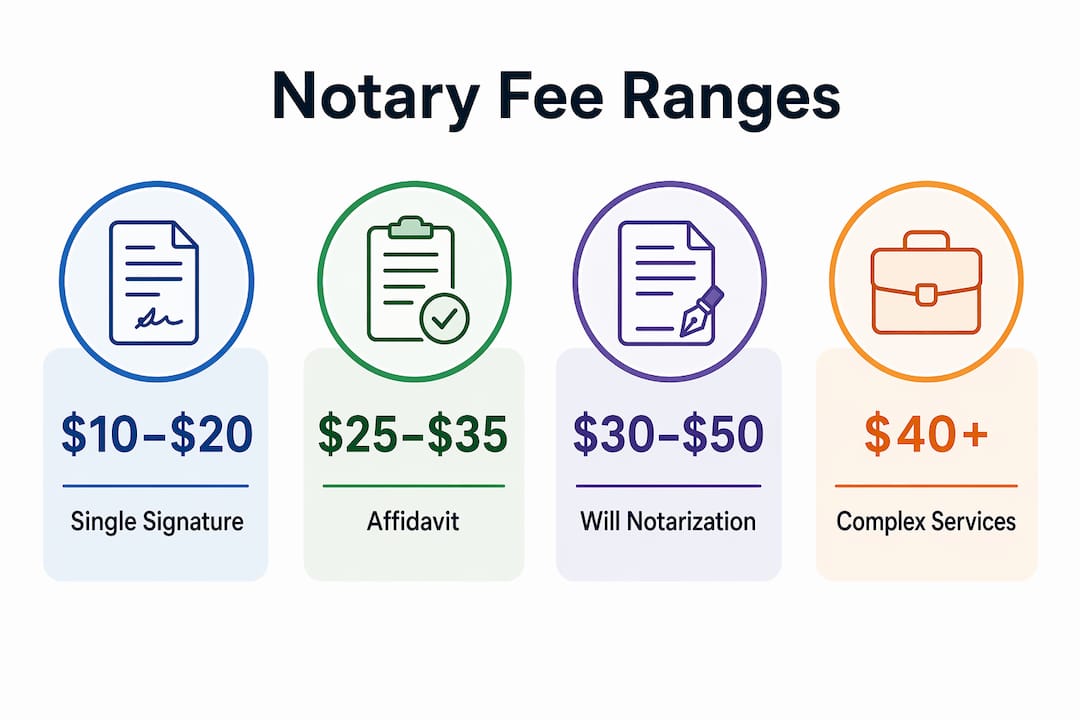
Standard notarization fees in Ontario for common documents range from about $10 to $35 per act. Simple single-signature notarizations sit at the lower end of that range. Complex documents with multiple pages or legal review requirements push toward the higher end.

Many Ontario notaries use a tiered pricing model for appointments involving multiple documents. A typical tiered structure charges $35 for the first notarization, $20 for the second, and $10 for each additional notarization in the same appointment. This rewards clients who batch their documents into one visit.
The table below shows typical price ranges for common notary services in Ontario. These are market ranges, not regulated rates.
| Service type | Typical price range |
|---|---|
| Single signature notarization | $10–$20 |
| Affidavit or statutory declaration | $20–$35 |
| Will or power of attorney | $35–$75+ |
| Certified true copy | $15–$30 per page |
| Mobile notary (travel included) | $50–$150+ |
| Online notarization session | $25–$50 |
Notarizing a will costs more than notarizing a simple declaration because the notary must review the document for legal sufficiency, not just witness a signature. That review time is what you are paying for.
Online notarization fees often include a technology platform charge on top of the notary’s professional fee. Remote notarization sessions typically run around $25 per session before any platform surcharges. For clients who need a single document notarized quickly, online services can still be cost-competitive once you factor in travel time saved.
For businesses notarizing multiple documents regularly, understanding notary fees for affidavits and declarations helps you budget accurately and avoid overpaying per document.
How does Ontario’s notary appointment system affect fees?
Ontario’s notary appointment system creates a credentialed baseline that affects both service quality and pricing. Lawyers and paralegals in Ontario are automatically appointed as notaries through their professional licensing. Non-lawyers who want notary authority pay a government appointment fee of CAD 110 to the Ontario government’s Legal Appointments Office.
That CAD 110 is a one-time government charge, not a consumer fee. It has no direct impact on what you pay for notarization. What it does create is a formal credential that signals the notary has met provincial requirements.
Ontario notary appointments are generally non-expiring, unlike some U.S. states that require annual renewals. This continuity means an appointed notary in Ontario does not need to pass costs of annual recertification on to clients. It also means you can rely on the same notary for years without worrying about lapsed credentials.
The Notary Act governs what notaries can do, but it does not set retail fees. That distinction matters. You have the protection of a regulated credential without the benefit of a price cap.
“Focusing on the scope of notary service is more critical than just the base fee. Incomplete or improperly prepared documents can lead to extra drafting or re-notarization fees, increasing total cost.” — Joseph Mayo, legal expert
Pro Tip: Always verify that your notary holds a current Ontario appointment or is a licensed lawyer or paralegal. Credentials are publicly verifiable and protect you if a document is later challenged.
Online notarization vs. in-person in Ontario: which costs less?
Online notarization and in-person notarization serve different needs, and their costs reflect that difference. In-person notarization at a law office or notary public office typically costs $10–$35 per act for standard documents. Online notarization adds a technology layer that can push the per-session cost higher.
The convenience factor is real. Online notarization eliminates travel, parking, and time off work. For a single document, the total cost including your time often favors online services even if the stated fee is slightly higher.
Scenarios where in-person notarization is the better choice include:
- Documents requiring original wet signatures for foreign government submission
- Complex wills or estate documents where face-to-face legal review adds value
- Situations where the receiving institution does not accept electronically notarized documents
- Clients who need multiple documents notarized and can batch them in one office visit
For most everyday documents, including affidavits, statutory declarations, and invitation letters, online notarization is fully accepted in Ontario. The legality of online notary services in Ontario is well established under provincial electronic commerce legislation.
Choosing between the two options comes down to document type, receiving institution requirements, and your own schedule. Reading a detailed comparison of online vs. in-person notarization helps you match the service to your specific situation.
Pro Tip: Before booking online notarization, confirm that the institution or country receiving your document accepts electronically notarized copies. Some foreign embassies and courts still require original ink signatures.
How to avoid unexpected notary fees and get the best value
Unexpected notary fees almost always trace back to one problem: the client did not confirm the full scope of service before the appointment. Incomplete or improperly prepared documents lead to extra drafting or re-notarization fees that can significantly raise your total cost.
Follow these steps to protect yourself:
- Request an itemized quote. Ask the notary to list every charge, including drafting, printing, scanning, and any certification surcharges, before you agree to proceed.
- Confirm document acceptance. If your document is going to a foreign government or institution, verify that the notarized version will be accepted. Some destinations require apostille certification, which adds cost.
- Ask about re-notarization policies. If a document is rejected by the receiving party, find out whether the notary will redo the work at no charge or at a reduced rate.
- Batch your documents. If you need multiple documents notarized, book them in one appointment to take advantage of tiered pricing.
- Compare online options. Online notary services often publish transparent pricing upfront, making it easier to compare total costs before committing.
- Check credentials first. A low advertised rate from an unqualified provider can cost far more in the long run if the notarization is rejected.
Understanding how to choose the right online notary in Ontario gives you a practical framework for evaluating providers beyond just price.
Pro Tip: The lowest advertised rate is not always the best value. A $10 notarization that requires a $35 re-do because of a drafting error costs more than a $30 notarization done correctly the first time.
Key takeaways
Ontario notary fees vary by service type and provider, with no fixed provincial retail rate, so comparing full service scope rather than base price is the most reliable way to control costs.
| Point | Details |
|---|---|
| No fixed fee schedule | Ontario has no province-wide retail pricing; fees are set by each provider individually. |
| Typical cost range | Standard notarizations run $10–$35 per act; mobile and complex services cost more. |
| Tiered pricing saves money | Batching documents in one appointment reduces per-notarization costs significantly. |
| Scope beats base rate | Always confirm what is included in the fee to avoid drafting and re-notarization charges. |
| Online is often cost-competitive | Remote notarization adds technology fees but eliminates travel costs and time. |
What I have learned about notary fees after years in Ontario
The most common mistake I see clients make is treating notary fees as a commodity. They search for the lowest price, book without asking questions, and then discover that the fee did not include document review, or that the notarization was rejected because the provider lacked the right credentials for that document type.
The fee structure in Ontario rewards clients who ask good questions upfront. A notary who charges $35 for a statutory declaration and includes a full document review is often cheaper than one who charges $20 and bills separately for every additional service. The base rate tells you almost nothing on its own.
Credentials matter more than most clients realize. Ontario’s non-expiring appointment system means a properly appointed notary is a reliable choice. But not every person offering notary services holds a current Ontario appointment. Verifying credentials takes two minutes and can save you significant trouble if a document is later challenged.
Online notarization has genuinely changed the value equation for most everyday documents. The convenience is real, the legal acceptance is solid, and the transparent pricing that good online providers offer makes comparison shopping straightforward. For businesses that notarize documents regularly, online services reduce both cost and administrative friction.
My honest advice: spend five minutes confirming scope, credentials, and re-notarization policy before you book. That conversation will tell you more about a provider’s reliability than their advertised rate ever will.
— Ken
Theonlinenotary: clear pricing for Ontario notary services
Theonlinenotary provides trusted online notary services for individuals and businesses across Ontario, covering affidavits, statutory declarations, invitation letters, solemn declarations, and more.

Pricing is transparent and published upfront, so you know exactly what you are paying before your appointment. There are no hidden drafting fees or surprise surcharges. Appointments are available around the clock, which means you are not limited to office hours or a single geographic location. For anyone who needs a document notarized quickly and correctly, Theonlinenotary’s services page lists all available document types, current pricing, and booking options in one place.
FAQ
What is the average notary fee in Ontario?
Standard notarization fees in Ontario range from about $10 to $35 per act for common documents. Complex services like wills, mobile visits, or international certifications cost more.
Why are notary fees different from one provider to the next?
Ontario has no province-wide retail fee schedule, so each notary or law firm sets its own rates based on service scope, document complexity, and delivery method.
Is online notarization cheaper than in-person in Ontario?
Online notarization typically costs around $25 per session but may include technology platform fees. In-person notarization can be cheaper per act for simple documents, but online services eliminate travel costs and time.
What extra fees should I watch for when hiring a notary?
Watch for separate charges for document drafting, printing, scanning, mobile travel, apostille certification, and re-notarization. Always request an itemized quote before your appointment.
Do Ontario notary appointments expire?
Ontario notary appointments are generally non-expiring for eligible appointees, which means a properly appointed notary maintains valid credentials without annual renewal costs.