Notarizing a Power of Attorney: U.S. Guide

What does notarizing a power of attorney actually mean?
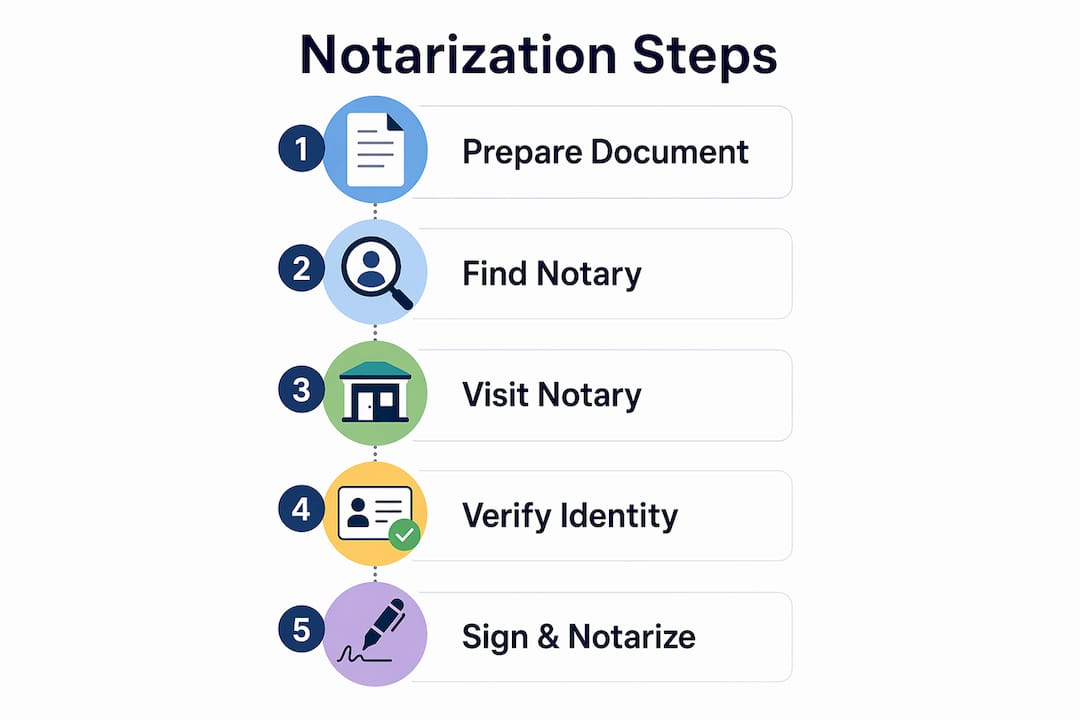
Notarizing a power of attorney is the formal act where a commissioned notary public verifies your identity, confirms you are signing willingly, and certifies the document with an official seal. That seal is what transforms a typed form into something banks, courts, and government agencies will actually honor.
Even when state law does not technically require notarization, banks and institutions routinely reject unnotarized POAs as an internal fraud-prevention policy. So practically speaking, notarization is non-optional.
Here is what the process accomplishes:
- Confirms the principal’s identity using government-issued photo ID
- Verifies the signature is voluntary, not coerced
- Creates an official record that the document was properly executed
- Satisfies institutional requirements at banks, courts, and agencies
- Provides legal protection if the document is ever challenged
How to notarize a power of attorney: step by step
The process is straightforward, but the order matters. Skipping a step or arriving unprepared is the most common reason people have to reschedule.
- Complete the document first. Fill in all names, granted powers, limitations, and the date. Leave only the signature lines blank.
- Bring valid photo ID. A driver’s license, passport, or military ID are accepted. Social Security cards and birth certificates are not, because they lack photos.
- Do not pre-sign. You must sign in the notary’s presence. A pre-signed POA cannot be notarized.
- Arrange witnesses if required. Some states require one or two witnesses. They must attend the signing and cannot be named agents or beneficiaries in the document.
- Sign before the notary. The notary verifies your identity, observes your signature, and completes the notarial certificate with the date, location, and type of act performed.
- Collect your copy. Give copies to your agent and any institution that will rely on the document.
Pro Tip: If traveling to a notary is not possible, mobile notaries will come to a home, hospital, or care facility. Remote online notarization (RON) is another option, covered below.
How do state-specific rules affect your notarization?
State requirements vary more than most people expect, and arriving without the right setup means rescheduling.
- Some states require notarization for all POA types; others only for durable or financial POAs
- Witness requirements range from none to two, depending on state and document type; Florida requires two witnesses for durable POAs
- Witnesses must generally be adults with no financial stake in the document
- Some states require witnesses to present their own photo ID at signing
- Rules on notarizing for relatives differ widely; most states allow it if no financial conflict exists, but the safer practice is always an unrelated notary
- RON acceptance varies; some states restrict it for healthcare or durable POAs
Check your state’s specific rules before the appointment. The Colorado Secretary of State, for example, publishes detailed POA notarization guidance that covers execution requirements clearly.
What are the notary’s ethical duties during a POA signing?
The notary’s role goes beyond stamping a document. Their job is to act as a neutral gatekeeper.
- Capacity check. The notary must confirm the principal understands what the POA grants and is signing without pressure. If mental competence is in doubt, the notary is obligated to refuse.
- Identity verification. Government-issued photo ID is required; personal appearance is mandatory in every state.
- No conflicts of interest. A notary named as agent or beneficiary in the POA cannot notarize it. That creates a direct conflict and can void the document.
- Journal entry. Detailed records including date, document type, and the principal’s ID details protect both the notary and the principal if the document is later challenged in court.
- Correct certificate. The notary completes either an acknowledgment (most common for POAs) or a jurat, depending on what the document requires.
A notary who keeps thorough journal entries provides the clearest legal defense if a POA is contested. POAs are among the most frequently challenged documents in probate and elder law proceedings, and a detailed journal entry can resolve disputes that would otherwise require litigation.
Who else can notarize a POA, and what about online options?
Commissioned notaries are the standard choice, but other officials have authority in specific circumstances: judges, court clerks, military legal officers, and U.S. consular officers can all perform notarizations on powers of attorney.
For situations where in-person attendance is difficult, two alternatives exist:
- Mobile notaries travel to homes, hospitals, or care facilities. Expect a travel fee of $25–$75 on top of the standard per-signature charge.
- Remote online notarization (RON) is authorized in at least 45 states, using live video, knowledge-based authentication questions, and electronic signatures. The principal must personally participate; a proxy cannot sign on their behalf.
Pro Tip: Before booking a RON session, confirm your state permits it for your specific POA type and that the receiving institution accepts remotely notarized documents.
Common mistakes to avoid during POA notarization

Most problems are preventable with a few minutes of preparation.

Signing the document before the appointment is the single most common error. Pre-signed POAs cannot be notarized. Equally problematic: showing up with incomplete forms, expired ID, or the wrong number of witnesses. Notaries cannot help you draft or fill in a document, so blank fields will end the appointment immediately.
Asking a family member who is also named as your agent to notarize the document voids the notarization entirely. The same applies to a bank employee notarizing a POA that grants authority over accounts at that same bank.
One detail many people miss: an agent using an existing POA to sign another document must sign their own name and note their representative capacity. Signing the principal’s name directly is forgery, regardless of what the POA authorizes.
How do you find and verify a qualified notary?
Banks and credit unions are the most accessible option, and many offer free notarization to account holders. Shipping stores, law offices, real estate agencies, and county clerk offices also frequently have notaries on staff.
To verify a notary’s commission, most states maintain a public database through the Secretary of State’s office. Search by name or commission number before your appointment if you have any doubt. For Ontario-based notarization needs, Theonlinenotary provides verified online notary services with clear credential documentation.
What types of POA documents can be notarized?
Most POA types are eligible for notarization, though requirements differ by type.
| POA Type | Typical Notarization Requirement |
|---|---|
| General POA | Notarization recommended; required by most institutions |
| Durable POA | Notarization required in most states; witnesses often required too |
| Limited POA | Notarization typically required for real estate or financial acts |
| Healthcare/Medical POA | Strictest requirements; often requires two witnesses regardless of notarization |
A general POA covers broad financial and legal acts. A durable POA remains effective if the principal becomes incapacitated. A limited POA restricts authority to a specific task or timeframe. Medical POAs govern healthcare decisions and carry the most demanding execution rules.
What does notarizing a power of attorney cost?
Most states cap notary fees per notarial act at amounts set by law, with typical fees varying by jurisdiction. About ten states, including Alaska, Kentucky, and Louisiana, set no statutory maximum, so fees there are market-driven. A POA requiring both the principal’s and agent’s signatures notarized costs twice the per-signature fee.
Mobile notaries generally charge a travel fee of $25–$75 in addition to the standard notarization fee. Remote online notarization platforms typically charge a fee for their sessions. Banks often waive the fee entirely for account holders.
What happens if a POA is improperly notarized?
An improperly notarized POA can be declared void, which strips the agent of all authority at exactly the moment it is needed most. The notary faces consequences ranging from commission revocation and fines to criminal charges in fraud cases.
After notarization, record the POA with the county recorder’s office in every county where you own real estate. Without that recording, title companies and county offices will refuse to process any sale or transfer. If you later revoke the POA, written notice to the agent is required, and every institution holding a copy must be notified directly.
Need notary services? Theonlinenotary can help

Theonlinenotary provides professional online notarization for affidavits, statutory declarations, solemn declarations, invitation letters, and more, available 24/7 from Ontario. If you need to prepare for a session, the step-by-step preparation guide walks you through exactly what to bring and what to expect.
Key Takeaways
A notarized power of attorney requires the principal’s in-person identity verification, a voluntary signature before a commissioned notary, and compliance with state-specific witness and recording rules.
| Point | Details |
|---|---|
| ID is mandatory | Bring a driver’s license, passport, or military ID; Social Security cards are not accepted. |
| Never pre-sign | The principal must sign in the notary’s presence or the document cannot be notarized. |
| State rules vary | Witness requirements range from none to two; durable and healthcare POAs carry the strictest rules. |
| Fees are modest | Most states cap notary fees at amounts set by law, with mobile notaries generally charging a travel fee of $25–$75 plus standard notarization fees. |
| Record real estate POAs | File a copy with the county recorder in every county where you own property after notarization. |