Notarizing Corporate Documents: Ontario Business Guide

TL;DR:
- Corporate document notarization mainly verifies external parties’ requirements, not all internal business papers. Proper preparation, including confirming signer authority and document completeness, ensures successful notarizations in Ontario. Remote online notarization offers fast, legal service, but international use requires additional authentication steps like apostilles.
Corporate document notarization is the official process of certifying signatures on business papers to verify the signer’s identity and authority. Ontario business owners encounter this requirement most often not because the law demands it universally, but because banks, foreign governments, and transaction counterparties require it. Notarizing corporate documents incorrectly, or skipping steps entirely, causes delays in real estate closings, loan approvals, and international contracts. This guide clarifies exactly which documents need notarization, how to prepare, and which method fits your business in 2026.
Which corporate documents actually require notarization?
The most common misconception in corporate notarization is that all official business papers need a notary’s seal. Most internal corporate resolutions do not require notarization unless an external party or a specific transaction type demands it. That distinction saves businesses significant time and money.
Articles of Incorporation and corporate bylaws are the clearest examples. These documents are filed with the government and certified by the relevant filing authority. Certified copies from filing offices carry official status. A notarized photocopy of the same document is almost always rejected by banks and government agencies because private notarization cannot substitute for state or provincial certification.
The documents that consistently require notarization are those presented to third parties as proof of corporate authority. Secretary’s certificates certify the authenticity of board resolutions to outside parties and are almost always notarized. Banks require them for loan signings. Lenders require them for real estate transactions. Foreign trade partners require them for international contracts.
Documents that typically require notarization for Ontario business compliance include:
- Secretary’s certificates accompanying board resolutions
- Corporate powers of attorney authorizing agents to act on behalf of the company
- Affidavits signed by corporate officers in legal proceedings
- Loan and mortgage documents where a lender requires verified authority
- International trade contracts where a foreign counterparty demands authentication
- Real estate transfer documents executed by a corporate entity
Documents that generally do not require notarization include Articles of Incorporation, standard bylaws, internal meeting minutes, and routine employment agreements. The trigger for notarization is almost always an external requirement, not the document’s inherent legal nature.
How to prepare for corporate notarization in Ontario
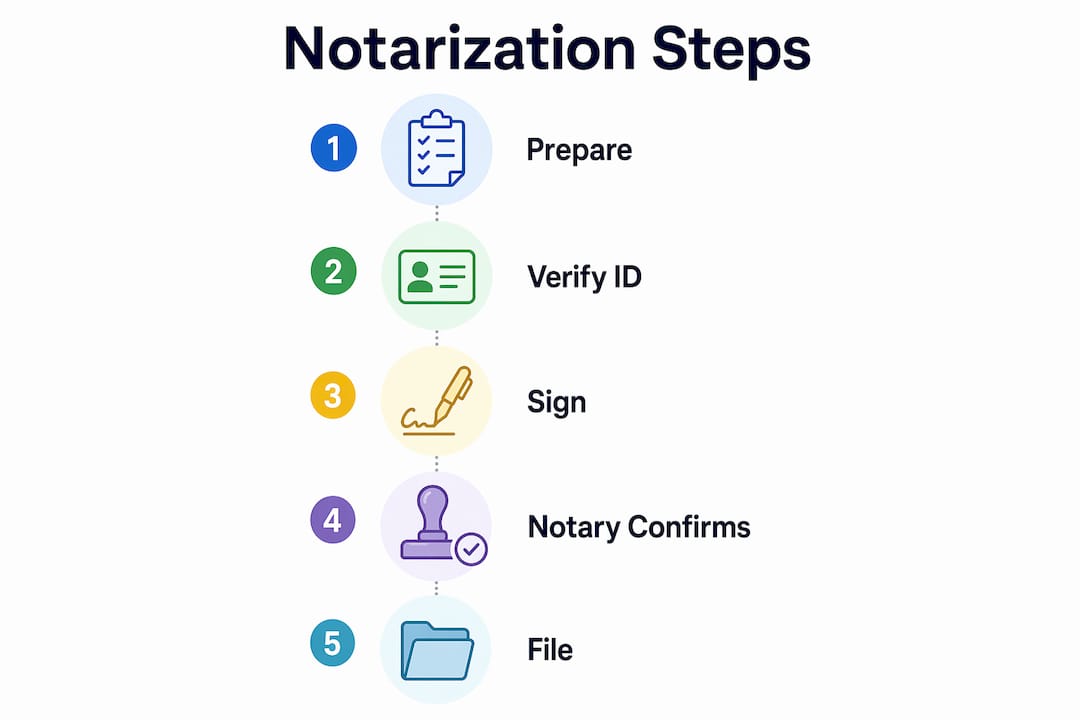
Preparation determines whether a notarization session succeeds or fails. A disorganized approach leads to rejected documents and rescheduled appointments. Follow these steps to get it right the first time.
-
Confirm the signer’s authority. A notary must verify that the person signing has the legal right to act for the corporation. Failure to confirm signer authority is one of the most frequent causes of notarized document refusals. Bring a board resolution, a power of attorney, or a corporate officer designation letter that names the signer explicitly.
-
Gather valid government-issued photo ID. Ontario notaries require at least one piece of primary identification, such as a passport or driver’s license. The name on the ID must match the name on the document exactly.
-
Complete the document before the appointment. A notary authenticates a signature, not a blank form. Arrive with every field filled in correctly. Leaving blanks for later is a common and avoidable mistake.
-
Bring the correct version of the document. If a certified copy is required rather than an original, obtain it from the issuing authority before your appointment. Presenting an uncertified photocopy when a certified copy is required will result in rejection.
-
Verify the notarial statement format. Ontario has specific requirements for how notarial certificates are worded. An incomplete or incorrectly worded notarial statement voids the notarization. Review the required language with your notary in advance.
Pro Tip: If your company uses Remote Online Notarization (RON), prepare a digital packet with your ID, the completed document, and your authority proof before the session. RON services provide live notarization sessions and can offer next-day apostille turnaround at fixed fees, which cuts processing time significantly for time-sensitive transactions.
Review the online notary preparation checklist from Theonlinenotary before your session to avoid the most common documentation errors.

Onsite vs. remote vs. digital: which notarization method fits your business?
Ontario businesses in 2026 have three practical options for certifying business documents. Each has a different cost profile, turnaround time, and level of convenience.
Onsite notarization means visiting a notary public in person. This method works well for complex transactions where the notary needs to review original documents physically, or where a counterparty specifically requires an in-person seal. The drawback is scheduling friction. Coordinating multiple corporate signers at one location takes time, and office hours limit flexibility.
Remote Online Notarization (RON) allows signers to appear before a commissioned notary via live video call. The notary verifies identity through knowledge-based authentication and ID scanning, then applies a digital seal. RON is legally accepted in Ontario and is increasingly preferred for corporate transactions because it eliminates travel and compresses timelines. Digital notary solutions built for corporate workflows integrate directly with document management systems, reducing manual handling.
Digital notary platforms offer business-oriented portals where companies can manage multiple documents, track notarization status, and store completed records. These platforms suit businesses with recurring notarization needs across multiple departments or locations.
| Method | Turnaround | Cost | Convenience | Legal standing in Ontario |
|---|---|---|---|---|
| Onsite notarization | Same day | Moderate | Low (requires travel) | Full |
| Remote Online Notarization | Same day to 24 hours | Low to moderate | High (video call) | Full |
| Digital notary platform | 24–48 hours | Variable | Very high (portal-based) | Full |
Pro Tip: Before selecting any notarization provider, confirm they are authorized under Ontario law. Who can notarize in Ontario is a specific legal question. Not every commissioner of oaths has the same authority as a notary public, and the distinction matters for documents destined for banks or foreign jurisdictions.
Businesses with recurring notarization needs benefit most from establishing a dedicated corporate notary relationship. Specialized B2B workflows, including mobile visits and business portals, reduce errors and speed transactions compared to ad-hoc retail notary use.
What is the difference between notarization and an apostille for international documents?
Notarization alone does not make a corporate document valid abroad. International corporate notarization involves a multi-step authentication process: notarization, government authentication, and an apostille for countries that are members of the Hague Convention. Skipping any step causes foreign officials to reject the document outright.
Here is what each step means in practice:
- Notarization confirms the signer’s identity and the voluntary nature of the signature. It says nothing about the document’s content or legal validity.
- Government authentication (in Canada, typically through Global Affairs Canada or a provincial authority) confirms the notary’s commission is genuine.
- Apostille is a standardized certificate issued by a designated government authority that makes the document recognized in all Hague Convention member countries without further legalization. Canada is a member of the Hague Convention, so documents sent to other member countries require this step.
Notarization confirms signature authenticity but does not approve the underlying agreement’s legality or content accuracy. Business owners who assume a notarized document is automatically enforceable abroad are frequently surprised when it is rejected at the border.
Certified copies add another layer of complexity. A corporate officer can swear that a copy is a true reproduction of the original, with the notary authenticating that oath. This process, called copy certification by document custodian, bypasses the need for original documents in some cross-border transactions. It is a practical tool for companies that cannot risk sending original corporate records overseas.
Common mistakes that cause international document rejection include:
- Submitting a notarized copy when the receiving country requires an apostilled original
- Using a notary whose commission has expired or who lacks provincial authorization
- Failing to authenticate the notary’s signature through the correct government channel before apostille
- Sending documents to non-Hague Convention countries without full legalization (a longer process than apostille)
Specialized services that handle the full chain, from notarization through apostille, reduce rejection risk significantly. For Ontario businesses sending documents to the United States, the European Union, or Asia, this end-to-end approach is the only reliable path.
Key Takeaways
Corporate document notarization is required primarily when external parties demand it, not for all business papers, and the process must match the document’s destination and purpose.
| Point | Details |
|---|---|
| Not all corporate documents need notarization | Articles of Incorporation and bylaws rarely require it; secretary’s certificates and powers of attorney almost always do. |
| Signer authority must be verified | Bring a board resolution or officer designation letter to confirm the signer’s right to act for the corporation. |
| RON is legally valid in Ontario | Remote Online Notarization offers same-day turnaround and full legal standing for most corporate transactions. |
| Apostille is required for international use | Notarization alone does not satisfy foreign jurisdictions; Hague Convention countries require an apostille after notarization. |
| Dedicated corporate notary relationships reduce errors | B2B-focused notary providers with specialized workflows outperform ad-hoc retail notary services for high-volume needs. |
What I’ve learned from watching corporate notarizations go wrong
The single most expensive mistake I see Ontario businesses make is treating notarization as a rubber stamp. A director signs a secretary’s certificate, a notary seals it, and everyone assumes the transaction is protected. Then the bank’s legal team rejects it because the board resolution attached to the certificate was never properly authorized by a quorum. The notary did nothing wrong. The document’s content was the problem, and notarization does not validate content. That distinction costs companies real money in delayed closings.
The second pattern I see constantly is businesses underestimating signer authority verification. A CFO assumes their title alone grants signing authority for a specific transaction. The notary seals the document. The foreign counterparty’s counsel checks the corporate bylaws and finds the transaction required board approval. The document is void. Careful verification of signer authority before the appointment is not bureaucratic caution. It is the difference between a deal closing and a deal collapsing.
My strongest recommendation for any Ontario business that notarizes documents more than a few times a year is to establish a dedicated relationship with a notary provider that understands corporate workflows. The difference between a notary who handles corporate documents daily and one who handles them occasionally shows up immediately in how they structure the notarial certificate, how they handle multi-signer documents, and how they flag problems before they become rejections. Ontario’s notarization rules are also evolving alongside RON adoption, so staying current with legal updates is not optional for businesses operating across borders.
— Ken
Theonlinenotary: corporate notarization without the scheduling friction
Ontario business owners who need reliable, fast notarization for corporate documents have a direct option with Theonlinenotary.

Theonlinenotary provides trusted online notary services for corporate documents, affidavits, statutory declarations, and more, available 24/7 across Ontario. The platform supports Remote Online Notarization via live video session, so your team can complete notarizations without leaving the office. Expert notaries on the platform understand corporate authority requirements, notarial certificate formatting, and the specific needs of business transactions. Whether you need a secretary’s certificate notarized for a bank or a corporate power of attorney certified for international use, Theonlinenotary handles the full process with no scheduling delays.
FAQ
What corporate documents require notarization in Ontario?
Secretary’s certificates, corporate powers of attorney, and affidavits signed by corporate officers most commonly require notarization. Articles of Incorporation and bylaws are certified by the government filing authority, not a private notary.
Does notarization make a corporate document legally enforceable?
Notarization confirms the signer’s identity and the voluntary nature of the signature. It does not validate the document’s content or guarantee its enforceability under Ontario or foreign law.
Can I notarize corporate documents online in Ontario?
Remote Online Notarization is legally accepted in Ontario. A commissioned notary verifies your identity via live video call and applies a digital seal, giving the document full legal standing.
What is an apostille and when does my company need one?
An apostille is a government-issued certificate that makes a notarized document recognized in Hague Convention member countries. Ontario businesses sending corporate documents abroad for international transactions need both notarization and an apostille.
How do I verify a notary’s authority to notarize corporate documents in Ontario?
Confirm the notary holds a valid Ontario commission as a notary public, not only as a commissioner of oaths. The authorized notary requirements in Ontario specify which professionals can notarize documents for corporate and international use.