
Last Updated: October 30, 2026
Quick Summary
To get a notarized document apostille, first have the document properly notarized, then submit the original notarized document to the federal Authentication Services Section, which issues the apostille. The apostille certifies the notary's signature and seal, not the content of your document.
- The notary certifies identity and signature, while the apostille confirms the notary's seal is genuine.
- Send the original notarized document, since a photocopy may not be accepted.
- Notarized documents from any province go directly to the federal Authentication Services Section.
- A notary whose commission expired before notarization will cause the apostille to be refused.
- Countries outside the Apostille Convention require legalization instead of an apostille.
Table of Contents
- Why a Notarized Document Still Needs an Apostille
- Apostille vs. Notarization: Two Separate Steps
- Documents Required for an Apostille
- Who Issues the Apostille and Where to Submit
- Online Notarization for Apostille: Getting the Notary Step Right First
- Apostille Processing Time, Fees, and Delivery
- When the Destination Country Is Not in the Apostille Convention
- Book Your Online Notarization Before You Submit
- Frequently Asked Questions
Why a Notarized Document Still Needs an Apostille
A notary signature proves who signed a document. It does not prove that signature is valid in another country. That gap is exactly why a notarized document apostille is still needed before the document can be used abroad.
Here is the short version. An apostille is a certificate that confirms the signature and seal on a public document are genuine. It is issued under the Hague Apostille Convention, which Canada is a member of (HCCH | #12).
So why does the notary step come first? Because an apostille certifies a signature that already exists. There is nothing to certify until a notary or other authorized official has signed and sealed the document.
At The Online Notary, we see this mix-up constantly. Clients assume the apostille validates the content of their letter or affidavit. It does not. It validates the official who signed it.
Below, we walk through how to get documents apostilled after notarization, from the notary seal to the mailroom.
Apostille vs. Notarization: Two Separate Steps
Notarization is the act of a notary public witnessing a signature and confirming the signer's identity. An apostille is a separate certificate, added later by a government authority, that confirms the notary's signature and seal are genuine for use in another Convention country.
Think of it as a chain of trust. The notary vouches for you. The government vouches for the notary. A foreign office then accepts the government's word.
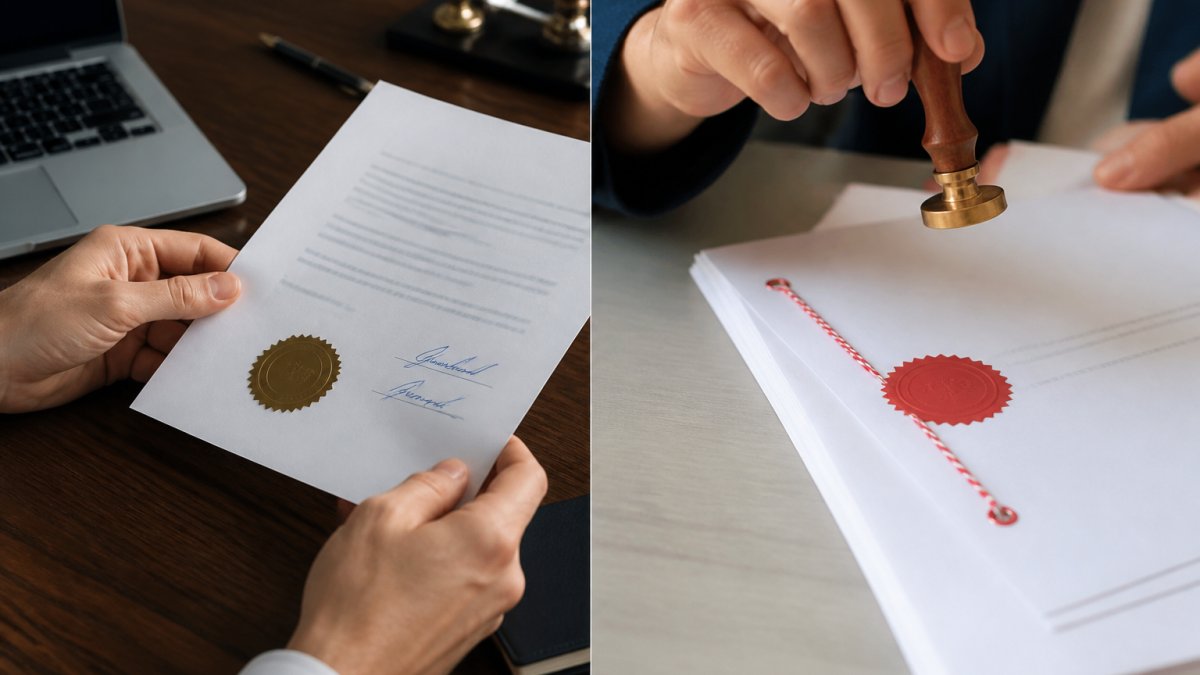
What the Notary Actually Certifies
A notary certifies identity and signature, not truth. The notary confirms you are who you say you are and that you signed willingly. They do not confirm the statements in your affidavit are accurate.
That distinction matters for rejection. If your notary block is incomplete, or the seal is unclear, the apostille office can refuse the document. The fix is almost always at the notary stage, not the apostille stage.
Documents Required for an Apostille
The documents required for a notarized document apostille fall into two groups: the original notarized document, and the submission paperwork that travels with it.
The apostille attaches to a public document. In practice, that means:
- Notarized affidavits and statutory declarations
- Notarized consent letters for travel with a minor
- Notarized copies of diplomas and transcripts
- Notarized corporate documents and powers of attorney
- Court and government-issued records
Preparing the Original Document for Submission
Send the original. A photocopy of a notarized document may not be accepted, so check the requirements of the issuing authority first.
Before you mail anything, run this checklist:
- The notary signed and dated the document in ink
- The notary seal is clear, complete, and not smudged
- The notary's name and commission details are legible
- Every page that needs a signature has one
- No blank fields remain in the notary block
- You have a scanned copy for your own records
A notary seal that overlaps text or sits partly off the page may cause problems with a submission, so review the document carefully before sending it.
Who Issues the Apostille and Where to Submit
Apostilles for Canadian public documents are issued through the federal government's authentication services. Check the official government website for the current submission process and designated office.
Provincial and territorial authorities govern how notaries are commissioned. Before you submit, confirm your notary's commission is active in the province or territory where the notarization took place.
Province-by-Province Routing for Notarized Documents
The apostille itself always comes from the federal Authentication Services Section, but the path to get there depends on where your document was notarized and what type of document it is. Use this decision tree:
- Document notarized in any province or territory (affidavits, statutory declarations, consent letters, powers of attorney, corporate documents): Submit the original notarized document directly to the federal Authentication Services Section. No provincial pre-authentication is required for notarized documents.
- Document issued by a provincial or territorial court (court orders, certified court copies): Confirm with the issuing court whether the document needs a certified true copy from the court before submission. Some courts issue their own certified copies that the federal office will accept; photocopies of court documents will be rejected.
- Document issued by a provincial or territorial government (birth, marriage, death certificates, provincial diplomas and transcripts): Submit the original government-issued document. If the document is a notarized copy of a diploma or transcript, submit the notarized original, not a photocopy of the notarized copy.
- Document issued by the federal government (RCMP criminal record checks, federal corporate documents, federal court records): Submit the original federal document directly to the Authentication Services Section. Some federal documents require prior authentication by the issuing department before the apostille is applied; confirm with the issuing department.
- Document notarized by a notary commissioned in one province but submitted from another: The apostille is still issued federally. The notary's commission must be valid in the province or territory where the notarization actually took place, not where you currently live.
Submission Routes and What Each Requires
- In-person submission at the Authentication Services Section in Ottawa. Bring the original notarized document and any supporting paperwork. In-person submission is the fastest route for the apostille itself, but it requires travel to the federal office.
- Mail submission with the original document and supporting paperwork. Mail is slower because of transit time in both directions, and you should use a trackable courier rather than ordinary mail for the original.
- Through an agent or courier if you cannot attend in person. An agent can hand-deliver and retrieve the document, which shortens the queue time but adds a service fee on top of the government fee.
If your document touches Ontario requirements, our guide to Ontario notarized letter requirements covers who can legally notarize and the rejection errors that sink applications.
The apostille always comes from the federal Authentication Services Section. The province or territory only determines whether your notary was validly commissioned. Confirm the commission first, then submit the original notarized document federally.
Online Notarization for Apostille: Getting the Notary Step Right First
Online notarization for apostille purposes works the same as any other notarization. A licensed notary witnesses your signature over live video, verifies your ID, and applies a tamper-evident digital seal. The output is a notarized document that you can then submit for an apostille, subject to the requirements of the receiving authority.
The catch is format. Some receiving offices want a physical document with a wet-ink seal. Others accept a printed digital seal with an audit trail. Confirm which one your destination expects before you book.
At The Online Notary, sessions use bank-grade identity verification with encrypted video and document storage. Appointments are available from 7am to 11pm, including evenings and weekends.
If you are new to the process, our walkthrough on how to notarize documents online in Ontario explains the video verification step by step.
Apostille Processing Time, Fees, and Delivery
Processing time depends on the submission route and the current processing volume at the issuing office. Check the official government website for current processing times.
Fees work the same way. There is a government fee for the apostille, plus whatever you pay for courier or agent handling. We will not quote you a number here, because government fees change and a stale figure helps nobody. Check the official Authentication Services Section page for current amounts.
Notary fees are charged separately. Our online notary fees in Ontario page explains the pricing for affidavits and statutory declarations.
A general plan looks like this:
| Stage | What Happens | What to Budget For |
|---|---|---|
| Notarization | Notary verifies ID and seals the document | Notary fee |
| Preparation | Original plus supporting documents assembled | Your time, copies |
| Submission | In-person, mail, or courier to the federal office | Government fee plus delivery |
| Return | Apostilled document mailed back to you | Return courier cost |
When the Destination Country Is Not in the Apostille Convention
Not every country accepts an apostille. If your destination is outside the Apostille Convention, the document goes through legalization instead. That means authentication by Global Affairs Canada, followed by legalization at the destination country's embassy or consulate.
The notary step does not change. You still need a properly notarized original before anything else happens. What changes is the chain after it.
Plan extra time for this route. Embassy legalization adds a second queue, and some consulates require appointments.
Book Your Online Notarization Before You Submit
The apostille is only as good as the notary signature under it. Get that step right, and the rest is paperwork and postage.
If you are still deciding which documents need the seal at all, our guide to documents requiring notarization in Ontario sorts domestic use from international use.
At The Online Notary, we connect you with commissioned and licensed Canadian notaries over live video. You get a tamper-evident digital seal with an audit trail, and transparent flat-rate pricing. No travel, no printing, no waiting rooms.
Book your online notary appointment and get your document sealed before it heads to the apostille office.
The hardest part of an apostille is rarely the apostille itself. It is catching a defective notary block before your document leaves your hands. Get your notarization done with The Online Notary, where licensed Canadian notaries verify your identity over encrypted video and apply a tamper-evident digital seal with an audit trail. Appointments are available from 7am to 11pm, including weekends.
Frequently Asked Questions
How can I apostille a document after it has been notarized?
Once your document carries a valid notary signature and seal, you submit the original to the competent authority for the province or territory where it was notarized. Check the official government website for the designated authority for your document type and province or territory. Complete the application form, include the original notarized document and any supporting documents, pay the fee, and choose mail or in-person submission. The authority verifies the notary's commission, then attaches or issues the apostille certificate.
Can a notary apostille a document?
No. A notary in Canada can notarize a document, but cannot issue an apostille. Apostilles are issued only by the competent authority designated for each province or territory, or by Global Affairs Canada for federal public documents. This is the core of apostille vs. notarization: the notary confirms identity and signature, while the government authority confirms the notary's commission and then issues the certificate of authentication. Sending a notarized document to a notary for an apostille will not produce an apostille, so the apostille must be requested from the designated authority.
Can a digitally notarized document be apostilled?
It depends on the receiving authority. Acceptance of electronically notarized documents depends on the receiving authority, so confirm the submission format the authority accepts before you book. Before you book online notarization for apostille purposes, confirm the submission format the issuing authority accepts. If a paper original is required, print the digitally notarized document and check whether the authority treats that printed copy as valid, or ask the notary to complete a paper version.
What is the difference between an apostille and legalization?
An apostille is used between countries that are members of the Apostille Convention. Legalization is the longer chain used when the destination country is not a member: the document may need notarization, then authentication by the provincial or federal authority, then consular legalization by the destination country's embassy or consulate. Legalization involves additional steps beyond an apostille, so check the requirements of your destination country. Confirm which route your destination country requires before you start, because the steps and documents required for an apostille differ from those for legalization.
