
Last Updated: November 15, 2026
Quick Summary
A mobile notary for hospital patients travels to the bedside to confirm identity, witness signatures, and apply a notarial seal, or handles the signing by live video so the patient never leaves the ward. The notary cannot give legal advice or draft documents, and hospital staff cannot notarize. Confirm hospital access and the document's witness rules before the appointment.
- Call the unit's charge nurse, not the main switchboard, to confirm visiting hours and room access.
- The notary needs the document printed and complete, with no blank fields to fill in.
- Do not let the patient sign before the notary is present, or the document may need redoing.
- If capacity is in doubt, have a physician document an assessment before the signing.
- Remote appointments at The Online Notary run from 7am to 11pm with flat-rate pricing.
Table of Contents
- What a Mobile Notary for Hospital Patients Actually Does
- Documents Hospital Patients Commonly Need Notarized
- Hospital Notary Appointment Requirements You Need to Meet
- Why Mental Capacity Matters Before the Notary Arrives
- Getting a Notary for Power of Attorney at the Bedside
- Remote Online Notarization vs. an In-Person Hospital Visit
- What to Prepare Before the Notary Arrives
- Book a Notary for a Hospital Signing
- Frequently Asked Questions
What a Mobile Notary for Hospital Patients Actually Does
A mobile notary for hospital patients is a commissioned notary public who travels to a hospital room, bedside, or care facility to witness signatures and apply a notarial seal on legal documents. The notary confirms identity, administers oaths where required, watches the signature happen, and applies a tamper-evident seal. (Source: provincial requirements for powers of attorney)
The role is narrow but essential. A notary does not give legal advice or draft documents. A notary verifies that the signer is who they claim to be, is signing willingly, and signs in front of a witness with signing authority.
That distinction matters when a family is under pressure. Hospital staff cannot notarize. A nurse can witness a signature in some cases, but a nurse cannot apply a notarial seal. If a bank, insurer, or government office requires notarization, you need a commissioned notary, full stop.
Documents Hospital Patients Commonly Need Notarized
The paperwork that brings a notary to a bedside falls into a handful of categories, each with execution quirks families discover too late.
Advance planning documents. A durable power of attorney for property lets a trusted person manage finances if the patient cannot.
Affidavits and statutory declarations. Patients frequently need affidavits for insurance claims, statutory declarations for government benefits, or sworn statements for court.
Real estate and financial documents. Hospitalized patients sometimes need to sign real estate documents, loan agreements, or bank forms.
Estate documents. Wills sometimes require notarization depending on provincial rules and how the will is executed.
One practical note: not every document needs a notary.
Hospital Notary Appointment Requirements You Need to Meet
Most hospital notarizations hinge on three things: valid identification, a willing signer, and a witness who meets the document's requirements. Get those in place and the appointment usually runs smoothly. But hospitals add administrative coordination that office notarizations never face, and that is where most appointments fail.
Identification and Witness Rules
Every signer needs current government-issued photo identification. A passport, driver's licence, or provincial photo card works in most cases. The notary must confirm the photo matches the person and that the ID has not expired. Our guide to notary public identification in Ontario walks through exactly which documents are accepted.
Witness requirements vary by document. Some affidavits need one witness; some need two. The witness cannot usually be the notary, and in some cases cannot be a beneficiary or spouse. Confirm the witness rule with whoever drafted the document before the appointment, because a signing that fails this test often has to be redone.
Hospital Administrative Coordination: A Checklist for Families
Hospitals are not public buildings with open doors. The biggest reason a mobile notary is turned away at the ward is that nobody cleared access in advance. Use this checklist to coordinate with the hospital before the appointment:
- Call the unit, not the main switchboard. Ask for the charge nurse or unit clerk. Confirm visiting hours, screening requirements, and whether a notary will be admitted to the room. Some units restrict non-family visitors entirely.
- Confirm the patient's availability window. Ask the charge nurse whether the patient will be available and alert at the scheduled time. Booking a notary for a window that collides with a procedure, physiotherapy, or a medication round that leaves the patient drowsy is a common mistake.
- Ask about isolation or infection-control rules. If the patient is in isolation, staff may require the notary to gown up or sign outside the room. Sort this out before the appointment, not at the door.
- Confirm whether a device is permitted. For remote online notarization, ask whether the patient can use a phone or tablet in the room and whether the hospital's Wi-Fi or cellular signal is reliable enough for a video call. Some units restrict device use near certain equipment.
- Get the name of the staff member who approved access. Write it down. If a different staff member is at the desk when the notary arrives, having a name and time of approval resolves the conversation quickly.
- Ask about security screening. Some hospitals require visitors to sign in at a security desk and show identification. A notary arriving with a bag of documents may be asked to declare contents. A quick call ahead avoids a delay at the entrance.
Watch out: hospital policies vary by unit and province, and a policy that applied last month may have changed. Confirm access the day before the appointment, not a week earlier.
What the Notary Needs From You
Beyond hospital access, the notary needs the document itself, printed and complete, with no blank fields the notary is expected to fill in. Notaries cannot draft or complete documents for you. Have the patient's ID ready, any required witness present with their own ID, and the receiving institution's written instructions on format and witnesses. If the patient is paying, confirm the fee method in advance, many mobile notaries accept e-transfer or card, but some prefer cash, and a hospital room is not the place to discover a payment problem.
Why Mental Capacity Matters Before the Notary Arrives
A notary cannot proceed if the signer does not understand what they are signing. This is the part families underestimate most. Mental capacity is the signer's ability to understand the nature and effect of the document at the moment of signing.
Signs that warrant a pause include confusion about what the document does, inability to recall the person being appointed, or a patient who is sedated or disoriented.
For families managing an elderly or hospitalized signer, our guide to notary services for seniors in Ontario covers capacity-sensitive documents in more depth. Watch out: pushing a signing through when the patient is not lucid can invalidate the document later, which is far worse than delaying a day.
Getting a Notary for Power of Attorney at the Bedside
A notary for power of attorney at a hospital bedside is one of the most requested signings, and one of the most rule-bound. A power of attorney for property lets someone manage finances; a power of attorney for personal care covers health and living decisions. Ontario has strict requirements for how each is signed and witnessed.
A power of attorney for property generally must be signed by the grantor in the presence of witnesses, and certain people, including the attorney named in the document, cannot act as witnesses. Check the current requirements with the official Ontario source or a lawyer. Our page on how to notarize a power of attorney online in Canada explains the POA types and witness rules in detail.
Remote Online Notarization vs. an In-Person Hospital Visit
Remote online notarization lets a signer appear before a notary by live video instead of in person. For some hospital patients, this may be a convenient option. The patient stays in bed, the notary joins by video, and identity is verified through a secure process rather than a physical ID check at the door.
An in-person bedside visit still has its place. Some documents or receiving institutions may require a physical wet-ink seal. If the patient cannot manage a video call, or the hospital will not permit it, a mobile notary who travels to the room is the fallback.
The trade-offs are worth weighing honestly:
| Factor | Remote online notarization | In-person hospital visit |
|---|---|---|
| Travel | None | Notary travels to the ward |
| Scheduling | Often same day, evenings and weekends | Depends on notary availability and visiting hours |
| Identity check | Bank-grade digital verification | Physical photo ID inspection |
| Best for | Alert patients with a phone or tablet | Wet-ink requirements or no device access |
| Coordination | Minimal hospital involvement | Requires staff cooperation and room access |
If you are weighing the two, our comparison of alternatives to in-person notary services sets out the options side by side.
What to Prepare Before the Notary Arrives
Preparation separates a smooth signing from a wasted appointment. Have the documents printed and complete, with no blank fields the notary is expected to fill in. Notaries cannot draft or complete documents for you.
Gather the following before the appointment:
- Government-issued photo ID for the patient
- The full document, printed and unsigned
- Any witness the document requires, with their own ID
- The receiving institution's instructions on format and witnesses
- A pen, and a flat surface the patient can sign on
- The charge nurse's okay for the notary or device to be in the room
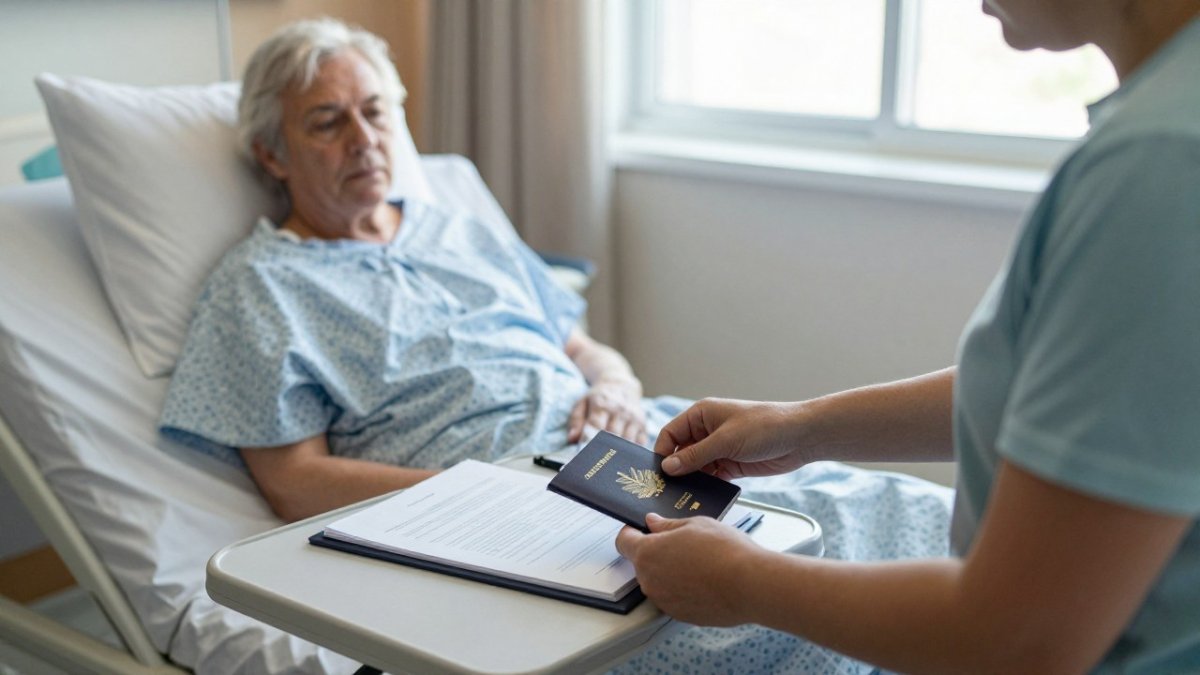
Do not let the patient sign anything before the notary is present. A document signed early usually has to be redone. Confirm the patient is awake, comfortable, and has had water before the appointment starts.
Book a Notary for a Hospital Signing
Hospital signings rarely wait for a convenient moment, and that is where a remote appointment earns its keep.
At The Online Notary, our notaries are commissioned and licensed, and appointments are available from 7am to 11pm. Identity is verified with bank-grade checks, and every signing produces a tamper-evident digital seal with an audit trail.
When you are ready to schedule, you can book your online notary appointment and choose a time that fits the patient's day.
A hospital notarization is a small piece of paperwork at a difficult moment, and getting it right the first time saves a family a second trip. If the receiving institution accepts a digital seal, book a remote appointment and keep the patient in bed.
Frequently Asked Questions
Can a notary come to a hospital?
Yes. A mobile notary can travel to a hospital room, care facility or hospice to witness signatures and apply a notarial seal, provided the patient is awake, understands what they are signing and has valid government-issued identification. Some hospitals ask that the visit be cleared with nursing staff or unit administration first, so call ahead. If the patient cannot have visitors or is in isolation, ask whether remote online notarization by live video is an option instead.
What should a patient have ready for a mobile notary visit?
Have the unsigned document in hand, plus a second copy for the patient's records. Bring government-issued photo identification that has not expired, such as a passport or driver's licence. Line up any required witnesses in advance, since some documents need one or two people present who are not named as beneficiaries. Confirm the patient's full legal name matches the document exactly, and check with hospital staff about visiting hours and whether the room can accommodate a short signing session.
Can documents be notarized remotely by video?
Remote online notarization lets a commissioned notary witness a signature over a live video call, verify identity through bank-grade checks and apply a tamper-evident digital seal with an audit trail. It suits patients who are well enough to appear on camera but cannot receive visitors, and it avoids travel fees. Not every document or receiving institution accepts a digital seal, so confirm the format with the bank, government office or lawyer who will rely on the document before booking.
Can a family member arrange a notary for a hospital patient?
Yes, a spouse, adult child or trusted friend can book the appointment and handle logistics, but the patient must be the one who signs and must speak with the notary directly. The notary needs to hear the patient confirm they understand the document and are signing voluntarily. If the patient is too ill to speak or follow the conversation, the notary may decline to proceed, and a lawyer should be consulted about alternatives.
