Mailing Notarized Documents in Ontario: 2026 Guide

TL;DR:
- Mailing notarized documents requires using trackable carriers with signature confirmation to ensure legal validity and chain of custody. Proper preparation includes verifying notarization, creating copies, and accurate labeling, to prevent rejection or delays. Digital delivery options are increasingly acceptable in Ontario, reducing transit risks and expediting legal processes.
Mailing notarized documents is defined as the process of physically or digitally transmitting legally authenticated papers to a recipient while maintaining their legal validity through traceability and signature confirmation. For individuals and businesses in Ontario, getting this wrong means rejected filings, lost fees, and delayed legal proceedings. Industry standards require trackable courier services with delivery confirmation and signature requirement for originals to preserve chain of custody. Services like FedEx, UPS, and Canada Post Xpresspost all offer signature confirmation options suited to this purpose. This guide covers every step: what you need, how to prepare, which shipping options to use, and how to avoid the mistakes that derail legal filings.
What are the essential requirements for mailing notarized documents?
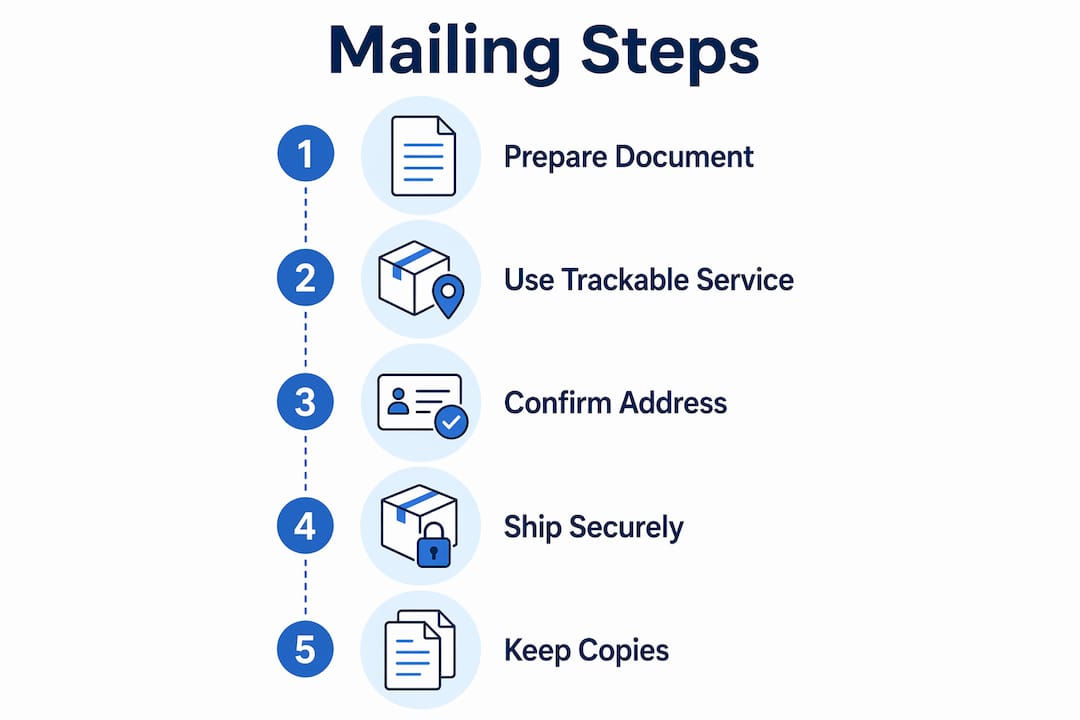
Mailing notarized documents correctly starts with three non-negotiables: traceability, signature confirmation, and document copies. Treating legal documents like standard mail causes loss or damage. Signature confirmation adds a layer of control that standard postage simply does not provide.

Courier options at a glance
Canada Post, FedEx, and UPS each offer trackable services with signature confirmation. Canada Post’s Xpresspost and Priority services include tracking and optional signature. FedEx and UPS both offer express delivery with mandatory signature release options. For international filings, specialized legal document couriers provide monitored hand delivery with full chain of custody documentation.
Pro Tip: Always request “signature required” at the point of purchase, not as an afterthought. Some carriers default to leaving packages at the door unless you specify otherwise.
What you need before you mail
- A complete, verified copy of every notarized document in the packet
- Tamper-evident envelope or rigid mailer to prevent physical damage
- Accurate recipient address including department name, suite number, and postal code
- Tracking number confirmation sent to both sender and recipient
- A self-addressed, postage-paid return envelope for government filings
Courier comparison table
| Carrier | Signature Option | Tracking | Typical Delivery | Best For |
|---|---|---|---|---|
| Canada Post Xpresspost | Yes (add-on) | Yes | 2–3 business days | Domestic Ontario filings |
| Canada Post Priority | Yes (add-on) | Yes | Next business day | Urgent domestic |
| FedEx Express | Yes (standard) | Yes | 1–3 business days | Business and legal filings |
| UPS Express | Yes (standard) | Yes | 1–3 business days | Business and legal filings |
| Legal document courier | Yes (mandatory) | Yes | 1–4 business days | International or high-value |
How to properly prepare notarized documents for mailing in Ontario
Preparation is where most mailing errors originate. A document that arrives damaged, incomplete, or improperly packaged can be rejected outright. Government offices in Ontario and elsewhere will not accept torn, water-damaged, or unsealed notarized papers.
Follow this checklist before you seal the envelope:
- Verify the notarization. Confirm the notary’s seal, signature, and date are all present and legible. A missing seal is grounds for immediate rejection.
- Make complete copies. Always create a scanned copy of the full notarized packet before mailing. Verified copies help prove the contents if originals are delayed or lost.
- Use rigid or tamper-evident packaging. Place documents inside a flat, rigid cardboard mailer or a poly envelope with a tamper-evident seal. Never fold notarized documents unless the recipient explicitly permits it.
- Label clearly and accurately. Print the recipient’s full name, department, street address, city, province, and postal code. Include your return address on the front and back of the package.
- Include a self-addressed return envelope. For government filings such as apostilles or court submissions, incorrect or missing return envelopes cause rejected filings and lost fees. This applies equally to Ontario government offices.
- Attach a cover letter. A brief cover letter identifying the document type, the notary’s name, and your contact information gives the recipient immediate context and reduces processing delays.
- Confirm recipient requirements in advance. Call or email the receiving office before you mail. Ask whether they require the original or will accept a certified copy, and whether they have a preferred carrier.
Pro Tip: If you are mailing to a government office in Ontario, call ahead to confirm the exact mailing address. Many government departments have separate intake addresses for legal documents that differ from their general correspondence address.
Mistakes to avoid
Skipping the copy step is the single most common and costly error. If your original notarized document is lost in transit, you may need to restart the entire notarization process. Notarizing a business document in Ontario takes time and money. Losing the original because you skipped a scan is avoidable.
What are the secure shipping options, costs, and delivery times?
Choosing the right shipping method depends on three factors: urgency, value of the document, and whether the recipient is domestic or international.
Standard and express domestic options
Canada Post Xpresspost covers most Ontario domestic filings at a reasonable cost. FedEx and UPS Express are better for business filings where speed and tracking reliability matter. Both carriers provide real-time tracking and automatic signature confirmation at the door.
Specialized legal document couriers
For international filings or documents with high legal stakes, specialized legal document couriers are the strongest option. Specialized courier pricing typically starts around $75 as a base fee. Express delivery adding 2–4 days costs approximately $25 more, while urgent 1–2 day service adds roughly $40 to that base. These services provide monitored custody from pickup to delivery, which standard carriers do not guarantee.
When digital delivery is the right call
Digital or scanned notarized documents are accepted by many recipients and eliminate transit risk entirely. Electronic delivery removes waiting time, loss risk, and courier expense when legally acceptable. Ontario’s legal framework now recognizes online notarization for many document types, making digital delivery a practical alternative for affidavits, statutory declarations, and solemn declarations.
Shipping options summary
| Method | Estimated Cost | Delivery Speed | Security Level | Best Use Case |
|---|---|---|---|---|
| Canada Post Xpresspost | $15–$30 | 2–3 business days | Medium | Routine domestic filings |
| Canada Post Priority | $25–$50 | Next business day | Medium | Urgent domestic |
| FedEx / UPS Express | $30–$60 | 1–3 business days | High | Business legal documents |
| Legal document courier | $75+ | 1–4 business days | Very high | International or high-value |
| Digital / secure email | Minimal | Immediate | High (if encrypted) | When originals not required |
How to handle common challenges when sending notarized papers
Even well-prepared packages run into problems. Knowing the most common failure points lets you prevent them before they happen.
- Missing signature requirement. Packages delivered without signature confirmation have no proof of receipt. Always select signature required, regardless of the carrier.
- Wrong recipient address. Government offices and law firms often have multiple addresses. Verify delivery instructions with the recipient before mailing. Confirm whether they accept delivery to a P.O. Box or only a street address.
- Centralized mailroom delays. DIY mail-in routes for legal documents tend to experience delays because centralized mailrooms can hold documents for weeks before routing them to the correct department. Professional couriers with direct hand delivery avoid this entirely.
- Overnight shipping that still fails. Even overnight shipping can fail if recipient offices have specific intake hours or require delivery to a named individual. Confirm intake hours and the correct contact person before you ship.
- No tracking follow-up. After mailing, log the tracking number and set a reminder to check delivery status within 24 hours of the expected delivery date.
“Confirm whether the original notarized document is required or if a certified digital copy is acceptable. This single step eliminates the most common cause of unnecessary mailing costs and delays.”
If a package is delayed or lost, your scanned copy becomes your recovery tool. Contact the carrier immediately and file a trace request. For high-value documents, purchase insurance at the time of mailing. Canada Post, FedEx, and UPS all offer declared value coverage for legal documents.
What are the Ontario-specific legal considerations for mailing notarized documents?
Ontario has specific rules about which documents require an original notarized copy and which accept certified reproductions. Courts, government ministries, and financial institutions each have their own policies. The safest practice is to confirm in writing before you mail.
Documents notarized in Ontario by a licensed notary public or commissioner of oaths carry legal weight across Canada and, with proper authentication, internationally. If you are sending notarized papers abroad, confirm whether the destination country requires an apostille or additional authentication from Global Affairs Canada. Understanding the full range of document types requiring notarization in Ontario helps you determine the correct mailing protocol from the start.
For affidavits, statutory declarations, and invitation letters, many Ontario recipients now accept digitally notarized documents that comply with Ontario’s Electronic Commerce Act. This reduces the need for physical mailing in a growing number of situations.
Pro Tip: Keep a mailing log for every notarized document you send. Record the date, carrier, tracking number, recipient, and delivery confirmation. This log is your legal record if a dispute arises over whether documents were received.
Key Takeaways
Mailing notarized documents safely requires trackable shipping with signature confirmation, complete document copies, and recipient-verified delivery instructions before you seal the envelope.
| Point | Details |
|---|---|
| Use trackable shipping | Always select a carrier with tracking and mandatory signature confirmation for notarized originals. |
| Copy before you mail | Scan the full packet before sending so you have proof of contents if originals are lost. |
| Verify recipient requirements | Confirm address, intake hours, and whether originals or digital copies are accepted before mailing. |
| Know your cost tiers | Domestic options start around $15; specialized legal couriers start at $75 for high-stakes filings. |
| Consider digital delivery | Ontario recognizes online notarization for many document types, eliminating transit risk entirely. |
Why I think most people underestimate the mailing step
After years of working with notarized documents in Ontario, I have seen the same pattern repeat itself. People spend significant time and money getting a document properly notarized, then treat the mailing step as an afterthought. They drop it in a standard envelope, skip signature confirmation, and wonder why it never arrived or was rejected.
The mailing step is not administrative. It is a legal handoff. The moment a notarized document leaves your hands without a traceable chain of custody, its legal integrity is at risk. A rejected filing because of a missing return envelope or a wrong address can set a legal process back by weeks.
My honest recommendation: if the document matters enough to notarize, it matters enough to ship properly. Use FedEx or UPS with signature confirmation for anything time-sensitive. Use a specialized legal courier for anything international or irreplaceable. And for anything where the recipient accepts digital copies, skip the physical mail entirely. Ontario’s online notarization framework exists precisely to remove this friction.
Businesses should go further and build a standard mailing protocol into their document workflow. Define which carrier to use, who is responsible for tracking, and where the delivery confirmation gets filed. That protocol takes 30 minutes to create and saves hours of recovery work when something goes wrong.
— Ken
How Theonlinenotary simplifies notarized document handling in Ontario
Theonlinenotary provides online notary services in Ontario for affidavits, statutory declarations, invitation letters, solemn declarations, and more, all completed remotely and legally compliant with Ontario law.

When your notarized document is completed through Theonlinenotary, you receive a digitally authenticated copy that many Ontario recipients accept without physical mailing. For situations requiring an original, the platform guides you through preparation so your document is ready to ship correctly the first time. This removes the guesswork from both the notarization and the delivery process, saving you time and reducing the risk of rejection.
FAQ
What is the best way to mail notarized documents in Ontario?
The best method is a trackable carrier such as Canada Post Xpresspost, FedEx, or UPS with mandatory signature confirmation. Always scan the full document packet before mailing as a backup.
Do I need to mail the original notarized document?
Not always. Many Ontario recipients accept digitally notarized copies when they comply with Ontario’s Electronic Commerce Act. Confirm with the recipient before mailing to avoid unnecessary courier costs.
How much does it cost to mail notarized documents?
Domestic options through Canada Post or FedEx typically range from $15 to $60 depending on speed and weight. Specialized legal document couriers start at approximately $75 for base service, with express and urgent options adding $25 to $40 more.
What happens if my notarized document is lost in the mail?
File a trace request with your carrier immediately and submit your scanned copy as proof of contents. You may need to have the document re-notarized if the original cannot be recovered, which is why copying before mailing is non-negotiable.
Can I use Canada Post for mailing notarized documents?
Yes. Canada Post Xpresspost and Priority services both include tracking and optional signature confirmation, making them suitable for most domestic Ontario filings. For high-value or international documents, FedEx, UPS, or a specialized legal courier provides stronger chain-of-custody protection.