Liability of Online Notary in Ontario: 2026 Guide

TL;DR:
- Online notaries face personal liability for every remote notarization act, including identity verification and record retention. Proper compliance, adequate insurance, and reliable technology are essential to mitigate legal risks and protect both notaries and clients.
The liability of an online notary is defined as the full legal responsibility a notary bears for every remote notarization act, including identity verification, fraud prevention, and secure record retention. Online notaries carry the same civil and criminal exposure as traditional notaries, plus additional digital-specific duties. Surety bonds range from $5,000 to $15,000, but personal liability can far exceed that amount when errors occur. The Revised Uniform Law on Notarial Acts (RULONA) sets the baseline standard for remote notarization in North America, and Ontario’s own regulatory framework builds on those principles. Understanding where liability begins and ends protects both the notary and the client.
What is the liability of an online notary?
Online notary liability covers every act from the moment a session starts to the moment records are archived. A notary who fails at any point in that chain faces civil lawsuits, regulatory sanctions, and potential criminal penalties. Criminal fines reach up to $1,000 per violation, and negligence that causes financial loss to a third party can result in personal damages well beyond any bond. That exposure is not theoretical. Courts have held notaries personally liable when a flawed notarization enabled fraud or property loss.
The term “remote online notarization” (RON) is the recognized industry standard for what most people call online notarization. Both terms refer to the same process: a notary and signer connect via live audio-video, the notary verifies identity through approved technology, and the act is recorded. Ontario residents can learn more about how RON works in practice before engaging any notary service.
What are the legal responsibilities of online notaries in Ontario?
Online notaries in Ontario carry specific procedural duties that go beyond simply witnessing a signature. Each duty creates a corresponding liability if ignored.
The core responsibilities include:
- Identity proofing: The notary must use credential analysis and knowledge-based authentication (KBA) tools to confirm the signer’s identity. Relying on a casual video call without approved technology does not meet the legal standard.
- Audio-video recording: Every RON session must be recorded in full. The recording serves as the primary evidence of a valid notarial act.
- Secure storage: State and provincial laws often require 10-year retention periods for electronic journals and session recordings. Losing or deleting records before that period expires creates direct liability.
- Coercion detection: The notary must confirm the signer is in a private location and acting freely. This is a human judgment call that technology cannot make.
- Compliance with Ontario law: Ontario’s legal framework governs which documents qualify for remote notarization and which identity proofing methods are acceptable. Notaries must stay current with those rules.
Pro Tip: Before each session, ask the signer to pan their camera around the room. This simple step documents that no one else is present and reduces coercion liability.
A notarization is governed by the law of the notary’s commissioning jurisdiction, not the signer’s location. This matters in Ontario because a notary commissioned here must follow Ontario rules even when notarizing for a client calling in from another province or country. Businesses using online notarization in Ontario should confirm their notary holds a valid Ontario commission.
What are the most common liability risks for online notaries?
Most liability claims against online notaries trace back to a small set of recurring failures. Knowing them is the first step toward avoiding them.
- Notarizing without proper signer presence. Video chats outside authorized platforms do not satisfy legal presence requirements. A notary who uses an unapproved tool, even with good intentions, has no legal defense.
- Inadequate identity verification. Skipping KBA or accepting expired documents opens the door to identity fraud. If a fraudster uses a stolen identity and the notary missed the signs, the notary shares liability for the resulting harm.
- Missing or incomplete records. A session recording that was never saved, or a journal entry with gaps, leaves the notary unable to defend against a later challenge.
- Failing to detect coercion. The notary is responsible for verifying that the signer is not coerced. A signer who later claims duress can void the notarization and expose the notary to civil action.
- Seal theft and platform breaches. A compromised digital seal can be used to forge documents. The notary bears responsibility for securing their credentials.
“A notary’s failure to follow procedural safeguards leads to personal civil liability and potential criminal penalties. Negligence can cause financial losses far exceeding bond amounts, with criminal fines reaching up to $1,000 per violation and bonds capped at $25,000.”
The gap between a $25,000 bond and a six-figure fraud loss is real. Surety bonds cover a fraction of what a court may award. That gap is precisely why E&O insurance and strict procedural discipline matter so much.
How does technology affect online notary liability?
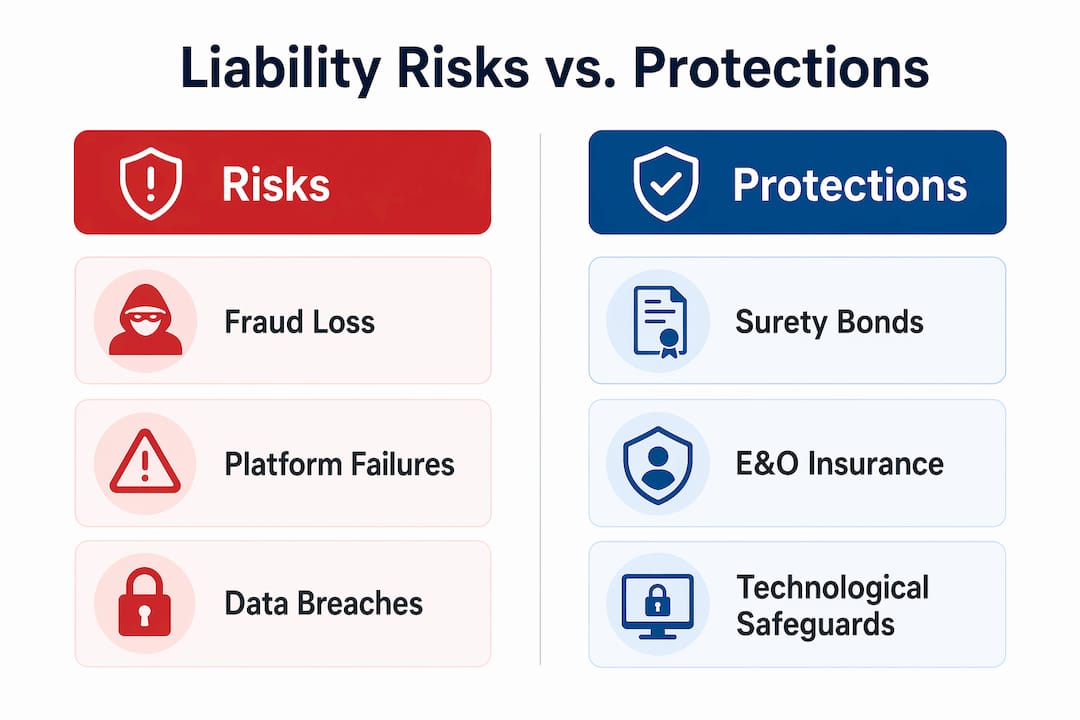
Technology is both the strongest protection and the biggest new risk for online notaries. Used correctly, it builds a nearly unassailable legal record. Used carelessly, it creates liability that did not exist in traditional notarization.

Technology as a safeguard
RON platforms create immutable digital certificates that cryptographically prove document integrity. Any tampering disables verification and flags the document as altered. Session recordings and KBA logs together produce stronger fraud evidence than traditional notarization because every step is time-stamped and archived. As of may 2026, 47 states plus D.C. authorize remote e-notarization, which reflects broad legal confidence in the technology’s reliability.
Technology as a liability source
| Risk category | What goes wrong | Liability consequence |
|---|---|---|
| Platform failure | Session drops mid-notarization | Incomplete record; act may be void |
| Improper storage | Provider portal is the only backup | Single point of failure; records lost |
| Missing recordings | Software error deletes session file | No evidence to defend against challenge |
| Credential compromise | Digital seal stolen via data breach | Forged documents traced back to notary |
Pro Tip: Keep encrypted local backups of every session recording and journal entry. Relying solely on a provider portal creates a single point of failure that courts will not excuse.
The digital security requirements for Ontario notaries are specific and enforceable. A notary who delegates all record-keeping to a third-party platform without maintaining independent copies accepts unnecessary risk.
How can online notaries and clients reduce liability?
Reducing notary public liability issues requires both the notary and the client to take deliberate steps. Neither party is passive in this process.
For notaries, the most effective measures are:
- Carry E&O insurance. Errors and omissions insurance protects against financial loss from negligence, though not from intentional misconduct. The recommended minimum coverage is $25,000, with higher amounts required for signing agents handling high-value transactions.
- Refuse when in doubt. A notary who proceeds despite red flags accepts liability for the outcome. Declining a questionable notarization is always the safer choice.
- Validate your platform. Not every video conferencing tool qualifies as an authorized RON platform. Use only platforms that meet Ontario’s technical and security standards.
- Maintain independent records. Store encrypted copies of all session recordings, KBA logs, and journal entries outside the provider’s system.
- Stay current on regulations. Ontario’s rules for remote notarization continue to evolve. A notary operating under outdated procedures has no regulatory defense.
For clients, the key steps are:
- Confirm the notary holds a valid Ontario commission before the session begins.
- Use the notary’s approved platform, not a personal video call app.
- Keep a copy of the completed, notarized document and the session confirmation.
- For high-value transactions, vet the platform’s anti-fraud infrastructure before proceeding.
Clients seeking secure online notarization in Ontario should ask their notary directly which platform they use and whether it meets current provincial standards. That single question filters out most low-quality providers.
Key Takeaways
Online notary liability is real, personal, and not fully covered by surety bonds, making E&O insurance and strict procedural compliance the only reliable protection for notaries and clients alike.
| Point | Details |
|---|---|
| Liability equals traditional notaries | Online notaries face the same civil and criminal exposure as in-person notaries, plus digital-specific risks. |
| Bonds do not cover everything | Surety bonds cap at $25,000, but negligence claims can far exceed that amount in high-value cases. |
| Technology cuts both ways | Immutable audit trails protect notaries, but platform failures and missing recordings create new liability. |
| E&O insurance is non-negotiable | A minimum of $25,000 in errors and omissions coverage is the recommended baseline for practicing notaries. |
| Human judgment still matters | Technology cannot detect coercion or signer awareness. The notary’s personal observation remains a legal duty. |
The part of online notary liability most people get wrong
Most people assume that because a RON session is recorded, the notary is automatically protected. That assumption is wrong, and I have seen it cause real problems.
The recording only protects you if it exists, if it is stored correctly, and if you actually watched the session closely enough to catch what the camera caught. A notary who clicks through a session without genuinely observing the signer’s demeanor has a recording that works against them, not for them. The footage shows exactly what they missed.
The other misconception I encounter constantly is that RON legitimacy is still in question. It is not. With 47 U.S. states authorizing remote e-notarization and Ontario’s own framework firmly in place, the legal foundation is solid. The risk is not in the technology. The risk is in the notary who treats the technology as a substitute for professional judgment.
My honest advice: choose a notary service that treats compliance as a baseline, not a selling point. Any provider worth using will tell you exactly which platform they use, how long they retain records, and what their E&O coverage looks like. If those answers are vague, keep looking.
— Ken
Trusted online notary services in Ontario
Liability concerns should not stop you from getting documents notarized. They should push you toward a provider who takes compliance seriously.

Theonlinenotary offers professional online notary services in Ontario for affidavits, statutory declarations, invitation letters, solemn declarations, and more. Every session follows current Ontario regulations, uses approved identity verification technology, and produces a complete audit trail. The service is available 24/7, so you are never forced to choose between convenience and compliance. If you need a notarization that holds up legally, Theonlinenotary is built to deliver exactly that.
FAQ
What is the liability of an online notary in Ontario?
An online notary in Ontario carries the same civil and criminal liability as a traditional notary, plus additional responsibility for digital identity verification, session recording, and secure record retention. Personal liability can exceed surety bond limits when negligence causes financial harm.
Does E&O insurance cover all notary mistakes?
Errors and omissions insurance covers financial losses from negligence but does not protect against intentional misconduct. The recommended minimum coverage is $25,000.
Can a notarization be voided if the online session was not recorded?
Yes. A missing or incomplete session recording removes the primary evidence that a valid notarial act occurred, leaving the notarization open to legal challenge and the notary exposed to liability.
What happens if an online notary uses an unauthorized platform?
Using an unauthorized platform means the notarization does not meet legal presence requirements. The act can be declared void, and the notary faces civil liability for any harm that results from the invalid document.
How long must an online notary keep records in Ontario?
Laws in many jurisdictions require notaries to retain electronic journals and session recordings for up to 10 years. Ontario notaries should confirm the current retention period under provincial rules and maintain independent encrypted backups.