Legalized documents in Ontario: What they mean and why they matter

TL;DR:
- Document legalization involves authentication and embassy legalization, beyond notarization.
- Proper preparation and licensed professionals prevent delays and rejections.
- Post-2024, Hague member countries accept apostilles, simplifying the process.
Many Ontario residents and businesses assume that once a document is notarized, it is ready for international use. That assumption is wrong, and it causes real problems. A notarized document is just the starting point. To be recognized in another country, it typically needs to go through authentication and legalization, two additional steps with their own requirements, timelines, and authorities. Missing either one can result in rejected applications, delayed business deals, or stalled immigration processes. This article breaks down exactly what document legalization means in Ontario, what the process involves, and what you need to know to get it right the first time.
Table of Contents
- What does document legalization mean?
- The step-by-step legalization process in Ontario
- Requirements: What makes a document eligible for legalization?
- Recent changes: Apostille and Ontario’s shift post-2024
- Why clear understanding of legalization requirements saves time and money
- Ontario’s trusted partner for document legalization and notary needs
- Frequently asked questions
Key Takeaways
| Point | Details |
|---|---|
| Legalization is not notarization | Notarization alone isn’t enough—legalization ensures Ontario documents are valid internationally. |
| Step-by-step process is crucial | Skipping a step or misunderstanding eligibility is the main cause of delays or rejections. |
| Apostille simplifies some cases | Since 2024, Ontario apostilles speed up legal use in Hague Convention countries but not everywhere. |
| Authority verification matters | Check that you submit to the correct Ontario or federal authority to avoid unnecessary setbacks. |
What does document legalization mean?
Legalization is a formal process that makes a Canadian public or private document legally recognized in another country. It is not the same as notarization, and it is not the same as certification. Each of these terms refers to a distinct step with a different purpose, and confusing them is the single most common reason documents get rejected abroad.
Here is how these concepts differ:
- Notarization confirms that a signature is authentic and the person signing is who they claim to be. A notary public in Ontario performs this step.
- Certification or a certified true copy confirms that a copy of an original document is an accurate reproduction.
- Authentication confirms that the notary’s or official’s signature on the document is genuine. In Ontario, this step is handled by provincial or federal authorities.
- Legalization is the final step, where the destination country’s embassy or consulate verifies the authentication and accepts the document for use in their jurisdiction.
As Ontario’s government confirms, document legalization for international use in Ontario typically involves both authentication and legalization steps, meaning the process goes well beyond a single notary visit.
The most common situations requiring legalized documents include:
- Signing international business contracts or opening foreign bank accounts
- Applying to study or work abroad
- Getting married in another country
- Sponsoring a family member for immigration
- Buying or transferring property in a foreign country
“Legalization is not a bureaucratic formality. It is the legal bridge between Canadian document standards and the legal requirements of another country. Without it, your document simply does not exist in the eyes of foreign authorities.”
Pro Tip: Before preparing any document for international use, contact the embassy or consulate of the destination country in Canada. Their requirements vary widely, and knowing them upfront can save you weeks of rework. To understand how to legalize a document in Ontario from start to finish, review the specific steps required for your document type.
The step-by-step legalization process in Ontario
Once you understand what legalization means, the next question is: how does the process actually work? The workflow varies slightly depending on whether your document was issued in Ontario, another province, or federally. But the general structure follows a clear sequence.
Step 1: Notarize the document (if it is a private document)
Private documents like affidavits, powers of attorney, or statutory declarations must first be notarized by a licensed Ontario notary public. Without this step, authentication authorities will not accept the document. Learn more about how to notarize documents in Ontario before starting this process.
Step 2: Prepare your submission package
You need the original notarized or official document, a completed application form, the applicable fee, and often a cover letter explaining the purpose and destination country. Review certified copy requirements carefully if you are submitting copies rather than originals.
Step 3: Submit to the appropriate authentication authority
For Ontario-issued or Ontario-notarized documents, Ontario’s Official Document Services (ODS) handles authentication. For federally issued documents, or documents notarized outside Ontario, the authentication goes through Global Affairs Canada instead.
Step 4: Legalization by the destination country’s embassy or consulate
After authentication, the document goes to the embassy or consulate of the country where it will be used. They verify the authentication stamp and issue their own legalization stamp or certificate.
According to citizenship solutions, ODS handles Ontario-issued and notarized documents through online, mail, or in-person submissions, with processing times ranging from 1 to 15 business days, and fees that vary by document type and volume. Federal documents handled by Global Affairs Canada have their own timelines and fee structures.
| Submission method | Estimated processing time | Best for |
|---|---|---|
| Online (ODS portal) | 5 to 15 business days | Most Ontario documents |
| Mail (ODS) | 7 to 15 business days | Documents sent from outside Toronto |
| In person (ODS office) | 1 to 3 business days | Urgent submissions |
| Global Affairs Canada | Varies (typically 10+ days) | Federal or non-Ontario documents |
Pro Tip: Always keep photocopies of every document in your submission package. If something gets lost or returned with corrections requested, having a complete copy set saves you from starting over entirely.
Requirements: What makes a document eligible for legalization?
Understanding the process is important, but knowing what makes a document eligible is equally critical. Ontario authorities and foreign embassies are strict. Even a small oversight, like a smudged notary seal or an unrecognized translation, can trigger an outright rejection.
According to Global Affairs Canada, the key requirements for document authentication and legalization in Ontario are as follows:
- Original documents or certified true copies. Photocopies made without proper certification will not be accepted. A certified true copy must be prepared by an authorized person such as a notary public.
- Notarization for private documents. Affidavits, powers of attorney, consent letters, and statutory declarations must be notarized by an Ontario notary public before submission. This is not optional.
- Clear and verifiable signatures and seals. Authorities authenticating your document will check that the notary’s signature and seal are legible and on file with the relevant registry. Faded stamps or unclear signatures are a common cause of rejection.
- Certified translations for non-English and non-French documents. Ontario authentication authorities only process documents in English or French. If your document is in another language, you must include a certified translation prepared by an accredited translator.
The most frequent mistakes that cause rejections include:
- Submitting a plain photocopy instead of a certified copy
- Using a notary who is not licensed in Ontario for a document that requires Ontario notarization
- Forgetting that some foreign embassies require apostille certification rather than full legalization
- Providing translations without certification from a recognized translation service
Important callout: Studies of rejected document submissions in Canada show that missing or unclear notary seals account for a significant portion of authentication refusals. This is a detail that takes seconds to verify but can cost weeks in delays if overlooked.
Pro Tip: Before submitting your documents, do a visual check of every seal and signature under good lighting. If there is any doubt about clarity, have the document re-notarized before submission. It is much faster than dealing with a refusal letter weeks later.
Recent changes: Apostille and Ontario’s shift post-2024
One of the most significant developments for Ontario residents needing internationally recognized documents is Canada’s accession to the Hague Apostille Convention in January 2024. This shift changed the process for residents sending documents to certain countries, and understanding it is now essential.

The Hague Apostille Convention is an international treaty that simplifies document legalization between member countries. Instead of going through the full authentication plus embassy legalization process, documents bound for Hague member countries only need an apostille certificate, which is a single stamp or attachment issued by a designated authority that other member countries automatically accept.
As confirmed by the Ontario government, the post-2024 apostille shift reduces the number of steps and costs for documents going to Hague member countries. However, it is critical to confirm which authority handles the apostille for your specific document type. ODS is the designated apostille authority for Ontario-issued and Ontario-notarized documents. Using the wrong authority will still result in delays or rejections.
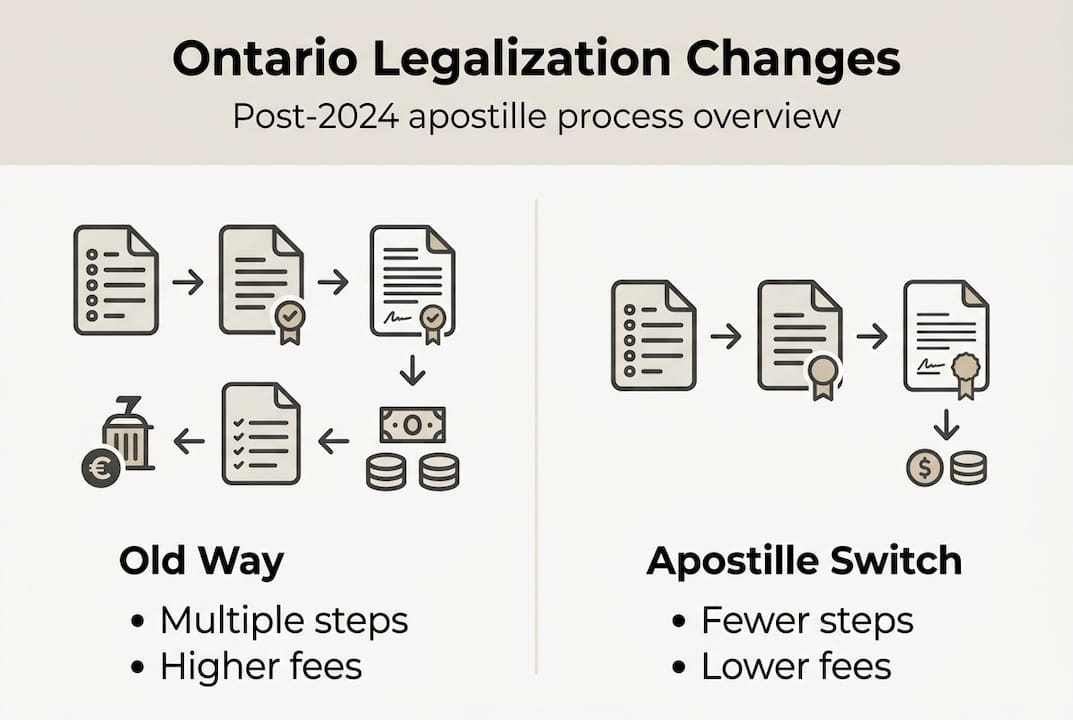
For countries that are not members of the Hague Apostille Convention, including many countries in the Middle East, Asia, and Africa, the traditional two-step process (authentication plus embassy legalization) still applies. It is not possible to substitute an apostille for embassy legalization in those cases. Federal authentication requirements also continue to apply for federal documents regardless of the destination country.
| Feature | Apostille (Hague member countries) | Traditional legalization (non-Hague countries) |
|---|---|---|
| Steps required | 1 to 2 (notarization + apostille) | 2 to 3 (notarization + authentication + embassy) |
| Cost | Lower | Higher |
| Processing authority | ODS (for Ontario docs) | ODS + destination embassy or consulate |
| Recognized in | 125+ Hague member countries | Non-member countries only |
| Common destinations | France, Germany, USA, Australia | Saudi Arabia, UAE, China, many African nations |
“Canada’s accession to the Hague Convention was a long-overdue modernization. But the simplification only works if you know exactly which countries are members and which authority applies to your document. Guessing wrong costs time, money, and often opportunity.”
Knowing who can notarize a document in Ontario is also critical here, because the apostille process still requires that private documents be notarized by a properly licensed Ontario notary public before the apostille is issued. The chain of authority matters at every step.
Why clear understanding of legalization requirements saves time and money
After years of working with individuals and businesses navigating Ontario’s document legalization process, one pattern becomes very clear: most delays and rejections are completely preventable. They rarely happen because the system is too complicated. They happen because applicants treat legalization as a formality and skip the verification steps.
We see it repeatedly. Someone spends two months preparing an immigration application, invests hundreds of dollars in translation services, and then has the entire submission returned because their affidavit was notarized by someone not authorized to act in Ontario. Or a business executive needs a power of attorney legalized for a deal closing in Dubai, uses an apostille because it sounded right, and learns too late that the UAE is not a Hague Convention member.
These are not edge cases. They are the norm for applicants who skip the preparation work.
Our honest take is this: the essential document steps are not complicated once you understand them. But they do require deliberate attention to three things. First, confirm the exact requirements of the destination country before preparing anything. Second, verify that every professional involved (notary, translator) is properly accredited and licensed for Ontario documents. Third, treat the visual quality of seals and signatures as seriously as the content of the document itself.
The upfront investment of 30 minutes of research saves weeks of back-and-forth. That is not an exaggeration. It is the consistent experience we see with clients who prepare carefully versus those who rush.
Ontario’s trusted partner for document legalization and notary needs
Getting document legalization right in Ontario requires accurate preparation, licensed professionals, and a clear understanding of the 2026 requirements. Whether your document is heading to a Hague Convention country or requires the full traditional legalization process, starting with the right support makes all the difference.

The Online Notary provides online notary services for Ontario residents and businesses, covering affidavits, statutory declarations, solemn declarations, invitation letters, and more. If your documents need to be properly prepared before submission to ODS or a foreign embassy, our team can help you avoid the common pitfalls. Explore our certified copy services and get your documents ready with confidence. The process does not have to be stressful when you have experienced guidance from the start.
Frequently asked questions
Is a notarized document the same as a legalized document in Ontario?
No. A notarized document still needs to undergo authentication by ODS and, if required, legalization steps by the destination country’s embassy or consulate before it is accepted internationally.
How long does it take to legalize a document in Ontario?
Processing typically ranges from 1 to 15 business days at ODS, depending on submission method and volume. Embassy legalization after authentication adds additional time that varies by country.
What documents are eligible for legalization in Ontario?
Originals or certified true copies of public and private documents are eligible. Private documents, such as affidavits and powers of attorney, must be notarized by a licensed Ontario notary public before submission.
Do all countries accept Canadian apostilles after 2024?
No. Only Hague Convention member states accept apostilles. Documents destined for non-member countries still require full authentication plus embassy or consulate legalization.
Who is responsible for authenticating Ontario-issued documents?
Ontario’s ODS is the designated authority for authenticating documents issued or notarized in Ontario. Federal documents go through Global Affairs Canada instead.