Legal Validity of Online Notary in Ontario: 2026 Guide

TL;DR:
- Online notarization is a lawful process where documents are notarized via a live video session using a compliant digital platform. The legal validity of online notarizations in Ontario and across North America is well established, making them equivalent to in-person notarizations when proper procedures are followed. However, acceptance by receiving parties is often uncertain, so verifying their policies before proceeding is crucial for enforceability.
Online notarization is defined as the process of notarizing documents through a live, two-way video session using a commissioned notary and a compliant digital platform. The legal validity of online notary services in Ontario and across North America is well established. Documents notarized remotely carry the same legal weight as those notarized in person, provided the process follows authorized frameworks. What trips up individuals and businesses is not the law itself. It is the gap between statutory legality and whether the receiving party will actually accept the document.
What is the legal validity of online notary services?
Remote online notarization, commonly called RON, produces documents that are legally equivalent to in-person notarizations and enforceable in courts across the United States under the Full Faith and Credit Clause. That clause requires every state to honor valid legal acts performed in other states. Ontario operates under a comparable framework, recognizing electronically notarized documents when the notary is properly commissioned and the platform meets required security standards.
The legal status of e-notaries depends on three conditions: the notary holds a valid commission in a RON-authorized jurisdiction, the platform meets technical security requirements, and the session follows mandated identity verification procedures. All three must be satisfied. Miss one, and the notarization may be challenged.
Legal frameworks like the Revised Uniform Law on Notarial Acts, known as RULONA, provide a standardized interstate approach that supports both domestic and international recognition of RON documents. Ontario’s own regulations align with these principles, making cross-border use practical for businesses and individuals dealing with U.S. counterparts. The legal implications for Ontario are clear: a properly executed online notarization is not a workaround. It is a fully authorized legal act.
How does online notarization work and what are the requirements?
The requirements for online notarization are specific, and meeting them is what gives the final document its legal force. The process is not simply a video call with a notary. It involves a structured sequence of steps governed by law.
- Identity proofing. The signer must pass credential analysis, which verifies a government-issued ID against database records, and knowledge-based authentication, which asks questions only the real person could answer. Many platforms also require biometric liveness detection to confirm the signer is physically present.
- Live video session. The notary and signer meet in a recorded, two-way audio-video session. RON sessions typically last 15–20 minutes, covering identity checks, document review, and the notarial act itself.
- Digital seal application. The notary applies a tamper-evident digital seal to the document. Any alteration after sealing is detectable, which actually makes RON documents more secure than paper equivalents.
- Record retention. Platform providers retain session recordings for 5–10 years depending on applicable law. This audit trail strengthens the document’s evidentiary reliability in any future dispute.
- Notary commissioning. The notary must hold a valid commission and complete platform-specific training before performing any RON session. Unverified notaries operating outside authorized platforms produce invalid notarizations.
Pro Tip: Before booking a session, confirm that your notary’s commission is current and that the platform is authorized under the relevant jurisdiction’s RON statute. A notary using a non-compliant platform cannot produce a legally valid document, regardless of their credentials.
Ontario individuals preparing for a session should review the step-by-step notarization process to understand exactly what to expect and how to prepare their documents in advance.

How does online notarization compare to traditional notarization?
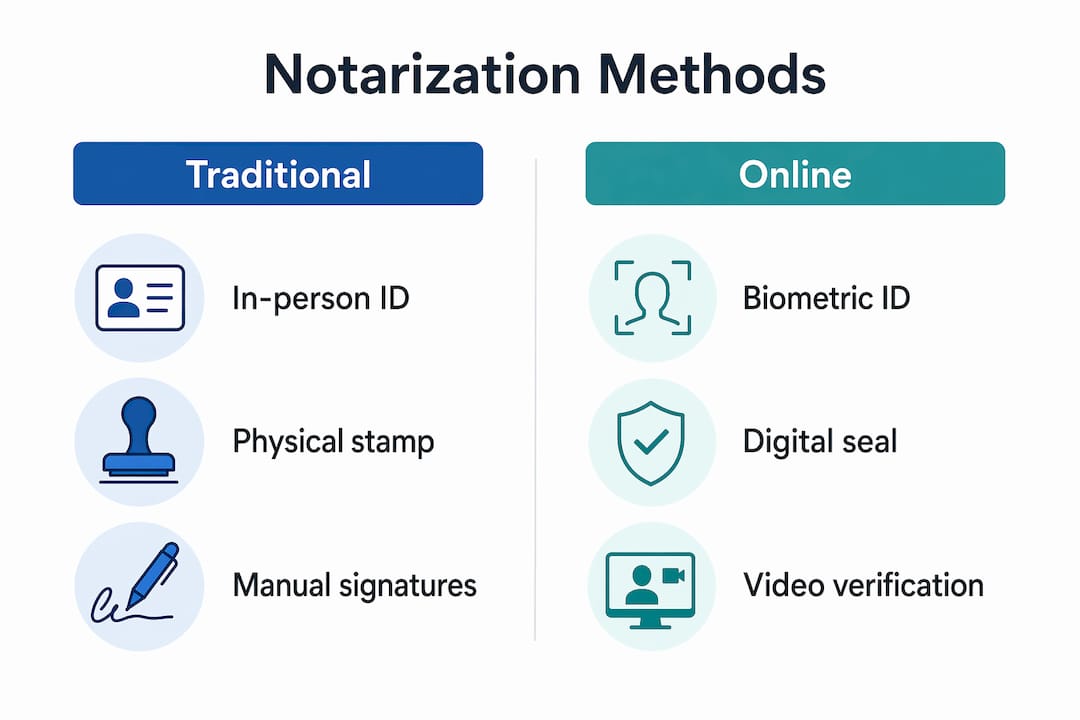
The core difference between online and in-person notarization is how identity is verified. Traditional notarization requires physical presence. The notary examines your ID face to face and watches you sign. Online notarization replaces physical presence with layered digital verification that is, in many respects, more rigorous.
Security and technology
RON platforms use biometric liveness detection and real-time credential analysis that common video tools like Zoom do not have. These controls are mandated by state and provincial law, not optional features. A standard video call cannot substitute for a compliant RON platform. That distinction matters when a document’s validity is later questioned.
Key differences at a glance
| Feature | Traditional notarization | Online notarization |
|---|---|---|
| Identity verification | In-person ID check | Credential analysis, KBA, biometrics |
| Session recording | Not required | Mandatory, retained 5–10 years |
| Document security | Ink seal, paper | Tamper-evident digital seal |
| Signer location | Must be physically present | Anywhere with internet access |
| Speed | Appointment dependent | Often same day or faster |
| Document exclusions | Minimal | Wills and testamentary trusts often excluded |
Limitations to know
Not every document type qualifies for online notarization. In Texas, for example, online notaries cannot notarize wills or testamentary trusts. Similar restrictions apply in other jurisdictions. Ontario individuals dealing with estate documents should confirm eligibility before scheduling a session.
A common misconception is that the signer must be located in the same jurisdiction as the notary. That is not the case. The signer’s location is generally irrelevant as long as the notary holds a valid commission in an authorized jurisdiction. This makes RON particularly useful for Ontario businesses working with U.S. counterparts, or for Canadians living or traveling abroad.
Is online notarization accepted everywhere?
Legal validity and practical acceptance are two different things. A document can be perfectly valid under the law and still be rejected by a bank, a government office, or a title company. This is the most underestimated challenge in using online notarization for business transactions.
Some entities refuse electronically notarized documents due to internal policies, not because the documents are legally defective. Financial institutions and county recording offices are the most common sources of friction. They may lack the technical infrastructure to verify digital seals, or their internal compliance policies simply have not caught up with the law.
“The primary challenge for businesses using RON is often counter-party acceptance, not statutory legality.” — Notary Brief
Practical acceptance issues tend to cluster around these situations:
- Real estate transactions. Title companies and lenders vary widely in their acceptance of RON documents. Always confirm with the title company before proceeding.
- Government filings. Federal and provincial agencies each set their own policies. Some accept electronic notarizations; others require wet signatures.
- Financial institutions. Banks and credit unions often have legacy document policies that predate RON legislation.
- Cross-border use. Ontario documents used in U.S. proceedings generally benefit from the Full Faith and Credit Clause, but the receiving party’s internal policies still apply.
The practical rule is simple: verify acceptance with the receiving party before the notarization session, not after. Redoing a notarization because the recipient rejected the format wastes time and money. For Ontario businesses dealing with non-resident counterparts, the online notarization guide for non-residents covers cross-border acceptance in detail.
What steps should Ontario residents follow for valid online notarization?
Getting a legally valid and practically accepted online notarization requires preparation on your end, not just the notary’s. Follow these steps to avoid the most common failure points.
- Choose an authorized platform and notary. Confirm the platform is compliant with Ontario’s requirements and that the notary holds a current commission. Theonlinenotary operates specifically within Ontario’s legal framework, which removes much of this guesswork.
- Prepare your identification. You will need a valid, government-issued photo ID. Some platforms require two forms of ID. Review the identification requirements for Ontario before your session to avoid delays.
- Format your documents correctly. Upload documents in the required file format, typically PDF. Ensure the document is complete before the session. Notaries cannot notarize incomplete documents.
- Test your internet connection. A stable, high-speed connection is critical for biometric liveness checks to work. A dropped session invalidates the attempt and requires restarting the process from the beginning.
- Confirm recipient acceptance. Contact the receiving party before booking. Ask specifically whether they accept electronically notarized documents with digital seals. Get confirmation in writing if the transaction is high-value.
- Retain your records. Save the notarized document, the session confirmation, and any audit trail provided by the platform. These records are your evidence if the document’s validity is ever questioned.
Pro Tip: If you are notarizing a document for use in a U.S. state, ask the receiving party which state’s RON laws they recognize. Some institutions specify that the notary must be commissioned in a particular state, even if the signer is in Ontario.
Key Takeaways
Online notarization in Ontario is fully legally valid when performed on an authorized platform by a commissioned notary, but practical acceptance by banks, government offices, and title companies requires verification before the session.
| Point | Details |
|---|---|
| Legal equivalence | RON documents carry the same legal weight as in-person notarizations under applicable law. |
| Three core requirements | Valid notary commission, compliant platform, and proper identity verification are all mandatory. |
| Counterparty acceptance | Verify that the receiving party accepts electronic notarizations before booking your session. |
| Document exclusions | Wills and testamentary trusts are commonly excluded from RON in many jurisdictions. |
| Record retention | Session recordings and audit trails are retained for 5–10 years, strengthening evidentiary value. |
What I have learned about online notarization after years in Ontario
The question I hear most often is not “Is this legal?” It is “Will they actually accept it?” Those are two very different questions, and conflating them causes real problems for Ontario individuals and businesses.
The law is settled. A properly executed RON document is valid. What is not settled is whether the person on the other end of your transaction has updated their internal policies to reflect that reality. I have seen clients complete a flawless online notarization, only to have a bank teller reject it because their branch had no procedure for verifying a digital seal. The document was perfect. The institution was not ready.
My advice is to treat counterparty verification as a non-negotiable first step, not an afterthought. Call the receiving party. Ask specifically about their acceptance policy for electronically notarized documents. If they hesitate or seem unsure, escalate to their compliance department. That one phone call can save you from redoing the entire process.
The technology behind RON is genuinely more secure than a wet signature on paper. Biometric checks, tamper-evident seals, and recorded sessions create an evidentiary record that a traditional notarization simply cannot match. The gap is not in the law or the technology. It is in institutional adoption, and that gap is closing fast. Ontario businesses that build RON into their document workflows now will be ahead of the curve when full adoption arrives.
— Ken
How Theonlinenotary can help you notarize documents in Ontario
Theonlinenotary provides legally compliant online notary services for Ontario individuals and businesses, available 24/7. The platform handles affidavits, statutory declarations, solemn declarations, invitation letters, and more, all within Ontario’s legal framework.

Every session on Theonlinenotary uses tamper-evident digital seals, recorded video verification, and identity proofing that meets Ontario’s requirements. You do not need to travel, book an in-person appointment, or navigate unfamiliar platforms. If you are ready to notarize a document or want to confirm whether your document type qualifies, visit the Theonlinenotary services page to book your session or speak with a notary directly.
FAQ
Are online notaries legal in Ontario?
Yes. Online notarization is legal in Ontario when performed by a commissioned notary using a compliant platform that meets identity verification and security requirements. The resulting document carries the same legal force as an in-person notarization.
What are the requirements for online notarization to be valid?
The notary must hold a valid commission, the platform must use credential analysis and biometric identity verification, and the session must be recorded with a tamper-evident digital seal applied to the document.
Will all institutions accept an electronically notarized document?
Not automatically. Some banks, government offices, and title companies have internal policies that require physical presence or wet signatures. Always verify acceptance with the receiving party before your session.
Can I use an Ontario online notarization for documents in the United States?
Yes. Documents notarized by a properly commissioned notary in an authorized jurisdiction are recognized across U.S. states under the Full Faith and Credit Clause, regardless of where the signer is located.
Are wills and testamentary trusts eligible for online notarization?
No, in most jurisdictions. Wills and testamentary trusts are commonly excluded from RON. Confirm document eligibility with your notary before scheduling a session.