Legal Recognition of Online Notary in Ontario: 2026

TL;DR:
- Legal recognition of online notarization ensures digitally signed documents have the same legal weight as in-person signatures, with laws now enacted in 49 U.S. states and Washington, D.C. Ontario permits valid remote notarizations through video conferencing, aligning with U.S. standards when following jurisdictional rules, but acceptance varies among institutions, requiring prior confirmation. Strict technical standards such as live synchronous sessions, identity verification, X.509 certificates, and record retention are essential to ensure the validity and enforceability of online notarizations.
Legal recognition of an online notary means that documents notarized remotely through an authorized platform carry the same legal force as those signed in front of a notary in person. This standard is formally called Remote Online Notarization, or RON, and it is now law in 49 U.S. states and Washington, D.C. as of 2026. For individuals and businesses in Ontario, this matters because many cross-border transactions, immigration documents, and commercial agreements require notarization that must hold up under both Canadian and American law. Understanding where RON is valid, what it requires, and where it may still face resistance is the difference between a document that gets accepted and one that gets rejected.
Is the legal recognition of online notary valid in ontario and the u.s.?
Online notarization is legally valid in Ontario and across most of North America, provided it follows the rules of the jurisdiction where the notary is commissioned. Ontario’s legal framework permits notarization by video conference under guidelines set by the Law Society of Ontario, which were formalized during the COVID-19 pandemic and have since become permanent practice. That means a notary in Ontario can legally witness your signature over a live video call and apply a digital seal with full legal effect.
Across the border, online notarizations carry the same legal weight as in-person notarizations when performed in compliance with the commissioning state’s laws. Interstate recognition is generally upheld under the U.S. Constitution’s Full Faith and Credit Clause, which requires each state to honor the public acts and judicial proceedings of other states. That clause is the legal backbone of cross-state RON acceptance.
Federal agencies have also signaled acceptance. Fannie Mae and the Federal Housing Administration (FHA) both accept electronically notarized mortgage documents, which pushed many title companies and lenders to follow. That federal-level buy-in accelerated institutional adoption faster than state legislation alone could have.
That said, legal validity and universal acceptance are not the same thing. Some institutions still reject online notarized documents based on outdated internal policies that require physical signatures or wet-ink seals. Banks, foreign consulates, and certain courts may fall into this category. For Ontario users sending documents to U.S. recipients, the safest move is to confirm acceptance with the receiving institution before you book a session.
- Affidavits, statutory declarations, and solemn declarations are widely accepted via RON in Ontario.
- U.S. federal agencies including Fannie Mae and FHA accept electronically notarized documents.
- Foreign authorities and some banks may still require traditional wet-ink notarization.
- Always confirm with the recipient before relying on a digitally notarized document for high-stakes transactions.
For a deeper look at how Ontario law specifically governs this process, the guide on online notary legality in Ontario covers the foundational rules and common misconceptions in detail.
Pro Tip: Ask the receiving institution for their written policy on electronic notarization before you schedule anything. A two-minute email can save you from a costly re-notarization.
What technical requirements must an online notary meet?
RON is not simply a video call with a notary. Specific technology and procedural standards must be met for the notarization to be legally recognized and enforceable.
The most critical requirement is a live, synchronous audio-video session. RON must be performed synchronously, meaning both the notary and the signer must be present at the same time. Asynchronous notarizations, where a signer records a video and a notary reviews it later, do not meet RON legal standards in the U.S. or Ontario. That distinction matters because some offshore or budget platforms use asynchronous methods, which can invalidate the entire notarization.
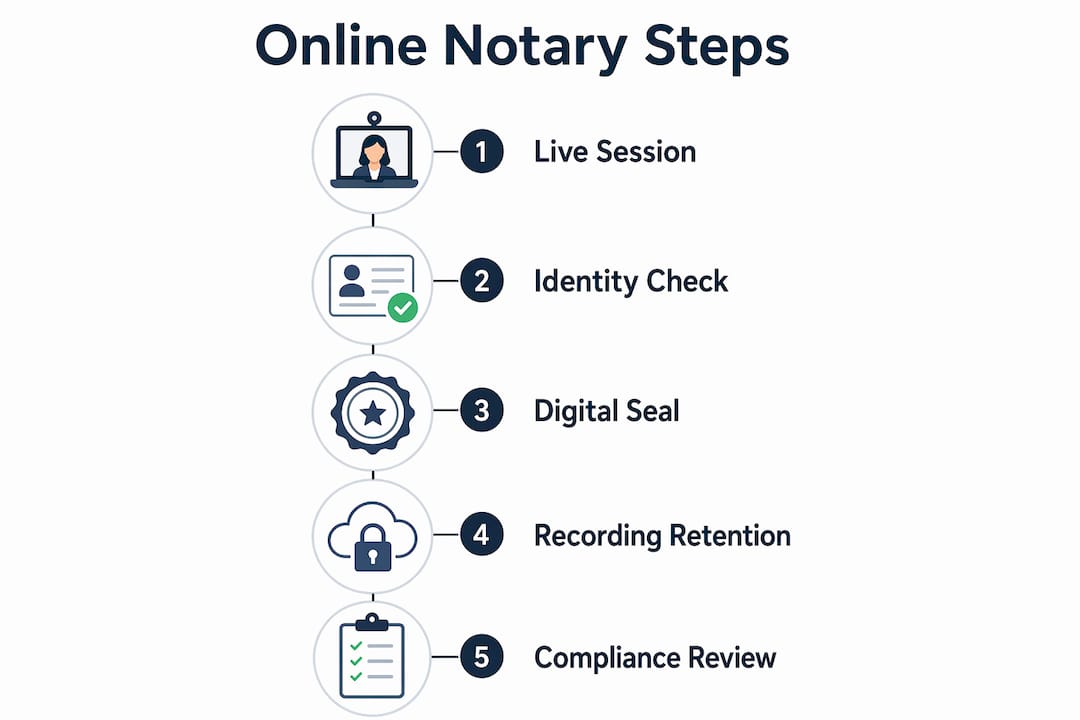
Identity verification is the second pillar. Most jurisdictions require knowledge-based authentication (KBA), which asks the signer a series of questions drawn from their personal credit or public records. Some states also require credential analysis, where the platform scans a government-issued ID to confirm it is genuine. Ontario’s Law Society guidelines similarly require the notary to be satisfied of the signer’s identity through reliable means.
The digital seal itself must meet strict technical standards. RON platforms must use X.509-compliant digital certificates approved by the relevant state or jurisdiction. Using an expired or non-compliant certificate voids the notarization entirely, even if every other step was followed correctly. This is one of the most overlooked risks when choosing a RON platform.
Finally, recordings and audit trails must be retained for 5–10 years depending on the jurisdiction. These records protect both the notary and the signer if the document’s validity is ever challenged.
| Requirement | Standard | Risk if Missed |
|---|---|---|
| Audio-video session | Live and synchronous | Notarization is void |
| Identity verification | KBA and/or credential analysis | Document rejected or challenged |
| Digital certificate | X.509-compliant, state-approved | Notarization invalidated |
| Record retention | 5–10 years depending on jurisdiction | Legal exposure if disputed |
| Platform registration | Notary must use state-approved platform | Non-compliant notarization |
Pro Tip: Before booking any RON session, ask the platform which state the notary is commissioned in and confirm that the platform is registered with that state’s notary authority.
How does online notary recognition affect ontario businesses and individuals?
The practical benefits for Ontario users are significant. A standard RON session is typically completed in under 15 minutes, compared to the time required to travel to a notary’s office, wait, and return. For businesses managing high volumes of contracts, affidavits, or statutory declarations, that time savings compounds quickly.

Cross-border transactions are where RON recognition becomes especially valuable for Ontario users. If you are signing a real estate agreement with a U.S. counterparty, submitting an affidavit to a U.S. court, or completing an immigration-related document for a U.S. agency, a properly executed RON notarization from a commissioned U.S. notary will generally be accepted. Ontario users can access U.S.-commissioned notaries through compliant platforms, which expands their options considerably.
International use is more complicated. Online notarized documents can usually be apostilled for international use, but acceptance depends on the destination country’s recognition of digital notarizations. Many countries still require traditional legalization. If you are sending documents to a country that does not recognize digital notarization, you will need a wet-ink notarization regardless of what Ontario or U.S. law permits.
For Ontario businesses, the most practical approach is to categorize documents by destination and risk level. Documents staying within Canada or going to U.S. federal agencies are strong candidates for RON. Documents headed to foreign embassies, certain courts, or countries with no digital notarization framework need traditional notarization.
- Affidavits, invitation letters, and statutory declarations are well-suited for online notarization in Ontario.
- Real estate and mortgage documents destined for U.S. lenders are widely accepted via RON.
- Immigration documents vary by country and agency. Verify before proceeding.
- Corporate resolutions and powers of attorney may face institutional resistance depending on the recipient.
For a full breakdown of which documents qualify, the resource on types of documents for online notarization in Ontario is the most direct reference.
What are the current limitations of online notarization recognition?
The biggest structural limitation is the absence of a uniform federal standard in the United States. The lack of a federal RON standard complicates interstate recognition despite widespread state adoption. The Secure Notarization Act has been introduced in Congress multiple times but has not passed as of 2026. That means each state sets its own rules, and a notarization valid in Virginia may face scrutiny when presented in a state with stricter requirements.
California is the clearest example of delayed adoption. California operates a limited RON pilot program until full authorization takes effect on January 1, 2030. The pilot restricts which document types qualify and which platforms can be used. For Ontario businesses with California counterparties, this is a real operational constraint right now.
Institutional resistance is a separate problem from legal validity. Banks, title companies, and foreign authorities sometimes reject digitally notarized documents not because they are illegal, but because internal compliance teams have not updated their policies. This is especially common in institutions that process documents infrequently or have legacy systems that flag anything without a physical seal.
Cybersecurity and data privacy risks are also real. RON platforms handle sensitive personal data including government IDs, biometric verification data, and financial documents. A platform that does not meet current encryption and data storage standards creates legal exposure for both the notary and the signer.
The most effective way to mitigate these risks is to use a platform with verified state registration, current X.509 certificates, and a clear data retention policy. Cutting corners on platform selection is the single most common reason a legally valid RON session produces a document that gets rejected downstream.
Ken’s take: what ontario users actually need to watch for
The legal framework for online notarization is solid. What trips people up is the gap between what the law permits and what institutions actually accept on any given day.
I have seen Ontario clients complete a perfectly valid RON session, only to have a document rejected by a bank that simply had not updated its internal policy. The notarization was legal. The bank’s process was not. That distinction is frustrating, but it is fixable if you verify acceptance before you start.
The other thing I want to flag is platform quality. Not every RON platform is equal. Some use notaries commissioned in states with weaker requirements. Some use digital certificates that are technically compliant but issued by authorities that certain institutions do not recognize. When you use a service like Theonlinenotary, you are not just getting a video call with someone who has a stamp. You are getting a notary who understands Ontario’s specific requirements and the cross-border implications of the documents you are signing.
My practical advice for Ontario users: treat RON as a legal tool, not a convenience shortcut. Verify with your recipient, use a compliant platform, and keep copies of the session recording and audit trail. The trend toward wider acceptance is real and accelerating. But until federal standardization arrives in the U.S. and international frameworks catch up, proactive preparation is your best protection.
— Ken
Get your documents notarized online in ontario today
Ontario residents and businesses can access fully compliant, legally recognized online notarization through Theonlinenotary, available 24 hours a day, 7 days a week. Whether you need an affidavit, statutory declaration, invitation letter, or solemn declaration, Theonlinenotary’s commissioned notaries follow every procedural and technical requirement to make sure your documents hold up wherever they are sent.

Visit the online notary services page to book a session or review available document types. If you want to arrive prepared, the step-by-step preparation guide walks you through exactly what to have ready before your session starts. Theonlinenotary makes the process straightforward, secure, and legally sound from start to finish.
FAQ
Are online notaries legal in ontario?
Yes. Ontario’s Law Society permanently authorized remote notarization by video conference, giving online notarizations the same legal standing as in-person ones. The notary must verify your identity and conduct the session live.
How do i verify an online notary’s credentials?
Confirm that the notary is commissioned in their stated jurisdiction and that the platform uses a current, state-approved X.509 digital certificate. You can verify notary commissions through the relevant state’s Secretary of State office or Ontario’s Law Society.
Will all institutions accept an online notarized document?
Not always. Some institutions reject online notarized documents due to outdated internal policies, even when the document is legally valid. Always confirm acceptance with the receiving institution before your session.
Can online notarized documents be used internationally?
Often yes, but with conditions. International use requires an Apostille in most cases, and the destination country must recognize digital notarizations. Many countries still require traditional wet-ink notarization for foreign documents.
What is the difference between RON and a regular electronic notarization?
RON requires a live, synchronous audio-video session with real-time identity verification. A regular electronic notarization may involve only an electronic signature without the live video component, which does not meet RON legal standards in most U.S. states or Ontario.
Key takeaways
Online notarization is legally recognized in Ontario and 49 U.S. states, but acceptance by individual institutions depends on their internal policies and the platform’s technical compliance.
| Point | Details |
|---|---|
| RON is broadly legal | 49 U.S. states plus D.C. and Ontario all recognize properly executed online notarizations. |
| Legal validity is not universal acceptance | Banks, courts, and foreign authorities may still reject documents based on internal policies. |
| Technical compliance is non-negotiable | X.509 certificates, live video sessions, and 5–10 year record retention are required by law. |
| California is a notable exception | Full RON authorization in California does not take effect until January 1, 2030. |
| Verify before you notarize | Confirming recipient acceptance before booking a session prevents costly re-notarization. |