Invitation letter Canada: Craft a strong Ontario visa letter

TL;DR:
- An invitation letter for a Canada visitor visa is a formal, supporting document, not a legal guarantee.
- It should include detailed host and guest information, purpose of visit, dates, accommodation, and proof of ties.
- In Ontario, notarization is optional but recommended for high-risk applicants to enhance credibility.
Many Ontario residents assume that writing an invitation letter for a visitor visa is either a simple formality or a legally binding promise. Neither is quite right. An invitation letter for a Canada visitor visa is a formal document written by a Canadian citizen or permanent resident to invite a foreign national for a temporary visit. Done well, it can meaningfully strengthen your guest’s application. Done poorly, it can raise red flags that no amount of good intentions will fix.
Table of Contents
- What is an invitation letter and why does it matter?
- Structuring an invitation letter: Mandatory elements and best practices
- Ontario-specific nuances: Legal status, notarization, and credibility
- Common mistakes and success tips for Ontario invitation letters
- The uncomfortable truth: Invitation letters aren’t enough without extra evidence
- Streamline your invitation letter process with trusted Ontario notary services
- Frequently asked questions
Key Takeaways
| Point | Details |
|---|---|
| Include all mandatory details | A strong invitation letter covers both host and guest information, purpose, dates, and support clearly. |
| Notarization adds credibility | While not required, notarizing your invitation letter can improve its impact, especially for high-risk visitors. |
| Tailor for Ontario-specific requirements | Ontario hosts should follow best practices and local guidance to maximize visa approval chances. |
| Avoid common mistakes | Incomplete letters or vague details can lead to visa rejection, so double-check your submission. |
| Supporting documents matter | Accompany your invitation letter with evidence of guest ties and accommodation for higher credibility. |
What is an invitation letter and why does it matter?
When your friend or family member applies for a Canadian visitor visa, immigration officers are trying to answer one core question: does this person have a genuine reason to visit and a real incentive to leave? Your invitation letter does not make that decision for them, but it contributes important supporting evidence. Think of it as your personal testimony in a written format, confirming the relationship, the visit’s purpose, and your role as a host.
A lot of Ontario hosts confuse the invitation letter with a sponsorship agreement or a legal guarantee. It is neither. You are not signing a contract that makes you financially liable if your guest overstays their visa. What you are doing is giving the visa officer a clearer picture of your guest’s situation in Canada. The richer and more credible that picture, the better.
Here is what the letter actually tells the visa officer:
- Who you are as a host and your legal status in Canada
- How you know the visitor and the nature of your relationship
- Why the visitor is coming, where they will stay, and for how long
- Whether you will help cover costs, and if so, to what extent
- Your confidence that the visitor intends to return home after the visit
Notice that none of these are legally binding. They are factual statements. If you provide accurate information, you carry no legal exposure beyond the moral responsibility of honesty. The letter influences the officer’s credibility assessment, not your immigration liability.
“An invitation letter for a Canada visitor visa is a formal document written by a Canadian citizen or permanent resident (host) to invite a foreign national (guest) for a temporary visit.” This framing matters because it establishes the letter’s purpose as informational, not contractual.
One thing many guides skip over: the quality and consistency of your letter matters as much as its completeness. A letter with vague language like “my friend is visiting for personal reasons” and no dates or financial detail looks incomplete at best, suspicious at worst. On the other hand, a well-organized letter that matches the applicant’s own documents is a strong signal that everything checks out. Check out the full invitation letter requirements to make sure your letter covers every required element before your guest applies.
Structuring an invitation letter: Mandatory elements and best practices
Now that you know what an invitation letter is, let us move to the nuts and bolts of how to build one from scratch.
According to the required invitation letter details published by Immigration, Refugees and Citizenship Canada (IRCC), the letter must cover two sides of the story: the host and the guest.
For the host (you), include:
- Full legal name and date of birth
- Complete home address and phone number
- Your status in Canada (citizen or permanent resident), backed by proof like a citizenship certificate or PR card number
- Job title and employer name
- Details about your household, including who else lives with you
For the guest (your visitor), include:
- Full legal name and date of birth
- Home address and contact details in their country
- Your relationship to them and how long you’ve known each other
- The specific purpose of the visit (tourism, family reunion, wedding, medical visit, etc.)
- Planned arrival and departure dates
- Where they will stay during the visit (your home address, or a hotel)
- Confirmation of who is covering travel and living costs during the stay
The letter must be addressed formally to the “Visa Officer, Immigration, Refugees and Citizenship Canada.” This is not optional. Starting the letter with a casual salutation or leaving it unaddressed is a surprisingly common mistake that immediately undercuts professionalism.
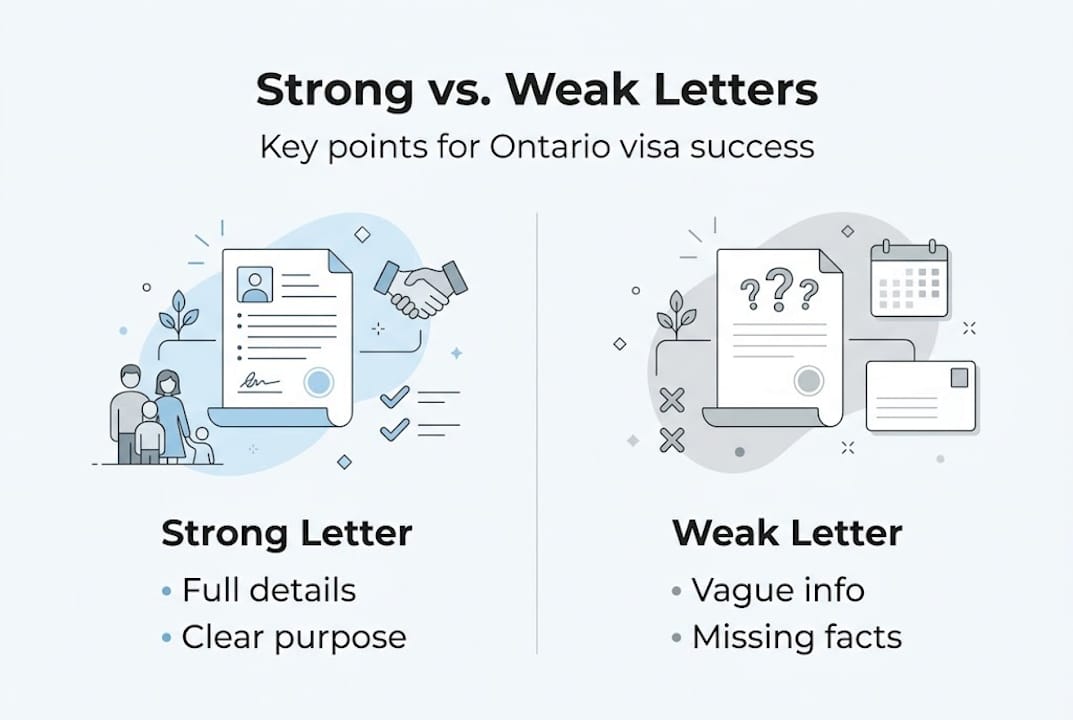
Comparison: Strong vs. weak invitation letter content
| Element | Strong example | Weak example |
|---|---|---|
| Purpose of visit | “My sister is attending my wedding on August 12, 2026” | “My sister is visiting for personal reasons” |
| Dates | “June 28 to September 3, 2026 (67 days)” | “A few months in summer” |
| Accommodation | “She will stay at my home: 145 Maple Ave, Toronto, ON” | “She has somewhere to stay” |
| Financial support | “I will cover all expenses including meals and local transport” | “I will help her out if needed” |
| Relationship | “She is my biological sister; we grew up together in Lagos” | “She is a close friend” |
Pro Tip: Write every date in full numeric format (day, month, year) to match how Canadian immigration documents are typically formatted. Inconsistencies between your letter and your guest’s travel itinerary are a common reason officers request more information.
For deeper guidance, the visa invitation letter guide and resources on drafting invitation letters walk through real Ontario scenarios that many hosts face when preparing for family visits.
Ontario-specific nuances: Legal status, notarization, and credibility
After building your letter, it is essential to understand the extra steps and local nuances in Ontario that can boost its weight and credibility.
Ontario hosts operate within the same federal immigration rules as the rest of Canada, but there are practical considerations specific to this province that matter when it comes to notarization and document credibility.
Notarization: Optional or essential?
Notarization is not legally required for a Canadian visitor visa invitation letter. The invitation letter structure guidance from IRCC explicitly states that notarization is optional. That said, notarization advice from university immigration offices consistently recommends it when the applicant’s profile carries higher risk.
What makes a profile “high risk” in this context? Visa officers flag applications more closely when the guest is young, single, has limited financial ties to their home country, or is applying from a country with historically higher refusal rates. If your guest fits any of these categories, a notarized letter from an Ontario notary adds a layer of third-party verification that can tip the balance.
When to consider notarization in Ontario
| Scenario | Notarization recommended? |
|---|---|
| Visitor is a close relative with strong home ties | Optional |
| Young, single applicant from high-refusal country | Strongly recommended |
| Applicant has prior visa refusals | Strongly recommended |
| Visitor is attending a specific event (wedding, graduation) | Optional, but helpful |
| Applicant lacks clear financial ties to home country | Strongly recommended |
Getting your letter notarized in Ontario is simpler than most people expect. A notarized invitation letter can often be prepared through online notary services without leaving your home, which matters when you are coordinating a visa application from across the globe with a tight timeline. Understanding notarized letter requirements will help you know exactly what to bring or prepare before the appointment. For situations involving foreign consulates, a consulate notarization guide for Ontario residents covers the additional steps that may apply.

Pro Tip: Even if notarization is optional for your guest’s specific consulate, having a notarized copy ready shows you’ve taken the process seriously. Visa officers notice the effort. A notarized letter paired with clear supporting documents sends a consistent signal of good faith.
Beyond notarization, consider attaching supporting documents to strengthen your letter’s credibility. This might include proof of your own status in Canada, recent bank statements if you are providing financial support, or documentation of the event your guest is attending. Your letter anchors the application; the supporting documents back it up.
Common mistakes and success tips for Ontario invitation letters
With legal nuances covered, it is time to make sure your invitation letter does not fall into common traps and instead stands out for visa approval.
Ontario hosts make certain errors more than others, and the good news is most of them are easy to fix once you know what to look for. Here are the most frequent problems:
- Vague purpose of visit. Officers see thousands of letters a month. “Visiting for tourism” with no further detail adds little value. Name specific plans, places, or events.
- Wrong salutation or missing addressee. Always start with “Visa Officer, Immigration, Refugees and Citizenship Canada.” Skipping this makes the letter look informal and unprepared.
- Mismatch between host and guest information. If your letter says the visit runs from July 1 to August 15, but the guest’s flight booking shows a departure on August 20, the inconsistency triggers questions.
- No mention of accommodation. This is a required element and leaving it out is a common oversight. Clearly state whether your guest is staying with you or at another address.
- Omitting financial support clarity. If you are covering costs, say so directly. If the guest is self-funded, mention that instead. Ambiguity here creates doubt.
- Missing the host’s immigration status details. The visa officer needs to confirm you are legally in Canada and have the standing to invite someone. Include your citizenship certificate number or PR card details.
- Emotional language over factual detail. Writing “my mother is the most important person in my life and I desperately want to see her” sounds heartfelt, but it does not give the officer the information they need. Keep the tone professional and factual.
As the IRCC invitation letter structure confirms, every letter must include a clear statement that the visitor intends to leave Canada at the end of their authorized stay. This is not just a formality. It directly addresses the officer’s core concern about overstay risk. Phrase it clearly: “I understand that [Guest Name] intends to return to [home country] on [departure date] and has strong ties to their home country including [employment, family, property, etc.].”
Pro Tip: If your guest has been denied a Canadian visa before, acknowledge it in your letter and provide context where you can. Pretending a refusal did not happen when there is a record of it damages your credibility far more than the refusal itself. Transparency is always the better strategy.
One more resource worth considering: if you are also providing financial support, pairing your invitation letter with a formal affidavit of support can make your commitment concrete and legally formalized. This is particularly useful for long stays or applications from high-refusal regions.
The uncomfortable truth: Invitation letters aren’t enough without extra evidence
Here is what most guides about invitation letters will not tell you directly: a perfectly formatted letter can still result in a visa refusal. The invitation letter is supporting evidence, not a deciding factor on its own. Visa officers weigh the entire application together.
Many Ontario hosts believe that once they write a thorough, detailed letter, their job is done. But the letter only carries weight when it is consistent with everything else in the application. If your guest’s financial situation looks shaky, if they have no dependents or property at home, or if their travel history suggests overstay risk, even the most polished invitation letter will not compensate for those signals.
The notarization insight from family and friend hosting resources makes this point directly: for high-risk profiles like young or single applicants, combining a notarized invitation letter with strong evidence of the guest’s ties to their home country gives the application its best realistic shot. Ties include steady employment, property ownership, family obligations, and financial commitments in the home country.
The hosts who get the best results treat the invitation letter as one component of a coordinated package, not a standalone fix. That means coordinating with your guest on what documents to include and ensuring nothing in your letter contradicts their own submission. And if you want to be sure your letter is ready to carry its full weight, reviewing the invitation letter essentials is a smart final check before your guest submits.
Streamline your invitation letter process with trusted Ontario notary services
Preparing a strong invitation letter takes attention to detail, but the process does not have to be complicated or time-consuming. If you are ready to take the next step and maximize your guest’s chances, working with an Ontario notary service can make the entire process faster and far more reliable.

Our Ontario online notary services are designed specifically for hosts like you, making it straightforward to notarize your invitation letter from anywhere in the province without booking an in-person appointment. We help you confirm that your letter meets IRCC’s requirements, that every required element is included, and that your document is properly authenticated. If your guest’s application also involves document legalization in Ontario, we can guide you through that process too. Clear, credible, properly prepared documents give your guest the best possible start.
Frequently asked questions
What are the mandatory details for a Canada invitation letter?
You must include both the host’s and guest’s full names, dates of birth, contact details, relationship, purpose of visit, duration, accommodation, and financial support. The required invitation letter details from IRCC also require the host’s immigration status and occupation.
Does an invitation letter need to be notarized for Canada visitor visas?
Notarization is optional and not legally required, but it can add meaningful credibility, especially for high-risk applicant profiles or situations involving prior visa refusals.
Who can write an invitation letter for visitors to Canada?
Any Canadian citizen or permanent resident living in Ontario can write an invitation letter for a guest, provided they include proof of their status in Canada.
Is there a specific template or format for Canada invitation letters?
There is no single rigid template, but the letter must be addressed to the “Visa Officer, IRCC” and include all required host and guest information in a clear, structured, and professional format.
How can I maximize my guest’s visa approval chances?
Provide a complete and accurate invitation letter, and pair it with strong supporting evidence such as proof of the guest’s home country ties, employment records, and clear accommodation details for the duration of the visit.
Recommended
- Invitation Letter for Visa: Complete Guide for Ontario - The Online Notary
- Drafting Invitation Letter for Ontario: Step-by-Step Guide - The Online Notary
- The Essential Guide to Invitation Letter Requirements Canada - The Online Notary
- Writing a Legal Letter: Complete Guide for Ontario - The Online Notary