How to write a business invitation letter in Ontario

TL;DR:
- Properly crafted invitation letters are crucial for Ontario visa success and reflect organizational credibility.
- Letters must include specific details like event info, relationship, and financial support tailored to each role.
- Ontario businesses should follow federal IRCC standards; notarization can boost credibility but is optional.
Many Ontario business owners discover the hard way that preparing a corporate invitation letter for an international guest is more nuanced than simply writing a formal email on company letterhead. A missing detail, a vague event description, or a copied template can result in a rejected visa application and an empty seat at your conference table. Getting this right matters not only for your guest’s travel plans but for your company’s professional reputation. This guide walks you through exactly what federal standards require, what each section of your letter must accomplish, and how to customize every invitation so it stands the strongest possible chance of supporting a successful visa application.
Table of Contents
- Why business invitation letters matter for Ontario companies
- What to include in a professional business invitation letter
- Following IRCC guidelines vs. Ontario-specific requirements
- Edge cases, common pitfalls, and increasing letter acceptance
- What most guides miss about business invitation letters
- Get support drafting and notarizing your business letters
- Frequently asked questions
Key Takeaways
| Point | Details |
|---|---|
| Customize for every event | A tailored letter with all required details avoids generic rejection and builds credibility. |
| Follow federal guidelines | There is no official Ontario template—always align with IRCC federal standards for your letter. |
| Notarization boosts credibility | Notarizing your invitation letter is optional but can help with challenging visa offices. |
| Letter does not guarantee visa | A strong invitation letter supports the application but does not ensure approval. |
Why business invitation letters matter for Ontario companies
When a foreign business associate needs to visit Ontario for a conference, a partnership meeting, or a networking event, one of the documents they will almost certainly need is a formal invitation letter from your company. This letter serves as official proof of the reason for their visit. Immigration officers use it to verify that the trip is genuinely business related, that the host organization is legitimate, and that the guest has a clear and specific purpose for entering Canada.
A professional business invitation letter for corporate events or networking in Ontario is typically issued by a Canadian company on official letterhead to invite foreign business associates, confirming the purpose such as conference attendance, meetings, or networking, along with dates, location, itinerary, relationship details, and any support provided by the inviting organization. This is not a ceremonial document. It is a working piece of evidence inside a visa application file.
What surprises many Ontario business owners is how much weight the invitation letter carries in the visa officer’s initial review. It frames the entire application. A strong, specific, and well-organized letter signals that the host company is credible and that the visit is legitimate. A vague or generic letter signals the opposite, regardless of how strong the applicant’s financial records might be.
Here are the most common mistakes Ontario companies make with invitation letters:
- Leaving out the company’s full legal name, business address, and contact information
- Writing a generic event description without specific dates, location, or program details
- Failing to explain the relationship between the inviting company and the guest
- Using a template downloaded from the internet without customizing any of the content
- Not stating what, if any, financial support the company is providing to the guest
“An invitation letter is not a guarantee of entry. It is evidence. Its quality directly reflects the quality of your event and the legitimacy of your organization in the eyes of an immigration officer.”
If you want to understand the full scope of what these letters accomplish in a visa context, the invitation letter visa guide from The Online Notary gives a clear Ontario-focused breakdown of the process and what each component achieves within the immigration system.
What to include in a professional business invitation letter
Once you understand why the letter matters, the next step is knowing exactly what goes into it. Each section of the letter serves a specific purpose, and leaving any of them out weakens the overall document significantly.
Here is the required content, in the order it should appear:
- Your company’s official letterhead including your legal business name, registered address, phone number, email, and website if applicable
- The date the letter is written, not the date of the event
- The full name and address of the invitee, matching their passport exactly
- A clear statement of the purpose of the visit, such as attending a trade conference, participating in a partnership meeting, or speaking at a corporate networking event
- Specific event details including the name of the event, the venue address in Ontario, and the exact dates of attendance
- The nature of the professional relationship between your company and the guest, for example whether they are a long-term supplier, a potential investor, or a conference keynote speaker
- A brief itinerary or program outline so the officer can see how the guest will spend their time in Canada
- Financial responsibility details, specifying whether your company is covering accommodation, travel, meals, or whether the guest is self-funded
- A closing statement with the name, title, and signature of an authorized company representative
Pro Tip: Tailor the language in the letter to the specific role of the person you are inviting. A letter for a keynote speaker should include their session title, time slot, and topic. A letter for a trade partner attending a meeting should reference the business relationship history and the agenda items they will participate in.
The table below summarizes how the content requirements shift depending on the invitee’s role at the event:
| Letter element | For an attendee | For a speaker |
|---|---|---|
| Event description | Event name, purpose, and dates | Event name, session title, and presentation dates |
| Role description | “Will participate as a delegate” | “Has been invited to present on [topic]” |
| Itinerary | General conference schedule | Specific session time and agenda slot |
| Financial support | As applicable | May include honorarium details if relevant |
| Relationship note | Business associate or client | Expert or featured presenter in your field |
As IRCC federal guidance emphasizes, you should prioritize official IRCC standards and customize per event and relationship to avoid generic rejections. Ontario small and medium businesses in particular benefit from using their local business context to add authenticity to each letter. The Ontario invitation letter drafting steps guide walks through this customization process in practical detail.

For a broader look at what federal standards define as required invitation letter requirements, that resource covers the full national picture including cases involving business visitors, conference attendees, and short-term professional engagements.
Following IRCC guidelines vs. Ontario-specific requirements
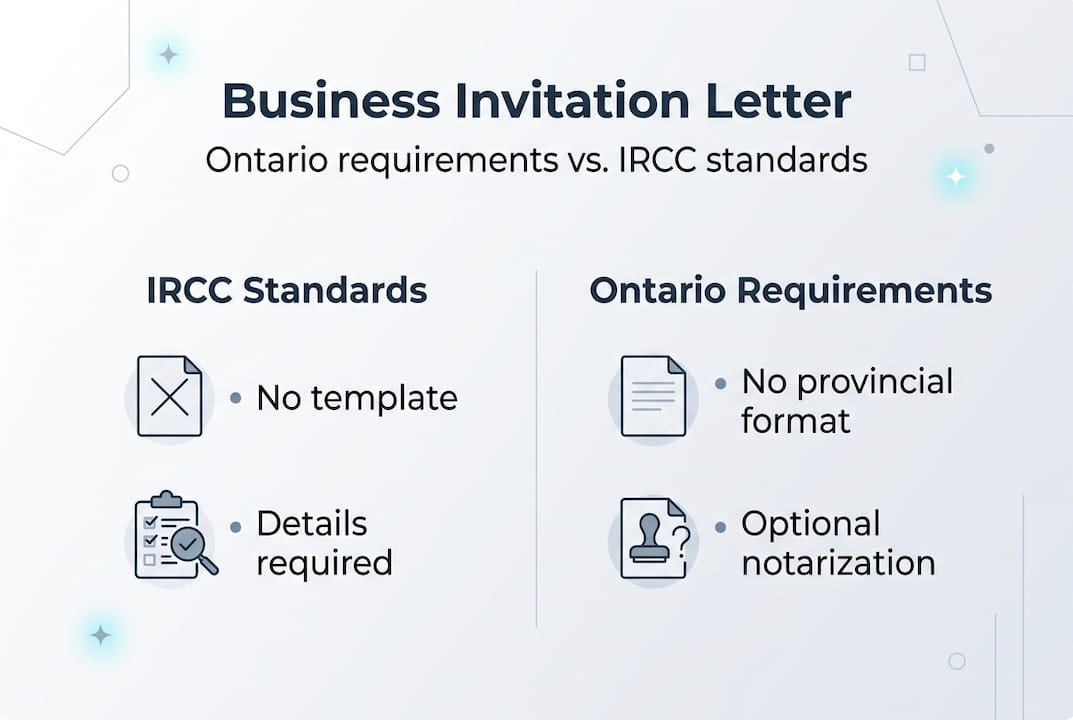
One of the most confusing points for Ontario business owners is whether the province has its own template or special requirements for business invitation letters. The answer is straightforward: Ontario does not have a separate government template. All invitation letters for business visitors to Canada must follow federal IRCC guidelines published on canada.ca. There is no Ontario government portal where you submit or register your invitation letter.
This is actually good news. It means your company does not need to navigate two sets of rules. What matters is whether your letter meets federal standards, and that guidance is publicly available and clearly written.
Here is a comparison of what falls under federal versus provincial scope:
| Requirement | Federal (IRCC) | Ontario provincial |
|---|---|---|
| Template or format | No mandatory template; must include specific content | No separate template or requirement |
| Notarization | Optional; recommended for some countries and consulates | No provincial requirement |
| Event registration | Special event codes available for large registered events | No Ontario-specific process |
| Legal authority over visitor admission | Full authority | No jurisdiction over immigration |
Notarization is worth a closer look. While it is not required by IRCC, having your invitation letter notarized for credibility can make a meaningful difference at certain visa offices, particularly those that process a high volume of business visitor applications from countries with elevated scrutiny. A notarized letter signals that a licensed professional has verified the document, which adds a layer of institutional credibility that a self-signed letter cannot replicate.
If your guest is applying from a country where Canadian visa approval rates are lower, or if the purpose of the visit involves significant financial commitments, notarization is a practical step worth taking. For context on how the formal verification process works, the Ontario legal letter guide explains the practical differences between a notarized letter and a standard business letter.
Larger events registered with IRCC, such as major trade shows or international conferences, sometimes receive special event codes that can be referenced in individual invitation letters. If your event has one of these codes, include it prominently in the letter. It signals to the visa officer that the event itself has already been vetted at a federal level, which can streamline processing. Check the notary process guide for details on how Ontario businesses can efficiently prepare and verify these documents.
Edge cases, common pitfalls, and increasing letter acceptance
Understanding the basics is important. Avoiding the specific mistakes that lead to rejections is equally important. Many Ontario companies believe their letter is strong simply because it is written on company letterhead and includes the event dates. That minimal level of effort is rarely enough.
Here are the most frequent pitfalls that undermine otherwise legitimate invitations:
- Using a generic boilerplate template. Downloaded templates often miss critical customization points. A visa officer can recognize a recycled template immediately, and it signals that the host company did not take the process seriously.
- Failing to distinguish between attendee and speaker roles. As conference visa guidance makes clear, you should differentiate attendee versus speaker roles and include the session title for any presenter. Treating a keynote speaker the same way you would treat a general delegate is a missed opportunity to strengthen the letter.
- Including language that implies employment. A business visitor visa does not permit the guest to work or receive payment from a Canadian company in a way that resembles employment. Your letter should be specific about the short-term, non-employment nature of the visit.
- Overstating financial commitments. If your company is not covering the guest’s accommodation, do not imply that it is. Misrepresentations, even unintentional ones, can trigger additional scrutiny.
- Neglecting to include the special event code when your event has been registered with IRCC and has received one.
Pro Tip: Write a separate, customized letter for each invitee rather than creating one master letter that you swap names into. Each person’s role, relationship to your company, and participation details are different, and those differences should be reflected in the language of the letter.
One of the most important realities to communicate to your international guests is that even a perfect invitation letter does not guarantee visa approval. As IRCC guidance clearly states, letters support but do not guarantee visas. The final decision rests with the visa officer who reviews the complete application, including the applicant’s financial ties to their home country, their travel history, and their reasons for returning home after the visit. Your letter is one important piece of that larger picture.
For specific situations where your letter was rejected or where you need to appeal a decision, the resource on notarized letter rejection tips offers practical steps for Ontario business owners dealing with complications in the process.
What most guides miss about business invitation letters
Here is something most template websites will not tell you: the widespread availability of downloadable invitation letter samples has actually made it harder for legitimate Ontario businesses to get their invitations taken seriously. When visa offices see the same sentence structures and section formats repeated across thousands of letters, those letters lose their credibility by association. They look copied because they usually are.
The real problem is not that business owners are lazy. It is that most guides stop at “here is what to include” without explaining why each element matters or how to make that element specific and credible. Knowing that you need to describe the relationship between your company and your guest is useful. Understanding that a visa officer is looking for evidence of an ongoing, verifiable professional relationship, not a vague mention that the guest is “a valued business contact,” is what actually helps you write a better letter.
Expert review, even a single pass from a notary or a legal professional familiar with immigration document standards, can catch the kind of vague or ambiguous language that you would never notice yourself. It is a small investment that protects both your guest’s travel plans and your company’s credibility. If you are drafting your letter for the first time or revising one that was previously rejected, having a professional review the final draft before submission is one of the highest-value steps you can take.
A well-written invitation letter is not just a bureaucratic requirement. It is a statement about your company’s professionalism, your respect for your guest’s time, and your commitment to a successful business relationship.
Get support drafting and notarizing your business letters
Preparing a compliant business invitation letter takes more than filling in a template. The stakes are real, and the details matter at every stage.

The Online Notary provides Ontario notary services online around the clock, so Ontario business owners can get expert support drafting, reviewing, and notarizing invitation letters without scheduling delays or in-person appointments. Whether you are preparing invitations for a corporate conference, a networking event, or a one-on-one partner meeting, the team understands exactly what IRCC-compliant letters require. For guidance on writing business letters in Ontario that meet federal standards, The Online Notary is ready to help you get it right the first time.
Frequently asked questions
Is notarization required for a business invitation letter in Ontario?
No, notarization is optional for business invitation letters, but it can help increase credibility at certain visa offices, particularly for business visitor applications that face higher scrutiny.
Should my invitation letter include the guest’s role at the event?
Yes, clearly state whether your guest is an attendee or a speaker, and if they are presenting, include their session title and any relevant topic details to strengthen the letter’s credibility.
Will a business invitation letter guarantee approval of my guest’s visa?
No, a strong letter supports the visa application but does not guarantee approval, since the final decision depends on the applicant’s complete case including their financial ties, travel history, and personal circumstances.
Is there an official Ontario template for business invitation letters?
No, Ontario does not have a provincial government template for business invitation letters. All letters must follow federal IRCC guidelines available through canada.ca.
Recommended
- Drafting Invitation Letter for Ontario: Step-by-Step Guide - The Online Notary
- Invitation Letter for Visa: Complete Guide for Ontario - The Online Notary
- Writing a Legal Letter: Complete Guide for Ontario - The Online Notary
- How to get a notarized application letter in Ontario 2026 - The Online Notary