How to authenticate foreign documents for Ontario use

TL;DR:
- Authenticating foreign documents in Ontario depends on the country’s Hague status and specific agency requirements.
- The process involves obtaining an apostille for Hague countries or embassy legalization for non-Hague countries, followed by certified translation.
- Always verify recipient agency requirements beforehand to avoid rejection due to translation, expiry, or improper procedures.
You hand over a foreign document at a government office, an immigration application, or a bank counter, and within seconds it comes back rejected. The reason? Improper authentication. This frustration is more common than most people realize, and it happens because the rules for accepting foreign paperwork in Ontario are layered, agency-specific, and rarely explained in one place. Whether you’re a newcomer supporting an IRCC application, a business verifying overseas credentials, or an individual managing an estate with international ties, this guide walks you through exactly how to get your documents recognized without costly delays.
Table of Contents
- Understanding authentication vs. legalization vs. apostille
- Step-by-step process: How to authenticate foreign documents for use in Ontario
- Key requirements and edge cases for Ontario acceptance
- Using online notary and related services to ease Ontario authentication
- The hidden traps and what Ontarians often overlook about foreign document authentication
- How The Online Notary can simplify your foreign document process
- Frequently asked questions
Key Takeaways
| Point | Details |
|---|---|
| No one-size-fits-all process | Ontario agencies follow case-by-case rules for documents from abroad, not a single central verification. |
| Check origin country requirements | Hague countries use apostille; non-Hague require both authentication and legalization steps. |
| Certified translation often needed | Non-English/French documents almost always require certified translation for Ontario acceptance. |
| Use online notaries wisely | Online notary services help with some notarization and translation tasks but do not replace apostille or consular steps. |
Understanding authentication vs. legalization vs. apostille
These three terms appear constantly when you research foreign documents, and many people use them interchangeably. They are not the same thing. Getting clear on these definitions before you take any action will save you significant time and money.
Authentication is the process of verifying that a document is genuine and that the signature or seal on it belongs to the authority that issued it. Think of it as a chain of confirmations. A local official signs a document, then a regional authority confirms that signature is real, then a national body confirms the regional authority’s seal. Each link in the chain adds a layer of credibility.
Legalization goes one step further. After a document is authenticated in its country of origin, the Canadian embassy or consulate in that country will legalize it, confirming it meets Canadian acceptance standards. This is the route for documents coming from countries that are not members of the Hague Convention on apostilles.
Apostille is the streamlined version for countries that are members of the Hague Convention. An apostille is a standardized certificate attached directly to the document by an authorized authority in the origin country. One certificate, one step. No embassy visit required.
Here is a quick comparison to make the difference concrete:
| Method | Used when | Who issues it | Canadian embassy step? |
|---|---|---|---|
| Apostille | Origin country is Hague member | Designated authority in origin country | No |
| Legalization | Origin country is not Hague member | Canadian embassy/consulate abroad | Yes |
| Authentication (domestic) | Canadian-issued docs going abroad | Global Affairs Canada | Varies |
A practical example: if you’re submitting a birth certificate from France (a Hague member) to IRCC, you need an apostille from French authorities. If that same birth certificate came from Saudi Arabia (historically outside the Hague Convention for apostilles), you’d need authentication from Saudi authorities followed by legalization at the Canadian embassy in Riyadh.
One critical point that surprises many people: authentication in Ontario does not mean Ontario has a central office that stamps incoming foreign documents. Ontario’s government does not authenticate inbound foreign documents as a general service. Each agency, court, employer, or institution decides what they will accept, which is why the acceptable identity documents rules differ between a driver’s license office and IRCC.
“The type of verification your document needs depends entirely on where it was issued and where it’s going. There is no one-size-fits-all stamp.”
Step-by-step process: How to authenticate foreign documents for use in Ontario
Understanding what you need is half the battle; here’s how to actually move through the process, step by step. The first thing to determine is whether your document’s country of origin is a member of the Hague Convention. This single fact dictates your entire path.
Step 1: Confirm your origin country’s Hague status. The Hague Conference on Private International Law maintains an updated list of member countries. If your country is on it, you follow the apostille route. If not, you follow the legalization chain. Do not skip this step. Assuming your country qualifies when it does not will restart your entire process.
Step 2a (Hague countries): Obtain an apostille. Contact the designated authority in the issuing country. In many countries this is the Ministry of Foreign Affairs, the Ministry of Justice, or a regional court, depending on the document type. Submit the original document with the required fees and wait times. Once issued, the apostille is physically attached to your document or issued as a separate certificate referencing it.
Step 2b (non-Hague countries): Get your document authenticated in the origin country, then legalized at the Canadian embassy. This two-part process starts with the official authentication chain in the issuing country. Then you bring the authenticated document to the Canadian embassy or consulate in that country. They review it and apply their own legalization certificate. This process can take weeks or months depending on the country, so plan well ahead.
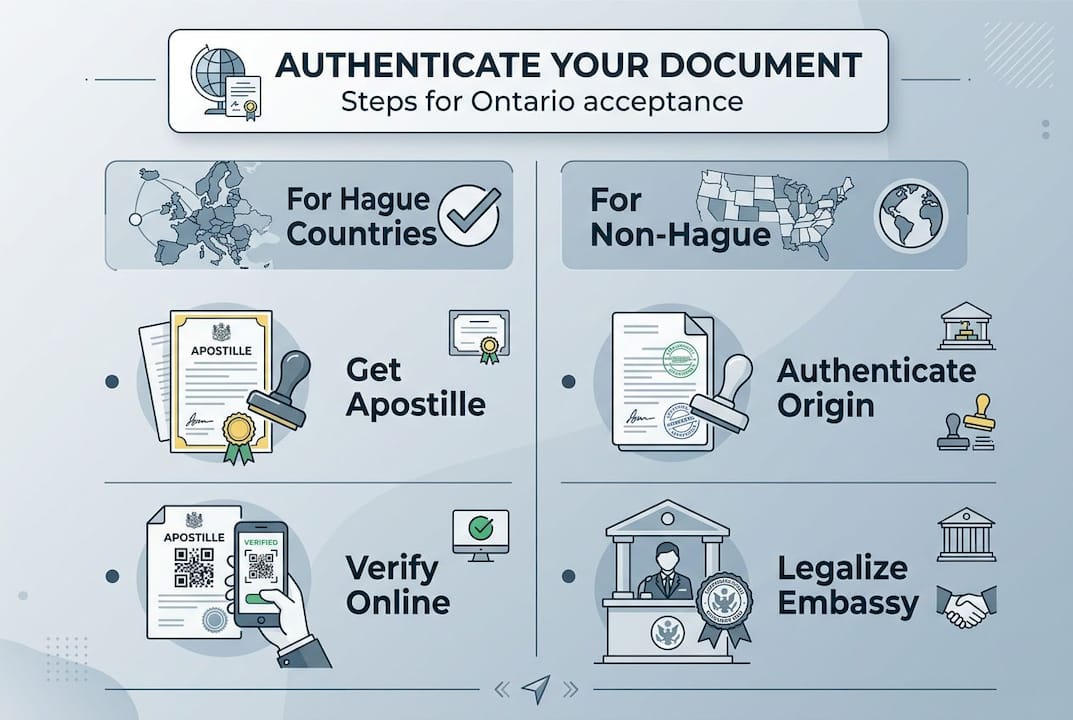
Step 3: Verify the apostille online if possible. Many countries now offer digital registers where Ontario agencies can verify an apostille’s legitimacy. Countries like India, the United States, and Spain have active online verification portals. Presenting a verifiable apostille dramatically reduces rejection risk.
Step 4: Check translation requirements and document expiry. An apostilled document in a language other than English or French is not yet ready for most Ontario agencies. Arrange certified translation before submission. Also check if your authentication itself has an expiry. Some institutions treat authentication older than six months as stale.
Step 5: Submit to the Ontario agency with a cover letter. Prepare a cover letter that explains the document, its origin, the type of authentication obtained, and what you are using it for. This small addition routinely prevents delays at agencies unfamiliar with your document type.
Pro Tip: Before you begin the authentication process, contact the receiving Ontario agency directly and ask what format they prefer and what they have accepted before. Getting this in writing (even via email) gives you a reference point if your submission is rejected on procedural grounds.
You can find a detailed breakdown of legalizing foreign documents and the specific steps for consular notarization in Ontario if your situation involves a Canadian embassy abroad.
Key requirements and edge cases for Ontario acceptance
The main process gets most people far, but subtle details often trip up applicants. Here is what to watch for, especially if your documents are unusual or your deadline is tight.
Translation requirements are non-negotiable for most agencies. If your document is not in English or French, you almost always need a certified translation before any Ontario agency will process it. A certified translation is not a Google Translate printout. It is prepared by a qualified translator and comes with a signed statement of accuracy. In Ontario, translators certified through the Association of Translators and Interpreters of Ontario (ATIO) are widely recognized. For some document types, especially driver’s licenses, the Ontario government specifically requires translation and notarization through an embassy or consulate of the issuing country, or through an ATIO-certified translator.

Here is a breakdown of what different Ontario recipients typically require:
| Recipient | Document type | Common authentication required | Translation needed? |
|---|---|---|---|
| IRCC | Birth/marriage certificates | Apostille or legalization chain | Yes, if non-English/French |
| Ontario courts | Foreign judgments | Authentication + notarized translation | Almost always |
| Employers/HR | Academic credentials | Apostille or consular legalization | Yes if non-English/French |
| Banks | Foreign ID documents | Varies; passport often accepted | Usually not for passports |
| Driver’s license office | Foreign license | Embassy/ATIO translation | Yes |
Passports and certain identity documents are sometimes exempt. Some Ontario services accept a valid foreign passport as direct proof of identity without requiring authentication. Banks are a common example. However, this is far from universal. When in doubt, confirm in advance. Assuming a passport is always sufficient has caused many applicants to show up underprepared.
IRCC has its own nuanced requirements. IRCC often requests that foreign documents be accompanied by a certified translation and the original authenticated document together. They may also require that translations include a statement from the translator confirming their qualifications. Submitting only the translation without the original, or vice versa, is a common and easily avoidable rejection trigger.
Pro Tip: If you are dealing with a less common document type, such as a tribal registry record, a notarized adoption decree from a country with limited infrastructure, or a military service record, call the receiving agency before you begin. These documents often need additional attestation that is not listed on standard instruction pages.
Common refusal reasons to avoid:
- Expired authentication certificate or apostille issued more than six to twelve months ago
- Incorrect sequence, such as getting legalization before authentication in the origin country
- Poor quality translation that omits official stamps, handwritten notes, or marginalia from the original
- Missing notarization on the translation itself when the agency requires it
- Using a country’s authentication body that is not officially designated for that document type
Using online notary and related services to ease Ontario authentication
Successfully gathering documents is one step, but using modern tools speeds up the last mile for many people in Ontario. Online notary services have become a practical part of the foreign document process, though it is important to understand exactly where they fit and where they do not.
What an online notary can do for your foreign document process:
- Notarize certified translations of foreign documents, adding a legally recognized layer of credibility for Ontario agencies
- Prepare and commission affidavits explaining the origin, context, or content of a foreign document
- Certify true copies of original documents for submission to agencies that do not want to handle originals
- Help draft statutory declarations or solemn declarations that accompany foreign documents in support applications
- Notarize cover letters and supporting statements for immigration, legal, or business submissions
What an online notary cannot do:
- Issue an apostille (only the designated authority in the document’s origin country can do this)
- Perform consular legalization (this must happen at a Canadian embassy or consulate)
- Replace the authentication chain required by the origin country
The practical workflow often looks like this: you obtain your apostille or legalized document from the proper authorities abroad, then engage an online notary to notarize a certified translation or prepare a supporting affidavit. These two pieces go together in your submission package. The documents needing notarization guide covers the full range of scenarios where this combination applies.
Online certified translation services are also useful here. Some Ontario agencies accept translations from qualified online translators paired with a notarization from a Canadian notary public. This is faster and often more affordable than going through a consulate for translation, as long as the agency’s specific requirements permit it.
As Global Affairs Canada confirms, there is no single Ontario service that authenticates all inbound foreign documents. Acceptance is case-by-case. This is precisely why combining a properly legalized document with a notarized translation and a supporting affidavit creates the strongest possible submission.
For people dealing with tight timelines, the online notary route for the supporting materials (translations, affidavits, declarations) is often the fastest legitimate path available.
The hidden traps and what Ontarians often overlook about foreign document authentication
Most failed submissions do not fail because of the authentication itself. They fail because the applicant did not understand what the specific Ontario recipient actually needed.
We see this pattern repeatedly. Someone obtains a perfectly valid apostille from a Hague member country. They submit it to IRCC. It gets rejected, not because the apostille is wrong, but because the translation was done by someone who is not recognized by IRCC, or because the translation omitted a stamp visible on the original. The acceptable identity documents framework is broad, but each agency interprets it through its own lens.
The other trap is last-minute translation. Translations rushed at the end of the process tend to have errors or omissions that are only caught when the agency reviews the full package. By that point, you may have a deadline breathing down your neck, and a corrected translation takes time. This is not a recoverable situation for many immigration or court filing deadlines.
Our strongest advice: treat recipient requirements as the starting point of your process, not the finishing line. Call the agency, ask about their preferred format, and get confirmation before you spend money on authentication. The consular notarization lessons we have gathered from real cases show that agencies vary more than most people expect, even within the same federal department. Blanket solutions rarely work. Customized preparation almost always does.
How The Online Notary can simplify your foreign document process
Navigating apostilles, consular legalization, certified translations, and agency-specific requirements is genuinely complex. You should not have to figure it all out on your own.

The Online Notary provides 24/7 Ontario-compliant notarization services that fit directly into the foreign document authentication process. From notarizing certified translations and preparing affidavits to commissioning statutory declarations and solemn declarations, the platform handles the notarization layer that most agencies require alongside your apostilled or legalized document. Explore the full range of Ontario notary services available online, or review the notary public requirements to understand what credentials and standards apply in Ontario. Fast, secure, and designed for exactly the situations this guide describes.
Frequently asked questions
What’s the difference between an apostille and legalization for Ontario?
An apostille is a simplified, single-step authentication recognized for documents from Hague Convention countries, while legalization is a multi-step process required for documents from countries that are not members of the Hague Convention.
Does Ontario provide official authentication for inbound foreign documents?
No. Ontario does not centrally authenticate incoming foreign documents; acceptance depends entirely on the rules of the receiving agency or institution, which vary widely.
What translation is required for foreign documents in Ontario?
Non-English and non-French documents typically require a certified translation from an ATIO-certified translator or, for some documents like foreign driver’s licenses, a translation provided or certified by the relevant embassy or consulate.
Who accepts foreign documents in Ontario without further authentication?
Some Ontario services accept valid foreign passports as direct proof of identity without additional authentication, but this varies by service and you should always confirm the specific agency’s requirements before submitting.