How to become a notary public in Ontario: a step-by-step guide

TL;DR:
- Notarized documents are legally required in Ontario for various official processes like immigration and real estate.
- Becoming a notary involves an application process with specific eligibility, documentation, and often requires renewal or professional credentials.
- Most individuals and businesses prefer to use professional notary services rather than applying themselves due to complexity and time.
Notarized documents are not optional in many legal and business situations in Ontario. Whether you’re processing immigration paperwork, finalizing real estate transactions, or certifying business documents for international use, you need a qualified notary public. Yet many people, both individuals and business owners, are deeply unclear about how to become one or whether they even qualify. This guide walks you through everything you need to know about the application process, eligibility rules, required documents, and the practical trade-offs of applying versus simply using a professional notary service.
Table of Contents
- Understanding the role and powers of a notary public
- Who is eligible to become a notary public in Ontario?
- What you need before you apply: key requirements and documents
- Step-by-step: how to apply for notary public in Ontario
- Why most people choose notary services over applying themselves
- Expert help for all your notary public needs
- Frequently asked questions
Key Takeaways
| Point | Details |
|---|---|
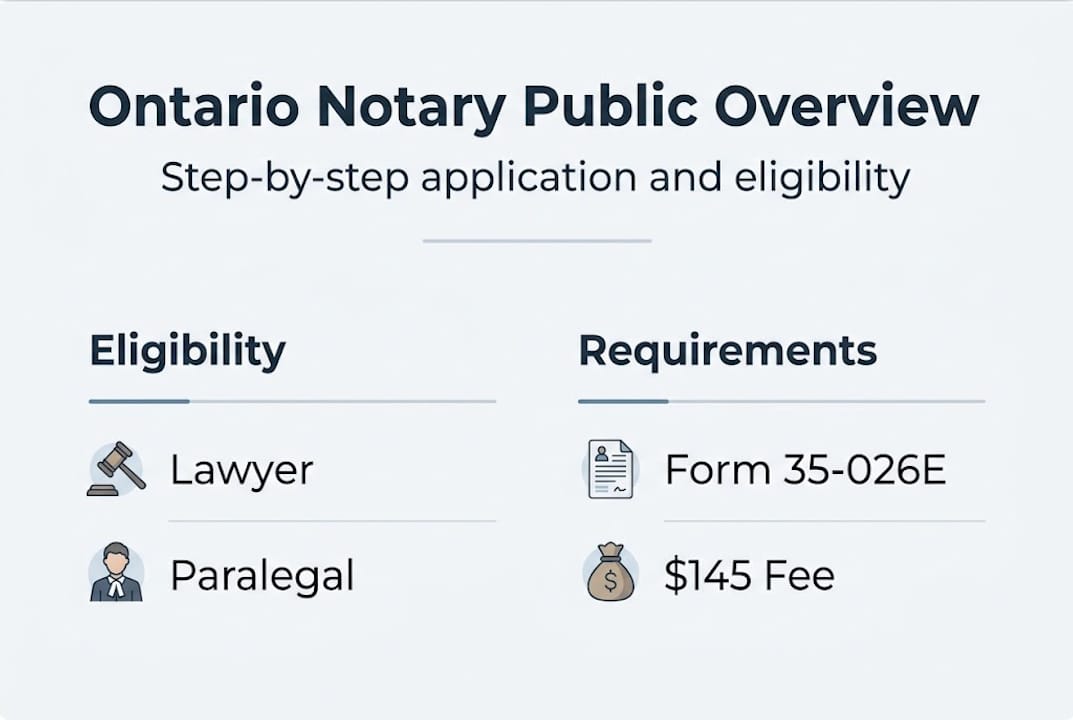
| Ontario notary eligibility | Lawyers and paralegals in good standing qualify for a lifetime appointment, while non-lawyers must renew every three years. |
| Key application steps | Prepare form 35-026E, supporting ID, and the $145 fee; submit by mail or in-person to Official Documents Services. |
| Notary public powers | Notaries in Ontario can witness and certify documents, take oaths, and certify true copies as per the Notaries Act. |
| Streamlined for professionals | The process is swift and permanent for legal professionals, but non-lawyers should weigh the value and conditions before applying. |
Understanding the role and powers of a notary public
By understanding why notaries are needed, it’s helpful to clarify what being a notary public actually involves in Ontario.
A notary public in Ontario is an officer of the law appointed by the provincial government. The role carries specific powers defined by statute, and those powers matter because they determine what types of documents and transactions you are legally authorized to handle. This is not a casual designation. It comes with real responsibilities and accountability to the public.
Under the Ontario Notaries Act, a notary public has the authority to witness and certify documents, certify true copies of original documents, and administer oaths and affirmations. These powers mirror those of a commissioner of oaths but extend further in scope. Notaries must also use an embossed seal that matches the details on their appointment certificate, which is a requirement that distinguishes notarized documents from those handled by commissioners of oaths.
Here’s a quick look at what a notary public is authorized to do in Ontario:
- Witness the signing of legal documents such as affidavits, statutory declarations, and solemn declarations
- Certify true copies of original documents, including passports, diplomas, and identification cards
- Administer oaths and affirmations in legal proceedings or for sworn statements
- Authenticate signatures for use in international or cross-border legal matters
- Execute notarial certificates for documents requiring foreign recognition
“A notary public’s power to certify true copies and administer oaths gives their seal a level of authority that a regular witness signature simply cannot provide. This matters enormously when documents are used in foreign courts or government agencies.”
It’s equally important to know what a notary public is not. In Ontario, a notary is not automatically a licensed lawyer or legal advisor. Lawyers who also hold notary appointments can provide legal advice, but a notary-only appointment does not authorize legal counsel. Understanding notary duties in Ontario helps you decide whether you need a notary, a lawyer, or both for your particular situation.
The distinction also matters when comparing notaries to commissioners of oaths. Commissioners can witness certain sworn documents, but they cannot certify true copies or handle documents destined for international use. Notaries carry more formal legal weight, which is why the appointment process is more rigorous.
Who is eligible to become a notary public in Ontario?
Having clarified what notaries do, the next step is knowing if you qualify to apply and whether the process is a fit for your needs.
Ontario’s eligibility rules for notary public appointments are more nuanced than most people expect. There are effectively two tracks: one for legal professionals and one for everyone else. The requirements, timelines, and renewal obligations differ significantly between the two.
Reviewing Ontario notary eligibility is the first thing you should do before gathering any documents. Here is a clear breakdown of who qualifies under each category:
| Category | Appointment type | Renewal required | LSO membership required |
|---|---|---|---|
| Lawyers in good standing | Lifetime | No | Yes |
| Paralegals in good standing | Lifetime | No | Yes |
| Non-lawyers (general public) | Conditional | Yes, every 3 years | No |
| Government employees | Conditional | Yes, every 3 years | No |
As the application form 35-026E confirms, lawyers and paralegals who are in good standing with the Law Society of Ontario (LSO) can apply for a lifetime notary public appointment. This is a significant benefit. It means no repeat applications, no renewal fees, and no lapse in authority as long as their professional standing remains intact.

Non-lawyers, on the other hand, receive a conditional appointment that expires after three years. They must reapply and go through a similar process again to maintain their status. This adds administrative burden and ongoing cost over time.
Who typically applies as a non-lawyer? Think of certain administrative professionals, civil servants, or people working in notarial-adjacent roles who need the authority to witness specific documents regularly in their jobs. Businesses rarely go through this process themselves. Instead, they rely on lawyers, paralegals, or established notary services to handle their documentation needs.
Here are the key eligibility requirements for non-lawyer applicants:
- Must be a Canadian citizen or permanent resident
- Must be at least 18 years of age
- Must be a resident of Ontario
- Must demonstrate a genuine need for the notary appointment
- Must provide character references or supporting employer documentation
Pro Tip: If you’re applying as a non-lawyer because your employer requires it, get a formal letter from your employer stating the business need. This greatly strengthens your application and speeds up the review process.
Understanding the difference between these two tracks also helps you understand why most businesses and individuals prefer to work with qualified notary vs lawyer professionals rather than pursuing their own appointment. The effort is simply not justified unless notarization is a regular, ongoing part of your professional responsibilities.
What you need before you apply: key requirements and documents
Once you confirm you’re eligible, collect the right documents and details to ensure your application process is smooth.
Preparation is everything in a government application process. Submitting incomplete documentation is the single most common reason applications are delayed or rejected. Before you print a single form, make sure you understand exactly what officials are looking for.
Here is a summary of the core application requirements:
| Requirement | Details |
|---|---|
| Application form | Form 35-026E (Ontario Government) |
| Application fee | $145 (waived for government employees) |
| Proof of identity | Government-issued photo ID |
| LSO membership evidence | Required for lawyers/paralegals |
| Supporting documentation | Employer letter, character references (for non-lawyers) |
According to the official application form, all applicants must submit the completed form 35-026E along with the $145 fee, unless they qualify as government employees. Lawyers and paralegals must also include current evidence of their standing with the Law Society of Ontario.
Here is the recommended preparation sequence before submitting anything:
- Download and carefully read form 35-026E from the Ontario government’s official forms repository
- Confirm your eligibility category (lawyer, paralegal, or non-lawyer)
- Gather all required identity documents, specifically government-issued photo ID such as a driver’s license or passport
- If applying as a lawyer or paralegal, obtain a current confirmation of your LSO standing
- If applying as a non-lawyer, prepare a detailed employer letter explaining your need for the appointment and arrange for at least one credible character reference
- Prepare your payment of $145, either by certified check or money order payable to the Minister of Finance
Common mistakes applicants make include submitting photocopies of ID instead of certified copies, omitting the LSO confirmation letter, or failing to explain the basis for their notary need clearly. Officials reviewing these forms are looking for completeness and clarity. Any ambiguity invites follow-up requests that delay your appointment.
Understanding what notary ID requirements are currently accepted and what required notary documents look like in practice helps you avoid the most frequent submission errors. The government does not contact applicants proactively about missing materials. It’s your job to get it right the first time.
One more detail worth noting: the name and information on your identification must match exactly what appears on your application form. Even minor discrepancies in spelling or address can cause processing delays.
Step-by-step: how to apply for notary public in Ontario
With your paperwork and documentation prepared, you’re ready to actually submit your application and officially start the process.
The application itself is straightforward once you have everything assembled. Follow these steps carefully to give yourself the best chance of a smooth, delay-free process.
-
Download form 35-026E directly from the Ontario government’s official forms portal. Do not use third-party copies or outdated versions. Always pull the most current version.
-
Complete the form in full, using block letters or typed text. Sign the form where required. Do not leave any fields blank. If a section does not apply to you, write “N/A” rather than leaving it empty.
-
Attach your proof of identity, ensuring it is properly certified if required. Your name must match every other document in your package.
-
Include your LSO standing confirmation if you are a lawyer or paralegal. This should be a current document, not one dated more than 90 days before submission.
-
Write and include your employer support letter if applying as a non-lawyer. This letter should specifically describe your role, explain why notary authority is needed for your work, and be signed by someone in a supervisory or HR capacity.
-
Prepare your payment of $145. This should be a money order or certified check made payable to the Minister of Finance. Personal checks are generally not accepted.
-
Compile your full package and review it one final time before sealing. A simple checklist works well here. Confirm that every item is present, every page is signed, and every attachment is included.
-
Submit your completed application to Official Documents Services. As confirmed in the application form instructions, you can mail or deliver your package in person to 777 Bay St, Lower Level, Toronto ON M7A 2J8.
Pro Tip: If submitting in person, request a dated receipt or confirmation stamp on a copy of your cover letter. This creates a paper trail if your application is ever misplaced or delayed in processing.
After submission, processing times can vary. Most applicants should expect several weeks before receiving a response. If approved, you will receive your appointment certificate and instructions for obtaining your notarial seal. You must order an embossed seal that exactly matches your certificate before you can begin practicing.
For a broader look at what happens after approval and how the role functions day-to-day, the Ontario notary application details page provides useful context on next steps.
Why most people choose notary services over applying themselves
Now that you know exactly how the application process works, it’s worth stepping back to consider whether applying is the best path or if using a professional notary service better fits your needs.
Here’s the honest reality: the application process makes strong sense for lawyers, paralegals, and certain government employees whose daily work requires notarial authority. The lifetime appointment for LSO members is genuinely efficient and cost-effective over time. But for the vast majority of individuals and businesses in Ontario, applying for your own notary appointment is unnecessary, time-consuming, and, frankly, overkill.
Think about it this way: you don’t become a licensed electrician just to install a light fixture. Similarly, you don’t need to become a notary public just to get a document certified. The expertise, liability, and experience that a professional notary brings to the process is something you cannot replicate by simply holding an appointment certificate.
For individuals who need documents notarized occasionally, or for businesses with periodic compliance needs, working with a qualified notary service is faster, more reliable, and often more legally sound. Professionals who specialize in notarization know how to spot errors in documents before they cause costly problems downstream. That knowledge matters.
Expert help for all your notary public needs
Whether you’re still weighing whether to apply or you simply need documents notarized right now, professional notary services in Ontario can solve the problem quickly and correctly.

The Online Notary offers fully online, 24/7 notary services for individuals and businesses across Ontario, including affidavits, statutory declarations, solemn declarations, invitation letters, and more. You don’t need to travel to an office or wait weeks for an appointment. If you want to explore your Ontario notary services options or understand public notary requirements before deciding your next step, the resources are there when you need them. You can also review what ID for notary applications is needed so you’re always prepared, whether you apply yourself or work with a professional.
Frequently asked questions
How long does it take to become a notary public in Ontario?
Processing time varies, but most applications are reviewed within several weeks after submission to Official Documents Services. Incomplete applications may experience significantly longer delays.
Do I need to be a lawyer to apply for notary public?
No, but lawyers and paralegals receive a lifetime appointment while non-lawyers receive a conditional 3-year appointment that requires renewal. The non-lawyer track also involves more documentation.
What is the fee to apply for notary public in Ontario?
The standard application fee is $145, though government employees may qualify for an exemption from this payment.
What documents can a notary public in Ontario certify?
Under the Ontario Notaries Act, a notary can certify true copies, witness official documents, and administer oaths or affirmations. Notarized documents are accepted in both domestic and international legal contexts.
Where do I send my notary public application in Ontario?
Mail or deliver your completed package to Official Documents Services at 777 Bay St, Lower Level, Toronto ON M7A 2J8, either by mail or in person.