Form 14A in Ontario: Your Complete Affidavit Guide

TL;DR:
- Form 14A is an Ontario legal affidavit form used to present sworn statements of fact for court and administrative matters. Proper completion, notarization, and alignment with supporting documents are essential to avoid rejection or delays. It differs from statutory declarations and requires careful attention to detail, especially during notarization, to ensure legal validity.
Form 14A is the official affidavit form used in Ontario to present sworn statements of fact for legal and administrative purposes. Courts, government agencies, and institutions across the province rely on it to verify claims made under oath. Getting it right matters. An incomplete or incorrectly notarized form 14A gets rejected, which delays your case and can affect your legal standing. This guide covers what the form is, how to fill it out correctly, what mistakes to avoid, and how it relates to other legal documents like statutory declarations.
What is Form 14A used for in Ontario?
Form 14A is used for affidavits submitted in Ontario courts and administrative processes. An affidavit is a written statement of fact that the person making it swears or affirms to be true before a notary or commissioner of oaths. The form gives that sworn statement an official, standardized structure that courts and institutions recognize.
Common situations where you will need this form include:
- Proof of facts in civil litigation: Parties use affidavits to present evidence without live testimony, particularly in motions and applications.
- Immigration and visa support: Sponsors and applicants use sworn affidavits to confirm relationships, financial support, or residency facts.
- Business and corporate compliance: Companies file affidavits to confirm corporate resolutions, ownership changes, or regulatory compliance.
- Real estate transactions: Lawyers require affidavits from buyers and sellers to confirm identity, marital status, or possession of property.
- Family law matters: Affidavits support custody applications, support claims, and property division proceedings.
- Administrative declarations: Government agencies accept Form 14A to verify facts for licensing, benefits, or registration purposes.
The form differs from a simple written statement because it carries legal weight. Incomplete affidavit forms without notarization or with vague statements risk being ruled inadmissible in Ontario courts. That distinction separates a useful legal document from a piece of paper with no standing.
One point worth clarifying: Form 14A in Ontario is not the same as the DEF 14A, which is a proxy statement filed with the SEC before shareholder votes in the United States. The names look similar, but they serve entirely different legal systems and purposes.
How to properly complete and notarize Form 14A
Accurate completion is the single biggest factor in whether your affidavit gets accepted. Follow these steps carefully.
- Enter your full legal name. Use the name exactly as it appears on your government-issued ID. Spelling variations cause rejection.
- State your address completely. Include your street number, street name, city, province, and postal code. Partial addresses create processing problems.
- Describe your occupation clearly. Vague entries like “self-employed” without further detail raise credibility questions. Write your actual job title or business type.
- Write your statement of facts. Use plain, direct language. Each paragraph should address one specific fact. Avoid conclusions or legal arguments. Courts want facts, not interpretations.
- Attach supporting documents. Relevant supporting documents like employment letters, government IDs, or official records should align directly with what your affidavit states. Contradictions between your affidavit and your supporting documents will sink your submission.
- Sign in front of a notary. Do not sign the form before your appointment. The notary must witness your signature to certify it. Affidavits need to be signed in black or dark blue ink and notarized to be accepted in Ontario.
- Have the notary complete their section. The notary adds their signature, seal, and certification details. This step is what transforms your written statement into a legally valid affidavit.
Notarization does more than stamp a document. Notaries public in Ontario verify your identity, confirm the signature is genuine, and certify that you made the statement voluntarily. Without that certification, the affidavit has no legal standing.
Pro Tip: Use the Machine Readable Zone on your passport or government ID as your reference when filling in personal details. It eliminates transcription errors in names, dates, and document numbers, which are among the most common rejection triggers.

Digital submission is possible in some contexts, but it typically requires wet-ink signatures and notarization that are then scanned or witnessed digitally under Ontario’s rules. Check with the receiving institution before assuming a digital copy is acceptable.
Common errors and pitfalls to avoid when submitting Form 14A
Errors on affidavits are more common than most people expect, and the consequences range from minor delays to outright rejection. The most frequent mistakes include:
- Signing before the notary appointment. This is the most disqualifying error. A pre-signed affidavit cannot be certified because the notary did not witness the act of signing.
- Signature mismatch. Signature discrepancies cause form rejection during verification. Your signature on the affidavit must closely match the one on your government ID.
- Vague or incomplete personal details. Missing apartment numbers, unclear occupation descriptions, or abbreviated names all trigger rejection.
- Inconsistent facts. If your affidavit says one thing and your supporting documents say another, the entire submission loses credibility.
- Using the wrong form. Ontario courts use specific forms for specific proceedings. Submitting Form 14A when a different affidavit form is required wastes time and may miss filing deadlines.
- Improper notarization. A notary who lacks the authority to certify affidavits in Ontario, or who certifies without proper identity verification, creates a document that courts will reject.
Pro Tip: Before your notary appointment, read your completed affidavit out loud. Errors that your eyes skip over become obvious when you hear the words. Pay particular attention to dates, names, and addresses.
If you discover an error after submission, act quickly. Minor clerical errors can sometimes be corrected with a supplementary affidavit. Substantive errors, meaning errors that change the meaning of your statement, typically require you to file a new affidavit entirely. Contact the court or institution where you filed to understand the correction process before assuming you can simply resubmit.
Correctly completed affidavits are legal tools, not mere formalities. Treating them with that level of seriousness from the start prevents costly delays and disputes down the line.
How does Form 14A relate to statutory declarations and other documents?
Form 14A affidavits and statutory declarations are related but serve different legal purposes in Ontario. Choosing the wrong one can mean your document is rejected or carries less legal weight than your situation requires.
| Feature | Form 14A Affidavit | Statutory Declaration |
|---|---|---|
| Legal basis | Sworn under oath before a notary or commissioner | Declared solemnly under the Canada Evidence Act or Ontario Evidence Act |
| Primary use | Court proceedings, litigation, and formal legal matters | Administrative purposes, government filings, and non-court declarations |
| Who certifies it | Notary public or commissioner of oaths | Notary public, commissioner of oaths, or lawyer |
| Legal weight | Higher, as it is sworn testimony | Slightly lower, used for declarations of fact outside court |
| Consequences of false statements | Perjury charges | False declaration charges |
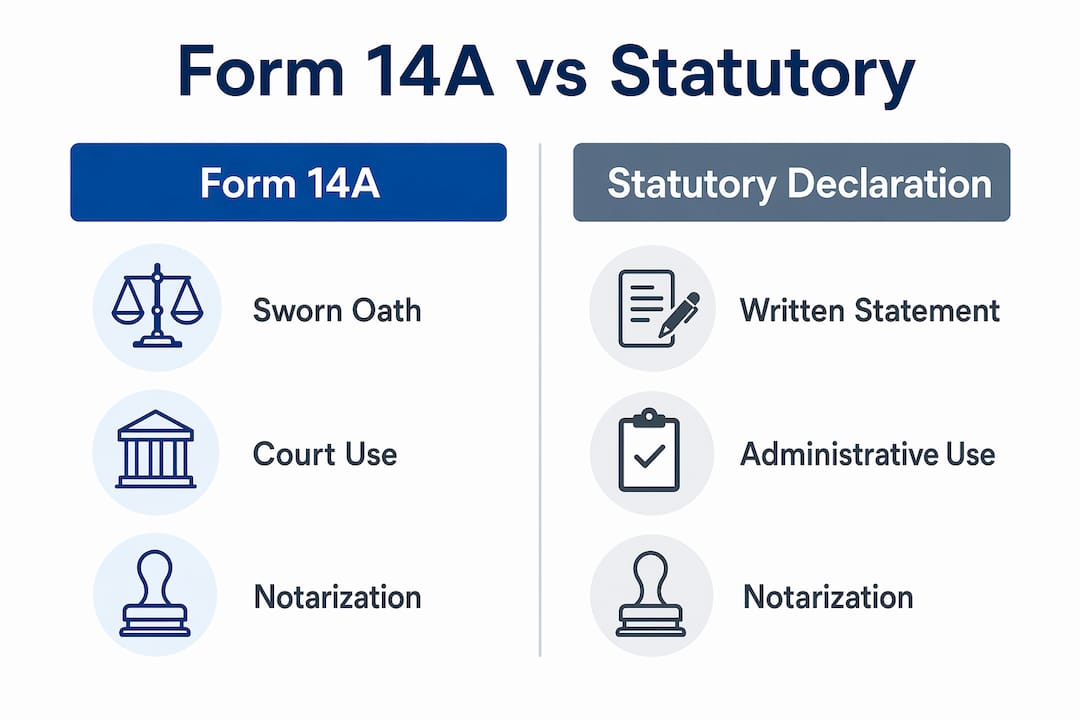
Statutory declarations differ from affidavits in legal weight and are separate documents, though both require notarization. The practical rule is straightforward: use Form 14A when a court or legal proceeding requires sworn testimony. Use a statutory declaration when a government agency or institution needs a formal, notarized statement of fact outside of litigation.
Both documents require supporting evidence to be credible. An affidavit claiming a business relationship should be accompanied by contracts, correspondence, or financial records. A statutory declaration confirming residency should come with utility bills or lease agreements. The affidavit or declaration states the facts; the supporting documents prove them.
Ontario courts accept Form 14A as evidence in motions, applications, and hearings. Government institutions, including immigration authorities and licensing bodies, accept both forms depending on their specific requirements. When you are unsure which document applies, the safest step is to ask the receiving institution directly or consult a notary who works with both types regularly.
Key Takeaways
Form 14A is a sworn affidavit form that requires accurate personal details, a witnessed signature, and proper notarization to be legally valid and accepted in Ontario courts and institutions.
| Point | Details |
|---|---|
| Form 14A is a sworn affidavit | It presents statements of fact under oath for courts and administrative bodies in Ontario. |
| Notarization is non-negotiable | A notary must witness your signature and verify your identity for the affidavit to have legal standing. |
| Common errors cause rejection | Pre-signing, signature mismatches, and vague details are the top reasons affidavits get rejected. |
| Affidavits differ from statutory declarations | Use Form 14A for court proceedings; use statutory declarations for administrative and government filings. |
| Supporting documents matter | Your affidavit and your supporting evidence must align. Contradictions undermine the entire submission. |
Why Form 14A deserves more respect than most people give it
Most people treat Form 14A like a bureaucratic checkbox. Fill it in, get it stamped, move on. That attitude is exactly why so many affidavits get rejected or challenged.
What I have seen repeatedly is that the details people rush through are the ones that cause the most damage. A name spelled differently from the passport. An address missing the unit number. A signature that looks nothing like the one on the ID. These are not minor oversights. They are the difference between a document that works and one that gets thrown out at the worst possible moment, right when you need it most.
The other misconception I encounter often is that notarization is just a formality. It is not. The notary is the legal anchor of the entire document. Their certification is what makes your statement admissible. Choosing a notary who understands Ontario’s specific requirements, rather than just anyone with a stamp, changes the outcome.
My honest advice: treat Form 14A the way you would treat a contract. Read every line. Verify every detail against your ID. Sign it in front of your notary, not before. And make sure your supporting documents tell the same story your affidavit tells. When all of those pieces align, the form does exactly what it is supposed to do.
— Ken
Theonlinenotary can help you get Form 14A right
Getting Form 14A notarized correctly the first time saves you time, stress, and potential legal setbacks. Theonlinenotary provides online notary services in Ontario for affidavits, statutory declarations, solemn declarations, and more, all without requiring you to travel or take time off work.

The process is straightforward. You prepare your affidavit, book an appointment online, and meet with a certified Ontario notary via video. Your document gets properly witnessed, certified, and returned to you ready for submission. Theonlinenotary’s notaries understand the specific requirements for Form 14A and related documents, so your affidavit meets the standards that Ontario courts and institutions expect. Whether you are an individual handling a personal legal matter or a business managing compliance filings, the service is built to handle both.
FAQ
What is Form 14A in Ontario?
Form 14A is the standard affidavit form used in Ontario to present sworn statements of fact in court proceedings and administrative processes. It must be signed in front of a notary or commissioner of oaths to be legally valid.
How do I fill out Form 14A correctly?
Enter your full legal name, complete address, and clear occupation details exactly as they appear on your government ID, then write your statement of facts in plain language before signing in front of a notary.
What happens if Form 14A has errors?
Errors such as a missing signature, mismatched details, or improper notarization result in rejection by courts or institutions. Minor clerical errors may be corrected with a supplementary affidavit, but substantive errors typically require filing a new document.
What is the difference between Form 14A and a statutory declaration?
Form 14A is a sworn affidavit used primarily in court proceedings, while a statutory declaration is used for administrative and government filings outside of litigation. Both require notarization, but they carry different legal weight.
Can I notarize Form 14A online in Ontario?
Yes. Ontario allows online notarization where a certified notary witnesses your signature via video and certifies the document digitally, provided the receiving institution accepts this format. Theonlinenotary offers this service for affidavits and related documents across Ontario.