Authority of a Notary Public in Ontario Explained

TL;DR:
- A notary public in Ontario has the official authority to verify identities, witness signatures, and administer oaths, strictly following procedural rules. They cannot interpret legal documents, give advice, or draft legal content, which are duties reserved for licensed lawyers. Their authority is limited to procedural acts within Ontario, and online notarizations are valid when complying with provincial standards.
The authority of a notary public is the official power granted by a provincial commission to verify identities, witness signatures, and administer oaths on legal documents. In Ontario, this authority is strictly ministerial. That means a notary follows set procedures without interpreting law or advising signers. The role exists to deter fraud and give documents legal weight. Understanding exactly what that authority covers, and where it stops, protects you from costly mistakes whether you are an individual filing an affidavit or a business processing corporate certifications.
What is the authority of a notary public in Ontario?
A notary public’s core function is acting as an impartial official witness, verifying identity and performing standardized notarial procedures without giving legal advice. That definition is the foundation of everything a notary can and cannot do. The authority is real and legally recognized, but it is narrow by design.
Notary public duties in Ontario fall into four main categories:
- Identity verification. The notary checks government-issued photo ID to confirm the signer is who they claim to be. This step is the first line of defense against document fraud.
- Witnessing signatures. The notary watches the signer sign the document in real time. A signature witnessed this way carries legal weight that an unwitnessed signature does not.
- Administering oaths and affirmations. For affidavits and statutory declarations, the notary formally swears in the signer. This creates a legal obligation to tell the truth.
- Stamping and record-keeping. The notary applies an official seal and maintains a journal of notarial acts. That record creates an audit trail if a document is ever challenged.
One critical point most people miss: notaries verify identity, not the truthfulness of what a document says. If someone swears a false affidavit, the notary is not responsible for the lie. The notary only confirms the person appeared, was identified, and signed voluntarily.
Pro Tip: Bring two pieces of government-issued ID to any notarization appointment. Ontario notaries are trained to flag inconsistencies, and having backup ID prevents delays or refusals.

Notary public responsibilities also include knowing what they cannot do. A notary cannot draft legal documents, advise you on contract terms, or tell you whether a document is legally sufficient for your purpose. Those tasks require a licensed lawyer.
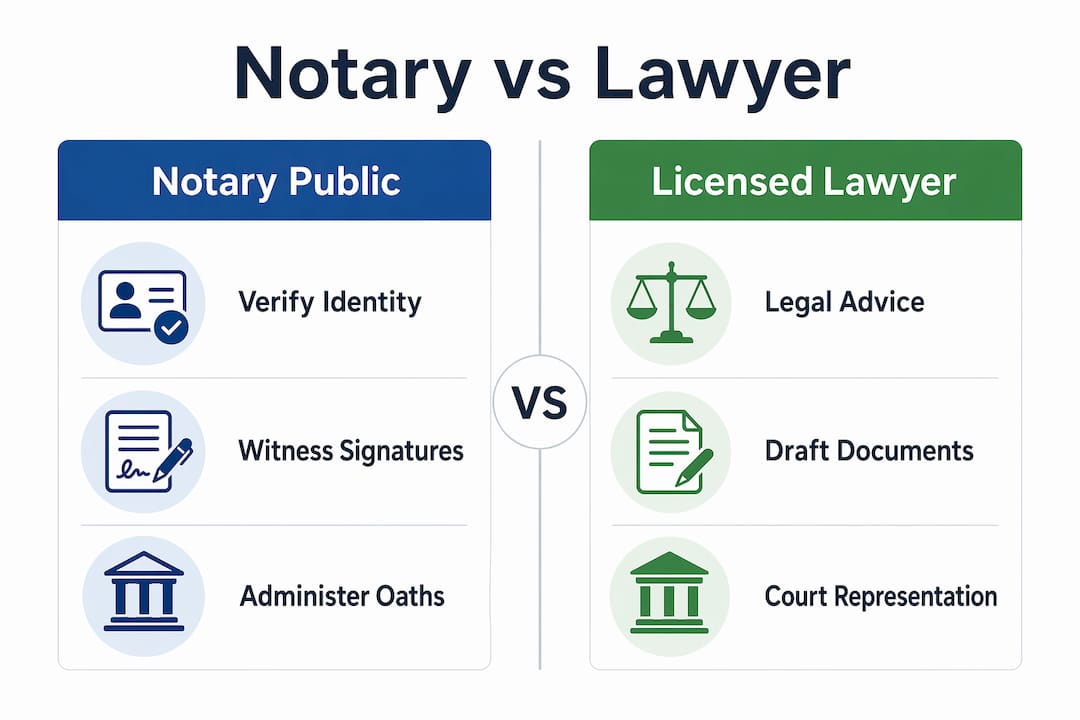
How does notary authority differ from a lawyer’s authority?
This distinction matters more than most people realize. Confusing the two can lead to serious legal and financial harm.
| Authority | Notary Public | Licensed Lawyer |
|---|---|---|
| Verify identity | Yes | Yes |
| Witness signatures | Yes | Yes |
| Administer oaths | Yes | Yes |
| Give legal advice | No | Yes |
| Draft legal documents | No | Yes |
| Represent clients in court | No | Yes |
| Interpret contract terms | No | Yes |
Notarial authority is limited to procedure. A lawyer’s authority covers legal judgment, strategy, and representation. These are fundamentally different roles, and Ontario law keeps them separate for good reason.
A particularly dangerous misconception involves the term “notario público.” In Latin American legal systems, a notario público holds broad legal powers similar to a lawyer. In Ontario and across North America, a notary public holds no such powers. This confusion has caused fraud in immigrant communities where unscrupulous individuals claim notarial credentials to offer unauthorized legal services.
The rule is simple. If you need a document signed and witnessed, a notary handles that. If you need to understand what that document means for your legal situation, you need a lawyer. For a detailed breakdown specific to Ontario, the notary vs. lawyer differences guide from Theonlinenotary covers the key distinctions clearly.
What are the legal limits on notary public powers?
Ontario notaries operate within strict legal and ethical boundaries. Those boundaries exist to protect signers, third parties, and the integrity of the legal system.
- No legal interpretation. A notary’s role is purely procedural. Offering an opinion on whether a contract is fair or a will is valid crosses into the practice of law.
- Right to refuse. Notaries must refuse to notarize if the signer appears impaired, confused, or under duress. Notaries watch for red flags such as coercion or incapacity and can suspend the process if concerns arise.
- Geographic limits. A notary’s commission is geographically limited to the province granting it. An Ontario notary cannot legally notarize a document while physically outside Ontario.
- No vital record copies. Notaries in most jurisdictions, including Ontario, cannot certify copies of vital records such as birth certificates or marriage certificates. Government offices handle those.
- Unauthorized practice consequences. Crossing into legal advice or document drafting without a law license can result in commission revocation, fines, or criminal charges.
“The line between notarial acts and unauthorized practice of law is strict. Notaries crossing this line face severe legal and professional repercussions.”
These limits are not bureaucratic obstacles. They are safeguards that keep the notarial system trustworthy. A notary who stays within their lane gives your document real legal standing. One who oversteps puts your document and their commission at risk.
How does notary authority affect real transactions in Ontario?
The practical impact of notarial authority shows up across dozens of everyday legal situations. Knowing how it applies helps you prepare and avoid surprises.
Real estate transactions in Ontario regularly require notarized documents, including statutory declarations confirming property ownership status. Powers of attorney must be witnessed and notarized to be legally valid. Affidavits used in court proceedings require a notary to administer the oath. Corporate certifications for business filings often need a notary’s seal to be accepted by government agencies.
Here is what to prepare before any notarization appointment:
- Valid government-issued photo ID. A passport or driver’s license works. Expired ID does not.
- The completed document. Do not sign it beforehand. The notary must witness the actual signing.
- Any supporting documents. For affidavits or statutory declarations, bring any referenced exhibits.
- Payment. Ontario notaries charge regulated fees. Confirm the amount before your appointment.
Digital notary services are now a practical option for Ontario residents and businesses. These services must comply with jurisdictional authority and procedural laws to produce valid notarizations. Not every document type qualifies for remote notarization, so confirm eligibility before booking.
Pro Tip: Businesses that regularly need notarized documents should build a relationship with a trusted notary service. Consistent use of one provider means faster turnaround and fewer errors from unfamiliarity with your document types.
For businesses, the notarized document validity rules in Ontario determine whether a notarized document will hold up in court or satisfy a government agency. Understanding those rules before you file saves significant time and cost.
How does someone become a commissioned notary in Ontario?
The commissioning process is how notarial authority is formally granted. It is not a casual credential.
- Meet eligibility requirements. Applicants must be Ontario residents, at least 18 years old, and of good character. A criminal record check is standard.
- Submit an application. The application goes to the Ontario government through the Ministry of the Attorney General. Fees apply at this stage.
- Complete any required training. Ontario does not require a formal exam for all notary applicants, but the commissioning process typically includes an oath of office and may involve training on notarial procedures.
- Receive the commission and seal. Once approved, the notary receives an official commission certificate and is authorized to purchase an official seal.
- Renew on schedule. Ontario notary commissions are not permanent. Renewal requires reapplication and continued good standing.
- Understand online notary appointments. Commissioned notaries who wish to offer remote services must meet additional technical and procedural requirements under Ontario’s rules for electronic notarization.
The public notary requirements in Ontario are specific and worth reviewing before starting the application process. Errors in the application can delay or deny the commission.
Key Takeaways
The authority of a notary public in Ontario is a defined, limited, and legally protected power that serves a specific function in document authentication.
| Point | Details |
|---|---|
| Authority is ministerial | Notaries verify identity and witness signatures but never interpret law or advise on documents. |
| Legal advice is off-limits | Only licensed lawyers can draft documents or give legal guidance; notaries who cross this line face serious penalties. |
| Refusal is a legal right | Notaries must refuse notarization if a signer appears impaired, coerced, or confused. |
| Geographic limits apply | An Ontario notary’s commission is valid only within Ontario; notarizing outside the province is unauthorized. |
| Digital notarization is valid | Online notary services in Ontario are legally recognized when they comply with provincial procedural rules. |
Why most people misread a notary’s authority
The single biggest mistake I see clients make is treating a notary appointment like a legal consultation. They arrive expecting the notary to review their contract, flag problem clauses, or confirm that their document will hold up in court. That is not what a notary does. It is not what they are trained to do, and it is not what their commission authorizes.
The notary’s power is real, but it is narrow. That narrowness is actually a feature. Because notaries do not interpret documents, they can process high volumes of notarizations consistently and without bias. The moment a notary starts offering opinions on document content, they introduce liability and undermine the impartiality that makes their seal meaningful.
What I find most underappreciated is the refusal power. A notary who turns away a signer showing signs of confusion or pressure is doing exactly what the law requires. Businesses sometimes push back on this, especially when a deal depends on a document being signed that day. But a notarization obtained under duress is legally worthless and potentially criminal. Planning notarizations with adequate time and calm conditions is not just good practice. It is the only way to get a document that will actually hold up.
The rise of digital notary services adds a new layer to this picture. Remote notarization is valid in Ontario when done correctly, but the procedural requirements are strict. The technology does not change the underlying authority. It just changes the delivery method. Anyone using an online service should confirm the notary holds a valid Ontario commission and that the document type qualifies for remote notarization.
— Ken
Notary services in Ontario from Theonlinenotary
Theonlinenotary provides legally authorized notary services for Ontario residents and businesses, covering affidavits, statutory declarations, solemn declarations, invitation letters, and more.

Whether you need a single affidavit notarized or regular corporate document processing, Theonlinenotary operates within Ontario’s full legal framework for notarial authority. Every notarization is handled by a commissioned Ontario notary. You can access trusted notary services online without traveling to an office. For a side-by-side look at your options, the online notary comparison for 2025 covers what to look for in a qualified provider.
FAQ
What is the authority of a notary public?
A notary public’s authority is the official power to verify identities, witness signatures, and administer oaths on legal documents. This authority is granted by a provincial commission and is strictly procedural, not legal.
Can a notary public give legal advice in Ontario?
No. Notarial authority excludes legal advice and document drafting. Ontario notaries who provide legal advice without a law license risk commission revocation, fines, or criminal charges.
What does a notary do when witnessing signatures?
A notary confirms the signer’s identity, watches the document being signed, and applies an official seal. The notary verifies the process was voluntary but does not confirm the accuracy of the document’s contents.
Can an Ontario notary refuse to notarize a document?
Yes. Notaries must refuse if the signer appears impaired, confused, or under pressure. This refusal power is a legal safeguard, not a discretionary choice.
Is online notarization valid in Ontario?
Online notarization is valid in Ontario when the notary holds a current Ontario commission and the process meets provincial procedural requirements. Not all document types qualify for remote notarization, so confirm eligibility before booking.