How to Apply for a Notary License in 2026

To apply for a notary license in the U.S., submit your state’s official application through the Secretary of State or equivalent office, pay the nonrefundable application fee, complete any required training or exam, pass a background check if your state requires one, obtain a surety bond where mandated, and take the oath of office to activate your commission.
Start here — minimum steps before you submit anything:
- Confirm you meet your state’s age, residency, and criminal-history requirements
- Create an account on your state’s official application portal
- Have a government-issued ID and proof of address ready to scan
- Complete required training or watch mandatory pre-assessment videos if your state requires them
- Secure a surety bond if your state mandates one before filing
- Budget for nonrefundable fees — you will not get that money back if your application is rejected
State fees vary, but they are universally nonrefundable. New York’s notary renewal fee is $60, and Pennsylvania charges $42 for a new application. Verify your eligibility completely before you pay.
Table of Contents
- What you need to check before you apply for a notary license
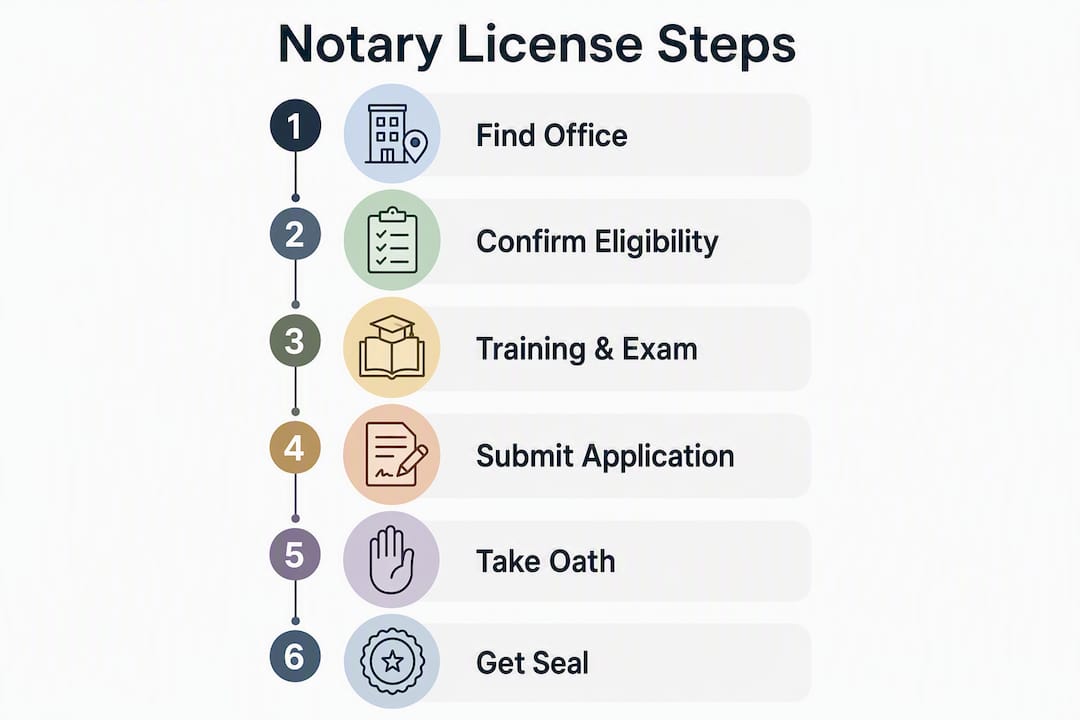
- Step 1: Find out which office handles your notary commission
- Step 2: Confirm eligibility, background checks, and fingerprinting
- Step 3: Complete required training or an exam
- Step 4: Submit the application, pay fees, and get a bond if required
- Step 5: Take the oath, get commissioned, and receive your seal
- Supplies, recordkeeping, and your first 48 hours as a commissioned notary
- Remote notarization (RON) and e-notary: what’s different in 2026
- How long does it take and what does it cost?
- Common mistakes that delay or kill applications
- Where to find official forms, approved courses, and commission verification
- Key Takeaways
- The part most guides skip
- Official sources to bookmark
What you need to check before you apply for a notary license
Getting rejected after paying a nonrefundable fee is avoidable. Run through this checklist in one sitting before you open any portal.
Eligibility:
- Age: most states require you to be at least 18
- Residency or employment: you typically must live or work in the state where you seek commission; Pennsylvania, for example, requires residency or a place of employment within the Commonwealth
- Criminal history: felony convictions or offenses involving fraud or dishonesty usually disqualify applicants; Louisiana requires you not to have been convicted of a felony without a pardon
- Literacy: several states require you to read and write English
Documents to gather:
- Government-issued photo ID
- Proof of current address
- Completed bond form (if your state requires one before filing)
- Training completion certificate (if you have already finished the course)
System prep:
- Create your state portal account before starting the application — portals often time out if you try to register mid-session
- Scan all required PDFs and name them clearly (e.g., “Bond_Form_YourName.pdf”)
- Have a credit card or check ready; most portals accept both
Pro Tip: Verify your eligibility against your state’s official commissioning office page before you enter any payment information. Fees are nonrefundable, and a disqualifying criminal record or residency gap will cost you both the fee and the processing time.
Step 1: Find out which office handles your notary commission
Every state designates a specific office to issue notary commissions, and the name varies. In New York and Pennsylvania it is the Department of State. In Michigan, Louisiana, and Illinois it is the Secretary of State. Texas routes applications through the Secretary of State as well. A handful of states use a different agency entirely, so searching “[your state] notary commission application” and looking for a .gov URL is the fastest way to land on the right page.
Once you are on the official page, look for:
- The online application portal link or a downloadable PDF form
- A list of required attachments (bond, training certificate, ID copy)
- Any RON or e-notary add-on application if you plan to notarize remotely
- Contact information for the commissioning office in case you need to follow up
Some states also require a separate filing with a county clerk after state approval. Michigan, for example, has applicants bring their bond and application to the county clerk for the oath. Bookmark the official state page and the county clerk’s page if both apply to your situation.
Step 2: Confirm eligibility, background checks, and fingerprinting
Most states share a common eligibility baseline: 18 years old, lawful U.S. presence, and no disqualifying criminal history. The details diverge from there.
Common eligibility criteria:
- Minimum age of 18
- Residency in the state, or a place of employment or practice within it
- No felony conviction or fraud-related offense (some states allow pardoned applicants; Louisiana does not)
- High school diploma or equivalent (required in Louisiana)
Background checks and fingerprinting:
States handle this differently. Some run a state criminal record check automatically when you submit your application. Others require you to schedule fingerprinting through an authorized vendor such as IdentoGO (used in several states for FBI-channeled prints) and upload the confirmation before your application can proceed. Check your state’s official instructions for the exact vendor list and submission method.
If you have a prior conviction, disclose it fully and attach court documentation. Omitting a conviction is treated as a false statement and is grounds for rejection on its own, separate from the underlying offense.
Step 3: Complete required training or an exam
Training requirements split states into three rough groups: those that require a course and an exam, those that require only a pre-assessment or training video, and those that require neither.
Where training is mandatory:
- Pennsylvania requires at least three hours of approved notary education within six months before applying, plus a written exam for first-time applicants
- New Jersey instructs applicants to review the Notary Public Manual and complete required training videos before registering for an exam
- Louisiana requires a mandatory online Notary Exam Pre-Assessment through the LSU Center for Assessment and Evaluation before you can register for the state exam
Finding an approved course:
Go directly to your state’s commissioning office page and look for a list of approved providers. Louisiana maintains a list of registered and bonded exam preparation course providers. Pennsylvania lists approved education vendors on its notary portal. Never pay for a course before confirming it appears on the official approved list.

Pro Tip: Save your course completion certificate as a PDF the moment you finish. Name it with your full legal name and the date (e.g., “NotaryEd_Certificate_JaneDoe_2026-05-01.pdf”) so it matches your application name exactly. Mismatched names on certificates are a common reason portals reject uploads.
Step 4: Submit the application, pay fees, and get a bond if required
Most state portals follow the same sequence: create or sign in to your account, fill out the application form, upload required attachments, and pay. Michigan encourages online applications because online submissions are often processed the same day, while mailed applications can take up to six weeks.
Payment and fees:
- State processing fees are nonrefundable regardless of outcome
- Pennsylvania’s application fee is moderate; New York’s renewal fee is somewhat higher.
- Additional charges may include county filing fees, exam registration fees, and course costs
Surety bond:
Michigan requires a $10,000 surety bond filed with the county clerk. Many other states have similar requirements, though bond amounts vary. You can purchase a surety bond from a licensed insurance or bonding company; the annual premium is typically a small fraction of the bond face value. Have the completed bond form ready to upload or bring to the county clerk.
Pro Tip: Save a PDF of your payment confirmation immediately after submitting. Portal sessions expire, and transaction receipts are sometimes the only proof you have that a payment went through. Store it in the same folder as your bond and training certificate.
Step 5: Take the oath, get commissioned, and receive your seal
State approval is not the finish line. After your application is approved, you typically must file your bond and take the oath of office with a county clerk or other authorized official within a strict deadline.
What happens after approval:
- You receive a commission certificate (downloadable or mailed, depending on the state)
- You must take the oath before an authorized official — usually the county clerk
- The bond must be filed locally at the same time in states that require it
Missing the local filing deadline can forfeit your commission entirely. Michigan and other states specify that failure to file the surety bond and take the oath within the required number of days after approval voids the commission. You would need to reapply and pay the fee again.
Seal and stamp:
Once commissioned, order your official notary seal or stamp from a licensed vendor. The text on the seal must match your commission exactly, including the spelling of your name and the state. Keep the commission certificate in a secure location; you will need it to verify your seal details and for any future renewal.
Supplies, recordkeeping, and your first 48 hours as a commissioned notary
Getting commissioned and getting operational are two different things. Here is what to do immediately.
Essential supplies:
- Official notary seal or rubber stamp (text must match commission exactly)
- Notary journal — either a bound paper journal or an approved electronic log
- Identity verification tools if you plan to perform in-person or remote notarizations
Recordkeeping:
For each notarization, record the date, type of notarial act, document description, signer’s name and ID type, and your fee. Retention requirements vary by state, but keeping records for at least ten years is a safe baseline. Store your journal securely; it is a legal record.
Day-one checklist:
- Verify every detail on your commission certificate (name spelling, county, expiration date)
- Order your seal immediately — some vendors take 3–5 business days
- If you plan to offer remote online notarization, test your platform and digital certificate before your first appointment
- Update any business listings or professional profiles with your new commission details
Pro Tip: Create a single secure folder (physical or cloud) labeled “Notary Commission” and store your commission certificate, bond paperwork, training certificate, and payment receipts together. When renewal time comes, everything you need is in one place.
Remote notarization (RON) and e-notary: what’s different in 2026
RON is not automatic when you receive a traditional notary commission. Most states treat it as a separate registration or add-on, and 2026 has brought additional technical requirements to several jurisdictions.
How RON applications work:
Illinois requires separate steps to add electronic notary to an existing commission, including submitting a copy of your electronic signature as approved by your e-notarization provider. Texas requires applicants to sign a Statement of Officer with an x.509 digital certificate and upload a digital seal file for online notary commissioning. These are not optional extras; they are prerequisites before you can legally perform a remote notarization.
| State | RON Requirement | Key Artifact |
|---|---|---|
| Illinois | Separate e-notary add-on application | Electronic signature copy from approved provider |
| Texas | Separate online notary application | digital certificate and digital seal file |
What to check for your state:
- Does your state have a separate RON application or is it an add-on to your existing commission?
- Which e-notarization vendors are approved?
- Are there additional fees for the RON registration?
For Ontario-based readers comparing U.S. RON processes to Canadian options, Theonlinenotary offers remote online notarization services for affidavits, statutory declarations, and more without the multi-step U.S. registration process.
How long does it take and what does it cost?
Processing timelines:
- Online applications: often same-day or within a few business days (Michigan reports same-day processing for online submissions)
- Mail applications: up to six weeks in some states
- Massachusetts estimates approximately two weeks from mailing a completed form to receiving appointment notification
- Local oath and bond filing: must happen within a set deadline after state approval (often 30–45 days)
Typical cost breakdown for a new applicant:
- State application fee: $42–$60 in states like Pennsylvania and New York (varies widely)
- Surety bond premium: varies by state bond amount and provider
- Training course: varies by state and provider
- Exam registration: varies by state
- Seal/stamp: typically $20–$50 from a licensed vendor
- Notary journal: typically $15–$30
- County filing fee: varies by county
Budget at least $100–$200 for a straightforward first-time application in most states, more if your state requires an exam or a high bond amount.
Common mistakes that delay or kill applications
Most rejections and delays come from a short list of avoidable errors.
Top mistakes:
- Name mismatch: the name on your application, ID, bond, and training certificate must be identical
- Missing bond or oath: submitting the state application without the bond form when required
- Wrong file format: portals often accept only PDF; submitting a JPEG or Word file causes an automatic rejection
- Portal timeout: starting the application without a pre-registered account, then losing data mid-session
- Incomplete disclosure: leaving criminal-history questions blank or answering “no” when the answer is “yes”
Practical fixes:
- Pre-register your portal account at least a day before you plan to submit
- Screenshot every completed page before clicking “Next”
- Call the commissioning office if your application status does not update within the stated processing window; most offices have a direct line for status inquiries
- If denied, request the specific reason in writing so you can address it in an appeal or reapplication
Pro Tip: Before uploading any document, open it and confirm the file renders correctly. A corrupted PDF that looks fine on your desktop will fail the portal’s validation check and may not trigger an error message until days later.
Where to find official forms, approved courses, and commission verification
Official application forms and portals:
Go directly to your state’s Secretary of State or Department of State website. Search for “notary public application” plus your state name and filter for .gov results. Never download forms from third-party sites; forms are updated regularly and an outdated version will be rejected.
Approved training providers:
- Pennsylvania: listed on the notary section of dos.pa.gov
- Louisiana: registered and bonded course providers listed on sos.la.gov
- New Jersey: training video links provided directly on njportal.com/dor/notary
- Other states: check the notary section of your Secretary of State’s website for an approved vendor list
Commission verification and appeals:
Most states offer an online commission lookup tool on the same Secretary of State site. For application status, use the portal’s status tracker first. If your application is denied, the commissioning office is required to provide a reason; contact them directly to request it and ask about the appeals process. Massachusetts routes notary questions through the Governor’s Council at (617) 725-4016 for appointment-related issues.
Key Takeaways
Applying for a notary commission requires verifying eligibility, preparing documents, and completing state-specific steps before your commission becomes active.
| Point | Details |
|---|---|
| Fees are nonrefundable | Verify eligibility completely before paying; New York charges $60 and Pennsylvania charges $42. |
| Online beats mail | Online applications are often processed the same day; mail can take up to six weeks in states like Michigan. |
| RON needs a separate step | Electronic and remote notarization require a separate application or add-on in most states, including Illinois and Texas. |
| Local filing has a deadline | After state approval, file your bond and take the oath within the required window or your commission is forfeited. |
| Name consistency is critical | Your name must match exactly across your application, ID, bond, training certificate, and commission. |
The part most guides skip
The single biggest friction point in the notary application process is not the paperwork itself. It is the gap between state approval and local activation. Applicants celebrate when the state approves their commission, then miss the county clerk deadline because no one told them that step existed. The commission certificate arrives, it looks official, and it feels done. It is not done until the oath is taken and the bond is filed locally, within whatever window your state sets.
The second thing worth saying plainly: RON is not a feature you unlock automatically. If you plan to notarize documents remotely, treat the RON registration as a separate project with its own checklist, its own fees, and its own technical requirements. In Illinois, you need your e-notarization provider to approve your electronic signature before you can even submit the add-on application. In Texas, you need an x.509 digital certificate. These are not minor details.
For readers in Ontario who need documents notarized now rather than after completing a U.S. commissioning process, Theonlinenotary provides remote notarization services for affidavits, statutory declarations, invitation letters, and more. The U.S. process described here is for those seeking their own commission; if you need a notarized document today, that is a different path entirely.
Official sources to bookmark
Keep these pages accessible throughout your application process.
State commissioning offices:
- New York Department of State — dos.ny.gov/become-notary-public (application portal, renewal, commission lookup)
- Pennsylvania Department of State — notaries.pa.gov (online application, approved education providers, forms)
- Michigan Secretary of State — michigan.gov/sos/all-services/notary-application (online portal, bond and oath instructions)
- Illinois Secretary of State — ilsos.gov/notary (commission application, e-notary add-on steps)
- Louisiana Secretary of State — sos.la.gov/NotaryAndCertifications (exam pre-assessment, approved course providers)
- Texas Secretary of State — sos.state.tx.us (online notary application, digital certificate guidance)
- New Jersey Division of Revenue — njportal.com/dor/notary (training videos, exam registration)
- Massachusetts Secretary of the Commonwealth — mass.gov/how-to/apply-to-become-a-notary-public (application download, appointment process)
Fingerprint and background check vendors:
- IdentoGO (identogo.com) is an authorized FBI-channeled fingerprint vendor used in multiple states; confirm your state’s approved vendor list before scheduling.
Reminder: Store your commission certificate, bond paperwork, and training completion certificate in a single secure folder. You will need all three at renewal time, and most states require you to complete education again before renewing.
This article is general information about the U.S. notary application process and is not legal advice. Confirm current requirements with your state’s official commissioning office before submitting any application.