Affidavit of Zero Income in Ontario: 2026 Guide

TL;DR:
- An affidavit of zero income is a sworn statement declaring no income from any source during a specified period. It must list all income sources as zero or N/A and include a penalty of perjury clause to be legally valid. Proper completion and notarization speed up approval and ensure legal compliance in Ontario applications.
An affidavit of zero income is a sworn legal statement declaring that an individual has received no income from any source during a specified period. In Ontario, this document goes by the formal term “zero income declaration” or “no income verification affidavit,” and agencies treat it as a binding legal record. Social services offices, housing authorities, and lenders all require it before processing applications where financial eligibility depends on verified income status. Getting it wrong delays your application. Getting it deliberately wrong carries criminal penalties.
What must an affidavit of zero income include to be valid in Ontario?
A valid affidavit of zero income must cover a defined income period, typically the prior calendar year or the upcoming 12 months, depending on the agency’s requirements. Misaligning the stated period with what the agency expects is one of the most common causes of processing delays. Always confirm the exact timeframe before you write a single word.
The document must contain these core elements:
- Full legal name, current address, and the date of signing
- Recipient details, including the agency name and address the affidavit is directed to
- An explicit negation of every income source: wages, tips, freelance or self-employment earnings, government benefits, rental income, investment returns, and financial gifts or support from household members or outside parties
- A statement explaining how basic living expenses are covered without income (for example, savings, support from a family member, or a community organization)
- A penalty of perjury clause, which is the sentence that legally transforms the letter into a recognized affidavit
- Your signature and the date, placed directly below the perjury statement
Agencies require complete listing and negation of all income types. Omitting even one category, such as informal cash gifts, gives reviewers grounds to reject the document.
Pro Tip: Fill every line item with “0” or “N/A.” Blank fields are treated as incomplete by reviewers and trigger immediate rejection, even when the intent is obvious.

How to create a zero income affidavit when no official form exists
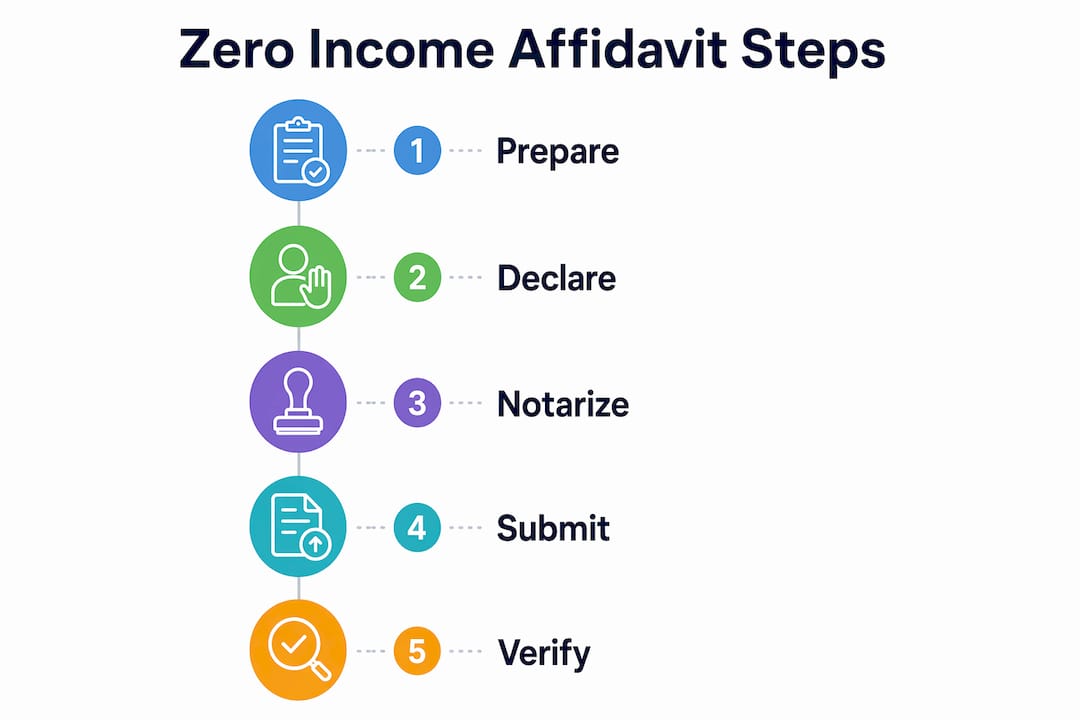
Many Ontario agencies do not supply a standard form. When that happens, you write the affidavit as a formal letter. Follow these steps exactly:
- Write a header. Include today’s date, your full name and address, and the agency’s name and address below it.
- Open with a plain declaration. State clearly: “I, [Full Name], declare that I have received no income from any source during the period [start date] to [end date].”
- List every income source and deny each one. Work through wages, self-employment, government benefits, pension, rental income, investments, and financial support from others. Write “None” or “$0” beside each.
- Explain how you cover basic expenses. One or two factual sentences are enough. Name the source, such as personal savings or support from a named family member.
- Add the penalty of perjury statement. A standard clause reads: “I declare under penalty of perjury that the foregoing is true and correct to the best of my knowledge.” This language is what elevates a letter to legal affidavit status recognized by agencies.
- Sign and date the document. If the agency requires notarization, do not sign until you are in front of a notary.
Common mistakes to avoid:
- Leaving any income category blank instead of writing “0” or “N/A”
- Using emotional language or hardship narratives, which slow down reviews
- Forgetting to include the penalty of perjury clause
- Signing before appearing before a notary when notarization is required
Pro Tip: Read the agency’s instructions before drafting. Some agencies specify exact phrasing for the perjury clause or require the affidavit on letterhead. Confirm these details first to avoid resubmitting.
How do agencies in Ontario verify zero income affidavits?
Agencies do not simply take your word for it. A zero income affidavit is part of a larger verification process that typically includes supplementary documents such as bank statements, Canada Revenue Agency tax returns, or a Notice of Assessment. The affidavit anchors the claim; the supporting documents corroborate it.
Reviewers look for specific problems that lead to rejection:
- Hardship narratives. Agencies prefer clear, factual, neutral language without emotional explanations. Phrases like “I am struggling” or “I desperately need help” slow down processing and add nothing legally.
- Blank fields. Any unanswered line item signals an incomplete submission and triggers automatic rejection.
- Inconsistent income definitions. The definition of income varies by agency. One program may count Ontario Works payments as income; another may not. Confirm the agency’s specific definition before you write.
- Missing household member information. Some agencies require you to account for all adults in the household, not just yourself. Omitting a household member’s income status is treated as misrepresentation.
- No supporting documents. An affidavit submitted without bank statements or tax records is often held pending further review.
The legal stakes are serious. False statements in affidavits may result in disqualification from the program, repayment of any funds received, fines, and possible imprisonment. Ontario residents are subject to equivalent penalties under provincial and federal law for fraudulent declarations.
Common misconceptions about completing a zero income affidavit
The single biggest misconception is that “zero income” simply means you have no job. It does not. Zero income is a program-specific, technical term, and what counts as income differs from one agency to the next. A cash birthday gift, a one-time payment from a friend, or a government subsidy may all qualify as income under certain program rules.
Applicants frequently misunderstand what income means legally, which leads directly to affidavit rejection or legal penalties for misstatements. The safest approach is to consult the agency’s income definitions before completing any section of the affidavit.
Other common errors worth knowing:
- Assuming benefits are not income. Ontario Works, Employment Insurance, and disability payments may count as income under certain programs. Confirm before excluding them.
- Handling intermittent or informal income incorrectly. If you received any cash payment during the stated period, even once, disclose it and let the agency determine whether it qualifies as income.
- Skipping line items you think are irrelevant. Complete every field. Agencies interpret blank lines as unanswered questions, not as zeros.
Pro Tip: Call the agency before submitting. Ask specifically: “What counts as income under your program?” That one question can prevent a rejection and weeks of delay.
When and why should you notarize your zero income affidavit in Ontario?
Notarization of a zero income affidavit in Ontario is often required to validate authenticity and prevent fraud. A notary public verifies your identity, witnesses your signature, and applies an official seal that confirms the document is genuine. That seal carries legal weight that a self-signed letter does not.
Key facts about notarization in Ontario:
- Not every agency requires it, but many housing authorities, financial institutions, and government programs do. Always check the agency’s submission requirements.
- Notarization adds credibility. Agencies process notarized affidavits faster because the identity verification step is already complete.
- Online notarization is available in Ontario. You can obtain notarization online through a licensed notary without traveling to an office, which saves time and removes scheduling barriers.
- Do not sign the affidavit before appearing before the notary. The notary must witness the act of signing. A pre-signed document cannot be notarized.
- Submitting an unnotarized affidavit when one is required leads to rejection. Resubmitting restarts the review clock and delays your application by weeks.
Choosing a notary with specific experience in affidavits and statutory declarations reduces the risk of procedural errors. Theonlinenotary specializes in exactly this type of document for Ontario residents and is available around the clock.
Key Takeaways
A valid affidavit of zero income in Ontario must explicitly negate every income source, include a penalty of perjury clause, and be supported by documents such as bank statements or tax returns to avoid rejection.
| Point | Details |
|---|---|
| Define the income period precisely | Confirm whether the agency requires the prior calendar year or upcoming 12 months before drafting. |
| Negate every income source | List wages, benefits, gifts, and self-employment income and write “0” or “N/A” beside each one. |
| Include the perjury clause | The penalty of perjury statement is what makes the letter a legally recognized affidavit. |
| Fill every field | Blank lines are treated as incomplete submissions and cause immediate rejection. |
| Notarize when required | Agencies process notarized affidavits faster; online notarization in Ontario removes the need to travel. |
What I’ve learned from watching zero income affidavits get rejected
The most common reason affidavits fail is not dishonesty. It is incompleteness. Applicants leave fields blank because they assume a blank line communicates “none.” Reviewers do not read it that way. They read it as “unanswered,” and the file goes back to the bottom of the pile.
The second most common problem is tone. People write affidavits the way they would write a letter to a friend, explaining their situation and asking for understanding. Agencies do not want that. They want a factual record, not a story. Every sentence that does not state a verifiable fact is a sentence that slows down your review.
The third issue is the income definition gap. I have seen applicants declare zero income while receiving regular e-transfers from a parent, not realizing the agency counts that as household financial support. That is not a technicality. Under program rules, it is a misstatement, and the consequences range from disqualification to repayment demands.
My advice is straightforward. Before you write anything, call the agency and ask for their income definition in writing. Then prepare your affidavit using that definition as your guide. Attach your most recent bank statements and your Canada Revenue Agency Notice of Assessment. If the agency accepts notarized documents, get it notarized. That combination, a complete affidavit plus supporting documents plus a notary seal, is the fastest path through any review process I have seen.
— Ken
Theonlinenotary can notarize your affidavit today
Completing a zero income declaration is only half the process. Getting it notarized correctly is what makes it legally binding and accepted by agencies across Ontario.

Theonlinenotary provides online affidavit notarization for Ontario residents 24 hours a day, 7 days a week. The process is straightforward: you connect with a licensed notary by video, present your identification, sign your affidavit on camera, and receive your notarized document digitally. No office visit, no scheduling delays. Whether you need a zero income affidavit, a statutory declaration, or another sworn document, Theonlinenotary handles it with the legal precision Ontario agencies expect. Start your session when you are ready.
FAQ
What is an affidavit of zero income?
An affidavit of zero income is a sworn legal statement declaring that an individual has received no income from any source during a defined period. It is used for social services, housing, and loan applications in Ontario where financial eligibility must be verified.
Does a zero income affidavit need to be notarized in Ontario?
Notarization is often required by Ontario agencies to confirm the document’s authenticity and prevent fraud. Always check the specific agency’s submission requirements before signing.
What happens if I submit a false zero income affidavit?
False statements in affidavits can result in program disqualification, repayment of funds received, fines, and possible imprisonment under federal and provincial law.
Do government benefits count as income on a zero income affidavit?
It depends on the program. Ontario Works, Employment Insurance, and disability payments may count as income under certain agency definitions. Confirm the agency’s specific income definition before completing the affidavit.
Can I write my own zero income affidavit if no official form is provided?
Yes. A self-drafted letter qualifies as a legal affidavit when it explicitly states it is signed under penalty of perjury and covers all required income categories. Follow the agency’s formatting instructions if any are provided.