Affidavit of Sole Support in Ontario: 2026 Guide

TL;DR:
- An affidavit of sole support is a sworn document proving you are the only caregiver and financial provider for your child in Ontario. It is required for programs like OSAP and Second Career to confirm your custody status and must be correctly drafted and witnessed to be accepted. Mistakes such as vague language, incomplete jurats, or signing before witnesses can lead to rejection and delays in funding.
An affidavit of sole support is a sworn legal document that proves you are the sole financial and custodial parent for your child or children in Ontario. Provincial programs like OSAP and Second Career require this document to confirm your status before releasing funding. Ontario authorities, including Commissioners for Taking Affidavits, justices of the peace, and lawyers, are authorized to witness and certify it. Getting the document right the first time matters because a rejected affidavit can delay financial aid or legal proceedings by weeks.

What is an affidavit of sole support?
An affidavit of sole support is a sworn written statement that substitutes for oral testimony in legal and government proceedings. You sign it under oath, and an authorized official witnesses your signature. The document declares that you are the only person responsible for the financial support and day-to-day care of your dependent child or children. Ontario government programs and courts treat it as formal legal evidence of that status.
The term “affidavit of sole support” is a descriptive phrase widely used in Ontario program applications. The formal legal category is simply “affidavit,” governed by Ontario’s Commissioner for Taking Affidavits Act. Both the descriptive phrase and the formal term appear throughout this guide so you can recognize either version on official forms.
The most common uses are OSAP student financial aid applications, Second Career funding requests, and certain immigration sponsorship files. Each program has its own submission deadline and formatting requirements, so a generic template rarely works without modification.
Who is eligible to use a sole support affidavit in Ontario?
Eligibility centers on your actual living and custody situation, not just your legal status. You qualify if you meet all of the following conditions:
- You are the biological or adoptive parent of a dependent child.
- You are single, separated, divorced, or widowed.
- You are not living with a spouse or common-law partner.
- You have sole custody or are the primary caregiver with no shared physical custody arrangement.
- Your child lives with you and depends on you financially.
Programs like OSAP and Second Career also require proof of sole caregiver status and confirmation of separate living arrangements. A separation agreement, divorce order, or death certificate can support your claim. If you share custody equally with another parent, you do not qualify as a sole support parent under most Ontario program definitions.
Pro Tip: Gather your custody order, separation agreement, or court documents before you start drafting. Having exact dates and legal descriptions on hand prevents vague language in your affidavit, which is one of the most common reasons for rejection.
Widowed parents sometimes overlook this document entirely. If your spouse passed away and you have never updated your financial aid file, a sole support affidavit can unlock benefits you have been missing.
What must a sole support affidavit include?
A compliant affidavit must contain four core components: a case caption or title, an introduction identifying you as the affiant, numbered paragraphs presenting facts in chronological order, and a jurat signed by an authorized official. Missing any one of these components invalidates the document for legal use.
The four required components
1. Case caption or title. This appears at the top of the document and identifies the matter, the program, or the court file the affidavit relates to. For OSAP, it typically reads “Affidavit of Sole-Support Status.”
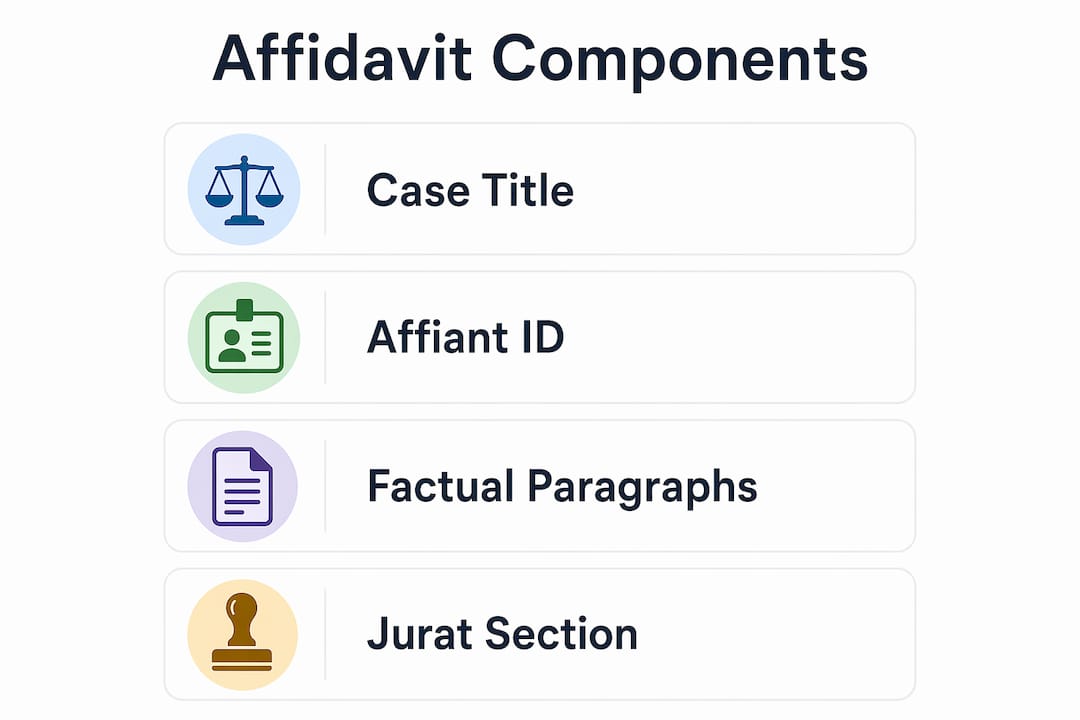
2. Affiant identification. The opening paragraph states your full legal name, date of birth, address, and your relationship to the child. Write in the first person: “I, [Full Name], of [City], Ontario, make oath and say as follows.”
3. Numbered factual paragraphs. Each paragraph covers one specific fact. Chronological order and concise paragraphs improve readability and increase acceptance rates. Grouping facts by theme instead of by timeline confuses reviewers and can trigger rejection. Each paragraph should contain 2–3 sentences focused on a single point, such as the date your separation began or the date your child began living with you exclusively.
4. Jurat. The jurat is the closing section where the authorized official certifies your oath. It must include the official’s signature, their commission expiry date, and their official seal. A missing or incomplete jurat causes rejection by Ontario government offices without exception.
Pro Tip: Never include opinions, hearsay, or speculative statements. Write only what you personally observed or know to be true. Statements like “I believe my ex-partner earns less than me” are inadmissible and will weaken your entire document.
Authorized witnesses in Ontario include a Commissioner for Taking Affidavits, a notary public, a lawyer, or a justice of the peace. You can find a full breakdown of who can sign an affidavit in Ontario through Theonlinenotary’s dedicated guide.
How to prepare, notarize, and file your affidavit
Follow these steps in order. Skipping any step creates a document that Ontario programs will not accept.
-
Gather your supporting documents. Collect your custody order or separation agreement, your child’s birth certificate, proof of your current address, and any court orders confirming sole custody. Note exact dates for every key event.
-
Draft the affidavit. Use a sole support affidavit form provided by your institution or draft one from scratch following the four-component structure above. Write in plain, factual language. Number every paragraph. Avoid adjectives that express emotion or judgment.
-
Review for accuracy. Read every sentence and confirm it reflects only personal knowledge. Check that dates are correct and that no paragraph contains more than one distinct fact. A guide on drafting a valid affidavit in Ontario covers format compliance in detail.
-
Sign before an authorized witness. Do not sign the affidavit before you are in front of your witness. Signing in advance voids the oath. The witness must watch you sign, administer the oath, and then complete the jurat section with their seal and signature.
-
Submit before the deadline. OSAP requires submission no later than 40 days before your study period ends. Late documents are not processed and can cost you an entire term of funding. Second Career and other programs have their own deadlines, so confirm the exact date with your program administrator before you book your notarization appointment.
-
Confirm receipt. After filing, follow up with the program office to confirm the document was received and accepted. Keep a certified copy for your records.
| Filing context | Key deadline | Submission method |
|---|---|---|
| OSAP | 40 days before study period end | Online portal or in-person at institution |
| Second Career | Varies by application stage | ServiceOntario or program office |
| Ontario court proceedings | As directed by court order | Filed with the court clerk |
| Immigration sponsorship | As specified by IRCC | Online or paper application package |
Pro Tip: Book your notarization appointment at least one week before the filing deadline. Last-minute appointments are hard to secure, and a single scheduling conflict can push you past the cutoff.
Common mistakes that get affidavits rejected
Rejection is almost always avoidable. Common affidavit mistakes include opinion-based statements, late filing, improper witnessing, and missing proof of service. Each one has a straightforward fix.
- Including opinions or hearsay. Phrases like “I think,” “I believe,” or “my neighbor told me” do not belong in an affidavit. Replace them with direct statements of personal knowledge.
- Signing before the witness. This is the single most common procedural error. The oath is invalid if the witness did not observe the signing.
- Incomplete jurat. A missing seal, an expired commission date, or an unsigned jurat causes automatic rejection. Confirm all jurat fields are complete before leaving the notary’s office.
- Vague or ambiguous language. Phrases like “around that time” or “sometime last year” create doubt. Use exact dates wherever possible.
- Missing supporting documents. An affidavit that references a custody order without attaching it gives reviewers no way to verify your claim.
- Filing after the deadline. Late documentation is not processed. There is no grace period for OSAP sole support submissions.
Affidavits are legal substitutes for oral testimony. Every statement you include carries the same weight as words spoken under oath in a courtroom. Vague language, opinions, and unverified claims do not just weaken your case. They can result in the entire document being set aside.
Review your draft against this list before booking your notarization appointment. A second set of eyes from a legal professional or a qualified notary can catch errors you have read past too many times to notice.
How does a sole support affidavit differ from other legal documents?
Choosing the wrong document type is a costly mistake. The three documents most often confused are the affidavit of sole support, the affidavit of support, and the statutory declaration.
An affidavit of sole support differs from an affidavit of support in both purpose and audience. The sole support version confirms that you are the only caregiver and financial provider for your child within Ontario’s provincial programs. The affidavit of support is primarily an immigration document used to prove a sponsor’s financial capacity to support a newcomer to Canada.
| Document | Primary purpose | Who uses it |
|---|---|---|
| Affidavit of sole support | Proves sole custody and financial responsibility | Single parents applying for OSAP, Second Career |
| Affidavit of support | Proves financial capacity to sponsor an immigrant | Immigration sponsors under IRCC programs |
| Statutory declaration | Declares a fact without a specific legal proceeding | General government and legal uses |
A statutory declaration covers a broader range of factual declarations and does not require a court or program context. If you are unsure which document applies to your situation, confirm with the program office or a qualified legal professional before drafting anything.
Key Takeaways
A valid affidavit of sole support requires accurate factual content, a compliant four-part structure, proper witnessing by an authorized Ontario official, and submission before program-specific deadlines.
| Point | Details |
|---|---|
| Definition and purpose | The affidavit declares sole financial and custodial responsibility for use in OSAP, Second Career, and legal proceedings. |
| Eligibility requirements | You must be single or separated, not cohabiting, and have sole or primary custody of your dependent child. |
| Required structure | Include a case caption, affiant identification, chronological numbered paragraphs, and a complete jurat with seal. |
| Filing deadline | OSAP requires submission at least 40 days before the study period ends; late documents are not processed. |
| Common rejection causes | Missing jurat elements, opinion-based statements, signing before the witness, and vague language all trigger rejection. |
Why precision matters more than length
I have reviewed hundreds of affidavits over the years, and the ones that get rejected almost never fail because of missing information. They fail because of how the information is written. A parent will write three paragraphs explaining their custody situation in emotional detail, and the reviewing officer will set the document aside because one sentence says “I believe my ex no longer contributes financially” instead of “My ex-partner has not made any financial contribution to our child’s care since [exact date].”
The fix is not to write more. The fix is to write only what you know, in the plainest language possible, in the order it happened. I always tell people: if you would not say it under oath in a courtroom, do not put it in your affidavit. That single filter eliminates most of the language that causes rejections.
The other thing I see constantly is people underestimating the jurat. They spend an hour drafting the perfect affidavit and then rush through the notarization step. They leave the office without checking that the seal is clear, the commission date is current, and every field is filled in. The jurat is as important as the content. A perfect affidavit with an incomplete jurat is a rejected affidavit.
My advice: engage a Commissioner for Taking Affidavits early, not as the last step. A qualified notary can review your draft before you sign, catch structural problems, and complete the jurat correctly the first time. That one step saves most people a resubmission.
— Ken
Theonlinenotary makes affidavit notarization straightforward
Preparing a legally valid sole support affidavit takes more than filling in a template. The document must meet Ontario’s format requirements, be witnessed by an authorized official, and reach the right office before the deadline.

Theonlinenotary provides online notary services for affidavits, statutory declarations, solemn declarations, and more, available 24/7 for Ontario residents. Every notarization is handled by a verified Commissioner for Taking Affidavits who reviews your document for compliance before certifying it. You do not need to travel or take time off work. The process is completed online, respects Ontario’s legal standards, and produces a certified document accepted by OSAP, Second Career, and Ontario courts. Book your appointment directly through Theonlinenotary and have your affidavit ready well before your filing deadline.
FAQ
What is a sole support affidavit used for in Ontario?
A sole support affidavit is used to confirm that you are the only financial and custodial parent of your child. Ontario programs like OSAP and Second Career require it to verify your eligibility for additional funding.
Who can witness an affidavit of sole support in Ontario?
An authorized witness must be a Commissioner for Taking Affidavits, a notary public, a lawyer, or a justice of the peace. You can review the full list of qualified witnesses through Theonlinenotary’s witnessing guide.
What is the OSAP deadline for submitting a sole support affidavit?
OSAP requires the affidavit to be submitted no later than 40 days before the end of your study period. Documents received after that deadline are not processed and will not count toward your funding application.
What makes an affidavit of sole support invalid?
The most common causes of invalidity are an incomplete jurat, opinion-based statements, signing before the authorized witness, and vague or undated claims. Every statement must reflect personal knowledge and be written in plain, factual language.
How is an affidavit of sole support different from an affidavit of support?
An affidavit of sole support confirms that you are the only caregiver and financial provider for your child within Ontario provincial programs. An affidavit of support is an immigration document that proves a sponsor’s financial capacity to support a newcomer to Canada.