Affidavit of Single Status in Ontario: 2026 Guide

TL;DR:
- An affidavit of single status is a sworn statement confirming you are unmarried and free to marry, required by foreign authorities and courts.
- It must be signed under oath before a licensed Ontario notary or commissioner of oaths, with proper supporting documents, and then authenticated by Global Affairs Canada or the embassy.
An affidavit of single status is a sworn legal statement confirming you are unmarried and free to marry, required by foreign marriage registries, immigration authorities, and Ontario courts when no other proof of single status exists. Canada does not issue a national single status certificate, so Ontario residents must rely on a sworn statutory declaration to fill that gap. This document functions as your official proof of single status for marriage abroad, spousal sponsorship applications, and other legal proceedings. Getting it right the first time saves weeks of delays and costly re-submissions.
What is an affidavit of single status and what does it require?
An affidavit of single status is a sworn statutory declaration that you sign under oath before a licensed notary public or commissioner of oaths in Ontario. The document formally states that you are not currently married and have no legal impediment to marrying. Foreign authorities treat it as the Canadian equivalent of a single status certificate because no federal registry exists to confirm marital status.
A valid affidavit must include the following personal details:
- Full legal name exactly as it appears on your government-issued ID
- Date of birth and current address
- A clear statement of current marital status, declaring you are single, widowed, or divorced
- Details of any prior marriages, including the full name of each former spouse, the date of marriage, and how it ended (divorce or death)
- Supporting documents for each prior marriage termination, such as a divorce decree or a death certificate
Pro Tip: Gather all supporting documents before you draft the affidavit. Missing a divorce decree or death certificate is the most common reason notarization appointments get rescheduled.
Ontario requires affidavits to be signed with a jurat, meaning the notary or commissioner of oaths administers an oath before you sign. A simple notarization acknowledgment is not sufficient. That distinction matters because foreign authorities specifically look for the jurat wording when reviewing Canadian affidavits.

How do you prepare and notarize a single status affidavit in Ontario?
Preparing a single status affidavit follows a clear sequence. Skipping any step creates a document that looks official but gets rejected at the border or the foreign registry office.
-
Draft the affidavit text. Write the document in plain, direct language. State your full legal name, date of birth, and current marital status. List every prior marriage with dates and termination details. Check whether your destination country’s embassy has a required template or specific wording. Exact wording requirements vary by country, and using the wrong phrasing is a common cause of rejection.
-
Attach supporting documents. Compile certified copies of divorce decrees, death certificates, or annulment orders for every prior marriage. These attachments become exhibits to the affidavit and must be referenced by letter (Exhibit A, Exhibit B) within the text.
-
Book an appointment with a licensed Ontario notary public or commissioner of oaths. Both are authorized to administer oaths on affidavits in Ontario. A notary public carries additional authority to certify documents for international use, which matters if you plan to authenticate the affidavit afterward.
-
Sign under oath. Appear before the notary with your government-issued photo ID. The notary administers the oath, you sign, and the notary applies their seal and signature. Do not sign the affidavit before the appointment. A pre-signed affidavit cannot be sworn and is legally invalid.
-
Review the completed document. Confirm the notary’s seal is clear, the jurat wording is present, and your name matches your passport exactly. Small discrepancies in name spelling cause rejection at foreign embassies.
Pro Tip: If you are preparing the affidavit for use in a country that requires translation, arrange a certified translator before your notary appointment. Some embassies require the translation to be notarized alongside the original.
Learning how to write an affidavit for Ontario standards before your appointment reduces errors and shortens the process significantly.
How do you authenticate your affidavit for acceptance outside Canada?
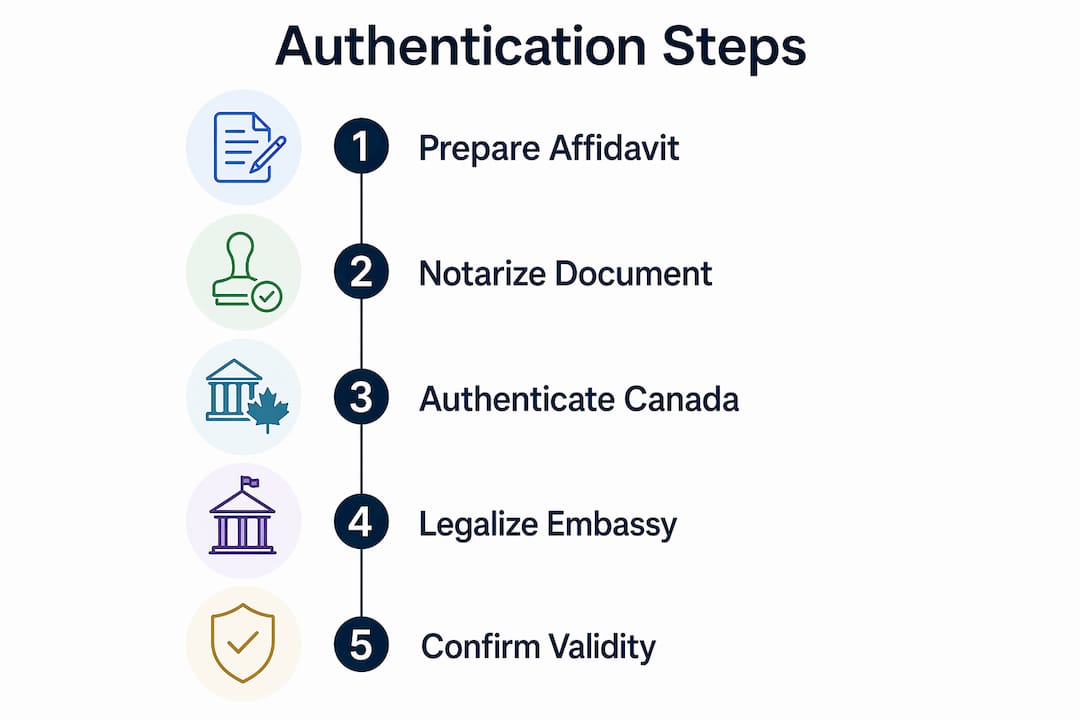
Notarization alone does not make your affidavit legally valid in another country. Notarized affidavits require additional authentication to be accepted by foreign authorities. The type of authentication depends on where you are sending the document.
The two main authentication paths are:
- Apostille. Countries that have signed the Hague Convention of 1961 accept an apostille, which is a standardized certificate that validates the notary’s signature and authority. Canada is not a member of the Hague Apostille Convention, so Canadian documents cannot receive a standard apostille. Instead, Global Affairs Canada authenticates the notary’s signature, and then the destination country’s embassy in Canada applies a legalization stamp. This two-step process achieves the same result as an apostille for Hague member countries.
- Consular legalization. For countries outside the Hague Convention, the process involves authentication by Global Affairs Canada followed by legalization at the relevant embassy or consulate in Canada. The steps are similar, but the final authority differs.
| Authentication path | Who applies it | Typical use case |
|---|---|---|
| Global Affairs Canada authentication | Federal government office | Required for all international documents |
| Embassy legalization | Destination country’s embassy in Canada | Non-Hague countries or Hague countries requiring consular step |
| Translation and notarization | Licensed translator and notary | Countries requiring documents in local language |
Affidavit validity runs 3–6 months from the date of notarization. Foreign marriage authorities enforce this window strictly. Do not begin the authentication process until you have a confirmed wedding date or immigration appointment, because an expired affidavit requires full re-notarization and re-authentication.
What are the most common issues and how do you avoid them?
Most affidavit rejections abroad are preventable. The problems cluster around four areas.
Skipping legalization. Skipping the apostille or consular legalization step is the single most common reason affidavits get rejected abroad. Notarization confirms your identity and oath. Authentication confirms the notary’s authority. Both steps are required.
Incorrect or missing wording. Each destination country has specific language it expects in a single status affidavit. Legal professionals recommend verifying wording requirements with the destination country’s embassy before drafting the document. A phone call or email to the consulate before you write a single word saves significant time.
Authenticating too early. Timing matters as much as content. Affidavits authenticated months before your actual use date may expire before foreign authorities process them. Complete notarization and authentication as close to your submission date as practically possible.
Missing a marriage search letter. Because Canada has no centralized marriage registry, some foreign authorities require a marriage search letter from Ontario’s Vital Statistics office alongside your affidavit. This letter formally states that no record of marriage exists in the province. It adds a second layer of verification that many embassies find reassuring.
“Supplementing a single status affidavit with a provincial marriage search letter provides a stronger evidentiary basis for foreign authorities due to Canada’s absence of a centralized marriage registry. Applicants who include both documents face fewer requests for additional evidence.”
Confirming the exact document checklist with your destination country’s embassy or consulate before you start is the single most effective step you can take. Requirements change, and what was accepted two years ago may not be accepted today.
Key Takeaways
A valid affidavit of single status in Ontario requires a sworn statutory declaration, proper notarization with a jurat, and authentication by Global Affairs Canada before foreign authorities will accept it.
| Point | Details |
|---|---|
| No national certificate exists | Ontario residents must use a sworn statutory declaration as proof of single status. |
| Jurat is mandatory | The notary must administer an oath; a simple acknowledgment does not make the affidavit valid. |
| Authentication is a separate step | Notarization alone is not enough; Global Affairs Canada authentication and embassy legalization are both required for foreign use. |
| Validity window is 3–6 months | Do not authenticate the affidavit until your submission date is confirmed to avoid expiry. |
| Marriage search letter adds strength | A letter from Ontario Vital Statistics supplements the affidavit when foreign authorities need extra verification. |
Why I think most people underestimate this process
People consistently treat the affidavit of single status as a simple form. It is not. The document sits at the intersection of Ontario provincial law, federal authentication procedures, and the legal requirements of a foreign country. Each layer has its own rules, and none of them communicate with each other automatically.
The most expensive mistake I see is authenticating the document too early. Someone gets their affidavit notarized in january, sends it through Global Affairs Canada in february, and by the time their wedding date arrives in july, the document is outside the 3–6 month validity window. They pay for the entire process twice. Timing is not a minor detail. It is the detail.
The second mistake is assuming the destination country’s requirements are the same as the last person’s. I have seen two clients marrying in the same country in the same year receive different checklists from the same embassy. Requirements shift. Always contact the embassy directly and get the current checklist in writing before you draft anything.
Ontario’s legal framework for affidavits has also evolved. The 2026 Ontario affidavit standards place greater emphasis on jurat wording and notary credentials than earlier versions did. A document prepared under older guidance may not meet current requirements. Working with a notary who stays current on provincial standards is not optional. It is the baseline.
— Ken
Theonlinenotary makes affidavit notarization simple
Getting your affidavit of single status notarized does not require an in-person office visit. Theonlinenotary provides online notary services in Ontario for affidavits, statutory declarations, and sworn statements, available seven days a week at hours that fit your schedule.

Licensed Ontario notaries at Theonlinenotary review your affidavit text before the signing appointment to catch wording errors, missing exhibits, and formatting issues that foreign embassies flag. The entire process happens online, from document review to oath administration to notarized output. If you need to understand the types of affidavits available in Ontario before you start, that resource is available on the Theonlinenotary website as well. Book your appointment and get a properly notarized affidavit without the back-and-forth of a traditional office.
FAQ
What is an affidavit of single status?
An affidavit of single status is a sworn statutory declaration signed before a licensed notary public or commissioner of oaths, confirming that you are not currently married and are free to marry. It serves as Ontario’s substitute for a national single status certificate, which Canada does not issue.
How long is a single status affidavit valid?
A notarized single status affidavit is generally valid for 3–6 months from the date of notarization. Foreign authorities enforce this window strictly, so time your notarization and authentication close to your actual submission date.
Do I need an apostille for my Ontario affidavit?
Canada is not a member of the Hague Apostille Convention, so Ontario affidavits cannot receive a standard apostille. Instead, Global Affairs Canada authenticates the document, and the destination country’s embassy in Canada applies a legalization stamp, which achieves the same legal effect.
What documents do I need to prepare the affidavit?
You need government-issued photo ID, and certified copies of any divorce decrees or death certificates for prior marriages. Some foreign authorities also require a marriage search letter from Ontario’s Vital Statistics office to supplement the affidavit.
Can I sign the affidavit before my notary appointment?
No. Signing the affidavit before appearing before the notary invalidates the document. The notary must administer the oath and witness your signature in real time for the jurat to be legally valid in Ontario.