Affidavit of Service in Ontario: 2026 Filing Guide

TL;DR:
- An affidavit of service proves court papers were properly delivered to the necessary parties and is required before proceedings can advance in Ontario courts. The affidavit must include specific details, be signed by the person who served the documents, and be filed using the correct form based on the court type; errors can cause delays or rejection. Proper preparation and timely filing ensure the court recognizes proof of service, protecting legal rights and maintaining case progress.
An affidavit of service is a sworn legal document that proves court papers were properly delivered to the required parties in a case. Ontario courts will not move a proceeding forward without this proof. Under Rule 16.09(1) of the Rules of Civil Procedure, every party who serves documents must file a completed affidavit confirming that service took place. The correct term in legal practice is “affidavit of service,” though you may also see it called a proof of service affidavit or service of process affidavit. Getting this document right is not optional. A single error can delay your case, trigger a motion to quash, or cause the court to reject your filing entirely.
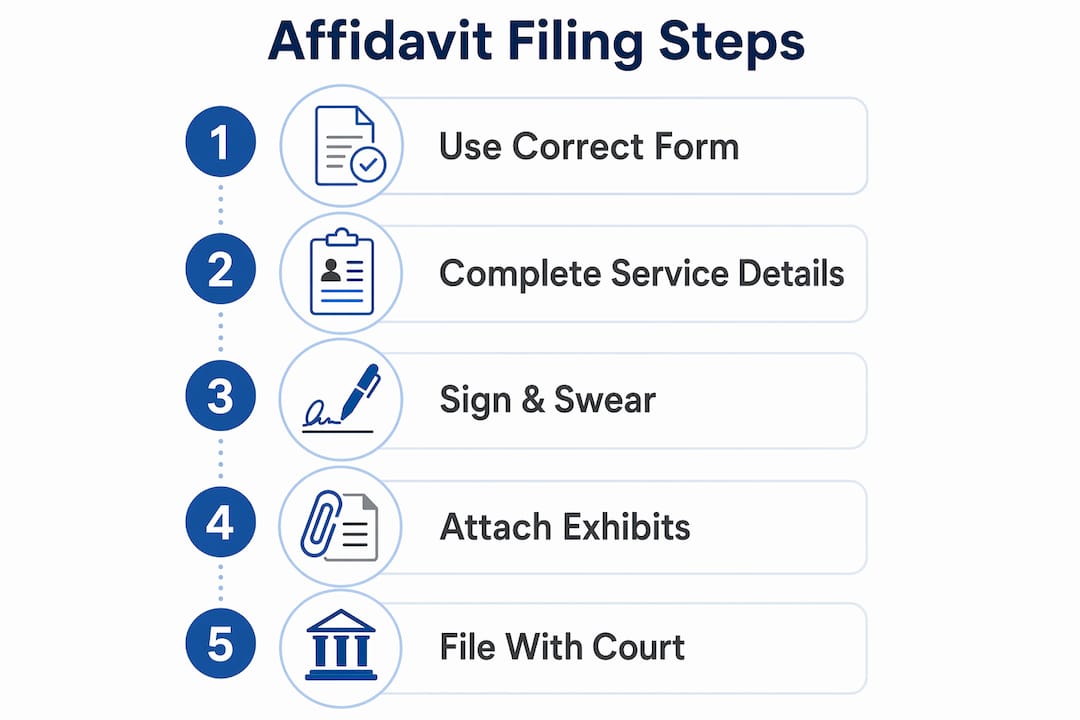
What is an affidavit of service and why does Ontario require it?
An affidavit of service is the official sworn record that a specific person received specific court documents on a specific date. It is not a formality. Ontario courts use it to confirm that every party had fair notice before any legal step proceeds. Without a valid affidavit on file, a judge cannot grant default judgment, schedule a hearing, or accept a motion.
Ontario’s Rules of Civil Procedure, the Family Law Rules, and the Small Claims Court Rules each require this proof before the court will act. The affidavit triggers court timelines. Once filed, the clock starts on response deadlines for the served party. That makes the affidavit for service one of the most time-sensitive documents in any proceeding.
The document also protects you. If the other party later claims they never received the documents, your sworn affidavit is the evidence that refutes that claim. Courts treat it as part of the permanent court record.
Which forms are required for different Ontario courts?
Ontario courts mandate specific affidavit of service forms depending on the type of case and the court handling it. Using the wrong form is one of the most common reasons court staff reject an affidavit at the counter.
Here is a breakdown of the three primary forms:
- Form 16B applies to Superior Court of Justice civil cases under the Rules of Civil Procedure. This is the standard form for most civil litigation in Ontario.
- Form 8A is required for Small Claims Court actions. Small Claims Court has its own procedural rules, and Form 16B will not substitute for Form 8A in that venue.
- Form 6B governs family law matters in Ontario Family Court under the Family Law Rules. Divorce, custody, and support proceedings all require this form.
| Court | Form | Governing Rules |
|---|---|---|
| Superior Court of Justice (Civil) | Form 16B | Rules of Civil Procedure |
| Small Claims Court | Form 8A | Small Claims Court Rules |
| Ontario Family Court | Form 6B | Family Law Rules |
Always download forms directly from the Ontario Courts website to confirm you have the current version. Court staff regularly reject outdated versions, even when the content is otherwise correct. A rejected affidavit service form means a delayed case.
What mandatory details must your affidavit of service include?
A legally valid affidavit of service must contain several specific pieces of information. Missing any one of them gives the opposing party grounds to challenge the service.
The required contents are:
- Server identity. The full legal name of the person who physically delivered the documents.
- Documents served. A precise description of every document handed over, with copies attached as exhibits.
- Date, time, and place. The exact moment and location where service occurred.
- Recipient identification. How the server confirmed the identity of the person served, such as photo ID or a physical description.
- Method of service. Whether documents were served personally, by mail, by courier, or by email.
Only the server can sign and swear the affidavit. A party to the case cannot sign it on behalf of the server, even if they were present. An affidavit signed by the wrong person is procedurally invalid and will be rejected.
Omitting recipient verification details is the single most common cause of affidavit rejection. Courts need to know how the server confirmed they delivered documents to the right person. A note that the recipient showed a driver’s license, or a physical description matching the named party, satisfies this requirement.

The affidavit must be sworn or affirmed before a Commissioner of Oaths or Notary Public. Signing without this step invalidates the entire document. Theonlinenotary provides this service online for Ontario residents, so you do not need to find a physical office.
Pro Tip: Attach a copy of every document you served as a labeled exhibit to the affidavit. Write “Exhibit A,” “Exhibit B,” and so on, and reference each exhibit by letter in the body of the affidavit. Courts expect this, and missing exhibits are grounds for rejection.
How does electronic service change affidavit requirements in Ontario?
Ontario Rule 16.09(1) permits email service with specific conditions attached. This is a significant procedural update that affects how you complete the affidavit when you serve documents digitally.
When serving by email, the following requirements apply:
- The subject line must read “SERVICE OF CLAIM UPON YOU” in capital letters.
- The email body must include a fraud warning telling the recipient the message is a legitimate legal document.
- The email must include instructions for verifying the sender’s identity and the authenticity of the documents.
The affidavit for electronic service carries additional obligations. The affidavit must show that the email address was active, that it belonged to the correct recipient, and that the server took steps to verify this. Courts require proof that the address was the recipient’s “last known” email and was used within the previous 12 months.
This level of documentation is more demanding than personal service. A server who emails documents and then files a vague affidavit stating only “sent by email” will face rejection. The affidavit must walk the court through every verification step taken.
Pro Tip: Screenshot the sent email, the recipient’s email address, and any read receipt or delivery confirmation. Attach these as exhibits to your affidavit. This gives the court concrete evidence that the email reached the right inbox.
What are the most common errors in preparing an affidavit of service?
Common errors in affidavit preparation cause case delays, motions to quash, and extra legal costs. Most of them are avoidable.
- Wrong signer. A party to the case signs instead of the actual server. This invalidates the affidavit entirely.
- Outdated form. Using a form from a prior year that no longer matches current court requirements. Court staff check form versions.
- Missing recipient verification. No description of how the server confirmed the recipient’s identity. This is the leading cause of rejection.
- No exhibits attached. The served documents are not attached as labeled exhibits. The affidavit references documents the court cannot see.
- Improper swearing. The affidavit is signed but never sworn before a Commissioner of Oaths or Notary Public. An unsworn affidavit has no legal force.
- Vague service details. Entries like “served the documents” without specifying date, time, place, or method.
Each of these errors has real consequences. A rejected affidavit means the court will not accept proof of service. The served party can bring a motion to quash, arguing they were never properly notified. That motion costs time and money, and it can set your case back by weeks or months.
The fix is straightforward. Use the correct, current form. Have the actual server complete and sign it. Attach all documents as exhibits. Swear it before an authorized official. Review the affidavit preparation steps before you finalize anything.
How do you file your affidavit of service with the Ontario court?
Filing the affidavit correctly is as important as preparing it correctly. A well-drafted affidavit that never reaches the court file does nothing.
- File with the correct court location. Submit the affidavit to the same court office handling your case. Filing at the wrong location will not place the document on your court file.
- Meet the deadline. File before the associated court event, such as a motion hearing or default judgment request. Missing or late affidavits can delay or derail proceedings entirely.
- Bring the required number of copies. Most Ontario courts require the original plus at least one copy. Confirm the specific requirement with the court office before you attend.
- Confirm the format. Some courts accept electronic filing through the Civil Claims Online portal. Others require paper. Check the court’s current filing instructions.
- Keep your filed copy. Once the court stamps your copy, retain it. You may need it later to prove the affidavit was accepted.
Self-represented litigants often overlook step two. Filing the affidavit after the hearing date has passed does not fix a missed deadline. Courts treat the affidavit as part of the official record, and that record must be complete before the court acts. If you are unsure about the timeline, consult the court office directly or review the Ontario affidavit guide for 2026 procedural updates.
Key Takeaways
A valid affidavit of service requires the correct Ontario form, complete service details, proper identity verification, and a sworn oath before an authorized Commissioner of Oaths or Notary Public.
| Point | Details |
|---|---|
| Use the correct form | Form 16B, Form 8A, or Form 6B depending on your court and case type. |
| Only the server can sign | The person who physically served the documents must swear the affidavit. |
| Document recipient identity | Record how you confirmed the served party’s identity to prevent rejection. |
| Attach all exhibits | Every document served must be attached and labeled as an exhibit. |
| File before the deadline | A late or missing affidavit can stall your case or invalidate your service. |
Why I treat affidavits of service as the most underestimated document in litigation
Most people preparing for court focus all their energy on the main application or motion. The affidavit of service gets treated as an afterthought. That is a mistake I have seen cost people weeks of delay and real money in extra legal fees.
Legal practitioners consistently note that inaccurate affidavits stall or jeopardize cases more often than any other procedural error. The affidavit is the gateway document. Nothing else moves until it is accepted. Treat it with the same care you give your main court filing.
The electronic service rules add another layer of complexity that catches people off guard. Serving by email feels simple. Documenting it properly for the affidavit is not. I have seen affidavits for email service rejected because the server wrote one sentence about sending an email and attached nothing. The court needs a paper trail, not a summary.
My advice: prepare the affidavit the same day you serve the documents, while every detail is fresh. Do not wait. Memory fades, and a vague affidavit is almost as bad as no affidavit. Get it sworn before a Commissioner of Oaths or Notary Public immediately. Theonlinenotary makes this step fast and accessible for anyone in Ontario.
— Ken
Theonlinenotary: affidavit of service preparation made simple
Preparing a legally sound affidavit of service takes more than filling in a form. You need the right version of the right form, complete and accurate details, and a sworn oath before an authorized official.

Theonlinenotary provides online notary services for Ontario residents and businesses, available around the clock. The team understands the specific requirements for Form 16B, Form 8A, and Form 6B, and can help you prepare and notarize your affidavit without leaving your home or office. Whether you are handling a civil claim, a small claims matter, or a family law proceeding, Theonlinenotary gives you a fast, reliable path to a court-ready document.
FAQ
What is the difference between Form 16B, 8A, and 6B?
Form 16B is used in Superior Court civil cases, Form 8A applies to Small Claims Court, and Form 6B is required for Ontario Family Court proceedings. Using the wrong form will result in rejection by court staff.
Who can swear an affidavit of service in Ontario?
The affidavit must be sworn before a Commissioner of Oaths or Notary Public. An unsworn affidavit has no legal force and will not be accepted by the court.
Can a party to the case sign the affidavit of service?
No. Only the person who physically served the documents can sign and swear the affidavit. An affidavit signed by a party to the case is procedurally invalid.
What happens if I file an affidavit of service late?
A late or missing affidavit can delay your case, prevent the court from granting default judgment, and give the opposing party grounds to challenge the validity of service.
Does email service require a different affidavit?
Yes. An affidavit for email service must confirm the email address was active, belonged to the correct recipient, and was used within the previous 12 months. The subject line of the email must read “SERVICE OF CLAIM UPON YOU.”