Affidavit of One and the Same Person: Ontario Guide

TL;DR:
- An affidavit of identity confirms that multiple names on legal documents belong to the same person and has legal weight when notarized.
- It addresses name discrepancies caused by maiden names, nicknames, or spelling errors and does not alter official records or change a legal name.
An affidavit of one and the same person is a sworn statement confirming that two or more different names on legal documents belong to the same individual. In Ontario, this document goes by the industry term “affidavit of identity” and carries full legal weight when properly notarized. False statements in such an affidavit can result in criminal penalties, including fines and imprisonment under provincial and federal perjury laws. Banks, courts, and government agencies across Ontario routinely require this document to resolve name discrepancies before processing applications, transfers, or estate matters.
What is an affidavit of one and the same person?
A same person affidavit formally connects two or more name variations to a single individual through a sworn declaration. The core language follows a direct pattern: “I, Robert Allen Smith, also known as Bob Smith, hereby declare under oath that I am one and the same person.” That statement, signed before a notary, becomes a legally binding document accepted by most institutions in Ontario.
The affidavit covers a wide range of name variations. Maiden names, nicknames, spelling errors made by clerks, and name changes after marriage or divorce all qualify. The document does not alter any official record on its own. It simply confirms, under oath, that the person named in one document is the same person named in another.
This affidavit is not the same as a legal name change. Formal name changes require a court order, a marriage certificate, or a divorce decree. Government agencies issuing photo IDs will not update their records based on an affidavit alone. The affidavit resolves discrepancies on existing records without replacing the legal process required to change a name permanently.
When do you need this affidavit in Ontario?
Several common situations trigger the need for a legal identity affidavit in Ontario. Knowing which situations apply to you saves time and prevents delays with institutions that have strict document requirements.
The most frequent scenarios include:
- Banking and financial accounts: A bank may flag a discrepancy between the name on a will and the name on an account. An affidavit of identity resolves that mismatch without requiring a court order.
- Estate administration: Executors frequently encounter name variations across old deeds, insurance policies, and government records. A common name affidavit clarifies the identity of the deceased or the beneficiary.
- Real estate transactions: Title companies and land registry offices in Ontario require consistent naming across all documents. A single spelling variation can stall a closing.
- Passport and travel document applications: A name on a birth certificate that differs from a passport triggers an identity review. An affidavit name declaration bridges that gap.
- Employment and professional licensing: Regulatory bodies may require proof that a credential issued under one name belongs to the applicant presenting a different name today.
- Immigration and visa applications: Name discrepancies across passports, birth certificates, and immigration forms are common and require formal resolution.
Banks, courts, and government agencies often have their own affidavit templates or specific language requirements. Always confirm the receiving institution’s format before drafting your document. A generic template submitted to the wrong agency is a common reason for rejection.
An affidavit of identity is not the right tool when a court order is required. If a government agency demands a legal name change rather than a clarification, the affidavit will not satisfy that requirement. Legal professionals in Ontario should advise clients on this distinction early to avoid wasted effort.

What documents do you need to prepare your affidavit?
Gathering the right supporting materials before drafting is the single most effective way to prevent rejection. The affidavit itself is a sworn statement, but the attached exhibits carry the evidentiary weight.
| Document Type | Purpose | Notes |
|---|---|---|
| Government-issued photo ID | Confirms current legal identity for notary verification | Passport, driver’s license, or Ontario photo card |
| Birth certificate | Establishes original legal name | Certified copy preferred |
| Marriage certificate | Documents name change after marriage | Certified copy required |
| Divorce decree or court order | Documents legal name change through legal proceedings | Full certified copy |
| Previous government IDs | Shows name history across time | Expired passports or old driver’s licenses accepted |
| Prior affidavits or statutory declarations | Establishes a paper trail for recurring name issues | Attach as additional exhibits |
Attaching certified copies of birth certificates, marriage licenses, or legal name change orders strengthens the affidavit’s reliability. These documents serve as labeled exhibits referenced directly in the body of the affidavit. Each exhibit should be marked clearly, for example “Exhibit A” or “Exhibit B,” and referenced by that label in the corresponding paragraph.
Notaries verify the signer’s identity using government-issued photo ID and witness the signing under oath. They do not validate the factual accuracy of the affidavit’s contents. That responsibility rests entirely with the person signing. This distinction matters because attaching strong supporting documents is the only way to corroborate the statements made.
Pro Tip: Check the ID requirements for notary services in Ontario before your appointment. Arriving without acceptable identification will cancel the session and delay your affidavit.
How do you write and notarize your affidavit?
Writing a clear, well-structured affidavit is the most important step in the process. Poorly drafted documents are the leading cause of rejection by Ontario institutions.
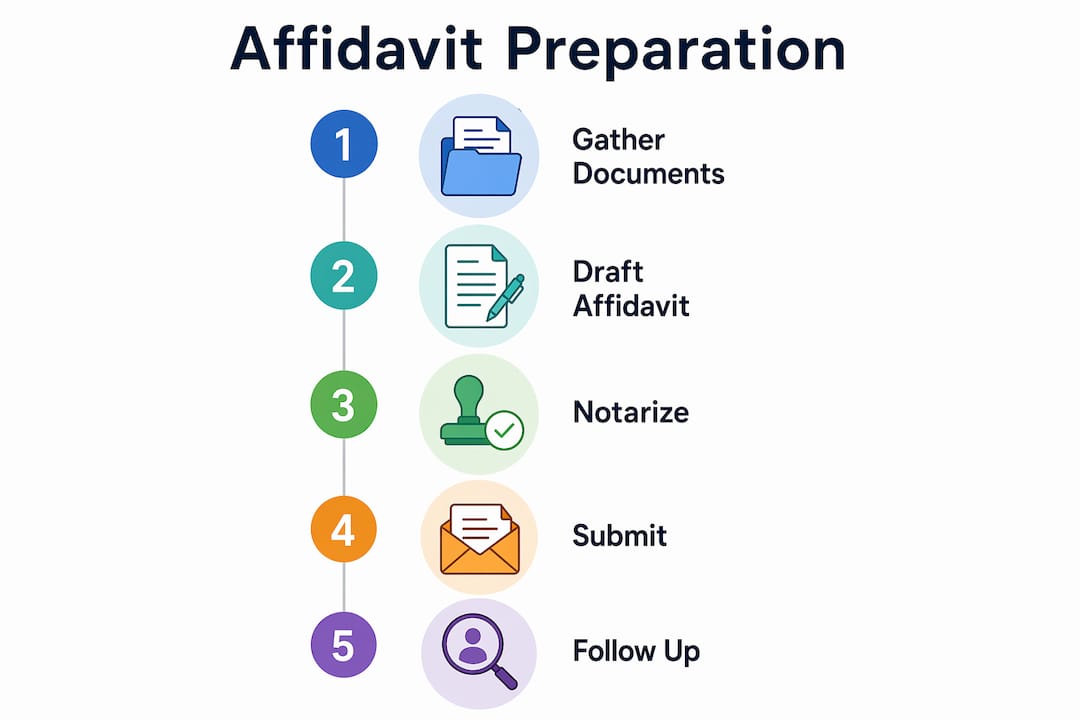
Follow these steps to draft and notarize your affidavit correctly:
-
Write a clear title. Use a heading such as “Affidavit of Identity” or “Affidavit of One and the Same Person” at the top of the document. This signals the document’s purpose immediately.
-
Open with your full legal identity. State your current legal name, date of birth, and address in the first paragraph. This anchors the affidavit to a specific, verifiable individual.
-
List each name variation in numbered paragraphs. Address each name chronologically. Explain why the variation exists, for example: “Paragraph 3: The name ‘Elizabeth Anne Brown’ appearing on my 1998 university degree refers to me. I used my maiden name prior to my marriage in 2003, as evidenced by the marriage certificate attached as Exhibit A.”
-
Attach and label all exhibits. Reference each supporting document by its exhibit label within the corresponding paragraph. Never attach documents without referencing them in the body text.
-
Include a jurat clause. This is the standard closing statement confirming the affidavit was sworn before a notary. Your notary will provide or confirm the correct wording for Ontario.
-
Sign in the presence of a notary. The notary administers an oath or affirmation, witnesses your signature, and applies their seal. The document has no legal force without this step. Learn more about what a notary does in Ontario before your session.
-
Consider Remote Online Notarization (RON). RON sessions can produce a sealed PDF affidavit in under 15 minutes. Ontario institutions increasingly accept digitally sealed affidavits, making this option practical for most applicants.
The affidavit must use clear numbered paragraphs that explain identity facts sequentially. Vague or combined paragraphs create ambiguity that automated review systems flag immediately. Keep each paragraph to one name variation and one explanation.
Pro Tip: Generic templates without tailoring are frequently rejected. Always verify the specific wording requirements of the institution receiving your affidavit before finalizing the draft.
How do you submit your affidavit and get it accepted?
Submitting a notarized affidavit correctly is as important as drafting it well. Even a properly written document can be rejected if submitted through the wrong channel or without required attachments.
Key practices for successful submission include:
- Confirm the institution’s format requirements in advance. Call or email the receiving agency before submitting. Ask specifically whether they accept digitally sealed affidavits and whether they have a required template.
- Submit certified copies of all exhibits. Original documents should stay with you. Submit certified copies attached to the affidavit in the order they are referenced in the body text.
- Keep a complete copy for your records. Store a digital and physical copy of the signed, notarized affidavit and all exhibits. You may need to submit the same document to multiple agencies.
- Track your submission. Use registered mail or a courier with tracking for physical submissions. For digital submissions, request a confirmation email or receipt.
- Know what to do if rejected. If an institution rejects your affidavit, ask for the specific reason in writing. Common rejection reasons include missing exhibits, incorrect wording, or an unacceptable notarization format. Correct the identified issue and resubmit.
One notarized affidavit can be submitted to multiple agencies simultaneously, especially when produced through a Remote Online Notarization session. This avoids the cost and delay of separate notary visits for each institution. A valid affidavit in Ontario must meet specific legal standards to be accepted across different agencies.
An accepted affidavit resolves a name discrepancy on existing records. It does not update your name on government-issued IDs. That distinction matters when dealing with agencies like Service Ontario or the Canada Revenue Agency, which require formal legal documentation to change a name in their systems.
Key Takeaways
A well-drafted, notarized affidavit of identity is the most direct way to resolve name discrepancies across legal, financial, and government records in Ontario without initiating a formal name change.
| Point | Details |
|---|---|
| Affidavit of identity defined | A sworn statement confirming multiple names belong to one person, notarized for legal acceptance. |
| Not a legal name change | The affidavit resolves record discrepancies but cannot replace a court order or marriage certificate for official ID updates. |
| Supporting documents are critical | Attach certified copies of birth certificates, marriage licenses, or court orders as labeled exhibits. |
| Notary role is limited | Notaries confirm your identity and witness the signing; they do not verify the facts you state. |
| RON speeds up the process | Remote Online Notarization produces a sealed affidavit in under 15 minutes, accepted by most Ontario institutions. |
What I’ve learned from handling these affidavits in Ontario
The biggest mistake I see is treating this document as a formality. People draft a vague, two-paragraph statement, attach nothing, and expect a bank or government agency to accept it on faith. That approach fails consistently.
Chronological clarity is what separates accepted affidavits from rejected ones. When I review a well-constructed affidavit, every name variation has its own paragraph, its own explanation, and its own exhibit. The reviewer, whether human or an automated system, can follow the identity trail without guessing. Clear, chronological statements with documented reasons for name differences improve acceptance rates significantly. That is not a minor detail. It is the core of the document’s function.
Remote Online Notarization has changed the practical reality of this process in Ontario. What used to require scheduling, travel, and multiple appointments can now happen in a single video session. I have seen applicants notarize one affidavit and submit it to three agencies the same afternoon. The resistance from institutions has dropped considerably as RON becomes standard practice.
My honest advice: consult a notary or legal professional before you draft, not after. The cost of a consultation is far lower than the cost of restarting the process after a rejection. And if your situation involves multiple name changes over many years, consider having a legal professional draft the document rather than using a template.
— Ken
Theonlinenotary makes affidavit notarization simple in Ontario
Resolving a name discrepancy should not require multiple appointments, long waits, or confusing paperwork. Theonlinenotary provides online notarization services for affidavits of identity, statutory declarations, and other legal documents for Ontario residents, available 24/7 from any device.

The process is straightforward. You prepare your affidavit and supporting documents, book a session online, and connect with a qualified Ontario notary by video. The notarized, sealed affidavit is ready in minutes and accepted by banks, courts, and government agencies across the province. Theonlinenotary handles the full range of affidavit types in Ontario, so whether your situation is straightforward or involves several name variations across decades of records, the right expertise is available without leaving your home.
FAQ
What is an affidavit of one and the same person?
An affidavit of one and the same person, formally called an affidavit of identity, is a sworn statement confirming that two or more different names on legal documents belong to the same individual. It must be signed before a notary to carry legal weight.
Does this affidavit legally change my name?
No. An affidavit of identity resolves discrepancies on existing records but does not legally change your name. Official name changes require a court order, marriage certificate, or divorce decree accepted by the issuing government agency.
What documents should I attach to my affidavit?
Attach certified copies of any document that explains the name variation, such as a birth certificate, marriage certificate, or court order. Each document should be labeled as an exhibit and referenced by that label in the body of the affidavit.
Can I notarize my affidavit online in Ontario?
Yes. Remote Online Notarization is accepted by most Ontario institutions and produces a digitally sealed affidavit in under 15 minutes. Theonlinenotary offers this service 24/7 for Ontario residents.
What happens if my affidavit is rejected?
Ask the institution for the specific rejection reason in writing, then correct the identified issue before resubmitting. Common reasons include missing exhibits, incorrect wording, or a notarization format the institution does not accept.