Affidavit Meaning in Ontario: Your 2026 Legal Guide

TL;DR:
- An affidavit is a sworn written statement that holds the same legal weight as live testimony in court. It must be properly prepared, signed before an authorized official, and follow specific formal requirements under Ontario law. Using the wrong document type or signing prematurely can invalidate it, risking rejection and legal penalties.
An affidavit is defined as a written statement sworn or affirmed to be true before an authorized official, carrying the same legal weight as live testimony in court. Ontario residents encounter affidavits in court motions, immigration applications, estate matters, and government filings. Getting the definition right matters because false affidavits may result in perjury charges under the Criminal Code of Canada. This guide covers the legal affidavit meaning, Ontario’s formal requirements, key distinctions from similar documents, and the mistakes that most commonly invalidate them.
What is the affidavit meaning under Ontario law?
An affidavit is a formal written statement where the person making it, called the deponent, swears or affirms that every fact stated is true. The oath can be religious or non-religious. Both forms are legally equal under Ontario law, so neither carries more weight in court than the other.

Three elements make an affidavit legally valid. First, the deponent must sign the document in front of an authorized official. Second, that official must administer an oath or affirmation. Third, the document must include a jurat, which is the certification block that records where, when, and before whom the oath was taken. Without all three, the document is not a valid affidavit.
Ontario’s Rules of Civil Procedure govern how affidavits are prepared and used in court proceedings. The affidavit definition under these rules is precise: it is sworn written evidence, not a general letter or declaration. Treating it as anything less creates real legal risk.
What are the legal requirements for affidavits in Ontario?
Ontario law sets clear formatting and content standards for affidavits. Requirements under Rule 4.06 of the Ontario Superior Court Rules specify that facts must appear in numbered paragraphs, be based on personal knowledge, and include a jurat using Form 4D. These rules exist to make affidavits easy to read and challenge in court.
A valid Ontario affidavit must include:
- A clear title identifying the document as an affidavit
- The deponent’s full name and jurisdiction (Ontario)
- Numbered paragraphs, each containing one factual statement
- An oath clause stating the deponent swears or affirms the contents are true
- The deponent’s signature, witnessed by an authorized official
- The official’s signature, designation, and the date and location of signing
- No blank spaces and no alterations after the document is signed
Authorized officials who can witness affidavits in Ontario include notaries public and commissioners for taking oaths. Lawyers admitted to the Ontario bar also qualify. The official’s role is to verify your identity, confirm you understand what you are signing, and administer the oath or affirmation before you sign.
Pro Tip: Prepare a government-issued photo ID before your appointment. The authorized official must verify your identity before the oath, and missing ID is one of the most common reasons appointments get delayed.
If a fact in your affidavit is not within your direct personal knowledge, you must state the source of your belief. For example: “I am informed by my lawyer and believe that the property transfer was registered on March 3, 2026.” That phrasing satisfies the personal knowledge requirement without overstating what you actually know.
How does an affidavit differ from a statutory declaration?
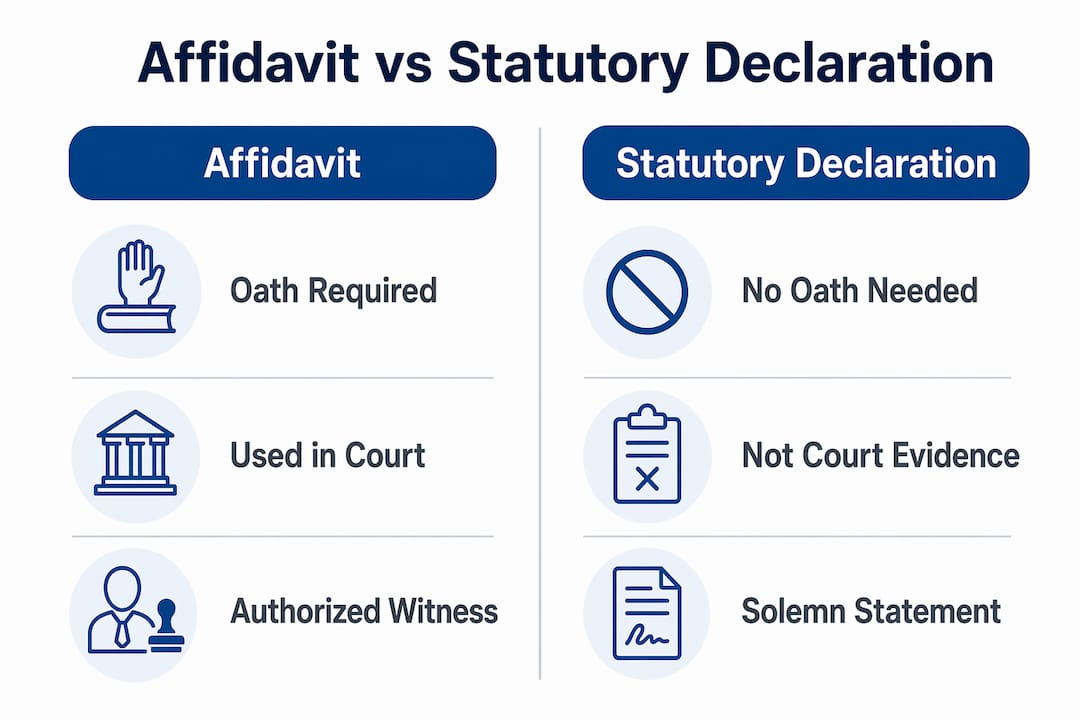
Affidavits and statutory declarations are often confused, but they serve different legal purposes. An affidavit requires an oath or affirmation and is used as evidence in court proceedings. A statutory declaration is a solemn statement made without an oath, used for administrative purposes such as government forms, name changes, or confirming facts for a registry.
Choosing the wrong document causes real problems. Courts reject statutory declarations submitted as evidence. Government agencies reject affidavits submitted in place of declarations. The rejection means you must redo the document, which costs time and money.
| Feature | Affidavit | Statutory declaration |
|---|---|---|
| Requires oath or affirmation | Yes | No |
| Primary use | Court evidence | Administrative matters |
| Governed by | Rules of Civil Procedure | Canada Evidence Act / Ontario Evidence Act |
| Signed before | Notary or commissioner | Notary or commissioner |
| Perjury risk if false | Yes | Yes (false declaration) |
The key practical difference is context. If a court, tribunal, or lawyer requests a sworn statement, you need an affidavit. If a government form or registry asks you to confirm facts in writing, you likely need a statutory declaration. When in doubt, ask the requesting party which document they require before you draft anything.
A related document worth knowing is the solemn declaration, which Theonlinenotary also handles. It follows a format similar to the statutory declaration but is used in specific federal and provincial contexts. None of these documents are interchangeable, and each has its own authorized form.
In what situations are affidavits used in Ontario?
Affidavits serve as written testimony that allows courts to establish facts quickly without requiring live testimony, which improves judicial economy in pretrial and motion proceedings. That said, they do not replace cross-examination at trial. A judge can accept an affidavit for a motion but still require the deponent to testify in person at a full hearing.
The most common affidavit uses in Ontario include:
- Court motions. Affidavits are the standard way to present facts to a judge in a motion, such as a request for an injunction or a custody order.
- Proof of service. When a legal document is served on another party, the person who delivered it swears an affidavit confirming the details of service.
- Identity verification. Government agencies and financial institutions sometimes require a sworn statement confirming your identity or personal details.
- Sponsorship and immigration. Sponsors in immigration applications often submit affidavits confirming income, relationship, and financial capacity.
- Proof of relationship. An affidavit for proof of relationship confirms family ties for immigration, estate, or benefits purposes.
- Business and government forms. Corporations and sole proprietors use affidavits to confirm facts for notarized business documents and regulatory filings.
- Estate administration. Executors swear affidavits to confirm the contents of an estate or the validity of a will.
The common thread across all these uses is that the affidavit converts a personal statement into sworn legal evidence. That shift in status is what gives the document its power and its risk.
Common pitfalls when preparing and notarizing affidavits in Ontario
The single most damaging mistake is signing the affidavit before meeting the authorized official. Signing before the appointment invalidates the document under Ontario law because the official must physically witness the signing. There are no exceptions. If you sign early, you must redo the entire document.
Other frequent errors include:
- Leaving blank spaces. Any blank space in a signed affidavit creates a risk of unauthorized additions. Fill every field before signing.
- Making changes after signing. Alterations after notarization void the document. If a correction is needed, prepare a fresh affidavit.
- Using the wrong document type. Submitting a statutory declaration when a court requires an affidavit, or vice versa, results in rejection.
- Vague or combined facts. Each numbered paragraph should contain one clear fact. Stacking multiple claims in one paragraph makes the affidavit harder to challenge and easier to dismiss.
- Failing to state the source of belief. If you include a fact you did not personally witness, you must name the source. Omitting this detail weakens the affidavit’s credibility.
Pro Tip: Draft your affidavit fully before your appointment, then read every paragraph aloud. If a sentence is unclear or combines two ideas, split it. The authorized official cannot edit your content, only witness your signature.
Notarizing an affidavit involves three steps: identity verification, oath administration, and official validation with the notary’s signature and seal. Each step is mandatory. Skipping or rushing any one of them produces a document that courts and agencies will reject.
Key Takeaways
An affidavit is a sworn written statement that carries the legal weight of court testimony, and its validity depends entirely on proper preparation, correct document type, and witnessed signing before an authorized official.
| Point | Details |
|---|---|
| Core affidavit definition | A sworn or affirmed written statement signed before a notary or commissioner, equal in weight to live testimony. |
| Ontario formatting rules | Facts must appear in numbered paragraphs with a jurat under Rule 4.06 of the Rules of Civil Procedure. |
| Affidavit vs. declaration | Affidavits are for court evidence; statutory declarations are for administrative matters. Using the wrong one causes rejection. |
| Never pre-sign | Signing before the authorized official witnesses you invalidates the affidavit and requires a full redo. |
| Common uses | Court motions, proof of service, identity verification, immigration sponsorship, and estate administration. |
Why affidavits deserve more respect than most people give them
People treat affidavits like a formality. They draft something quickly, show up to get it signed, and assume the job is done. What I have seen, working with clients across Ontario, is that this attitude creates problems that are entirely avoidable.
The most common issue is not fraud or bad intent. It is carelessness with structure. A deponent combines three facts in one paragraph, leaves a field blank, or signs at home before the appointment. Each of these errors produces the same result: a rejected document and a wasted filing fee.
What I tell every client is this: the affidavit’s power comes from its precision. Courts and agencies trust it because it follows strict rules. The moment you cut a corner, you undermine the very thing that makes the document useful. A well-drafted affidavit moves a case forward. A defective one stalls it.
My practical advice is to treat the preparation stage as seriously as the signing stage. Know what type of document you need before you draft a single word. Confirm with the requesting party whether they need an affidavit or a statutory declaration. Then draft clearly, number every fact, and bring your ID to the appointment. That process takes an extra 20 minutes and saves hours of rework.
— Ken
Affidavit notarization made straightforward with Theonlinenotary
Getting an affidavit notarized does not require a trip across town or a week-long wait for an appointment. Theonlinenotary provides online notary services in Ontario around the clock, covering affidavits, statutory declarations, solemn declarations, and more.

The team at Theonlinenotary understands Ontario’s affidavit requirements, from proper jurat formatting to Rule 4.06 compliance, and can guide you through the process from draft to certified document. Whether you need a standard court affidavit, a proof of relationship affidavit, or help identifying the right document type for your situation, Theonlinenotary has the expertise to get it right the first time.
FAQ
What is an affidavit in simple terms?
An affidavit is a written statement of facts that you swear or affirm to be true in front of an authorized official such as a notary public or commissioner. It carries the same legal weight as testimony given in court.
Who can witness an affidavit in Ontario?
Notaries public, commissioners for taking oaths, and Ontario-licensed lawyers can all witness affidavits in Ontario. The witness must be present when you sign and must administer the oath or affirmation before you do so.
What happens if an affidavit contains false information?
A false affidavit can result in perjury charges under the Criminal Code of Canada. The legal consequences are serious because the document is treated as sworn testimony, not a simple written statement.
What is the difference between an affidavit and a statutory declaration?
An affidavit requires an oath or affirmation and is used as evidence in court. A statutory declaration is a solemn statement without an oath, used for administrative purposes. Submitting the wrong document to a court or government agency causes rejection.
Can I sign an affidavit before my appointment with the notary?
No. Ontario law requires the authorized official to witness your signature. Signing the affidavit before the appointment invalidates the document, and you will need to prepare and sign a new one.