Affidavit for Property: Ontario Commissioning Guide

TL;DR:
- An affidavit for property is a sworn statement that confirms ownership, title status, or encumbrances, requiring proper notarization to be accepted. Proper preparation, including the correct type, exhibits, and complete jurat details, prevents rejection by authorities. Remote online notarization is an accepted method, but must meet jurisdiction-specific requirements for validation.
An affidavit for property is a sworn written statement of facts about ownership, title status, or encumbrances — and the moment you finish drafting it, your next step is to have it sworn or affirmed before an authorized official, either in person or through an approved remote online notarization (RON) session. The most common form is the Affidavit of Title, used at real estate closings to confirm the seller owns the property free of undisclosed liens. Other types cover ownership proof, possession, and estate transfers.
Before your appointment, confirm three things:
- You have the correct affidavit type for your transaction or filing
- All exhibits are attached, labeled, and match the references in your affidavit text
- The receiving party (title company, court, or land registry) accepts your chosen commissioning method
Table of Contents
- What “affidavit for property” actually covers
- How to draft a property affidavit that will actually be accepted
- Step-by-step commissioning: in-person and RON
- How remote online notarization works for property affidavits
- Technical errors that get property affidavits rejected
- Your pre-commissioning checklist
- When you need a lawyer, not just a commissioner
- Key Takeaways
- The part most guides skip
- Authoritative resources to verify affidavit and RON requirements
- Get your property affidavit commissioned without the back-and-forth
What “affidavit for property” actually covers
A property affidavit is a sworn statement of facts within the deponent’s personal knowledge. Courts, title insurers, lenders, and land registries rely on it because the signer personally guarantees accuracy — false statements carry serious legal consequences.
The four main types:
- Affidavit of Title. Used at real estate closings to confirm the seller’s ownership and that the property carries no undisclosed liens, judgments, or encumbrances. Title insurance companies and lenders request this as a condition of closing.
- Affidavit of Ownership. Proves ownership for registration purposes when a deed or certificate of title alone is insufficient. Banks and county recorder offices commonly request it.
- Affidavit of Possession. Documents continuous, open occupancy of a property, typically in adverse possession claims or occupancy disputes.
- Affidavit of Heirship. Used in probate and estate transfers to establish the rightful heir when no will exists or when a small estate qualifies for a simplified transfer process. In California, for example, estates worth $184,500 or less may qualify for a small estate affidavit instead of full probate.
Knowing which type you need before you draft anything saves you from commissioning the wrong document.
How to draft a property affidavit that will actually be accepted
The drafting standard is clinical: facts only, first person, within your personal knowledge. No legal arguments, no opinions, no hearsay — unless you clearly identify the source and label it as belief rather than direct knowledge.
Required content elements:
| Element | What to include |
|---|---|
| Identification block | Full legal name, current address, occupation |
| Competency statement | Statement that you are of legal age and sound mind |
| Numbered fact paragraphs | Each paragraph = one discrete fact within personal knowledge |
| Exhibit references | “Attached hereto as Exhibit A is…” for every document referenced |
| Jurat | Place, date, oath/affirmation language, commissioner’s title, and commission expiry or authority |
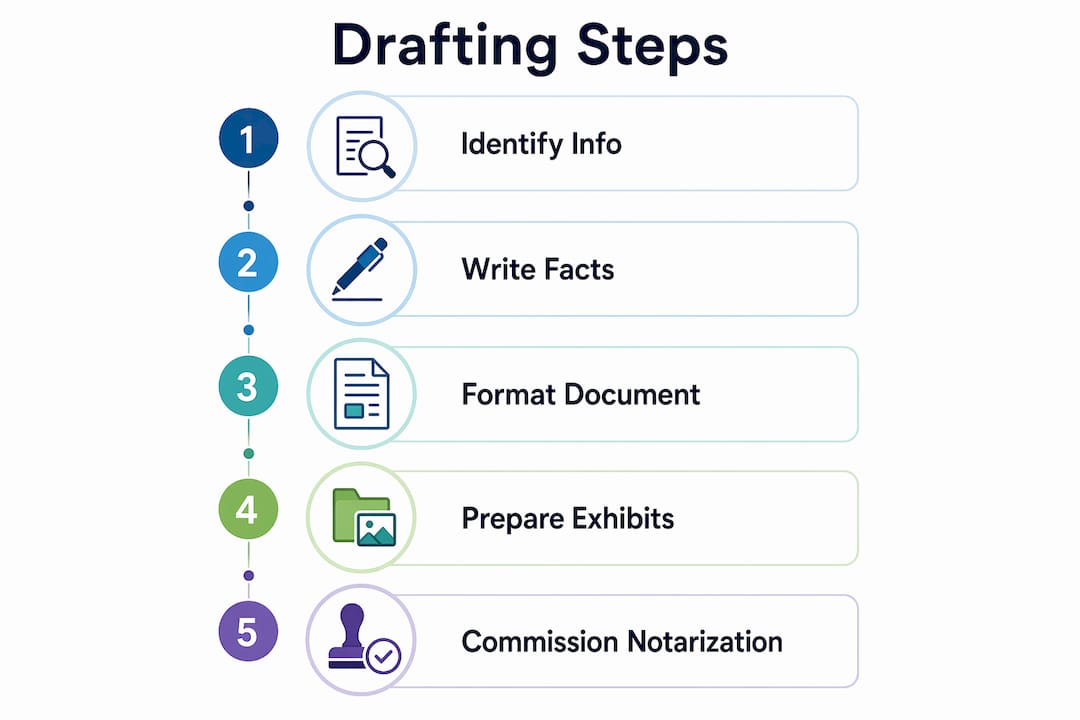
Formatting rules that registries enforce: typed in a readable font (size 11 or 12), numbered pages, numbered paragraphs, and single-sided printing. Sign and initial every page. Each exhibit gets its own label (Exhibit A, Exhibit B) and must be referenced in the affidavit text before it is attached. Courts frequently reject exhibits embedded in electronic-only formats without a printed, commissioner-stamped copy.
Pro Tip: Prepare exhibits as separate, clearly labeled files before your appointment. When the commissioner stamps or initials each exhibit at the time of swearing, that stamp is what makes the exhibit legally part of the affidavit.
Step-by-step commissioning: in-person and RON
Getting the affidavit sworn or affirmed remotely via audio-visual technology is accepted in many jurisdictions, provided identity verification and real-time witness of signing meet local requirements. Here is the full sequence for both paths.
In-person commissioning:
- Bring valid government-issued photo ID and the original affidavit with all exhibits attached.
- Do not sign the affidavit before you arrive — the signature must happen in the commissioner’s presence.
- Sign the affidavit and initial every page in front of the commissioner.
- Have the commissioner sign each page, stamp or initial each exhibit, and complete the jurat.
- Confirm the jurat includes: place, date, oath/affirmation language, and the commissioner’s title and commission expiry.
RON (Remote Online Notarization):
- Schedule an appointment with an authorized RON provider and confirm the technology platform they use.
- Join the session via a stable audio-visual link (platforms like Zoom or provider-specific tools).
- Present government-issued photo ID on camera; complete any multi-factor or credential analysis the provider requires.
- Sign the affidavit electronically while the commissioner observes in real time.
- The commissioner completes the digital jurat and electronic signature; an audit trail or recording is generated.
Timeline and cost: In-person appointments typically run 15–30 minutes for a single-document affidavit. RON sessions are often comparable in length. Fees vary by provider and jurisdiction; additional pages or multiple exhibits increase cost. Always confirm the receiving institution accepts RON before booking.
Pro Tip: Ask the receiving title company or land registry in writing whether they accept RON-commissioned affidavits before your session. Get that confirmation in writing — it protects you if a question arises later.

How remote online notarization works for property affidavits
RON is a live audio-visual administration of the oath or affirmation, with real-time witness of signing and identity verification via government ID. The authorized official verifies identity through photo ID presented on camera, sometimes supplemented by credential analysis or knowledge-based authentication.
| RON requirement | What it means in practice |
|---|---|
| Audio-visual link | Stable video connection; both parties must be visible and audible throughout |
| Identity proofing | Government photo ID shown on camera; some providers require additional verification steps |
| Real-time signing | Deponent signs while commissioner observes — no pre-signing |
| Audit trail | Session recording or log that some registries require as part of the commissioned document |
| Digital jurat | Electronic equivalent of the traditional jurat, including commissioner credentials |
Not all land registries, title companies, or courts accept RON for property affidavits. Acceptance varies by state and by the specific institution receiving the document. Always confirm in advance and, when possible, get written confirmation.
Pro Tip: Request a sample digital jurat or commissioning certificate from your RON provider before the session. Show it to the title company or registry so they can confirm it meets their format requirements.
Technical errors that get property affidavits rejected
Administrative mistakes are a leading cause of rejection by registries and courts — often more common than substantive factual problems.
| Error | Why it causes rejection |
|---|---|
| Unsigned or un-initialed pages | Failure to sign each page can invalidate the entire affidavit |
| Missing jurat elements | No place, date, or commissioner authority listed; land titles offices treat an incomplete jurat as fatal |
| Exhibits not attached or not labeled | An exhibit referenced in the text but missing from the document is grounds for rejection |
| Exhibits not initialed by commissioner | Without the commissioner’s stamp or initials, exhibits are not legally part of the affidavit |
| Post-signature alterations | Crossing out text after swearing typically invalidates the document; a new affidavit is usually required |
| Wrong venue or date in jurat | The jurat must reflect where and when the oath was actually administered |
If a correction is needed after signing, the proper fix is a new sworn affidavit or a formally acknowledged amendment sworn before the commissioner. Simply crossing out text is not acceptable.
Your pre-commissioning checklist
Run through this before every appointment, in-person or remote.
- Confirm you have the correct affidavit type for your transaction.
- Verify all factual paragraphs are numbered and limited to personal knowledge.
- Attach all exhibits, labeled Exhibit A, B, C in the order they appear in the text.
- Confirm each exhibit is referenced by name in the affidavit body.
- Check the jurat block includes: place, date, oath language, commissioner title, and commission expiry.
- Bring valid government-issued photo ID (passport or driver’s license).
- Arrange any additional signers or witnesses required by the receiving institution.
- Confirm in writing that the receiving party accepts your commissioning method (RON or in-person).
- Have payment ready for the commissioning fee.
- Do not sign the affidavit until you are in the commissioner’s presence.
Allow sufficient time for an in-person appointment or a RON session, plus buffer time for the receiving institution’s review process.
When you need a lawyer, not just a commissioner
A commissioner’s role is to witness and authenticate your oath — not to review the legal accuracy of what you swear to. Several situations require counsel before you commission anything.
Get legal advice before commissioning if: you discover an undisclosed lien or judgment on the property; there are competing ownership claims or a disputed title; the affidavit involves probate, estate transfers, or complex conveyances; the title company or lender requests specific legal language you are unsure about; or any statement in the affidavit could expose you to a perjury charge if later found inaccurate. The Affidavit of Title functions as a legal warranty — false statements carry significant legal consequences.
For straightforward ownership confirmation with no title complications, a self-drafted affidavit reviewed against the official template and then commissioned is usually sufficient. When the facts are contested or legally complex, combine counsel review with your commissioning appointment.
Key Takeaways
A property affidavit must be drafted with facts only, formatted to institutional standards, and sworn before an authorized official — technical errors in the jurat or exhibit handling are the most common cause of rejection.
| Point | Details |
|---|---|
| Choose the right type first | Affidavit of Title, Ownership, Possession, or Heirship each serve distinct legal purposes. |
| Jurat completeness is non-negotiable | Missing place, date, or commissioner authority invalidates the affidavit at the registry. |
| Never pre-sign | Sign only in the commissioner’s presence — in person or live on a RON video call. |
| Exhibits need commissioner initials | Each exhibit must be stamped or initialed by the commissioner at the time of swearing. |
| Theonlinenotary | Ontario clients can book a remote or in-person commissioning appointment to get property affidavits sworn correctly the first time. |
The part most guides skip
Most articles about property affidavits focus on what to write. The real problem is what happens between finishing the draft and getting it accepted by a title company or registry.
The jurat is where most rejections originate. A missing commission expiry date, the wrong venue, or a digital jurat format the registry has never seen before — these are not rare edge cases. They show up regularly, and they send clients back to square one. The fix is not more careful drafting. It is confirming format requirements with the receiving institution before the appointment, not after.
The other underestimated issue is exhibits. Clients often attach supporting documents without referencing them in the affidavit text, or they reference “Exhibit A” without having the commissioner initial it. Either way, the exhibit is not legally part of the affidavit. A pre-commission walkthrough that checks exhibit labeling, page initials, and jurat wording against the receiving institution’s requirements eliminates most of these problems before they become delays.
For Ontario clients, working with a commissioning service that handles property affidavit notarization regularly means the jurat wording and exhibit protocol are already calibrated to what title companies and registries expect. That is worth more than any template.
Authoritative resources to verify affidavit and RON requirements
Before submitting any property affidavit, check the official requirements published by the receiving institution. These sources are the most reliable starting points.
- California Courts Self-Help Guide — small estate affidavit rules and forms for property transfers in California probate situations.
- BC Government Affidavit Guidebook — detailed exhibit handling, pagination, and commissioner certification requirements.
- Department of Justice Victoria — RON acceptance criteria, jurat requirements, and post-signature correction rules.
- Your state’s notary office or land titles office — confirm whether RON is accepted for property affidavits in your specific jurisdiction before booking.
- The receiving title company or lender — always ask for their specific jurat format and exhibit requirements in writing; many have internal standards beyond the statutory minimum.
Download the official affidavit template from the receiving institution whenever one is available. Using their form reduces the chance of a format rejection.
This article is general information, not legal advice. Confirm current requirements with the relevant authority or a qualified legal professional for your specific situation.
Get your property affidavit commissioned without the back-and-forth
Property affidavits rejected for jurat errors or missing exhibit initials cost you time and closing delays. Theonlinenotary offers remote online commissioning and in-person notarization for property affidavits, statutory declarations, and related legal documents for individuals and businesses in Ontario.

The process is straightforward: book an appointment online, join via video for a RON session or visit in person in Brampton, present your ID, and have your affidavit sworn correctly with a properly completed jurat and commissioner-initialed exhibits. Fees are set per document with no surprise add-ons for standard additional pages.
Book your commissioning appointment at Theonlinenotary and get your property affidavit sworn right the first time.
Recommended
- Ontario affidavit guide: Prepare and notarize legally in 2026 - The Online Notary
- Affidavit of Ownership Ontario: Complete Guide - The Online Notary
- 7 Affidavit Types in Ontario: 80% Rental Disputes Use Them - The Online Notary
- How to Write Affidavit for Ontario: Step-by-Step Guide - The Online Notary